

If you were turned against a parent as a child, the patterns you carry now have a name and a literature. Adult children of parental alienation often report lower self-esteem, depression, and trouble trusting, as researcher Amy Baker documented. Those effects are real and not your fault. Recovery is a genuine process, and this page maps it.
A note on safety
This page is for adults whose childhood rejection of a parent was driven by alienating behavior, not by that parent’s own abuse or neglect. Where a child pulled away because a parent was genuinely harmful, the distancing is justifiable estrangement, and the path forward is accountability, not reconnection technique. Anyone unsure which applies should work with a qualified professional.
This page is general education, not clinical advice. It describes patterns researchers have documented and a recovery path many people find useful. It cannot diagnose anyone or replace care from a licensed mental-health professional.
What “adult children of parental alienation” means
Adult children of parental alienation are adults who, as children, were turned against one parent by the other, and who carry the effects of that experience into adult life. The rejection was not a free choice. It was shaped by an adult who needed the child to take a side.
Psychologist Amy Baker gave this experience much of its early language. In a qualitative study and a 2007 book, she interviewed adults who had been alienated as children and listened for what the experience had cost them. Her work named a population that had largely gone unseen: grown people, often high-functioning on the surface, quietly carrying a childhood loss they had never been allowed to grieve.
If that describes you, the first useful thing to know is simple. What happened to you was real, it has been studied, and you are not the first person to feel its weight years later. Naming it is where a lot of people begin. The rest of this page is about what comes after the name. The full Recover silo collects related healing resources.
The long-term effects researchers have documented
The honest answer to “does this leave a mark” is yes, often, though not in the same way for everyone. Several studies have traced how childhood alienation can echo into adulthood. The point of listing them is not to hand you a diagnosis. It is to show you that the patterns you may recognize are documented, common, and not a personal failing. For a fuller treatment, see long-term effects of parental alienation.
Baker’s seven reported areas of impact
In her qualitative research, Amy Baker interviewed about 40 adults who had been alienated from a parent as children. Across those interviews she heard seven recurring areas of long-term impact. They were low self-esteem, depression, substance abuse, lack of trust, becoming alienated from their own children, divorce, and a broad “other” category for harms that did not fit the first six.
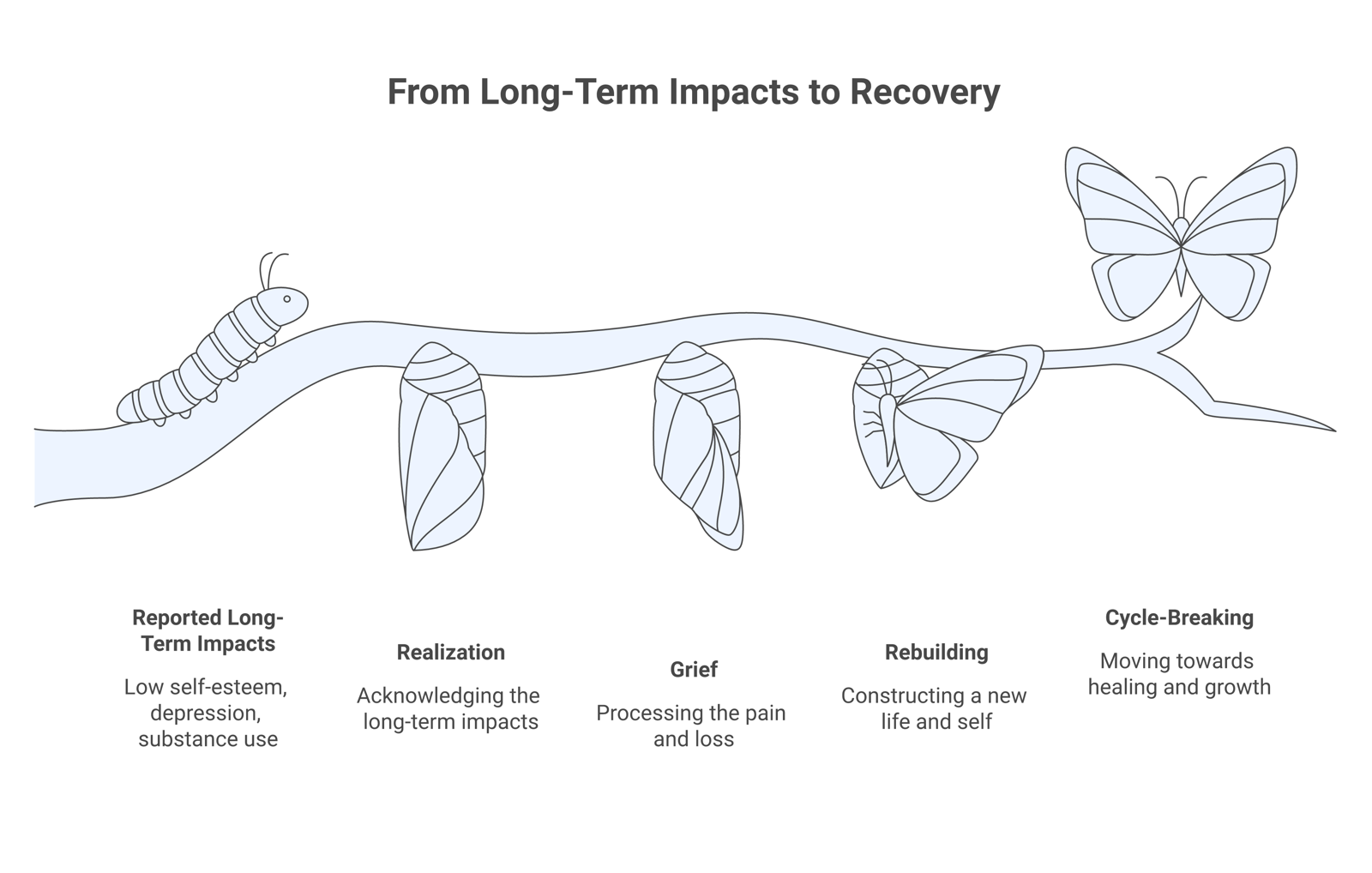
Read that list gently. It is a map of what some adults reported, not a prediction about you. Many survivors recognize two or three items and not the rest. Some recognize the pattern and have already done real work to heal it. The list earns its place here because seeing your private experience named in research can loosen the grip of self-blame.
What later studies add
Baker’s work was qualitative and based on a self-selected group, so other researchers tested the patterns with different methods. Ben-Ami and Baker, writing in 2012, found that adults exposed to alienation in childhood reported lower self-sufficiency and wellbeing and higher rates of depression. Verrocchio and colleagues, in a 2019 study, linked perceived exposure to alienating behaviors with depression and reduced quality of life. A 2021 systematic review by Miralles and colleagues pulled the long-term emotional findings together.
A 2022 study by Verhaar, Matthewson, and Bentley added two things worth holding onto. First, the difficulties were real and sometimes severe. Second, the same adults showed coping and resilience, and most of them had later reunified with the rejected parent. Roughly half had become targeted parents themselves, a finding we return to below. The research describes a hard inheritance and a survivable one.
Is “parental alienation syndrome” a real diagnosis?
You will see the phrase “parental alienation syndrome,” often shortened to PAS, especially in older material and in the title of Baker’s book. It is worth being precise about what that phrase is and is not.
“Parental alienation syndrome” is Amy Baker’s framing for the cluster of effects she observed. It is not a formally recognized psychiatric diagnosis. Major diagnostic manuals do not list it as a syndrome, and the broader construct of parental alienation is contested among researchers, clinicians, and courts. Some scholars argue the science is not settled. Others argue the harm is well documented even if the label is debated.
For an adult survivor, the practical takeaway is that you do not need a contested diagnostic label to take your experience seriously. The documented long-term correlates, the lower self-esteem, the depression, the trust difficulties, are real whether or not anyone agrees on what to call the package. You are allowed to name your own experience in your own words.
Why naming it matters
Many adults describe a moment of realization, sometimes decades in, when the story they were raised inside stops holding together. A memory does not add up. A sibling says something. They read a description of alienating behavior and feel the floor shift. Baker called these moments catalysts for realization.
Naming the experience does two quiet things at once. It moves the responsibility off the child you were, who did what children do under pressure, and onto the dynamic that shaped you. And it gives you a foothold. Clinician Craig Childress, in work aimed at adult survivors, makes the point that survivors have earned the right to find their own voice and their own words for what happened, rather than waiting for a professional to hand them a label. Treat his framing as one practitioner’s view, not settled science, but the underlying move is sound. Once a thing has a name, you can begin to set it down.
The recovery path, step by step
Recovery from childhood alienation is not a single event, and it is not a cure. It is closer to a path with recognizable stages. People move through them at their own pace, loop back, and skip around. None of the stages requires a reunion to be worthwhile. Each one is a way of becoming more yourself.
Realization: putting a name to it
The path usually opens with realization, the shift described above. This stage can be disorienting, because it asks you to re-see your own childhood. Going slowly helps. So does company, whether a therapist, a trusted friend, or a peer who has been there. You are not rewriting the past to punish anyone. You are letting yourself understand it.
Grief: mourning what was taken
Under the realization is grief, and it deserves room. Adults alienated as children often lost a parent who was alive the whole time, plus the grandparents, cousins, and family story that went with them. That kind of loss, where the person exists but the relationship was taken, is heavy precisely because it was never openly mourned. Letting the grief be real, rather than rushing past it, is part of the work. This is one place where many people find a therapist invaluable.
Rebuilding self-worth and trust
Low self-esteem and difficulty trusting are two of the most commonly reported effects, so rebuilding both is central. A useful early move, described in Childress’s recovery framing as finding your values first, is to decide what you actually believe and want, separate from the narrative you were raised to repeat. Values give structure while the rest of the self steadies. You can read more in find your values first. Trust tends to rebuild slowly, through small, kept commitments to yourself and a few safe people, rather than all at once.
Deciding about reconnection (yours to make)
At some point many survivors face a choice about the rejected parent. The next section covers it in full. For now, the point is only that this is a decision you get to make, on your timeline, with no obligation either way.
Breaking the cycle with your own children
The finding that roughly half of alienated adults later become targeted parents themselves is sobering, and it is also a place of real agency. Naming the pattern is how people interrupt it. Parents who know the dynamic can choose, deliberately, not to badmouth a co-parent, not to force a child to take sides, and to protect their child’s right to love both sides of the family. The inheritance is not destiny. It is something you can see and refuse to pass on.
Reconnecting with the rejected parent, or not
One of the most common questions adult survivors ask is whether to reconnect with the parent they were turned against. There is no single right answer, and anyone who promises you one is overselling.
Some adults choose reconnection and find that repair is genuinely possible. In the 2022 Verhaar study, most participants had reunified with the rejected parent at some point, which suggests the door is not closed by default. Relationships, including ruptured ones, are often rebuilt through repair rather than through pretending the rupture never happened. That gentle truth, that a relationship can survive being broken if both people work at the repair, is worth carrying into any reconnection. You can read how that applies in rupture and repair in reconnection, and the companion page on why an alienated child’s love is not gone speaks to parents on the other side of this experience.
Other adults choose not to reconnect, or to keep contact limited, and that can be a healthy choice too. Sometimes the rejected parent has changed; sometimes they have not. Sometimes the survivor needs more time, or more safety, than reconnection would allow. Outcomes vary, and a reunion is never guaranteed. The goal of recovery is not a particular relationship status. It is your own wholeness, whatever you decide about contact.
When to seek therapy, and what kind
You do not have to be in crisis to benefit from therapy, and you do not have to do this alone. Many adult survivors find that a good therapist is what lets the grief move and the trust rebuild.
Trauma-informed care is a reasonable thing to look for. A trauma-informed therapist understands how early relational injuries shape adult patterns, and works at a pace that does not re-overwhelm you. The American Psychological Association keeps a general resource on trauma worth reading as a starting point. If you are not sure what you are dealing with is trauma, that uncertainty is itself a good reason to talk to a professional. Pages on parental alienation trauma and on trauma therapy for parental alienation go deeper on what that care can look like.
Seek help sooner rather than later if you notice persistent depression, substance use that worries you, or thoughts of harming yourself. Those are signals to reach out, not signs that you are broken. The crisis resources at the foot of this page are available any time.
Validating your experience without pathologizing it
Two things are true at once, and recovery asks you to hold both. The harm researchers documented is real, and you are not reducible to that harm.
It is easy, once you have a name and a list of effects, to start reading every struggle as damage. That overcorrection has its own cost. Plenty of what you feel is simply being human. The same studies that found difficulty also found coping and resilience in the very same people. You survived something designed to divide you against yourself, and you are still here, asking how to heal. That is not the profile of someone who is broken. It is the profile of someone doing the work.
So take the research seriously without letting it define you. Use it to lift the self-blame, not to add a new layer of it. You were a child who did what children do under pressure. The adult you are now gets to decide what comes next.
Frequently asked questions
What are the long-term effects of parental alienation on adult children?
Amy Baker’s qualitative study of about 40 adults reported seven areas of impact: low self-esteem, depression, substance abuse, lack of trust, becoming alienated from their own children, divorce, and other. Later studies by Ben-Ami and Baker, Verrocchio, and others found higher depression and lower wellbeing on average. These are documented patterns across groups, not a prediction about any one person, and many survivors recognize only some of them.
Is parental alienation syndrome a real diagnosis?
“Parental alienation syndrome” is Amy Baker’s term for the cluster of effects she observed, and it is not a formally recognized psychiatric diagnosis. Major diagnostic manuals do not list it, and the broader construct is contested among researchers and clinicians. The documented long-term correlates can be real even though the diagnostic label is debated. You do not need a contested label to take your own experience seriously.
How do adults heal from parental alienation?
Healing tends to move through naming what happened, a realization process, grief, rebuilding self-worth and trust, deciding about reconnection, and breaking the cycle with one’s own children. Trauma-informed therapy supports this work for many people. Progress is real even without a reunion, and there is no fixed timeline. Going slowly, with support, tends to work better than forcing the pace.
Should I reconnect with the parent I was alienated from?
Reconnection is one valid option, not an obligation. Some adults choose it and find repair possible; others keep contact limited or choose not to reconnect, and that can be healthy too. Outcomes vary and a reunion is never guaranteed. A qualified therapist can help you weigh safety, readiness, and realistic expectations before you decide.
Can parental alienation be passed to the next generation?
Research has found that a meaningful share of adults alienated as children later become targeted parents themselves. The pattern is not destiny. Naming it is how many people interrupt it, choosing deliberately not to badmouth a co-parent or force their own children to take sides, and protecting a child’s right to love both sides of the family.
Sources and further reading
- Baker, A. J. L. (2005). The Long-Term Effects of Parental Alienation on Adult Children: A Qualitative Research Study. American Journal of Family Therapy. See also Baker, A. J. L. (2007). Adult Children of Parental Alienation Syndrome: Breaking the Ties That Bind. W.W. Norton.
- Ben-Ami, N., & Baker, A. J. L. (2012). The Long-Term Correlates of Childhood Exposure to Parental Alienation on Adult Self-Sufficiency and Well-Being. American Journal of Family Therapy, 40(2). https://doi.org/10.1080/01926187.2011.601206
- Verrocchio, M. C., et al. (2019). Depression and quality of life in adults perceiving exposure to parental alienation behaviors. Health and Quality of Life Outcomes, 17:14. https://doi.org/10.1186/s12955-019-1080-6
- Miralles, P., et al. (2021). Long-term emotional consequences of parental alienation exposure: a systematic review. Current Psychology. https://doi.org/10.1007/s12144-021-02537-2
- Verhaar, S., Matthewson, M., & Bentley, C. (2022). The Impact of Parental Alienating Behaviours on the Mental Health of Adults Alienated in Childhood. Children, 9(4):475. https://doi.org/10.3390/children9040475
- American Psychological Association. Trauma. apa.org/topics/trauma
If you or someone you love are in crisis
Free and confidential help is available right now.
- 988 Suicide and Crisis Lifeline. Call or text 988. 988lifeline.org
- Childhelp National Child Abuse Hotline. 1-800-422-4453. childhelp.org
- NAMI HelpLine. 1-800-950-6264. nami.org/help
Last reviewed: 2026-06-07. Author: Alex Buckles (PAC Founder). Editorial review: held to the PAC Editorial Standards (balance, primary-source citation, reader safety); an independent expert review board will be appointed.