
A high conflict personality describes an enduring pattern of blame, all-or-nothing thinking, and intense reactions that can push one parent to turn a child against the other. Not every alienation case involves such a pattern, though. A personality label is never proof on its own, and no one can be diagnosed from the outside.
A note on safety
A high conflict label or any personality label must never be used to discredit a parent who reports genuine abuse. When a parent has been abusive, neglectful, or frightening, a child’s distancing can be healthy estrangement, not alienation. Abuse-driven estrangement is a different and serious matter. If a child is in danger, contact local law enforcement or a domestic-violence resource first.
This page offers general information, not clinical advice, and it does not diagnose any individual. A personality disorder can only be assessed by a qualified professional who has examined the person directly. Reading about traits online is not a way to diagnose a co-parent, a former partner, or anyone else.
What a high conflict personality means
A high conflict personality is a recurring way of relating to others, not a single bad day. People with this pattern tend to fixate on blame, see others as all good or all bad, feel emotions at high volume, and behave in ways most people would avoid. The term comes from the work of attorney and therapist Bill Eddy, who studies how these patterns play out in family courts.
The phrase covers behavior, not a formal diagnosis. A high conflict personality can overlap with a clinical personality disorder, yet the two are not identical. Many high conflict people have never been assessed by a clinician. The label is a plain-language way to describe a durable pattern, and it works best as a description of conduct over time, never as a weapon or a verdict.
This matters for parental alienation because the same drivers can appear. A parent who needs the child to take sides, who cannot tolerate the child loving someone else, and who blames the other parent for everything may slide into alienating behavior. The connection is real. It is also partial, since plenty of alienation happens without any high conflict personality at all.
Situational high conflict versus a high-conflict personality
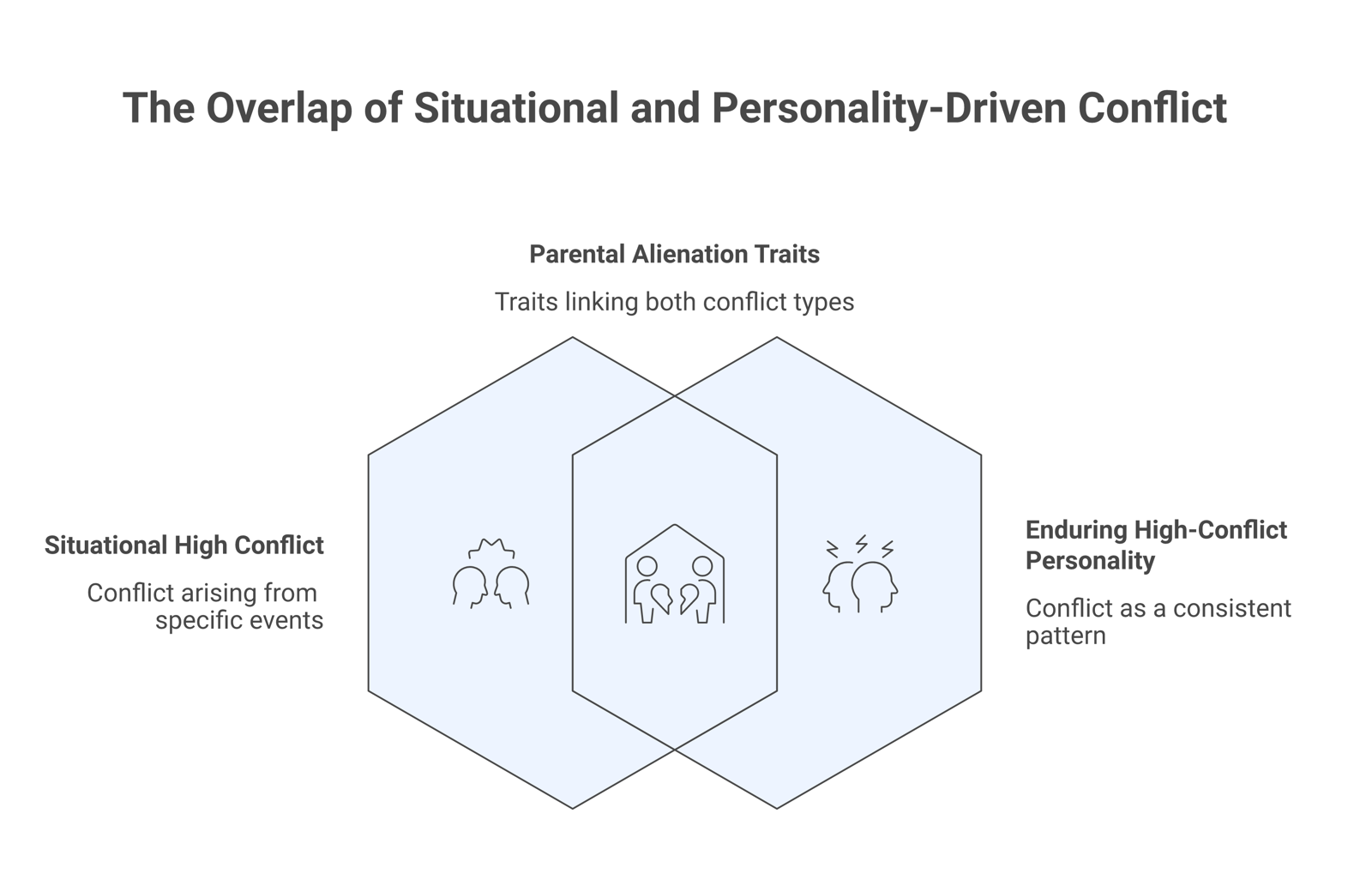
One of the most useful distinctions here separates a stressful moment from a lasting trait. Eddy compares it to drinking. A social drinker has a glass at dinner. Someone might drink too much once at a wedding, regret it, and never repeat it. An alcoholic shows an enduring pattern they cannot self-correct. High conflict behavior works the same way across three tiers.
Tier one is ordinary conflict, the friction any separating couple feels. Tier two is a one-off high conflict episode, a parent who blows up during a brutal divorce yet takes responsibility, accepts feedback, and steadies over time. Tier three is the high conflict personality, an enduring pattern the person cannot correct and tends to blame on everyone else. A single extreme act that most people would never commit can sometimes signal that third tier.
Why does the difference carry weight? Family courts often default to the idea that high conflict always takes two equal combatants. Eddy notes that when judges and lawyers are polled, they tend to say by a wide margin that one party usually drives the conflict. A situational reaction can ease once the divorce settles. A trait-level pattern usually does not. Telling the two apart protects a targeted parent from being painted as an equal cause of harm they did not create.
A quick, low-stakes screen helps. Offer a mild suggestion and watch the response. A person without the pattern usually absorbs it. A person with the pattern often attacks. That feedback test is not a diagnosis. It is a small clue about whether a parent can take in information without treating it as an assault.
The Cluster B traits sometimes seen in alienation cases
When clinicians discuss personality and alienation, they often point to a group of patterns known as Cluster B. The cluster includes narcissistic, borderline, antisocial, and histrionic styles. These patterns involve intense, unstable, or self-centered ways of relating to other people. Eddy’s plain-language typology of high conflict people maps onto several of them.
Narcissistic patterns center on status and admiration, with the child cast as a mirror or a possession. Borderline patterns can bring rapid swings between idealizing and devaluing a person, plus a fear of abandonment that can spill into the child’s relationships. Antisocial patterns can bring a lack of remorse and a readiness to use the child as a tool. Histrionic patterns lean on drama and attention. Narcissism itself splits into a grandiose form, which is colder and more calculated, and a vulnerable form, which is shame-driven and quick to react.
One vivid behavior is “splitting the children,” where a parent treats one child as all good and another as all bad, then recruits them onto a team against the other parent. The family therapist Linda Gottlieb, drawing on decades of custody work, predicts that the most severe alienators, those who pursue total removal of the other parent through repeated false allegations, most often show one or more Cluster B patterns. She treats this as a clinical hypothesis about a group, never as a diagnosis of any single parent.
Why personality traits can fuel alienation
Researcher and psychologist Amy Baker offers a clear way to understand the link. Borderline, narcissistic, and antisocial patterns each make it harder for a parent to separate their own needs from the child’s. When that happens, a devalued former partner can become, in the parent’s mind, a devalued parent the child should also reject. Baker calls this a kind of psychic platform that makes alienation more likely.
A platform is not a guarantee. Baker frames this as a population-level tendency, not a verdict about any one alienating parent. The trait raises the odds. It does not seal the outcome, and many people with these traits never alienate a child at all. The point is that the personality pattern creates conditions in which alienating behavior can take root more easily.
This helps explain a frustrating experience many targeted parents describe. The pattern shows in conduct over months and years, not in a single meeting. A composed, articulate parent can look entirely reasonable in a one-hour intake, while the worried, upset parent looks less credible. The signal lives in the documented pattern, not in the room. Courts and evaluators who look only at a snapshot can be misled.
A label is not proof, and no one diagnoses from the outside
Here is the caution that holds the whole page together. A personality label, by itself, proves nothing about who is alienating a child. Eddy makes this concrete with borderline personality disorder. A parent who is actively unwell behaves very differently from a parent in recovery, where the symptoms are dropping and the person is seeking treatment. Current behavior, not a stale label, is what should matter.
Courts can fall into a diagnosis asymmetry. They shine a spotlight on the parent who has a known diagnosis, often the more self-aware and treatment-seeking one, while a possibly disordered co-parent who has never been assessed looks calm and stable by comparison. A bare diagnosis tells you very little. Examining how each parent actually behaves tells you much more.
Two further cautions matter. The most dangerous profile, sometimes called malignant narcissism, blends antisocial and narcissistic traits and is genuinely rare. Naming it should not become a habit of seeing it everywhere. And in a destructive dynamic, it is a mistake to assume both adults are equally disordered. Some extreme situations involve one driving personality paired with a manipulated or highly compliant partner, not two predators. Symmetry should never be assumed.
Not every alienation case involves a personality disorder
This deserves its own heading because it is so often missed. Plenty of alienating behavior comes from parents who carry no personality disorder of any kind. Fear, grief, a bitter divorce, bad legal advice, or a parent’s own unhealed wounds can all produce it. Some alienation is situational and eases once the conflict cools. Treating every alienating parent as a disordered one is both inaccurate and unfair.
The reverse error is just as serious. A child who pulls away from a parent is not always being alienated. The same caution from the top of this page applies in full. When a parent has been abusive or frightening, the child’s distance can be a protective and healthy response. A high conflict or personality label must never be used to silence a parent reporting real harm, and abuse-driven estrangement is not alienation.
None of this minimizes the damage that alienation does. Researchers Jennifer Harman, Edward Kruk, and Denise Hines describe parental alienating behaviors as a form of family violence rooted in coercive control. The American Psychological Association also notes how much strain divorce and custody disputes place on children. The honest position keeps the focus on documented behavior and its effect on the child, not on a label pinned from a distance.
A parent can do something useful even without a diagnosis. Describe behavior accurately, write it down with dates, focus on the child’s wellbeing, and seek qualified help. For narcissism specifically, the companion explainer on parental alienation and narcissism goes deeper on that one pattern. To understand the broader concept, start at the Learn hub. For the day-to-day reality of managing exchanges, see how to deal with a narcissistic co-parent and the role that a controlling gatekeeping parent can play. Readers tracking warning signs can review parental alienation symptoms.
Frequently asked questions
What is a high conflict personality?
A high conflict personality is an enduring pattern of blaming others, all-or-nothing thinking, intense emotions, and extreme behavior, described by attorney and therapist Bill Eddy. It is a plain-language description of conduct over time, not a formal diagnosis. It can overlap with a clinical personality disorder, but the two are not the same, and only a qualified professional can assess a disorder.
Is a high conflict personality the same as parental alienation?
No. A high conflict personality is a way of relating to others. Parental alienation is a pattern of behavior that turns a child against a safe, loving parent. The two can occur together, and high conflict traits can fuel alienating behavior, yet each can exist without the other. Many alienation cases involve no personality disorder at all.
Can you tell if a co-parent has a personality disorder?
No, and neither can this page. A personality disorder is a serious clinical judgment that requires direct evaluation by a licensed mental-health professional. Online checklists and articles are not assessments. What a parent can do is describe and document specific behaviors over time, keep the focus on the child, and seek guidance from a qualified clinician or family-law professional.
What is the difference between situational high conflict and a high-conflict personality?
Situational high conflict is a stressful, often temporary reaction to a hard event like a divorce, where the parent takes responsibility and steadies over time. A high-conflict personality is an enduring pattern the person cannot self-correct and tends to blame on others. The first often eases as conflict cools. The second usually persists, which is why telling them apart matters.
Are Cluster B traits proof of parental alienation?
No. Cluster B is a group of personality patterns that includes narcissistic, borderline, antisocial, and histrionic styles. These traits can raise the odds of alienating behavior, which some clinicians call a psychic platform, but they do not prove it. A label is not evidence. Courts and clinicians weigh documented behavior over time, not a personality term applied from the outside.
What this page does not do
This page does not diagnose any individual and does not label any named or implied person. It does not claim that every alienating parent has a high conflict personality, or that every high conflict person alienates a child. It does not pathologize ordinary conflict between separated parents. And it does not frame these ideas as ammunition for court. The goal is understanding, grounded in the child’s wellbeing. For a closer look at one pattern, see parental alienation and narcissism. For the broader concept, start at the Learn hub.
Sources and further reading
- American Psychological Association. Divorce and child custody. apa.org/topics/divorce-child-custody
- Harman, J. J., Kruk, E., & Hines, D. A. (2018). Parental alienating behaviors: An unacknowledged form of family violence. Psychological Bulletin, 144(12), 1275 to 1299. https://doi.org/10.1037/bul0000175
If you or your child are in crisis
Free and confidential help is available right now.
- 988 Suicide and Crisis Lifeline. Call or text 988. 988lifeline.org
- Childhelp National Child Abuse Hotline. 1-800-422-4453. childhelp.org
- NAMI HelpLine. 1-800-950-6264. nami.org/help
Last reviewed: 2026-06-07. Author: Alex Buckles (PAC Founder).