

This page is general information, not legal or clinical advice. It does not create a professional relationship and does not address any one state’s rules.
Grandparent alienation is the same pattern of alienating behaviors targeted parents face, turned on grandparents: controlled or withheld contact, denigration, false allegations, and blocked information. Research describes a distinctive multi-layered grief that comes with it. It is a named, studied harm, not just family drama, and grandparents are not powerless.
A note on safety
A family pulling back from a grandparent who has been harmful or unsafe is protective, not alienation. This page is about a different situation: a grandparent who has been loving and safe being cut off through another adult’s influence. If a child’s safety is ever at risk, that comes first.
What grandparent alienation is
Grandparent alienation is the loss of a relationship between a grandparent and a grandchild caused by another adult’s influence rather than by anything the grandparent did. It often runs alongside the alienation of the grandparent’s own adult child, the targeted parent. When one parent works to erase the other parent from a child’s life, the grandparents on that side are frequently erased too.
Dr. Mandy Matthewson, who researches these dynamics at the University of Tasmania, studied a group of alienated grandparents and found something important: they report the same alienating behaviors targeted parents report, and they carry a grief with a structure all its own. Naming both halves matters, because grandparents are often told they are overreacting to ordinary family distance. The research says otherwise. The generational picture is covered further in intergenerational parental alienation.
The alienating behaviors grandparents report
Grandparents in these situations describe a familiar list. Contact is tightly controlled, conditional, or cut off entirely. The grandparent is denigrated to the grandchild, and so is the targeted parent. Information is blocked in both directions, so the grandparent learns nothing about the grandchild and can send nothing to them.
The list often goes further. Gifts and cards are returned or blocked. The grandchild is questioned after any contact, or coached to be cold and disrespectful. Some grandparents receive threatening messages. Some are pressured into secrecy if they do manage to see the grandchild at all. False allegations, commonly of abuse, sometimes appear and are later found to be unsubstantiated. Social-media doors close one by one.
If this reads like the experience of an alienated parent, that is the point. The behaviors are the same recognized pattern of alienating conduct that researchers describe as a form of family violence in the work of Harman, Kruk, and Hines. The target is simply a grandparent rather than a parent.
The grief that comes with it: four layers
What makes grandparent alienation distinct is the grief. Matthewson’s work describes it as multi-layered, and naming the layers helps grandparents understand why the loss feels so total.
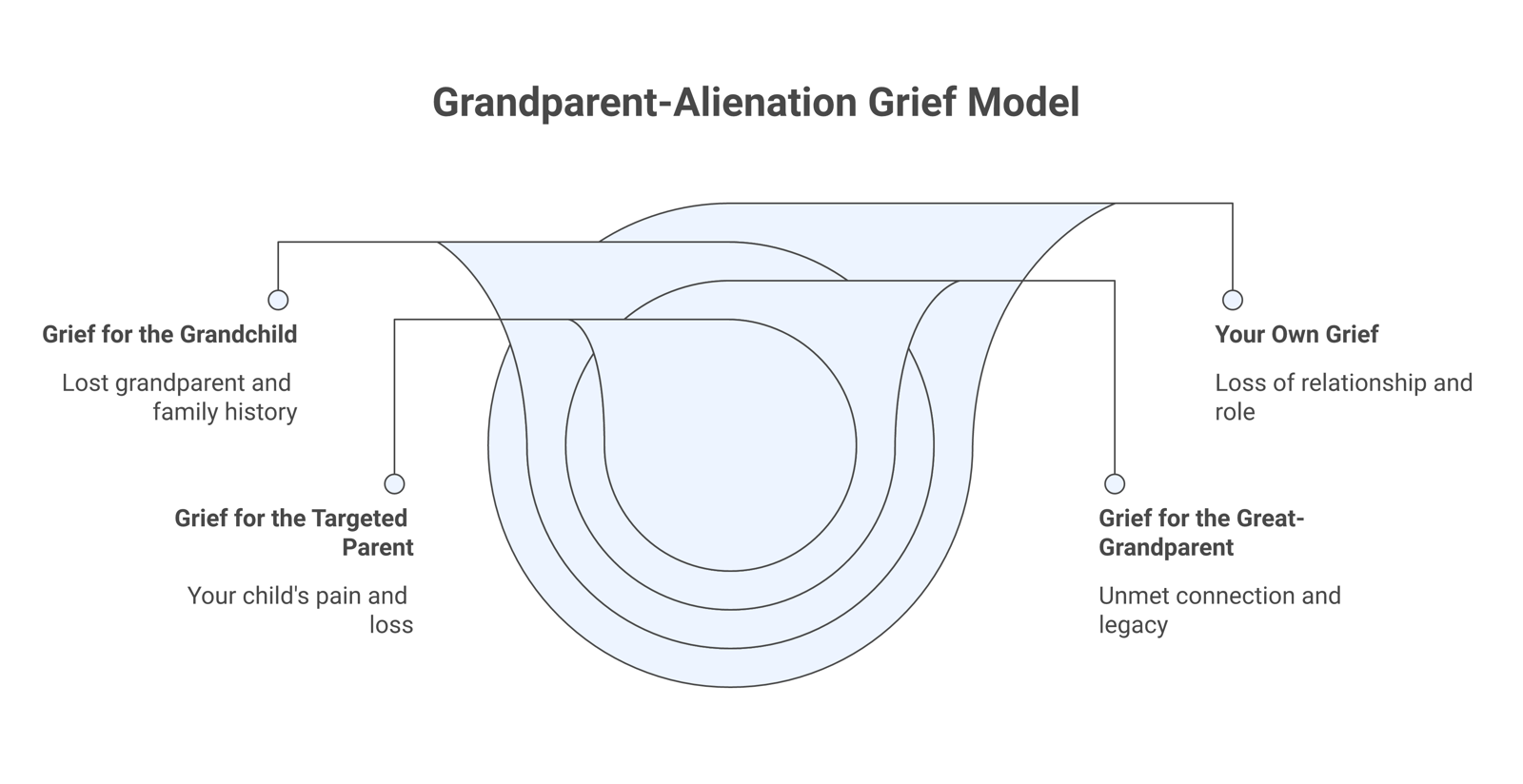
The first layer is the grandparent’s own grief, for the relationship, for the grandparenting role, and for the family history and traditions they can no longer pass down. The second is grief on behalf of the grandchild, who is losing a grandparent and a whole branch of their story. The third reaches up a generation: grief on behalf of the great-grandparent, the grandparent’s own aging parent, who may die before the grandchildren ever know them. The fourth is grief on behalf of the targeted parent, the grandparent’s own child, whose pain the grandparent watches and cannot fix.
These layers stack. A grandparent is not grieving one loss but four at once, across three generations. Matthewson also documents concrete costs that come with them: knowledge and traditions that die unspoken, social losses as friends enjoy grandchildren freely, and financial losses, since many grandparents drain retirement savings to fund their child’s legal battles. The strain shows up in the body too, in sleep, immune function, and mental health.
Why it is not “just family drama”
Grandparents are often waved off with some version of “families fall out, that is life.” The research offers a firmer answer. Grandparent alienation pairs named, observable behaviors with a measurable health toll and a layered grief structure. That combination is what separates a genuine, studied harm from ordinary distance.
This distinction also protects against the opposite error. Not every gap between a grandparent and grandchild is alienation. Sometimes a family steps back for good reason, and that boundary deserves respect. The honest test is the same one used throughout this site: alienating behavior is about a campaign of influence against a safe, loving relationship, not about a family protecting a child from harm. For more on that line, see parental alienation versus estrangement.
The high road: protecting your one ally
When grandparents ask what to do, the most consistent guidance is to take the high road and protect the one relationship that can reopen the door. The social scientist Edward Kruk frames the posture plainly: support both parents, never take sides in their disputes, and refuse to be drawn into conflict with the adult child or the child-in-law. The grandparent’s job is to stay a place of “loving compassion, emotional availability, and total safety.”
There is a practical reason for this. In most families, grandparents reconnect through the gatekeeping parent, not directly to the grandchild. Pushing past that parent, or feuding with them, usually closes the one channel that matters. Clinicians who work on reconnection warn grandparents against the patterns that get them labeled and shut out: smothering, overbearing contact, and undermining the parent’s authority. Steady, low-pressure, respectful availability tends to keep the door open in a way that pressure never does.
Kruk also points to multigenerational family mediation as a path that can put future grandparent contact on the table as a negotiable item, rather than fighting it out in court. For the emotional side of staying steady through a long wait, the parental alienation support groups page and the guidance on how to reconnect with an alienated child both apply to grandparents as well as parents.
What about visitation rights?
Many grandparents want to know whether the law can compel contact. The honest answer is that grandparent visitation rights are limited and vary widely. In Troxel v. Granville, the United States Supreme Court affirmed that fit parents have a fundamental right to make decisions about their children’s care, including who the child spends time with. That ruling constrains how far courts will override a parent’s choice to limit grandparent contact.
What this means in practice differs from place to place, and only a family-law attorney in the relevant jurisdiction can say what options exist there. This page does not give legal advice and does not name any one state’s rules. The realistic frame is that legal remedies for grandparents are narrow, which is part of why the high-road, relationship-first approach matters so much. Keeping a calm record of contact and the pattern of behavior, as described in how to document parental alienation, can help if a legal conversation does become necessary.
Frequently asked questions
What is grandparent alienation?
Grandparent alienation is the loss of a grandparent-grandchild relationship caused by another adult’s influence rather than by the grandparent’s own conduct. It usually involves the same alienating behaviors targeted parents face, such as withheld contact, denigration, and blocked information, and it often happens alongside the alienation of the grandparent’s adult child.
What are the signs grandparents are being alienated?
Common signs include contact that is cut off or made conditional, returned gifts and cards, the grandchild being coached to be cold or disrespectful, blocked information in both directions, denigration of the grandparent, and sometimes false allegations or threatening messages. The pattern mirrors what alienated parents experience.
Do grandparents have legal rights to see their grandchildren?
Grandparent visitation rights are limited and vary by place. In Troxel v. Granville, the Supreme Court affirmed that fit parents have a fundamental right to decide their children’s associations, which constrains court-ordered grandparent contact. Whether any option exists in a given situation is a question for a local family-law attorney.
How should an alienated grandparent respond?
Most guidance points to the high road: support both parents, stay out of their disputes, and remain a calm, safe, available presence. Grandparents usually reconnect through the gatekeeping parent, not around them, so avoiding smothering or undermining that parent protects the one channel that can reopen the door.
Is grandparent alienation a real thing?
Yes. Research describes grandparent alienation as a named pattern of observable behaviors paired with a distinctive multi-layered grief and measurable health effects. That combination is what distinguishes it from ordinary family distance, even though it is still under-recognized.
What this page does not do
This page does not promise that a grandparent can win court-ordered contact, and it does not coach grandparents to take sides against either parent. It does not treat a family’s protective boundary as alienation, and it does not give legal advice or address any one state’s rules. Decisions about a specific situation belong to a licensed professional working with the real facts.
Sources and further reading
- Harman, J. J., Kruk, E., and Hines, D. A. (2018). Parental alienating behaviors: An unacknowledged form of family violence. Psychological Bulletin, 144(12). doi.org/10.1037/bul0000175
- American Psychological Association. Divorce and child custody. apa.org/topics/divorce-child-custody
- Troxel v. Granville, 530 U.S. 57 (2000). Cornell Legal Information Institute. law.cornell.edu/supremecourt/text/530/57
If you or your family are in crisis
Free and confidential help is available right now.
- 988 Suicide and Crisis Lifeline. Call or text 988. 988lifeline.org
- Childhelp National Child Abuse Hotline. 1-800-422-4453. childhelp.org
- NAMI HelpLine. 1-800-950-6264. nami.org/help
Last reviewed: 2026-06-10. Author: Alex Buckles (PAC Founder). Editorial review: held to the PAC Editorial Standards (balance, primary-source citation, reader safety); an independent expert review board will be appointed.