

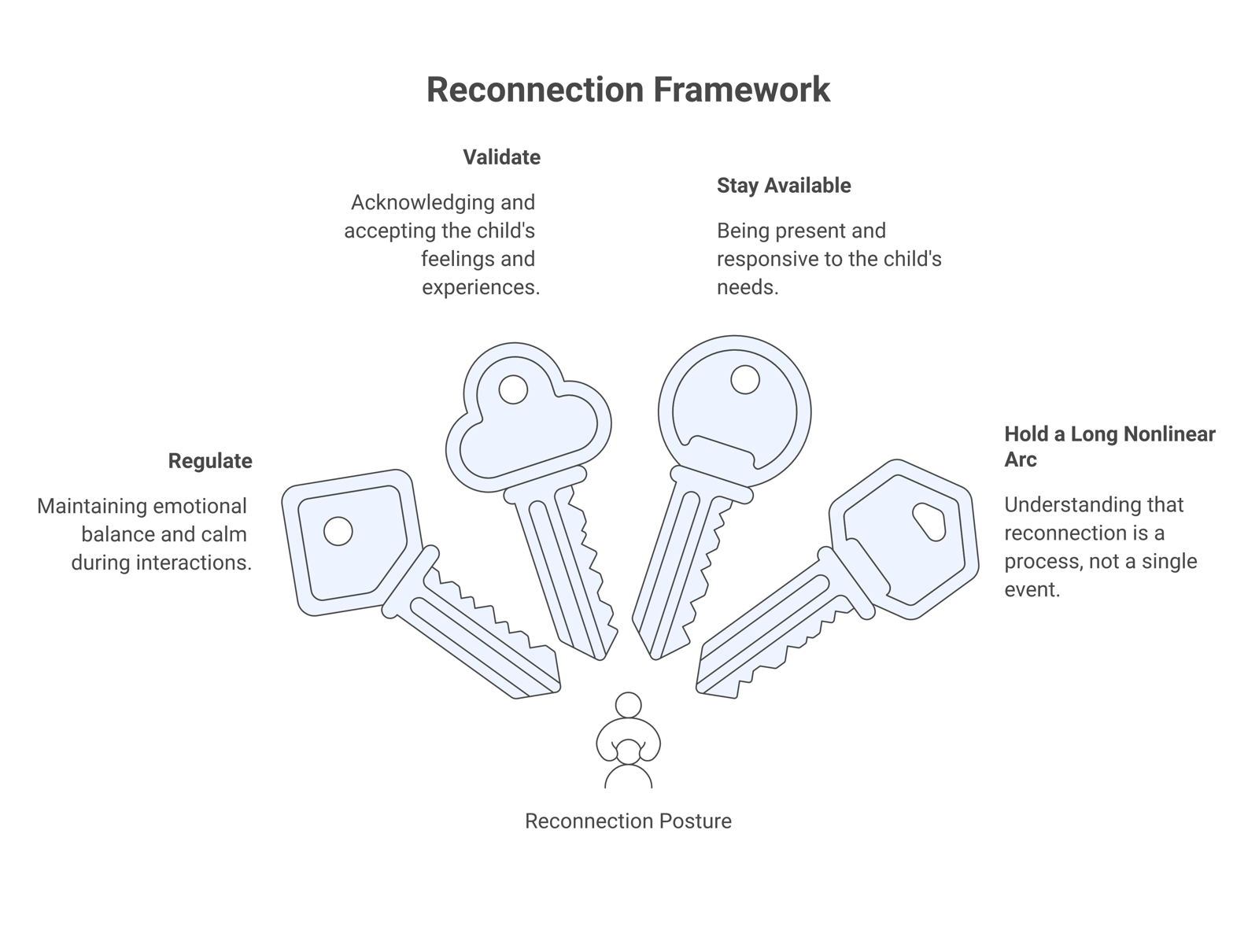
How to reconnect with an alienated child starts with posture, not persuasion. Once any door is open, a returned message, supervised time, or a child nearing adulthood, the targeted parent stays calm and available, leads with validation instead of defense, and keeps showing up over a long, uneven arc. Outcomes vary, and no parent can force a feeling.
A note on safety
A child’s distance is not always alienation. If the rejected parent has been abusive, neglectful, or genuinely frightening, the child may be protecting themselves, and that is justified estrangement, not parental alienation. In that case the goal is safety and the child’s own pace, never reconnection on the parent’s timeline. If a child is in danger, contact local authorities or a crisis resource before anything else.
This page is general information, not clinical advice. It does not create a professional relationship and does not address any one family’s facts. Anyone making decisions for a real case should consult a licensed clinician who knows that case.
What reconnecting with an alienated child really means
Reconnecting with an alienated child is a posture, not a script. It is how a targeted parent shows up once contact becomes possible. That might be a returned text, a supervised visit, a chance meeting, or a child who is growing toward adulthood. The aim is not to win an argument or prove the past. The aim is to be a safe, steady person the child can move toward when they feel ready.
This page is about the relationship side of reconnection. It assumes a door is at least cracked open. The wider repair arc, including the protection-first step that usually has to come before any of this can hold, lives in how to reverse parental alienation. Reconnection is the relational part of that larger picture.
One idea runs through everything below. A child cannot be argued back into a bond. A child can only be invited, slowly, into a relationship that feels safe. So the work is less about what the parent says and more about who the parent is when the child looks.
Start with your own nervous system
The first move in reconnecting is not outreach. It is regulation. Children read which parent feels steady and which feels frantic, and a parent who arrives anxious, bitter, or desperate is hard to move toward, even when the love is real.
Clinicians who study reconnection put co-regulation before talk. Dr. Rebecca Bailey, drawing on the work of Stephen Porges, makes the point plainly. A calm person helps an anxious person settle through nearness and warmth. The helper has to be regulated first. The same rule holds for a parent. A settled body is a safety cue, and safety is what lets a guarded child come closer.
Faust Ruggiero, a clinical psychologist, frames this as lowering your baseline before contact rather than during a crisis. Many targeted parents live at a constant low alarm. A hard moment then spikes them into panic. Daily practice helps: breathing, movement, prayer, or quiet time. It brings that baseline down, so the parent can stay grounded when the child tests them. Put simply, calm yourself before you try to calm the child.
Lead with validation, not correction
The most common mistake is the fix-it speech. The parent shows up wanting to explain what really happened. Even when the facts are on the parent’s side, that move backfires. It tells the child the parent still does not see them.
Dr. Sue Cornbluth names the relational habits that do the work: listening, acknowledging, validating, and compassion. She reports never reuniting a family without all four. The rule is perception over argument. A child’s view is the only thing worth working with. That holds even when the other parent shaped it and it is plainly wrong. Validating how the child felt is not the same as agreeing the parent did harm. It means meeting the feeling, not conceding the story.
Attunement matters more than accuracy here. A parent can hold two realities at once: the child’s version and their own. Both can sit in the same room, and neither one has to give way. As trust grows, the overlap between those realities slowly widens. Forcing the child to drop their version only adds pressure. The child carries enough of that already. One firm limit applies: validation never extends to false abuse allegations. A parent acknowledges pain and perception, not invented harm.
Stay available without pressure
Reconnection runs on consistency, not big gestures. The signal that survives long silence is a steady, low-pressure presence that asks for nothing in return.
Cornbluth suggests a light cadence, roughly once a week for older children, and never daily, which reads as smothering. What matters is the message, not the volume. Outreach should lead with the child’s experience. It should not open with “I love you and I miss you,” which the child already knows. A useful closing line hands control back to the child: something like, “I am open to doing this on your terms, in whatever way works for you.”
The content stays small. Andrew Folkler was alienated as a child and now coaches parents. He compares early outreach to early dating. Nobody proposes marriage on a first date. A parent does not propose deep reconnection in a first message either. Begin with low-stakes, neutral topics: a film, a shared memory, a small kindness. Save the heavy talks for much later, if they come at all.
Keep the bridge open over a long, nonlinear arc
Reconnection is rarely a single moment. It is a long arc that moves in fits and starts. An honest guide says so. Some children respond in months. Others take years. Some never fully return, and that is not a measure of the parent’s worth.
Cindy Hirsch uses the image of a lighthouse parent, solid and stable in any storm. That steadiness, held over time, is what draws a child back. Hirsch also names grief as part of the process rather than a sign of failure. Because the arc is nonlinear, a setback does not mean the parent did something wrong.
Ruggiero reframes the whole effort as process over destination. The parent does not control either person’s arrival, only their own daily behavior. So the productive question is not “when will my child come back,” but “what kind of parent will I be while I wait.” Cornbluth describes a mother who texted her son a warm note every Friday. She kept it up for two and a half years with no reply. Then one Friday, he wrote back. Consistency was the only thing that survived the silence.
Moves that backfire
A few well-meant moves tend to push an alienated child further away. Knowing them in advance protects the reconnection.
- Defending yourself. Reopening old fights confirms the child’s sense that the parent does not hear them. Lead with the child’s feeling first.
- Reaching out from anger or panic. Children can sense the parent’s state. Cornbluth advises regulating first, then reaching out, never the reverse.
- Pushing too hard or too often. Daily contact, heavy gifts, and “we need to talk” messages read as pressure and smothering.
- Forcing the guilt issue. Ryan Thomas, once an alienated child himself, describes how loyalty gets converted into guilt, so that loving the targeted parent feels like betrayal. Pressing the child to choose deepens that bind. Steadiness eases it; pressure tightens it.
- Enlisting others to lecture the child. Recruiting relatives or friends to argue the parent’s case spreads the conflict and pushes the child away.
How to reconnect with an alienated child step by step
This is a posture, not a guaranteed sequence. Outcomes vary, and no step forces a feeling. Used together, these moves give the relationship its best honest chance.
- Regulate yourself first. Lower your own baseline through daily practice so you arrive calm. A steady parent is a safety cue.
- Lead with validation. Acknowledge the child’s feelings before anything else, and skip the defense and the correction.
- Stay available without pressure. Keep a light, steady cadence, ask for nothing back, and offer to meet the child on their terms.
- Keep messages short and child-led. Start with neutral, low-stakes topics, and save heavy conversations for much later.
- Hold a long, nonlinear arc. Expect setbacks, and measure yourself by consistency rather than by the child’s timeline.
- Bring in trained help when you can. A clinician who understands alienation can guide the work. See parental alienation therapy.
Honest hope about outcomes
Hope here has to be truthful. A parent controls their own regulation, their validation, their cadence, and the mistakes they avoid. A parent does not control whether or when the child responds. Both things are true at the same time.
Ginger Gentile, a reunification coach, observes that children do not move toward a parent who seems lost or defeated. Self-care is not a luxury in this work, but the precondition of any reunion. A parent who builds a steady, warm life has more to offer the child who eventually looks, not less. For the daily survival that keeps a parent grounded, see dealing with parental alienation, and for the longer healing path, see recovering from parental alienation.
The honest summary is short. Stay regulated. Validate first, and defend never. Keep the bridge open, and let the slow process do what force cannot. For how cases tend to move over time, see the stages of parental alienation, and for the broader library, start at the Help pillar.
Frequently asked questions
How do you reconnect with an alienated child?
Reconnecting with an alienated child works best as a posture rather than a campaign. The parent regulates their own nervous system, leads with validation instead of defense, and stays available on a light, low-pressure cadence. Messages stay short and child-led. The arc is long and uneven, so consistency matters more than intensity. No approach can force the child to respond, and outcomes vary widely from one family to the next.
What should you say to an alienated child?
Lead with the child’s feelings, not with your own pain. Clinicians suggest opening with acknowledgment rather than “I love you and I miss you,” which the child already knows. Keep early messages short and neutral, and end by offering to meet on the child’s terms. Avoid defending yourself or correcting the child’s version of events, since that tends to extend the silence rather than close it.
How long does it take to reconnect with an alienated child?
There is no fixed timeline. Some children respond within months once a parent is steady and available. Others take years of patient, low-pressure contact. One clinician describes a mother who wrote a warm note every Friday for two and a half years before her son replied. The variable a parent controls is consistency, not speed, and some relationships never fully recover.
Can you reconnect with an alienated adult child?
Often, yes, though never on a guaranteed schedule. Adult children gain independence and perspective over time, which can reopen a door that was closed in childhood. The same posture applies: regulate yourself, validate their experience, keep outreach light and consistent, and avoid pressure or guilt. A trained clinician can help, and a child protecting themselves from genuine harm always sets the pace.
Where to go next
- Start at the Help pillar for the broader library.
- The full repair arc, with its protection-first step, lives in how to reverse parental alienation.
- Treatment and reunification options are covered in parental alienation therapy.
- Daily coping while you wait is covered in dealing with parental alienation.
- The longer personal healing path is covered in recovering from parental alienation.
- The wider arc of a case is mapped in the stages of parental alienation.
Sources and further reading
- Cornbluth, S. Validation-first reconnection framework: listening, acknowledging, validating, compassion; consistency over frequency; the “on your terms” closing line.
- Bailey, R. Co-regulation and polyvagal-informed reconnection, crediting Stephen Porges: co-regulation precedes self-regulation; the helper must be regulated first.
- Ruggiero, F. Process-over-destination recovery model: lower the baseline before contact; control your behavior, not the child’s arrival.
- Hirsch, C. Stability-first reunification: the lighthouse parent, grief is not failure, and the multi-year nonlinear arc.
- Gentile, G. Reunification coaching: children move toward the steady parent, so self-regulation is the precondition of reunion.
- Thomas, R. Isolation-to-loyalty-to-guilt sequence: why loving the targeted parent can feel like betrayal to the child.
- Harman, J. J., Kruk, E., & Hines, D. A. (2018). Parental alienating behaviors: An unacknowledged form of family violence. Psychological Bulletin, 144(12), 1275 to 1299. https://doi.org/10.1037/bul0000175
- American Psychological Association. Divorce and child custody. apa.org/topics/divorce-child-custody
If you or your child are in crisis
Free and confidential help is available right now.
- 988 Suicide and Crisis Lifeline. Call or text 988. 988lifeline.org
- Childhelp National Child Abuse Hotline. 1-800-422-4453. childhelp.org
- NAMI HelpLine. 1-800-950-6264. nami.org/help
Last reviewed: 2026-06-06. Author: Alex Buckles, Founder.