

This page is general information, not legal advice. It does not create an attorney-client relationship, and it does not address any one state’s rules. Anyone facing a custody matter should consult a licensed family-law professional in their own jurisdiction.
Learning how to prepare for child custody mediation comes down to four calm habits. Get your documents and a proposed parenting schedule organized. Center the child’s needs instead of winning. Plan to stay regulated with a difficult co-parent. Know when mediation is not safe or appropriate. Here is each step, in order.
A note on safety
Mediation is not right for every family. Where there has been genuine abuse or family violence, sitting in a room to negotiate with the other parent may not be safe, and many programs screen these cases out. Safety comes first. If you are in this situation, ask the program about its safety screen and tell your attorney before agreeing to mediate.
How to prepare for child custody mediation: what it is and is not
Mediation is a guided conversation. A trained, neutral mediator helps two parents try to reach a parenting agreement together. The mediator does not decide the case and does not take sides. Their job is to keep the talk on track and help both parents hear each other. The Cornell Legal Information Institute keeps a general reference on mediation and how it differs from a hearing.
It helps to be clear about what mediation is not. It is not a trial. No judge is in the room, and no one is found guilty or innocent. It is not a place to prove the other parent wrong. And it is not a contest where someone wins and someone loses. The goal is a workable plan for the child, not a verdict.
Sessions are often confidential, though the rules vary by program and place. The Association of Family and Conciliation Courts publishes guidance on how family mediation works and how good programs protect families. Knowing the shape of the process ahead of time takes some of the fear out of it. You walk in expecting a conversation, not a battle.
Step 1: Get your documents and a proposed schedule organized
Walking in organized is half the preparation. Gather the basics first. Bring any current court order or filings, so everyone is working from the same starting point. Bring a calendar showing the child’s school year, activities, and holidays. Bring a short, calm note of the questions you want answered.
The single most useful thing to prepare is a proposed parenting schedule. Sketch out where the child sleeps each night, how exchanges happen, and how holidays split. Writing it down does two things. It shows the mediator you came ready to solve problems. And it gives the conversation a concrete starting point instead of an argument.
Keep your records short and factual. A thick binder of grievances can work against you. A clean one-page summary of dates and facts works for you. Bring what informs the plan, and leave the rest at home. If you also have a lawyer, ask them what to bring and what to expect, and read what to tell your lawyer about parental alienation before you go.
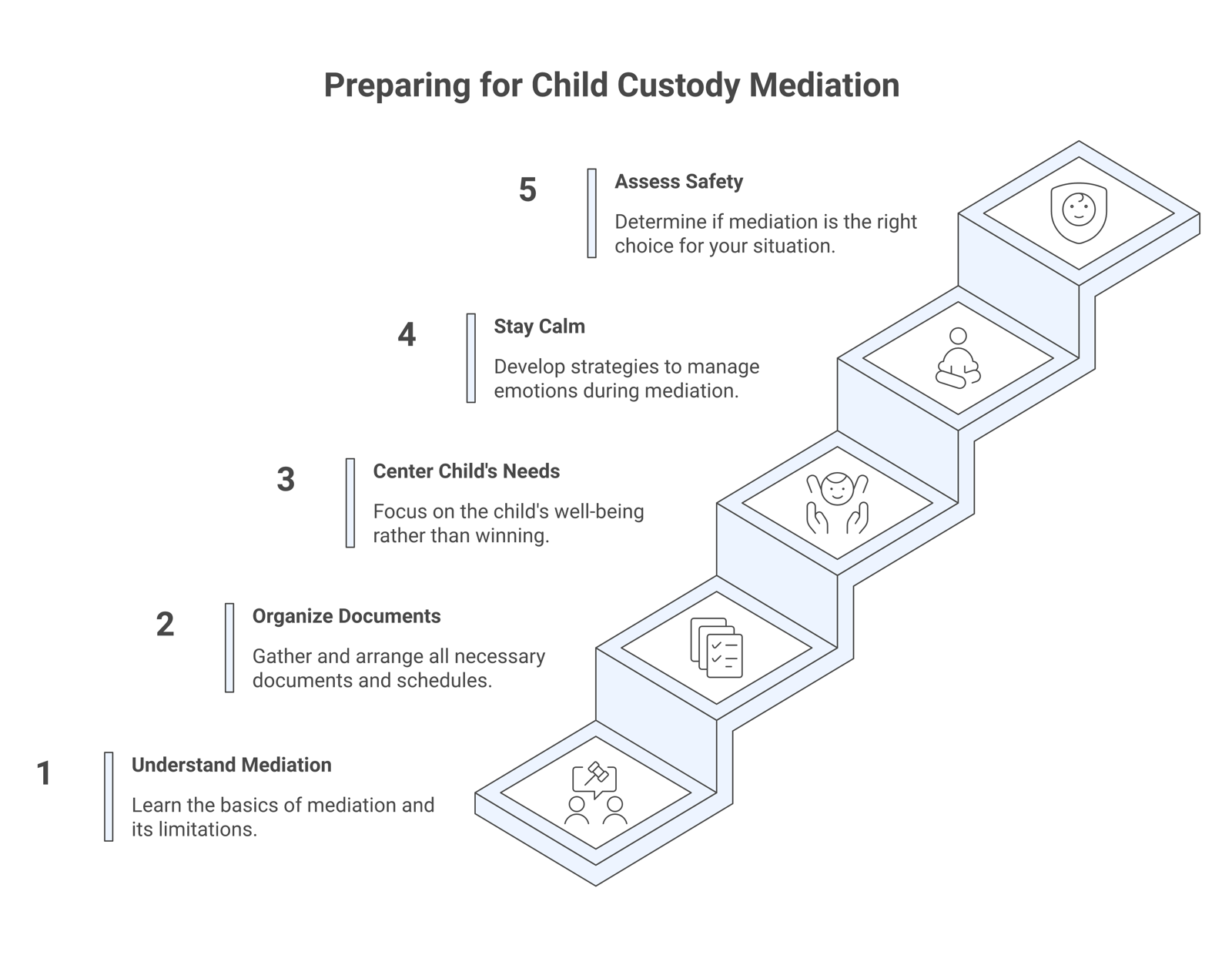
Step 2: Center the child’s needs, not winning
The strongest prep is a mindset shift. Mediation tends to go well when a parent walks in asking one question. What does the child need? It tends to go badly when a parent walks in asking a different one. How do I win?
Experienced professionals make a related point about labels. Courts and mediators act on documented behaviors, not on diagnostic words. A parent who arrives saying “the other parent is an alienator” hands the mediator a label and nothing to work with. A parent who arrives with the child’s routine, school needs, and a fair schedule gives everyone something to build on. Focus on facts and the child, not accusations.
This is not about being passive. It is about aiming your energy well. The American Psychological Association describes how children do best when conflict between parents stays low and routines stay steady. Every proposal you make can be framed around that. A schedule that protects the child’s sleep and school. A plan that keeps both parents in the child’s life. For the wider picture, see healthy co-parenting strategies.
Step 3: Plan to stay calm with a high-conflict co-parent
If the other parent is high-conflict or alienating, plan for the room to feel charged. The work of staying calm starts in the body, before the talk turns to words. A few slow breaths, feet flat on the floor, and a slower pace of speech all signal safety to your own nervous system. A regulated parent thinks more clearly and listens better.
There is a practical reason this matters in mediation. A targeted parent often arrives carrying four feelings at once, angry, anxious, agitated, and afraid. Those feelings are understandable. The trouble is that they can read badly to a neutral observer who does not know the history. A calm parent reads as the steady one. So the prep is partly emotional rehearsal. Picture the hard moment, and picture yourself pausing instead of reacting.
Lead with the issue, not the emotion. State what the child needs and let the facts carry the weight. If the conversation turns personal, it is fine to ask for a short break. For more on handling a difficult co-parent, see how to deal with a narcissistic co-parent and how to communicate with a toxic ex.
Step 4: Document concerns without weaponizing them
Real concerns belong in the room. The skill is bringing them as facts that inform the plan, not as ammunition. There is a clear difference between the two, and a mediator notices it quickly.
Weaponized documentation sounds like a case against a person. It piles up every fault and builds toward a verdict. Helpful documentation sounds like a plan for a child. It names a specific pattern, ties it to the child’s wellbeing, and proposes something concrete. Compare the two framings. “The other parent is toxic and unfit” gives no one a path forward. “Exchanges have been late six times, which makes the child anxious before school, so a fixed handoff time would help” names a fact and offers a fix.
Keep the record clean before you ever reach a session. Dates, times, and short notes are enough. The page on how to document parental alienation walks through building that record in a way that informs rather than inflames. Bring the version that serves the child.
Step 5: Know when mediation is not safe or appropriate
Mediation assumes two parents can sit and negotiate as rough equals. That assumption breaks down in some families. Where there has been genuine abuse or family violence, the table is not safe and the balance is not fair. Many programs screen for this before mediation begins, and a good program will not force a survivor to negotiate with the person who harmed them.
Knowing this protects you. If safety is a concern, ask the program directly about its safety screen and about other options, and raise it with your attorney first. Mediation is one path, not the only path. Choosing not to mediate in an abuse situation is not a failure. It is a reasonable use of your judgment.
Even where mediation is safe, it does not always work. With a high-conflict co-parent, sessions can stall, repeat, and eat months without progress. Watch for that pattern. If the same fights cycle with no movement, mediation may not be the right tool right now, and the case may need a different track. Recognizing when to stop is part of preparing well. If you are weighing how to structure things going forward, see parallel parenting versus co-parenting and the full Help section.
Frequently asked questions
How do you prepare for child custody mediation?
You prepare by getting organized and getting calm. Gather the current order, a calendar, and a proposed parenting schedule built around the child. Plan how you will stay regulated with a difficult co-parent. Frame your concerns as the child’s needs, not as accusations. And know in advance that mediation is not appropriate in genuine abuse situations.
What should you bring to custody mediation?
Bring any current court order or filings, a calendar with the child’s school year and activities, and a proposed parenting schedule you have written out. Bring a short, factual note of your concerns and questions. Keep records clean and brief. Bring what helps build a plan for the child, not a thick file of grievances.
What should you not say in custody mediation?
Avoid personal attacks, labels like “alienator,” and threats. Avoid framing the session as a way to win or to expose the other parent. Statements that center the child’s needs land far better than statements that score points. If you feel the urge to attack, pause, take a breath, and return to what the child needs.
Can you refuse mediation in a custody case?
Sometimes. Whether mediation is required varies by program and place, so ask about the rules where you are. Importantly, many programs screen out cases with genuine abuse or family violence, because mediation may not be safe there. If safety is a concern, raise it with the program and your attorney before agreeing to mediate.
What happens if mediation fails?
A session that does not reach agreement is not the end. The case can move to the next step, which is often a court process where a judge decides the open issues. A failed session is not a failure of the parent. It simply means this tool did not resolve things, and a different track is needed.
What this page does not do
This page is not legal advice. It does not name any one state’s mediation rules as if they applied everywhere, and it does not tell readers what to file or when. Decisions about a particular case belong to a licensed professional working with the real facts. The page also does not frame mediation as a way to beat the other parent. The right use of mediation is the calm, prepared, child-centered one.
For help with a high-conflict personality, see how to deal with a narcissistic co-parent. For day-to-day messaging, see how to communicate with a toxic ex. For the cooperative model, see healthy co-parenting strategies. The full Help section covers the rest.
Sources and further reading
- American Psychological Association. Divorce and child custody. apa.org/topics/divorce-child-custody
- Association of Family and Conciliation Courts. afccnet.org
- Cornell Legal Information Institute (Wex). Mediation. law.cornell.edu/wex/mediation
If you or your child are in crisis
Free and confidential help is available right now.
- 988 Suicide and Crisis Lifeline. Call or text 988. 988lifeline.org
- Childhelp National Child Abuse Hotline. 1-800-422-4453. childhelp.org
- NAMI HelpLine. 1-800-950-6264. nami.org/help
Last reviewed: 2026-06-08. Author: Alex Buckles (PAC Founder).