

How to deal with a narcissistic co-parent comes down to one principle: recognize the pattern, then disengage from it. Keep contact low, written, and business-only. Write down what happens. Hold steady boundaries without hitting back. Protect the child from the adult conflict, and build a support network so the work can last.
A note on safety
High-conflict behavior is not the same as a clinical diagnosis, and it is not the same as abuse. Where there is genuine abuse, threats, or danger, safety comes first. Supervised or parallel arrangements may be the right path. A child who pulls away from a parent who was frightening or harmful has a real reason. That is estrangement, not alienation. If anyone is in danger, contact local law enforcement or a domestic-violence hotline first.
This page is general information, not clinical or legal advice. It does not diagnose any person and does not create a professional relationship. Anyone facing a high-conflict custody situation should consult a licensed family-law attorney and a qualified mental-health professional in their own area.
What “narcissistic co-parent” means here
This guide uses the phrase “narcissistic co-parent” the way most searching parents do. It is shorthand for a co-parent whose behavior is high-conflict, controlling, and hard to predict. Naming a pattern is not the same as a clinical diagnosis. Only a qualified professional can diagnose narcissistic personality disorder, and most difficult co-parents do not meet that bar. The strategies below work with or without a diagnosis. They respond to actions, not to a label.
Winning against the other parent is never the goal. The work is to lower the conflict, protect the child, and keep the targeted parent steady enough to carry on. Everyday disagreement is part of every breakup. This page is about the harder pattern, where exchanges feel built to provoke rather than to solve a problem.
How to deal with a narcissistic co-parent: recognize, then disengage
The whole approach rests on one move. Spot the pattern, then disengage from it. Reacting is often exactly what a high-conflict co-parent wants. Disengaging starves the conflict of fuel while keeping the child out of the middle.
Research and practice both describe this pattern. Bill Eddy, the lawyer and therapist who co-founded the High Conflict Institute, describes high-conflict personalities that keep themselves at the center of every exchange and treat each message as a tool for control. Harman, Kruk, and Hines (2018) frame sustained alienating behaviors as a form of coercive control and family violence. Randi Fine, a narcissistic-abuse educator whose work is practitioner perspective rather than research, describes the same dynamic at household scale, with roles assigned and the controlling parent at the center. A parent does not need to confirm any model to use the insight. They only need to notice when an exchange is built to provoke, not to settle a question.
Practitioner accounts and the research on alienating behaviors catalog tactics that appear again and again. Spotting them early is what makes calm responses possible.
Common tactics to recognize
- Button-pushing. Repeated jabs meant to trigger a reaction, because the reaction itself is the payoff.
- Gaslighting. Insisting an event did not happen the way the other parent clearly saw it.
- Victim pulls. Framing themselves as the wronged party to draw the other parent or the child back in.
- Adultification. Treating the child as a peer or confidant. This can leave the child resentful of ordinary rules at the other home.
Recognizing a tactic is for the parent’s own clarity. It is never something to narrate to the child. Telling a child “your mother is gaslighting you” or “your father is a narcissist” puts the child right back in the middle. That is the opposite of the goal. For more on how these patterns can shade into alienation, see signs your ex is alienating your child.
Switch to low-contact, business-only communication
The most useful change a parent can make is simple: move messages to a low-contact, business-only footing. Fewer openings means fewer flare-ups. A clean written record means a clear account of what was actually said.
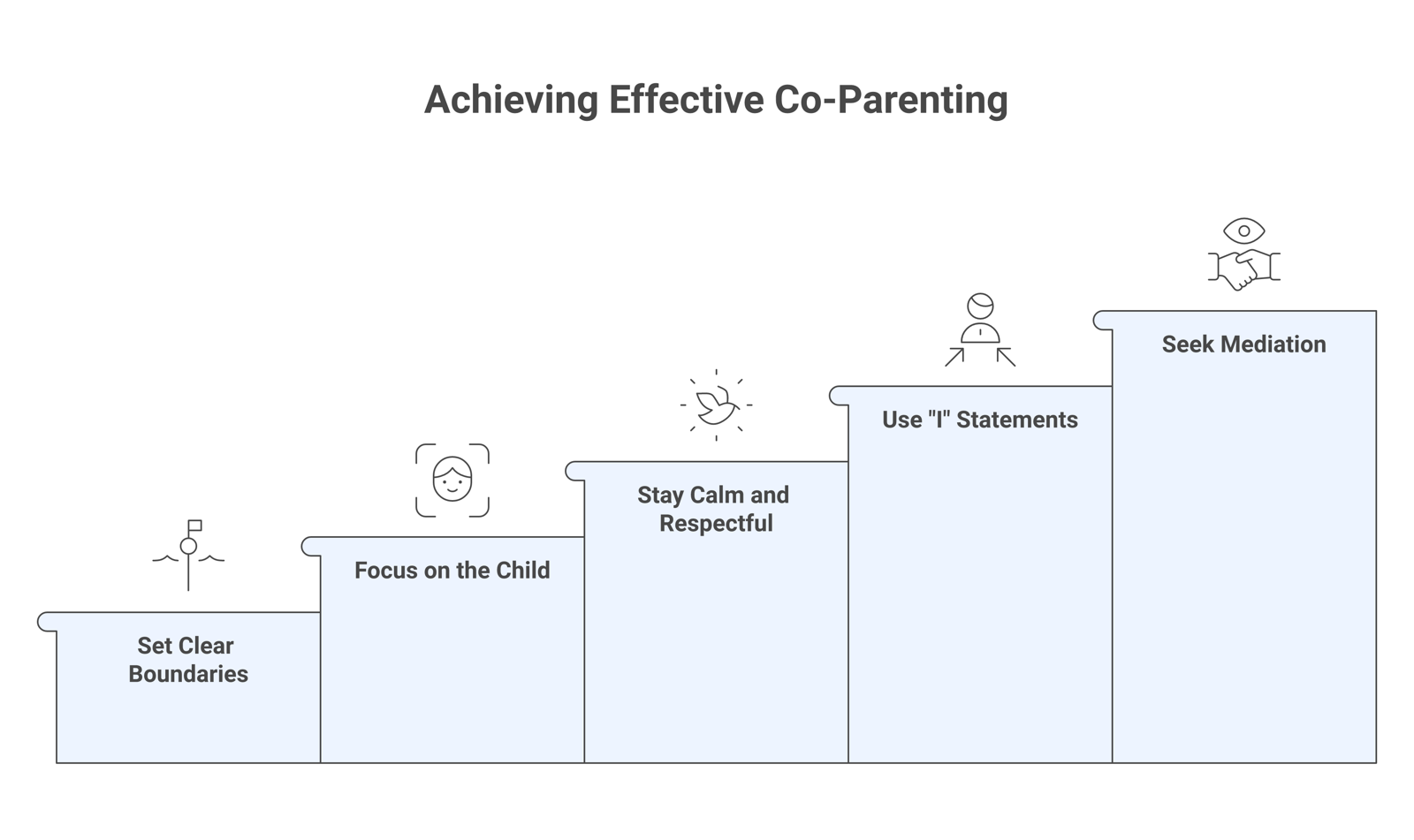
Here is a simple sequence that high-conflict co-parenting coaches often recommend.
Step 1: Move to written channels
Shift talk to email or a court-friendly co-parenting app. Writing gives a parent time to think. It also creates a paper trail. Handoffs are where many verbal flare-ups start, so keep those moments short and about logistics only.
Step 2: Write BIFF messages
Bill Eddy, a lawyer and therapist who works with high-conflict families, teaches a method called BIFF: Brief, Informative, Friendly, Firm. Keep each message to a few sentences. State the facts plainly. Stay civil. Be clear about the answer. A BIFF reply handles the logistics and ignores the bait.
Step 3: Use gray-rock when provoked
When a message is built to provoke, respond like a gray rock: flat, brief, and boring. Short replies such as “Noted” or “I will get back to you on that” give nothing to react to. Sue Cornbluth, a psychologist who coaches parents through high-conflict co-parenting, describes a similar approach she calls neutralizing communication. Hear them out, do not defend, and never ask “why.” Like gray rock itself, this is practitioner guidance rather than a tested clinical protocol, but it aligns with the disengage-first principle.
Step 4: State one boundary, then disengage
If a co-parent turns hostile, name one limit and stop there. A line such as “I will respond to messages about the schedule” sets the terms without an argument. After stating it, disengage. Re-explaining or defending only reopens the door.
Step 5: Keep and organize the record
Save messages, exchange logs, and missed-visit notes in one place, sorted by date. Calm, factual records protect the child’s time. They also give a counselor or court something solid later. The goal is a clear record, not a case built on anger.
Set boundaries without retaliating
Boundaries describe what a parent will do, not what the other parent must do. “Pickup is at six. If the schedule changes, send it in writing.” That is a boundary. Trading insults, holding back the child, or scoring points is hitting back. It usually backfires, most of all on the child.
A useful test before sending anything: would this message read as calm and child-focused if a counselor or judge saw it? If not, it is worth rewriting. Boundaries hold best when they are repeated quietly and applied the same way each time. A co-parent who pushes a limit is testing whether it is real. Staying steady, not raising your voice, makes a boundary stick.
Protect your child from the conflict
The center of all of this is the child, not the ex. Researchers Jennifer Harman, Edward Kruk, and Denise Hines describe parental alienating behaviors as a form of coercive control that can harm children. Keeping a child out of the adult conflict is the most important job there is.
- Do not pass messages through the child or quiz them about the other home.
- Do not run down the other parent, even after a painful exchange.
- Keep the child’s routines steady, so at least one home stays calm.
Children often sense more than adults expect. Amy Baker’s research on alienating strategies documents the withdrawal-of-love pattern, where a controlling parent’s affection blows hot and cold depending on the child’s loyalty. Children quietly track who is steady and who is not. When a child says “Mom does not love me” or “Dad does not love me,” a parent does not have to argue the point or vouch for the other parent. A simple, honest response works better: “I am so sorry you are hurting. I will always be here for you, no matter what.”
Eddy offers model lines for a parent’s own slips, too. After venting in front of a child, circle back and repair it: “I said some intense things. I should not have, and I want you to have a good relationship with your dad.” Fixing the moment matters more than never slipping at all. The work of staying steady for a child is covered further in dealing with parental alienation.
Build your own support
Co-parenting with a high-conflict ex is draining, and isolation makes it worse. A steady support network keeps the whole plan going. Helpful options include a therapist who knows high-conflict divorce, a support group of parents in similar cases, and trusted friends who can listen without making it worse.
Outside help can also lower the temperature for everyone. A neutral counselor can coach both parents and cut down on direct flare-ups. That is the focus of co-parenting counseling. For some families, a structured parallel-parenting setup fits better than traditional co-parenting. In parallel parenting, the two parents run their own homes with little direct contact. That removes many chances for conflict. The differences are explained in parallel parenting vs co-parenting.
When it is abuse, not just conflict
If a co-parent’s actions cross into abuse, threats, or danger, this is no longer a messaging problem. It is a safety problem. Write down the specifics, tell a lawyer or an advocate, and use the crisis resources below. Courts can order supervised exchanges, parallel parenting, or other protections when safety is at stake. Protecting a child from harm always comes before any messaging plan. Practical steps for keeping children steady through a hard breakup are gathered in protecting children during divorce. The broader Help center collects guidance for parents in this situation now.
Frequently asked questions
How do you deal with a narcissistic co-parent?
Spot the pattern, then disengage from it. Move contact to written, business-only channels. Keep messages brief and plain. Respond to jabs with flat, neutral replies. Set one clear boundary and stop defending it. Keep calm records, protect the child from the adult conflict, and build a support network so the plan can last.
What is the gray-rock method in co-parenting?
Gray-rock means answering a jab in a flat, brief, dull way, like a plain gray rock. Short replies such as “Noted” give a high-conflict co-parent nothing to react to. It is used only for messages built to provoke, not for genuine questions about the child’s care, which still deserve a clear answer.
Should you tell your child the other parent is a narcissist?
No. Labeling the other parent puts the child back in the middle of the adult conflict. That is what these strategies are meant to prevent. Recognizing tactics is for the parent’s own clarity. With the child, the goal is to stay steady, keep their routines calm, and avoid running down the other parent.
Is parallel parenting better than co-parenting with a narcissist?
For many high-conflict cases, parallel parenting fits better. The two parents run their own homes with little direct contact. That removes many chances for conflict. Traditional co-parenting asks for steady teamwork that a high-conflict co-parent may not give. A family-law expert or counselor can help decide which setup suits a case.
Can you co-parent with a narcissist at all?
Often yes, but usually in a limited, structured way rather than a warm and friendly one. Low-contact, written messages and firm boundaries make it workable. Where direct contact keeps fueling conflict, a parallel-parenting setup may serve the child better. Where behavior crosses into abuse, safety and possibly supervised time come first.
Sources and further reading
- American Psychological Association. Divorce and child custody. apa.org/topics/divorce-child-custody
- Harman, J. J., Kruk, E., & Hines, D. A. (2018). Parental alienating behaviors: An unacknowledged form of family violence. Psychological Bulletin, 144(12), 1275 to 1299. https://doi.org/10.1037/bul0000175
- Eddy, B. BIFF: Quick Responses to High-Conflict People. Unhooked Books. Practitioner guidance on high-conflict communication.
- Baker, A. J. L., & Fine, P. R. (2014). Co-parenting with a Toxic Ex. Research-grounded guidance on responding to alienating strategies.
If you or your child are in crisis
Free and confidential help is available right now.
- 988 Suicide and Crisis Lifeline. Call or text 988. 988lifeline.org
- Childhelp National Child Abuse Hotline. 1-800-422-4453. childhelp.org
- NAMI HelpLine. 1-800-950-6264. nami.org/help
Last reviewed: 2026-06-06. Author: Alex Buckles, Founder.