

This page is general educational information for licensed clinicians. It is not clinical guidance for any specific family or child. A defensible assessment of parental alienation requires direct evaluation of the family by a qualified clinician, structured across multiple sessions, with documented behavioral evidence tied to a named framework.
Therapists identify parental alienation by triangulating three published frameworks (Baker’s four-factor behavioral model, the Bernet and Greenhill Five-Factor Model, and, used with a contested-status caveat, Childress’s attachment-based model), then ruling out abuse-driven estrangement, attachment disorder, and normal post-divorce adjustment through a structured differential. No single session and no single instrument can produce a defensible finding. A defensible clinical assessment needs at least three contacts, observation of the child across two contexts, and behavioral evidence linked to specific framework criteria.
Important distinction. A child’s rejection of a parent because that parent has been genuinely abusive or neglectful is not parental alienation. It is estrangement from abuse, and clinicians who suspect abuse have mandated reporting obligations that supersede any framework discussed here.
What clinicians mean by parental alienation
Parental alienation is a pattern in which a child rejects a previously loved parent without proportionate cause, after sustained influence from the other parent, typically in the context of a separation or divorce. It is behavioral, observable, and distinguishable from other reasons a child might reject a parent.
The clearest current taxonomy is Dr. Joshua Coleman’s: estrangement is the umbrella term for any cut-off or strained parent-child relationship, and parental alienation is one subset. Other pathways include genuine abuse or neglect, mental illness, triangulation by a new partner, and adult-child differentiation. The clinical task is to identify which pathway the family is on, because the right intervention depends on the answer.
Two operating definitions clinicians cite most often:
- Behavioral (Baker). A child who had a positive relationship now rejects that parent, in the absence of bona fide abuse, after the favored parent has engaged in identifiable alienating behaviors, and the child exhibits a recognizable behavioral pattern.
- Attachment-based (Childress). A previously normal attachment system is now suppressed toward the rejected parent, the favored parent shows specific personality features, and the child holds a fixed false belief about the rejected parent’s inadequacy. When all three are present, DSM-5 V-code 995.51 applies.
Both definitions exclude cases where the rejected parent has actually abused the child. That exclusion is a precondition.
Three frameworks that anchor clinical assessment
Clinicians who work in this space draw on three published frameworks. The frameworks are complementary rather than competing, and most working assessments use elements of each.
The Childress three-indicator attachment-based model
Dr. Craig Childress (2015), in Foundations: An Attachment-Based Model of Parental Alienation, names three diagnostic indicators, all of which must be present:
- Attachment-system suppression toward the rejected parent. A child who had a loving relationship now seeks to terminate it with no legitimate basis. The targeted parent must be assessed as broadly normal-range.
- Either personality-disorder features in the favored parent or phobic anxiety in the child toward the targeted parent. The five named features: grandiosity, absence of empathy, entitlement, haughty and arrogant attitude, and splitting.
- A fixed and false belief in the child regarding the targeted parent’s inadequacy, often characterized as emotionally or psychologically abusive despite no substantiated basis.
When all three are present, Childress argues the appropriate diagnosis is DSM-5 V995.51 (Child Psychological Abuse, Confirmed). The framework reframes alienation from a custody-dispute label into a clinical child-protection finding. Two limits matter. First, the three indicators require multi-session assessment and collateral contact and cannot be reliably scored from a single intake. Second, and more fundamentally, Childress’s attachment-based model is an influential minority position that remains contested even within the field that accepts parental alienation: courts, the PASG mainstream, and professional guidelines (APA, AFCC) have not adopted it. Clinicians who use the model should label it as Childress’s framework, never as field consensus.
Baker’s four-factor model
Dr. Amy J. L. Baker is the most-cited identification anchor in the empirical literature. Her four-factor model has been replicated across international samples. All four factors must be present:
- Prior positive relationship between the child and the now-rejected parent.
- Absence of bona fide abuse or neglect by the now-rejected parent.
- Multiple alienating strategies by the favored parent, drawn from a replicated set of 17.
- Behavioral manifestations in the child, drawn from a set of eight.
Baker’s framework is descriptive and behavioral. Each factor is observable and each piece of evidence can be tied to a named criterion. Its limit: the alienating-strategies factor requires collateral evidence (emails, voicemails, school records, third-party affidavits) that an ordinary therapy intake will not surface.
The Bernet and Greenhill Five-Factor Model
Dr. William Bernet and Dr. Laurence Greenhill proposed the Five-Factor Model in a 2022 commentary in the Journal of the American Academy of Child and Adolescent Psychiatry. It is Baker’s four factors with the child’s contact refusal added as factor one: (1) the child resists or refuses contact with one parent; (2) prior positive relationship; (3) no bona fide abuse or significantly compromised parenting by the rejected parent; (4) the favored parent has used multiple alienating behaviors; (5) the child shows the recognized behavioral manifestations. Factor one establishes that there is a problem to explain, and factors two through five distinguish alienation from justified estrangement.
The contribution is a structure built for systematic identification: each factor is an inclusion criterion and the absence of any one is disqualifying. The Five-Factor Model is a proposed framework, not a DSM diagnosis, and critics reject it as premature; clinicians should cite it honestly as the field’s leading identification framework rather than as settled science.
How the three frameworks fit together
A working assessment leads with the validated mainstream pair. Baker’s four factors organize the behavioral evidence, and the Bernet and Greenhill Five-Factor Model adds the child’s contact refusal as the threshold factor; the two are the same framework at different levels of resolution, not competitors. Childress can supply clinical-attachment language and the DSM-5 V-code anchor, but only with his model’s contested standing stated. A clinician fluent in the frameworks, and honest about each one’s standing, is harder to discredit on cross-examination than one committed to a single framework.
Differential diagnosis: four conditions to rule out before naming alienation
Identification is a differential process. Before a clinician documents anything suggesting alienation, four other explanations need to be considered and, where possible, ruled out.
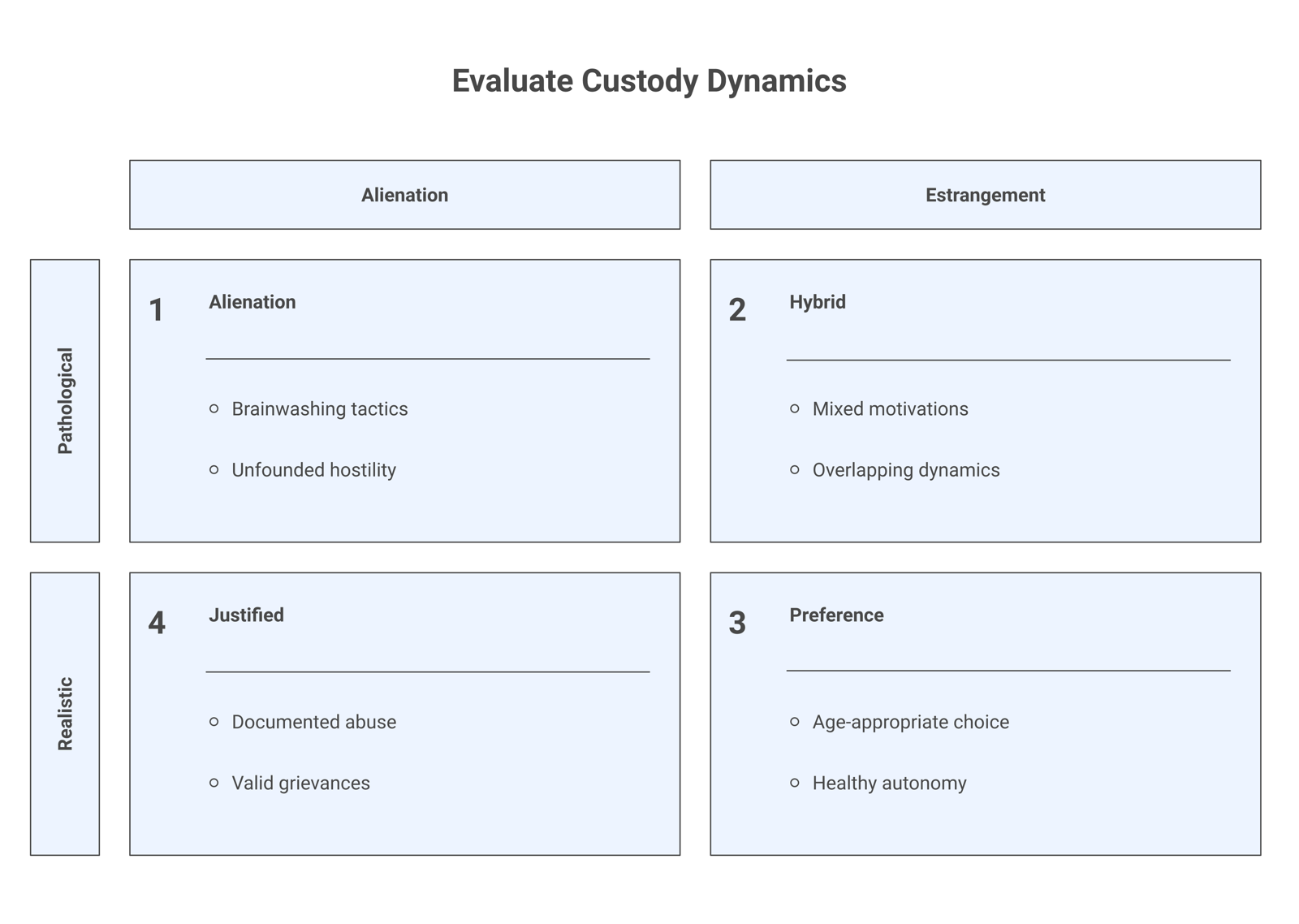
1. Estrangement from genuine abuse or neglect. The most important rule-out. A child who rejects a parent because that parent has been abusive is not alienated. Estranged children of abusive parents typically remember good times, want repair rather than severance, and answer Baker’s past-present-future probe with sadness rather than contempt. If a clinician suspects abuse, mandated reporting applies, not a parental-alienation work-up.
2. Anxious or insecure attachment that predates the separation. A child whose attachment to one parent was always anxious may present as fearful or avoidant after a separation even without alienating influence. The presentation is fear-coded, not contempt-coded. Pre-separation collateral history helps distinguish.
3. Oppositional-defiant or conduct presentations. A child with broader behavioral patterns may resist one parent because that parent enforces structure and the other does not. The presentation is generalized rather than parent-specific. School and peer reports surface the broader pattern.
4. Normal post-divorce adjustment. Adolescents in particular distance from both parents at developmentally appropriate times. A teenager who pulls back for several months and then re-engages is doing normal adjustment work, not alienation. The signal that distinguishes alienation from normal adjustment is duration plus disproportionality plus the eight behavioral manifestations.
What a single session can and cannot tell you
The largest source of misidentification in this space is the single-session conclusion. A clinician meets the child once, hears the child say something stark, and writes a note. That conclusion is unsupported by one session.
What a single session can do: identify gross safety concerns that trigger mandated reporting, note presenting affect, identify family-systems pattern signals, and establish rapport for the next contact.
What a single session cannot do: resolve causation, distinguish a generalized child disorder from an encapsulated presentation, or name alienation as a finding. A child can be high functioning at school, with peers, in sports, and still hold a fixed false belief structure about the targeted parent. Functional assessment outside the home does not screen for encapsulated alienation.
A defensible working assessment needs, at minimum: three contacts with the child across at least two contexts; one contact with each parent separately; collateral contact with the school, pediatrician, and any other clinician already involved; and a documented review of contemporaneous evidence the parents make available. Below that floor, the appropriate clinical posture is presenting concerns noted, working assessment in progress, no findings at this time.
Behavioral evidence: observing the child across contexts
Behavioral evidence is what differentiates a defensible assessment from a clinical opinion. Three observation tools are especially useful.
The loss-of-ambivalence signal
Bill Eddy, LCSW, names the most citable single indicator: all human relationships are ambivalent. Real relationships have mixed feelings. Even children abused by a parent retain mixed feelings about that parent. When a child presents as 100% positive toward one parent and 100% negative toward the other, with no nuance across multiple sessions, that pattern is not authentic relational experience.
The past-present-future probe
Dr. Amy Baker recommends a three-tense interview structure: a past question about a good memory, a present question about the current relationship, and a future question about what the rejected parent could do to repair it. An alienated child denies any good memory, is contemptuous in the present, and says nothing can fix it; an estranged-from-abuse child remembers good times, is fearful or sad, and wants repair. The three answers together are more diagnostic than any one in isolation.
The encapsulated presentation caveat
The encapsulation signature is what clinicians most often miss. A child can function normally at school, with friends, and in extracurriculars while holding a false belief structure confined to one relationship. The fallacy is to conclude that a high-functioning child does not need intervention.
Writing a clinical note that is useful and defensible
A treating therapist’s clinical note will often travel into the court file. Its credibility on cross-examination depends on a few disciplines.
- Describe behavior, not labels. Write what the child stated and did. Do not write that the child has been alienated; asserting alienation as a finding is forensic-evaluation work.
- Tie each documented behavior to a named framework criterion. Cite the framework; do not just assert.
- Note the source of each observation: what was observed directly, reported by a parent, reported by the child, and reviewed in collateral.
- Note dates, durations, and contexts. A pattern across three sessions and two contexts is evidence; a single observation is a data point.
- Avoid conclusory legal language and clinical-legal hybrids.
- Note the limits. A treating therapist’s note is not a forensic custody evaluation. If the family needs a custody finding, refer to a qualified forensic evaluator.
When to refer
Ordinary outpatient therapy has structural limits in moderate-to-severe parental alienation. When the alienating environment reinforces the loyalty contract around the clock, a 60-minute individual session cannot interrupt the dynamic. Failed conventional therapy is itself a diagnostic signal, and the right move is often escalation rather than persistence.
Three referral pathways: specialized reunification programs (intensive, court-ordered, and the target of sustained safety critiques, so abuse screening and knowledge of the forum state’s law come first); forensic custody evaluation (a different specialty from the treating clinician); and the court itself, for orders that protect the assessment process.
Frequently asked clinical questions
How is parental alienation diagnosed?
No single test. Working assessments lead with Baker’s four-factor model and the Bernet and Greenhill Five-Factor Model, use Childress’s contested attachment-based vocabulary only with its status stated, apply a structured differential to rule out estrangement from abuse, attachment disorder, conduct presentations, and normal post-divorce adjustment, and document behavioral evidence across multiple sessions and contexts.
Is parental alienation a DSM-5 diagnosis?
Parental alienation as a named disorder is not in the DSM-5. Childress argues that when his three indicators are met, a DSM-5 child-psychological-abuse V-code applies, although his model is a contested minority position. Bernet treats parental alienation as a recognizable clinical pattern, with related concepts appearing under parent-child relational problem and child affected by parental relationship distress.
How do clinicians distinguish parental alienation from estrangement?
The cleanest behavioral signal is loss of ambivalence. Children estranged from abusive parents typically retain mixed feelings, remember good times, and want repair. Alienated children present as unambivalent, deny any good memory, and reject any path to repair.
Can a child be alienated without showing symptoms outside the home?
Yes. The encapsulated presentation is contained to the relationship with the targeted parent. The child can be high functioning at school, with peers, and in extracurriculars while still holding a fixed false belief about the rejected parent.
Should the same therapist treat the alienating parent and the child?
Generally no. Treating both produces a structural conflict the systemic-family-therapy literature identifies as a recurring failure mode.
A short close
This page summarizes how clinicians identify parental alienation, names the working frameworks, and describes the differential, the limits of single-session observation, and the contents of a defensible clinical note. It does not diagnose any individual family and does not substitute for direct evaluation by a qualified clinician. See the For Professionals hub and how to document parental alienation for what evidence courts accept.
Sources
- Baker, A. J. L., and Darnall, D. (2006). Behaviors and strategies employed in parental alienation. Journal of Divorce & Remarriage, 45(1-2), 97 to 124.
- Baker, A. J. L. (2020). Reliability and validity of the four-factor model of parental alienation. Journal of Family Therapy, 42(1), 100 to 118.
- Bernet, W., and Greenhill, L. L. (2022). The Five-Factor Model for the diagnosis of parental alienation. Journal of the American Academy of Child and Adolescent Psychiatry, 61(5), 591 to 594.
- Warshak, R. A. (2015). Ten parental alienation fallacies. Professional Psychology: Research and Practice, 46(4), 235 to 249.
- Childress, C. A. (2015). An Attachment-Based Model of Parental Alienation: Foundations. Oaksong Press. An influential minority model, contested within the field.
- Coleman, J. (2021). Rules of Estrangement. Harmony.
- Joshi, A. S. (2021). Litigating Parental Alienation. American Bar Association.
- Mercer, J. (2019). Examining parental alienation treatments. Child and Adolescent Social Work Journal, 36(4), 351 to 363.
Last reviewed: 2026-06-10. Author: Alex Buckles (PAC Founder).