

A family systems therapist treating parental alienation works the whole family system rather than only the rejecting child. The model sequences protection before reunification, runs the case through a coordinated team with one accountable lead, treats the favored parent separately, and locates the hidden third party who often drives the dynamic. Outcomes remain probabilistic.
Screen for abuse first
A child’s rejection of a parent who has been abusive, neglectful, or genuinely frightening is justified estrangement, not alienation, and it must never be treated as alienation. Screen for abuse and coercive control before any reunification work begins. Protection precedes reunification in every case. Where there is founded intimate-partner violence, a founded protective order, or founded child abuse, the favored parent is excluded from the work.
This page is general professional information, not clinical or legal advice. It is not a substitute for the clinician’s own judgment and applicable practice standards. It does not diagnose or plan treatment for any specific family, and it does not name any jurisdiction’s law.
What a family systems therapist treats in parental alienation cases
A family systems therapist approaching parental alienation starts from a different unit of treatment than an individual clinician does. The rejecting child is the presenting symptom. The unit of treatment is the system that produced and now maintains the rejection. That reframe changes who sits in the room, what gets sequenced, and how progress is measured.
The case for the systemic frame rests on how the harm operates. Jennifer Harman and colleagues argue, in the journal Psychological Bulletin, that parental alienating behaviors map onto the recognized patterns of coercive control and amount to a form of family violence. Coercive control is a relational process, not an individual symptom. A clinician who treats only the child treats the downstream effect while the upstream process continues unobstructed.
This page assumes the prior clinical work is done. Identification and differential diagnosis belong to a separate process, covered in identifying parental alienation. Forensic assessment for the court belongs to a custody evaluation, which is a different role with a different scope. The material here is the treatment lens for a clinician who already has a defensible finding and a causation determination in hand.
Protection first, reunification second
The first discipline of family-systems treatment is a sequence rule. Linda Gottlieb, LMFT, LCSW-R, frames it directly in the protection-first model: once a finding is made, the primary intervention is child protection, and reunification with the rejected parent is the secondary, downstream goal. The order matters. Reversing it predicts failure.
Protection-first means the child is shielded from continued exposure to the controlling behavior until that behavior stops. The standard is the same one applied in any other case of suspected emotional maltreatment. There is no alienation-specific exception that allows a clinician to push reunification while the coercive process runs unchecked.
The modality the sequence requires is trauma-informed, not standard supportive talk therapy. The therapeutic task is to restore the child’s access to authentic feeling, which a coercive process has suppressed. A weekly fifty-minute session cannot accomplish that while the child returns each day to an environment that reinforces the loyalty bind for the remaining hours of the week.
The sequence also relocates responsibility. Durable reunification depends on the favored parent relinquishing the alienating behaviors and demonstrating the capacity to support the child’s other relationship. Until that work happens, the protective phase continues. The hard boundary from the caveat above governs here: where abuse, intimate-partner violence, or a protective order is founded, the rejected parent’s claim is not an alienation claim, and the protective logic runs in the opposite direction.
The coordinated-care team and one accountable lead
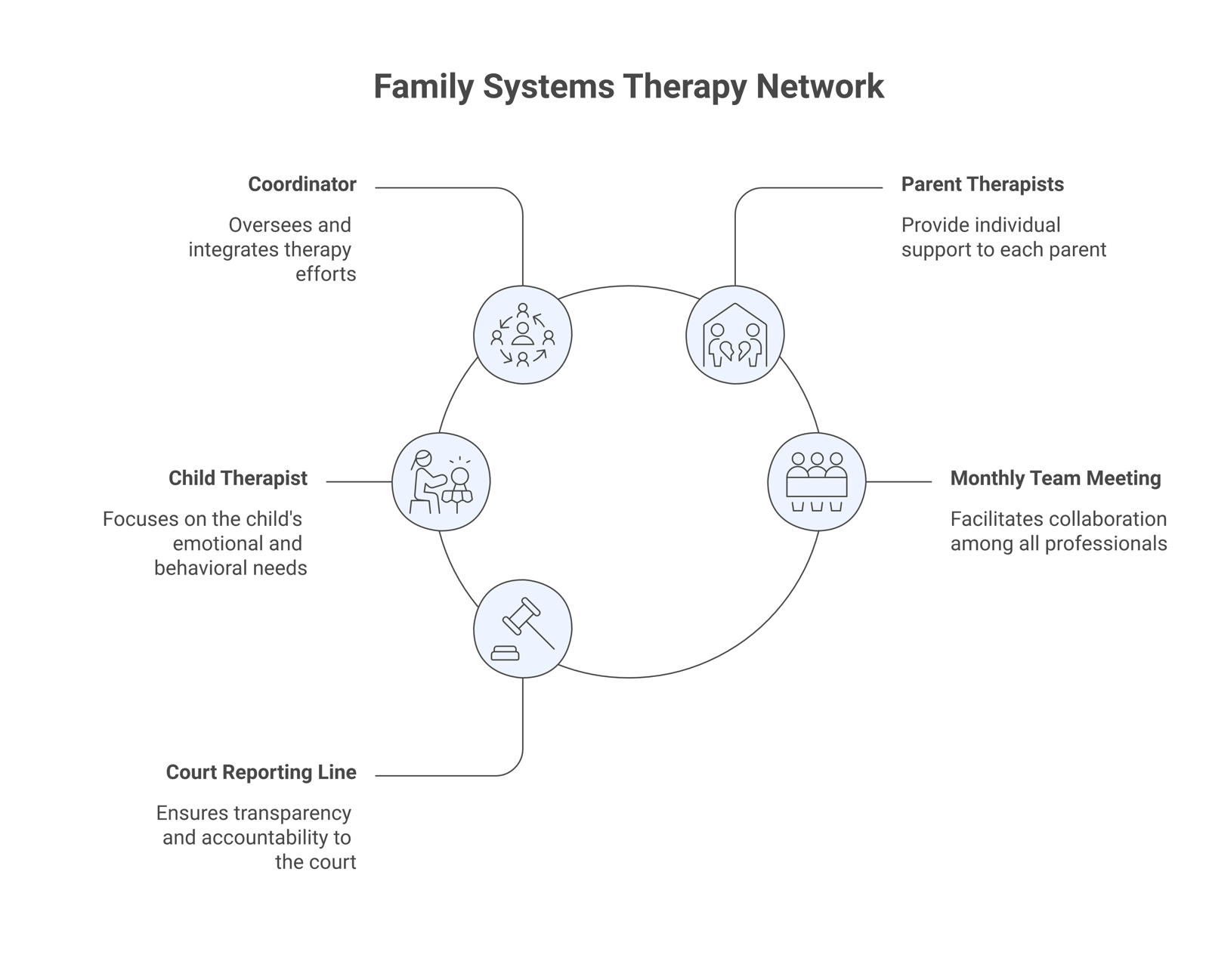
Complex cases fail when care is fragmented. A child has an individual therapist, each parent has a therapist, a reunification clinician enters late, and none of them share goals or information. The favored parent’s clinician hears one narrative, the child’s clinician hears another, and the system pulls in four directions at once.
The coordinated-care team-lead model answers that problem. Drs. Kelly Baker, Amy Eichler, and Michael Bone describe it as a modern update to the older one-therapist rule for complex cases. One court-appointed coordinator, often a guardian ad litem, selects all of the therapists rather than letting each party retain a sympathetic clinician. The coordinator runs monthly team meetings to align goals across the providers.
The coordinator is also the sole party who reports to and testifies before the court. That structure buffers the treating clinicians from capture, because no individual therapist becomes the favored parent’s instrument or the targeted parent’s advocate. It also preserves the confidentiality the treating relationships need to function. The clinicians treat; the coordinator reports.
A useful guard runs alongside the team structure. Keeping two to three clinicians involved, rather than concentrating the case in a single voice, keeps alternative hypotheses alive and reduces the risk that the team polarizes around one reading of the family. A treating clinician who has quietly decided the answer in week one has stopped assessing.
Failure modes of the team-lead model
The team-lead model has a signature failure mode, and naming it protects the work. The corpus calls it senior partner syndrome: a decades-veteran appointee whose long experience has made them closed to new input, and whose understanding of alienation has stayed primitive. Such an appointee takes the child’s stated voice at face value, treats the contact refusal as a settled preference, and steers the team away from the systemic reading. Seniority is not competence.
A second failure mode is the rogue or captured therapist. A clinician retained directly by one parent, operating outside the coordinated structure, can become an extension of that parent’s narrative. The treating relationship then reinforces the very dynamic the team exists to interrupt. The coordinated model exists precisely to prevent any one clinician from being weaponized.
A third failure mode is the case that never moves. Steven Lindenberg offers a practical benchmark from the around-the-table reunification method: if there is no measurable progress in roughly six to eight sessions, the team should consider changing therapists, because a clinician who cannot separate the issues has become part of the problem. Persistence in a stalled modality is not a virtue here. Escalation is the indicated move.
Working with the favored parent and the hidden new player
Two-party reunification work, the rejected parent plus the children, tends to stall on its own. Steven Lindenberg, drawing on Bernet and Blotcky, explains why: the best outcomes treat the rejected parent and the children together AND treat the favored parent separately, so that the favored parent can gain insight into how the behavior harms the children. Without that separate track, gains made in conjoint sessions get undone between sessions.
The separate work with the favored parent is not punitive and it is not a confession exercise. Its purpose is insight and behavior change toward becoming a safe and protective parent in a divided family. The around-the-table method starts with the adults rather than the children, holds the favored parent accountable, and also shows the rejected parent any role they play in sustaining conflict. Mediated, structured versions of this adult work are covered in parental alienation mediation.
The most useful diagnostic move in this phase is locating the hidden new player. Alienation is frequently driven not by the two original parents but by an added member of the system. Lindenberg notes that in his experience the driver is often a new spouse or significant other, a grandparent, or another relative, and frequently a stepmother or a grandmother, who feels threatened by the rejected parent’s continued contact. A clinician who maps only the two original parents will miss the actual engine of the dynamic. The systemic task is to map every player and bring each driver to the table progressively.
The exclusion boundary applies with full force here. Where intimate-partner violence, a protective order, or child abuse is founded, the favored parent is not brought into shared work, and the case is not an alienation case at all. Screening is continuous, not a one-time gate.
Stability first and the multi-year arc
Systemic treatment leans heavily on the rejected parent’s own regulation, because that parent’s steadiness is a safety cue the child can eventually move toward. Cindy Hirsch and Lawrence Joss describe the stability-first frame: nothing in the reconnection moves until the targeted parent is grounded. The clinical image is the lighthouse parent, solid and stable in any storm, whose steadiness is what draws the child back rather than any campaign to win the child.
Two reframes support that posture. Grief is not failure; the targeted parent’s grief is non-linear, and a clinician should normalize it rather than read it as a treatment setback. Boundaries are protection, not punishment; alienation thrives in systems with blurred or absent boundaries, so the work often involves helping the targeted parent hold boundaries that are firm without being rigid walls.
The arc is long. The stability-first model describes reconnection as moving through reconnection, reattachment, the child’s renewed emotional experience of the parent, and eventual reunification, with roughly three years to stabilize. A clinician who promises a faster result, or who treats a slow arc as a failed one, sets the family up for collapse. Outcomes vary by severity, by the favored parent’s cooperation, and by how early the system was interrupted. Consumer-facing orientation to this work sits at parental alienation therapy.
When the system needs an intensive
Conventional weekly therapy has a structural ceiling in moderate to severe cases. When the alienating environment reinforces the loyalty bind during the hours between sessions, a single weekly contact cannot interrupt the dynamic. Failed conventional therapy is itself a signal, and the indicated response is escalation rather than more of the same.
Intensive psychoeducational programs answer that ceiling. Lynn Steinberg’s four-day model descends from a lineage that runs through Family Bridges and the work of Richard Warshak. These are psychoeducational programs, not camps and not punitive behavioral interventions. They are designed for moderate to severe cases where once-a-week therapy has already failed, and they work intensively with the child and the rejected parent across consecutive days rather than across months.
The reported outcomes are encouraging and should still be presented as probabilistic. Family Bridges has been tested at roughly 90 to 94 percent effective by child report in the figures the corpus records. A responsible clinician cites such numbers as program-reported and case-dependent, not as a guarantee for any given family. The intensive is typically paired with a protective interval afterward, during which the favored parent is expected to do their own therapeutic work, which returns the model to the protection-first sequence that governs the whole approach.
Role and boundary discipline
The discipline that keeps all of this defensible is role clarity. A treating family systems therapist is not a forensic evaluator. The treating clinician’s product is treatment, not a custody recommendation, and crossing that line damages both the treatment and the clinician’s credibility. The expert-witness literature in the corpus is blunt on the point: therapists must not make custody recommendations, and a clinician who tries to “win” for a side loses standing.
Two practices hold the boundary. The first is to document behavior rather than apply labels. A note that records what a child said and did, tied to a named clinical pattern, survives scrutiny in a way that a conclusory label does not. The second is to keep the clinical hypothesis open until the assessment supports closing it, which is the bias guard described above. The American Psychological Association’s child custody guidelines and the interdisciplinary standards of the Association of Family and Conciliation Courts both frame the separation between treating and evaluative roles that this discipline protects.
Scope clarity at intake prevents the most common stall. A clear engagement defines whether the clinician is treating, coordinating, or evaluating, and it defines the reporting line. When those roles blur, the favored parent gains an opening to attack the clinician for overreach, and the work stops. Forensic assessment, when the court needs it, belongs to the separate custody evaluation process, and identification questions return to identifying parental alienation. The full hub for clinicians and other professionals sits at the For Professionals section.
Frequently asked clinical questions
Why treat the whole system instead of only the child?
Because the rejection is a product of the system, not a property of the child. Treating the child alone addresses the symptom while the coercive process continues. The systemic models in the corpus converge on treating the rejected parent and children together, treating the favored parent separately, and identifying any hidden third party who drives the dynamic.
What does protection-first mean in practice?
It means the child is protected from continued exposure to the controlling behavior before reunification is pursued, and reunification is treated as the secondary, downstream goal. It also means continuous screening, since a child’s justified estrangement from an abusive parent is not alienation and must not be treated as such.
Should the same therapist treat the favored parent and the child?
Generally no. The coordinated-care model assigns separate clinicians, aligned through one coordinator who reports to the court. Treating both the favored parent and the child in one relationship creates a structural conflict that the systemic literature names as a recurring failure mode.
When should a case be referred to an intensive program?
When conventional weekly therapy has failed in a moderate to severe case, and the home environment reinforces the loyalty bind faster than weekly contact can interrupt it. Failed conventional therapy is itself a referral signal, and a six to eight session no-progress benchmark is a practical trigger to escalate.
Can a treating family systems therapist make a custody recommendation?
No. A custody recommendation is forensic work that belongs to an evaluator. The treating clinician documents behavior, ties it to named clinical patterns, and stays inside the treating role. Crossing into custody recommendations damages both the treatment and the clinician’s credibility.
A short close
This page describes a family-systems treatment lens for resist or refuse and alienation cases: treating the whole system, sequencing protection before reunification, running a coordinated team with one accountable lead, treating the favored parent separately while finding the hidden new player, holding the stability-first arc, and keeping strict role discipline. It does not diagnose or plan treatment for any specific family, and it does not replace the clinician’s own judgment or applicable practice standards.
Sources and further reading
- Harman, J. J., Kruk, E., and Hines, D. A. (2018). Parental alienating behaviors: An unacknowledged form of family violence. Psychological Bulletin, 144(12), 1275 to 1299. https://doi.org/10.1037/bul0000175
- American Psychological Association. Guidelines for Child Custody Evaluations in Family Law Proceedings. apa.org/practice/guidelines/child-custody
- Association of Family and Conciliation Courts. afccnet.org
- Corpus frameworks cited by name in the body: F-070 (Gottlieb, protection-first sequence); F-103 (Baker, Eichler, Bone, coordinated-care team-lead and senior partner syndrome); F-091 (Lindenberg, treat the favored parent separately and find the hidden new player); F-094 (Hirsch and Joss, stability-first multi-year arc); F-032 (Steinberg, four-day intensive model).
If you or a client is in crisis
Free and confidential help is available right now.
- 988 Suicide and Crisis Lifeline. Call or text 988.
- Childhelp National Child Abuse Hotline. 1-800-422-4453.
- NAMI HelpLine. 1-800-950-6264.
Last reviewed: 2026-06-06. Author: Alex Buckles (PAC Founder).