

The differential diagnosis of contact refusal is the structured reasoning a clinician or evaluator uses to explain why a child resists or rejects a parent. The first task is to screen for genuine abuse. Only then does the clinician weigh alienation against estrangement, anxiety, affinity, enmeshment, and hybrid presentations, so no cause is missed and none is over-diagnosed.
Screen for abuse first
A child’s refusal can be a protective response to genuine maltreatment. A justified estrangement from an abusive or neglectful parent must never be classified as alienation. Over-diagnosis harms abuse survivors and can place a child back in danger. When abuse is suspected, mandated-reporting duties and child-safety standards take priority over any framework discussed here.
This page offers general professional information, not clinical or legal advice. It is not a substitute for the clinician’s own judgment and applicable practice standards. A defensible opinion about any specific child requires direct evaluation by a qualified professional.
What the differential diagnosis of contact refusal asks
Contact refusal is a presentation, not a diagnosis. A child who resists or rejects a parent sits somewhere on what the field calls a resist-refuse dynamic. The same surface behavior, a child who will not go on a visit, can arise from very different causes. Each cause points to a different intervention. Naming the cause correctly is the whole task.
Two errors sit at opposite poles. The first is missing alienation, reading a coached refusal as the child’s authentic, reality-based choice. The second is over-diagnosing alienation, labeling a frightened or appropriately distancing child as alienated when the rejected parent has in fact harmed them. Both errors damage children. A rigorous differential is the discipline that guards against each.
This page maps the reasoning across all causes. For the identification of alienation specifically, see identifying parental alienation. For the structure of a forensic assessment, see parental alienation custody evaluation.
Step one: screen for genuine abuse before any other reasoning
The differential begins with safety. Before weighing alienation, the clinician screens for abuse or neglect by the rejected parent. This ordering is non-negotiable. A child who avoids a parent who has hurt them is showing a protective, reality-based response, not a contaminated one.
Base rates discipline this screening. A forensic taxonomy of family-court allegations notes that roughly 2 percent of divorces involve a child-sexual-abuse allegation. Across full child-protection samples, most allegations are founded, a smaller share is unfounded or undetermined, and only a small fraction is intentionally false. A central distinction follows: unfounded does not equal maliciously false. Conflating the two inflates apparent false-allegation rates and biases the reader toward dismissing real harm.
Role discipline matters as much as base rates. A treating therapist accepts the client’s account in good faith and refers safety concerns to child protection; a treating therapist does not investigate. A forensic evaluator weighs and rates the reliability of every source. Treating a therapist’s good-faith belief as forensic proof is a recurring failure that contaminates these cases.
The dual mandate is “safety first” and “first do no harm.” Removing a child from an attachment figure on a thinly supported allegation is itself a harm. Leaving a child with an abuser is a graver one. Screening does not resolve the case. It sets the floor below which no alienation label may be applied.
Domestic-violence screening needs the same care. A useful typology separates intimate partner terrorism, where violence is embedded in a wider pattern of coercive control, from situational couple violence, which arises from specific conflicts without a control pattern. The categories are not interchangeable. A scientifically informed evaluation generates explicit hypotheses, tests them against documented evidence, compares them with the literature, and states conclusions probabilistically. That method tracks the APA guidelines for child custody evaluations.
The structured differential: competing explanations for refusal
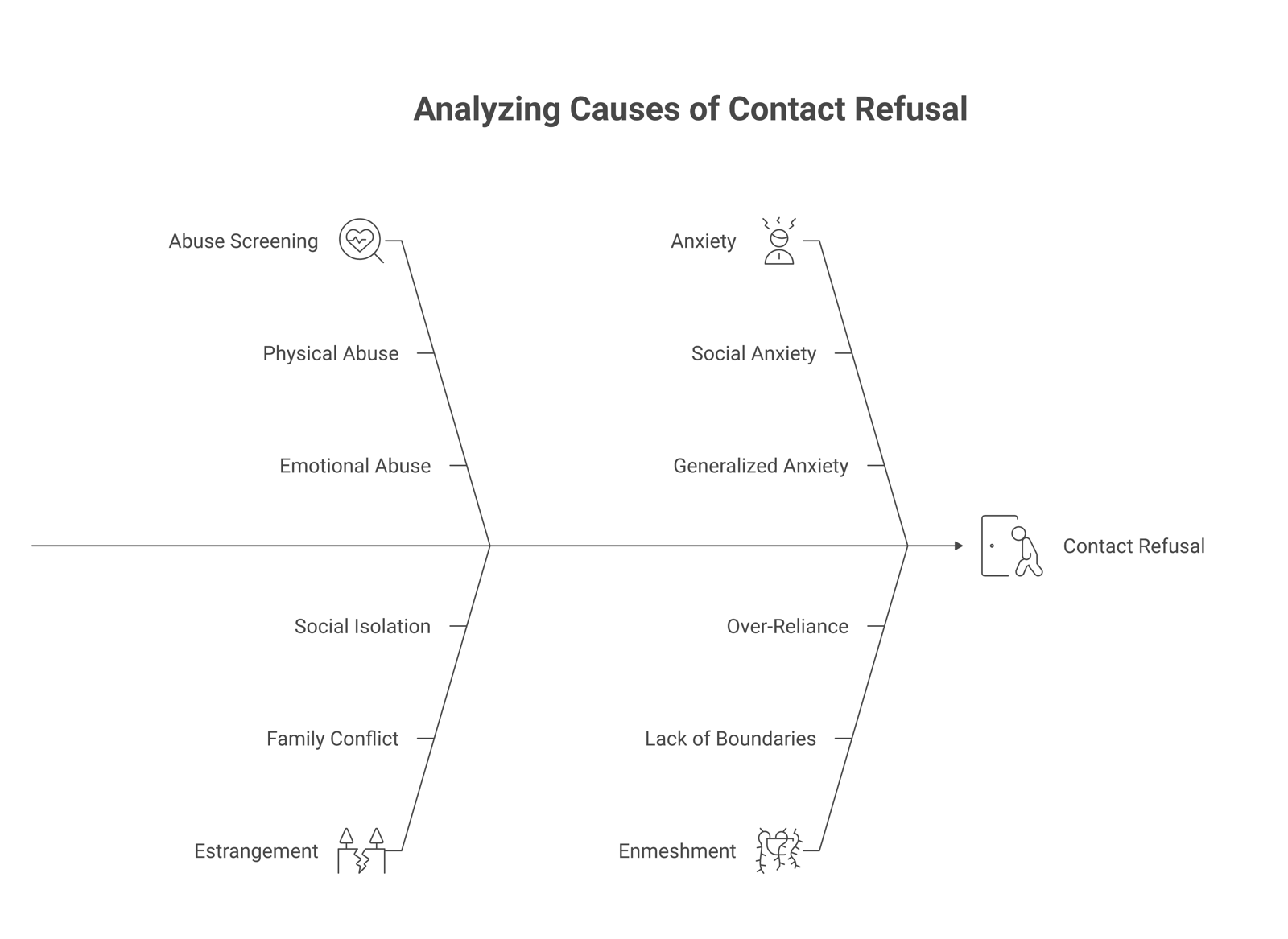
Once abuse screening sets the floor, the clinician works a structured differential. The resist-refuse spectrum, framed within the Association of Family and Conciliation Courts community, runs from estrangement grounded in real harm, through anxiety and protective parenting, to alienation driven by a contaminated narrative. Five explanations deserve explicit consideration. Comorbidity is common. When more than one driver is present, the most severe driver usually organizes treatment, and lesser contributors often ease once it is addressed.
Justified estrangement and realistic preference
Estrangement is refusal with a reality-based cause. The child distances because the rejected parent was abusive, neglectful, frightening, or chronically unavailable. The fear is proportionate to experience. A separate, milder pathway is realistic preference, sometimes called affinity or alignment. A child can feel closer to one parent for reasons of temperament, shared interests, or developmental stage, without rejecting the other.
Discriminating signals help here. Children estranged by real harm tend to retain mixed feelings, recall good times, and, when safe, want some form of repair. Realistic preference rarely produces a campaign of denigration, and the less-preferred parent is still loved and seen. Neither pattern should be relabeled alienation. The cross-silo explainer on parental alienation vs estrangement develops this boundary for a wider audience.
Anxiety-based refusal and affinity
Some refusal is anxiety. A child may resist transitions because of separation anxiety, generalized worry, or a wish to escape exposure to parental conflict. The presentation is fear-coded rather than contempt-coded. Often the child wants the parent but cannot tolerate the exchange, the second household, or the loyalty bind of leaving the other parent. Pre-separation history clarifies whether the anxiety predates the conflict.
This pathway matters because it is treatable and frequently misread. A child escaping the tension between two parents is not necessarily being alienated by either. The intervention targets the anxiety and the conflict exposure, not a presumed campaign.
Enmeshment and counterproductive protective parenting
A third pathway involves a parent who is anxious and overprotective rather than deliberately alienating. Naive or accidental alienation describes a parent whose own fear, transmitted to the child, frames the other parent as unsafe without a calculated strategy. Enmeshment is the related dynamic, a parent and child so fused that the child experiences the parent’s anxiety as their own and cannot separate without guilt.
The behavioral surface can resemble alienation, which is exactly why it is a trap. The distinguishing feature is intent and mechanism. The overprotective parent is not running a strategy; the parent is leaking distress. Treatment differs accordingly, and mislabeling enmeshment as deliberate alienation can harden a family system that would respond to lower-intensity work.
Alienation: purposeful indoctrination
Alienation is refusal produced by one parent’s influence rather than by the rejected parent’s conduct. In its clearest form it is purposeful indoctrination, where a favored parent uses ongoing strategies that lead the child to reject a previously loved parent without proportionate cause. At the extreme end of the spectrum the child can adopt the favored parent’s distorted belief as their own, a shared presentation the clinical literature describes as folie a deux. Researchers have argued that such alienating behaviors map onto coercive control and amount to a form of family violence.
The hallmark is disproportion. The intensity of rejection exceeds anything in the rejected parent’s actual behavior, the stated reasons are weak or borrowed, and the child shows little of the ambivalence that real relationships carry. Because identifying alienation has its own evidentiary requirements, the dedicated method sits in identifying parental alienation.
Hybrid presentations
Many real cases are hybrid. A rejected parent may have genuine deficits, such as harsh discipline, poor attunement, or a period of absence, while the favored parent amplifies and weaponizes those deficits well beyond their real weight. The clinical error is to treat any flaw in the rejected parent as a full explanation, or to treat any favored-parent influence as the whole story. The correct question is causal and proportional: but for the favored parent’s conduct, would the child reject this parent to this degree?
Hybrid cases require the clinician to hold two truths at once. Both parents contribute, and the contributions are rarely equal. Assigning a rough fifty-fifty split by default is itself an error, addressed below.
Signals that discriminate between causes
No single sign settles the differential. Patterns across signs, observed over multiple contacts, carry the weight. Several signals help separate the pathways.
Proportionality is the first. The clinician compares the intensity of the child’s rejection against the documented conduct of the rejected parent. Gross disproportion points away from estrangement and toward alienation or hybrid influence.
Ambivalence is the second. Authentic relationships, including abusive ones, carry mixed feelings. A child who presents one parent as wholly good and the other as wholly bad, with no nuance across several sessions, shows a pattern that real experience rarely produces.
The quality of the stated reasons is the third. Reasons that are specific, sensory, and proportionate fit estrangement. Reasons that are vague, borrowed, scripted, or trivial fit alienation. A past-present-future interview structure often exposes the difference, because a child estranged by harm can usually name a good memory and a path to repair, while a child captured by a contaminated narrative often denies any good memory ever existed.
Context breadth is the fourth. A child whose difficulties appear across home, school, and peers may have a broader condition, such as an anxiety or oppositional presentation, rather than an encapsulated rejection of one parent. The reverse also holds, since high functioning everywhere except toward one parent does not rule alienation out.
Evaluator error traps
The differential fails most often through predictable reasoning errors. A catalogue of evaluator cognitive errors names the most damaging ones, and each pushes the assessment toward a wrong label in a consistent direction.
The high-conflict fallacy treats every resist-refuse case as two roughly equal parents who simply cannot get along. The framing assumes its own conclusion and hides one-sided causation. The but-for error, sometimes called the holy hybrid, finds any flaw in the rejected parent and names it the cause, without asking whether that flaw alone would produce this degree of rejection.
Presentation bias is a third trap. A cool, charming, convincing favored parent can read as more credible than an anxious, agitated, angry, or afraid rejected parent, even when the calm presentation masks the manipulation. Mistaking pathological enmeshment for healthy closeness is a fourth. The last is the demand for certainty that box-checking cannot supply. Like a physician working up chest pain, the evaluator reasons under uncertainty with clinical judgment, generates and tests hypotheses, and states conclusions in probabilistic terms rather than as binary verdicts. For how these disciplines sit inside a full evaluation, see parental alienation custody evaluation.
Matching intervention to the cause
The reason the differential matters is that the two ends of the spectrum need opposite responses. Estrangement work paces with the child and respects the child’s reality-based fear, because pushing a genuinely frightened child toward a parent who harmed them retraumatizes them. Alienation work gently moves the child past a contaminated refusal that does not reflect the rejected parent’s conduct. Apply the wrong paradigm and the intervention backfires.
For that reason, an evaluative or judicial finding on causation should precede reunification work rather than follow it. Sequencing treatment ahead of diagnosis is how scared children get pushed and coached children get indulged. Counseling that follows a clear differential is covered in counseling alienated children. The wider professional resources sit in the For Professionals hub.
Frequently asked questions
What is the differential diagnosis of contact refusal?
It is the structured clinical reasoning used to identify why a child resists or rejects a parent. Rather than assuming a single cause, the clinician screens for abuse first, then weighs alienation, justified estrangement, anxiety, realistic preference, enmeshment, and hybrid presentations. The goal is to name the actual driver so the intervention fits, because the two ends of the resist-refuse spectrum need opposite treatments.
Why must abuse be ruled out before considering alienation?
Because a child’s refusal can be a protective response to real harm. A justified estrangement from an abusive or neglectful parent is not alienation, and labeling it as such can return a child to danger and discredit a survivor. Screening also respects base rates, since unfounded allegations are not the same as maliciously false ones, and treating them as identical biases the assessment.
How do clinicians tell alienation apart from estrangement?
Through proportionality, ambivalence, and the quality of the child’s stated reasons, observed across multiple contacts. Estrangement tends to be proportionate to real conduct, retains mixed feelings, and leaves room for repair. Alienation tends to be disproportionate, presents one parent as all good and the other as all bad, and rests on vague, borrowed, or trivial reasons. No single sign is sufficient.
What is a hybrid case?
A hybrid case is one where the rejected parent has genuine shortcomings and the favored parent also amplifies them beyond their real weight. Both parents contribute, but rarely in equal measure. The clinician asks a causal, proportional question: but for the favored parent’s conduct, would the child reject this parent to this degree? Assuming a fifty-fifty split by default is an error.
What are the most common evaluator errors in these cases?
Assuming two equal contributors who cannot get along, naming any flaw in the rejected parent as the whole cause, rewarding the calmer and more charming parent, mistaking enmeshment for healthy closeness, and demanding certainty that clinical judgment under uncertainty cannot provide. Each error pushes the assessment toward a wrong label in a predictable direction.
The PARQ-Gap as a differential tool
Within a full assessment, the PARQ-Gap can serve as one objective differential aid. As described in the Bernet et al., PARQ-Gap, Journal of Forensic Sciences (2020), it scores the difference between how a child rates acceptance and rejection by each parent, and an unusually wide gap is more consistent with alienation than with proportionate estrangement. It is one signal among several, it follows rather than replaces a careful history, and abuse is screened first. For the instrument and its limits, see our page on measuring parental alienation with the PARQ.
Sources and further reading
- American Psychological Association. Guidelines for Child Custody Evaluations in Family Law Proceedings. apa.org/practice/guidelines/child-custody
- Association of Family and Conciliation Courts (AFCC). afccnet.org
- Harman, J. J., Kruk, E., & Hines, D. A. (2018). Parental alienating behaviors: An unacknowledged form of family violence. Psychological Bulletin, 144(12), 1275 to 1299. https://doi.org/10.1037/bul0000175
If you or a family you work with is in crisis
Free and confidential help is available right now.
- 988 Suicide and Crisis Lifeline. Call or text 988. 988lifeline.org
- Childhelp National Child Abuse Hotline. 1-800-422-4453. childhelp.org
- NAMI HelpLine. 1-800-950-6264. nami.org/help
Last reviewed: June 17, 2026. Author: Alex Buckles (PAC Founder).