

Counseling for alienated children begins with a reframe: a child’s rejection of a parent in a resist or refuse dynamic is usually an attachment rupture, not defiance. Good clinical work screens for genuine abuse first, protects the child before any reunification aim, attunes rather than corrects, and coordinates with a wider team. Outcomes remain probabilistic.
Screen for genuine abuse first
A child who resists or refuses contact may be responding to real harm. Where a parent has been abusive, neglectful, or frightening, the child’s distancing is justified estrangement, not alienation, and it must never be treated as alienation. Screen for abuse, neglect, and coercive control before framing a case as alienation, and keep screening throughout. Protection precedes any reunification aim. A child’s safety is never traded against a relationship goal.
This page offers general professional information, not clinical or legal advice. It is not a substitute for the clinician’s own judgment and applicable practice standards. It does not diagnose or plan treatment for any specific child, and it does not name any jurisdiction’s law.
What counseling for alienated children must treat
Counseling for alienated children aims at a target the behavior hides. The child shows up rigid, certain, and hard to reach. A clinician’s job is to read that as an injury, not a trait. The rejection is a sign of a ruptured attachment. That sign is what brings the child in.
Attachment-focused clinicians who work these cases name the reframe well. When a child does not want to see a parent, the child feels rejected too. The refusal is an attachment rupture, not defiance. A child in a loyalty bind reads contact as a threat to a bond they cannot risk losing. So the refusal is a guard, not a verdict on the rejected parent.
Two things follow. Time is not neutral. Each stretch without safe contact deepens the felt rejection and hardens the stance. A clinician who waits for the child to soften lets the injury set. The goal shifts as well. Counseling here is not an effort to argue the child out of a belief. The aim is to give the child back access to real feeling that the dynamic has buried.
This page covers the child-facing work. The whole-system model, which adds the favored parent and any hidden third party, sits in family systems therapy for parental alienation. Whether a case is alienation at all is the question handled in identifying parental alienation. The work here assumes a sound read is already in hand, and the child is now in treatment.
Screen for genuine abuse before treating rejection as alienation
The first safeguard runs before the work and all through it. A child’s resistance can be a healthy answer to a parent who caused harm. Treating fair estrangement as alienation adds to the first harm. It can push a child into forced contact with someone unsafe. So the screen is ongoing, not a single gate at intake.
The research offers a hard finding that clinicians must hold with care. Researchers including Jennifer Harman note a pattern reported in the maltreatment literature: badly abused children tend to cling to the parent who hurt them, not reject that parent. So a strong, fixed, steady rejection of a once-loved parent is one sign that can point to outside influence. The finding is a flag for more assessment, never a stand-in for it.
The flag cuts both ways. Some children who were truly harmed do reject the parent who harmed them. A clinician who reads every firm rejection as proof of alienation will miss real danger. The safer stance keeps both ideas open. It tests them against records, history, and the child’s own account. Where abuse, partner violence, or a protective order is present, the case is not alienation. The protective logic flips, and the rejected parent is not brought into shared work. Custody calls belong to a parental alienation custody evaluation, a separate role with a separate scope.
Why individual child therapy alone often fails
A child seen weekly in supportive therapy, with no change to the wider system, often does not get better. The cause is structural, not a gap in the clinician’s skill. In session the child spends one hour in a room that doubts the rejection. At home the child spends many hours in a place that feeds it. Volume wins.
Linda Gottlieb, the family therapist who developed the Turning Points for Families intensive program, names the rule that explains the stall. Once a case reads as alienation, the first job is to protect the child from the controlling behavior. Reunification with the rejected parent is the second, later goal. Flip that order and the work fails. Pushing reunification while the coercion runs on re-injures the child and weakens the case.
Protection first reshapes what child therapy is for. The case needs trauma-informed work, not standard talk. The task is to loosen the loyalty bind and give the child back their own buried feeling. A weekly hour cannot do that while the home feeds the bind the rest of the week. A clinician who treats only the child treats the effect while the cause runs on. The system-level answer, including the work the favored parent must do, sits in the family systems therapy model.
Attunement over correction in the consulting room
The child-facing skill that sets good work apart is attunement, not correction. A child in a resist or refuse dynamic expects a fight, and a fight proves the threat. The attachment-rupture frame points to attachment-focused work. It stops reacting to the child’s mimicry and heat. It tunes to the fear under the behavior. The clinician reads the hostility as data about fear, not as the thing to fix.
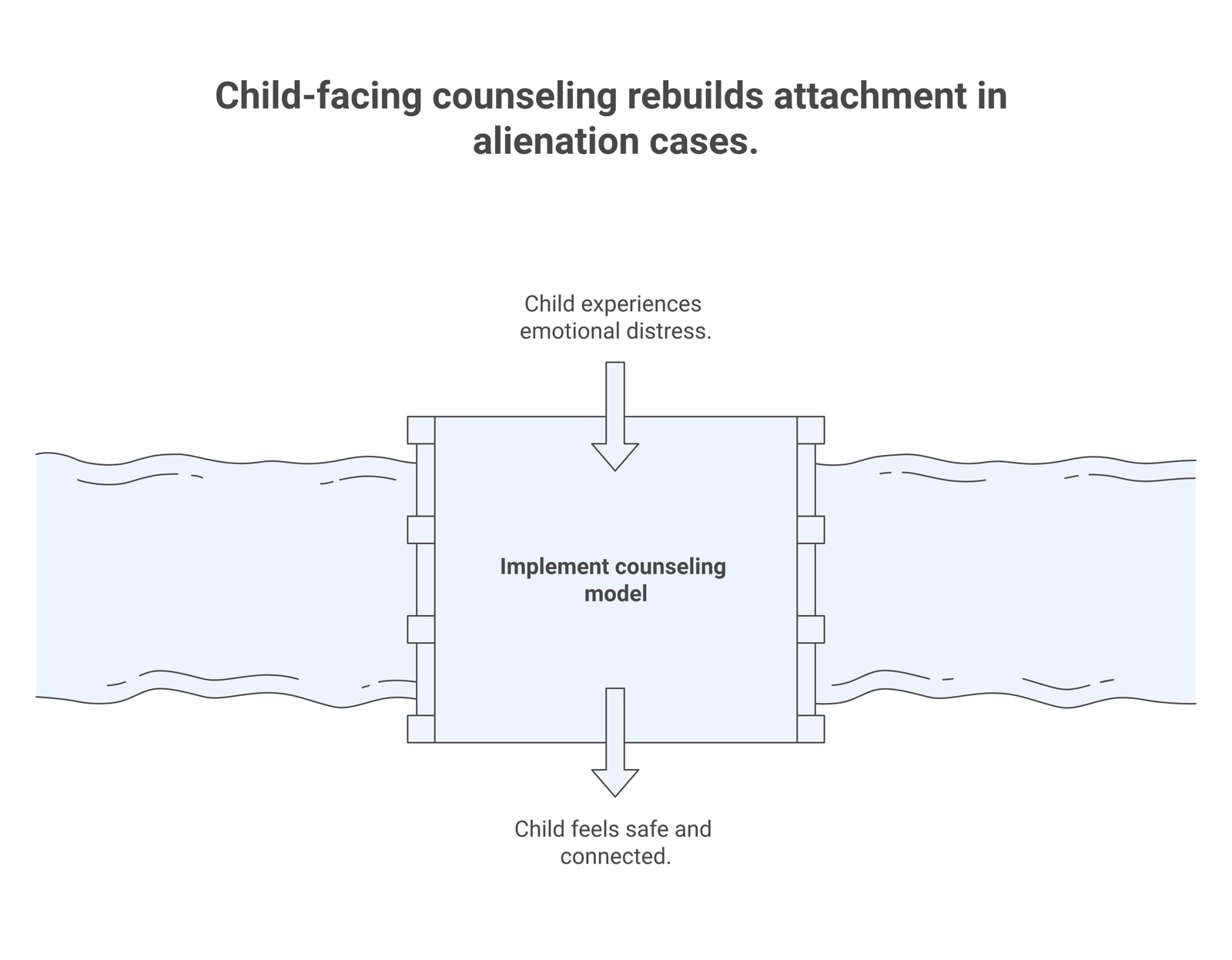
Clinicians who teach this work name four moves attunement asks for: listening, acknowledging, validating, and compassion, held over time. The clinician works with the child’s view, not against it. Fighting the view only widens the gap. A child who feels heard has less cause to guard the rejection. One line is firm. This stance fits grievances about feelings, such as a sense that a parent was too strict or too absent. It never fits made-up abuse claims. A clinician who hears a real disclosure follows reporting and safety duties instead.
Three habits keep attunement disciplined. The clinician validates the feeling without backing every fact tied to it. Defending the rejected parent in session is out, since defense reads as pressure. Pacing stays slow, since a child who senses a push to restore contact will brace. Reconnection follows safety. Safety follows being understood.
Coordinating care across the team
Complex cases fail when care splits apart. A child has one therapist. Each parent has another. A reunification clinician joins late. None of them share goals. The child’s clinician hears one story, the favored parent’s clinician hears another, and the team pulls four ways while the child stays stuck.
A coordinated-care model used in complex cases offers the structural answer. One court-appointed coordinator, often a guardian ad litem, picks the therapists. No party gets to retain a friendly clinician. The coordinator runs regular team meetings to line up goals. The coordinator is the one party who reports to the court and testifies. That shields the treating clinicians from capture. The child’s therapist then stays a therapist, not one parent’s tool or the other parent’s champion. The clinicians treat, and the coordinator reports.
The model has one telling failure mode, which practitioners describe as senior partner syndrome. A long-tenured appointee can close to new input, take the child’s stated rejection at face value, and steer the team off the systemic read. Long service is not the same as skill. A child’s clinician who sees the team drift toward the loyalty bind, treating the refusal as a settled choice, holds useful information. The move is to raise it through the structure, not around it.
Pacing, the stability-first arc, and realistic expectations
Repair runs on a long clock. A clinician who promises speed sets the family up to fall. Advocates and clinicians who guide targeted parents describe a stability-first arc. Nothing in the reconnection moves until the targeted parent is grounded. The image is the lighthouse parent, steady in any storm. That steadiness draws the child back, not a push to win the child. The child’s clinician backs that steadiness, since the rejected parent’s calm is a safety cue the child can move toward.
Two reframes help the family hold the pace. Grief is not failure. The targeted parent’s grief tends to move in waves, and a clinician should treat that as normal, not as a setback. Boundaries are protection, not punishment, since these dynamics thrive where boundaries blur. The arc runs in years. Practitioners often describe a multi-year path, on the order of three years, to a stable reconnection. A clinician who reads a slow arc as a failed one misreads the work. Outcomes vary with the severity of the case, with the favored parent’s cooperation, and with how early the system was broken open. Family-facing help sits in the parental alienation therapy page.
Role and boundary discipline
Role clarity keeps the work defensible. A clinician treating an alienated child is not a forensic evaluator. The product is treatment, not a custody call. Cross that line and both the treatment and the clinician’s standing suffer. It also hands the favored parent a chance to attack the clinician for overreach.
Two practices hold the line. The clinician records observed behavior tied to named patterns, not loose labels, since a behavior record holds up where a label does not. Keeping the read open until the assessment supports closing it is the second practice. That same habit guards against treating fair estrangement as alienation. The American Psychological Association’s child custody guidelines and the Association of Family and Conciliation Courts standards both set the split between treating and evaluating that this habit protects. A clear scope at intake, naming whether the clinician treats, coordinates, or evaluates, heads off the most common stall. The full hub for clinicians and allied professionals sits at the For Professionals section.
Frequently asked clinical questions
Why frame a child’s rejection as an attachment rupture rather than defiance?
Because the rejection is usually a guard against a loyalty bind, not an oppositional trait. A child caught between parents reads contact as a threat to a bond they cannot risk losing. Reading the refusal as defiance invites correction, which proves the threat. Reading it as an injury opens the attunement work that loosens the bind.
Why does individual child therapy alone so often stall?
Because one weekly hour cannot outpace what the child takes in the rest of the week. The protection-first rule holds that the child must be shielded from the controlling behavior before reunification can hold. A clinician who treats only the child treats the symptom while the system that drives it runs on.
How should a clinician screen for genuine abuse in these cases?
All through the work, using records, history, and the child’s own account, not the firmness of the rejection alone. A strong, fixed rejection can flag outside influence, but it is a prompt for more assessment, not proof. Where abuse, partner violence, or a protective order is present, the case is not alienation, and protection means keeping the child away from the parent who caused harm.
What does attunement over correction look like in practice?
It looks like listening, acknowledging, validating, and showing compassion for the child’s feeling, without backing every fact or defending the rejected parent in session. It validates grievances about feelings, never made-up abuse claims, and it keeps the pace slow so the child does not sense a push to force contact.
Can the child’s treating clinician recommend custody outcomes?
No. A custody call is forensic work that belongs to an evaluator with a separate role and scope. The treating clinician records observed behavior, ties it to named patterns, supports the child’s protection and recovery, and stays in the treating role.
A short close
Counseling for alienated children rests on three commitments: read the rejection as an attachment rupture, not defiance; screen for genuine abuse and protect the child before any reunification aim; and coordinate the child-facing work within a wider team across a slow, stability-first arc. It does not diagnose or plan treatment for any specific child, and it does not replace the clinician’s own judgment or applicable practice standards.
Sources and further reading
- Harman, J. J., Kruk, E., and Hines, D. A. (2018). Parental alienating behaviors: An unacknowledged form of family violence. Psychological Bulletin, 144(12), 1275 to 1299. https://doi.org/10.1037/bul0000175
- American Psychological Association. Guidelines for Child Custody Evaluations in Family Law Proceedings. apa.org/practice/guidelines/child-custody
- Association of Family and Conciliation Courts. afccnet.org
- Eddy, B. (2010). Don’t Alienate the Kids! Raising Resilient Children While Avoiding High Conflict Divorce. HCI Press. (Practitioner guidance on high-conflict dynamics, not peer-reviewed outcome research.)
- Templer, K., Matthewson, M., Haines, J., & Cox, G. (2017). Recommendations for best practice in response to parental alienation. Journal of Family Therapy, 39(1), 103 to 122.
If you or a client is in crisis
Free and confidential help is available right now.
- 988 Suicide and Crisis Lifeline. Call or text 988. 988lifeline.org
- Childhelp National Child Abuse Hotline. 1-800-422-4453. childhelp.org
- NAMI HelpLine. 1-800-950-6264. nami.org/help
Last reviewed: 2026-06-06. Author: Alex Buckles (PAC Founder).