

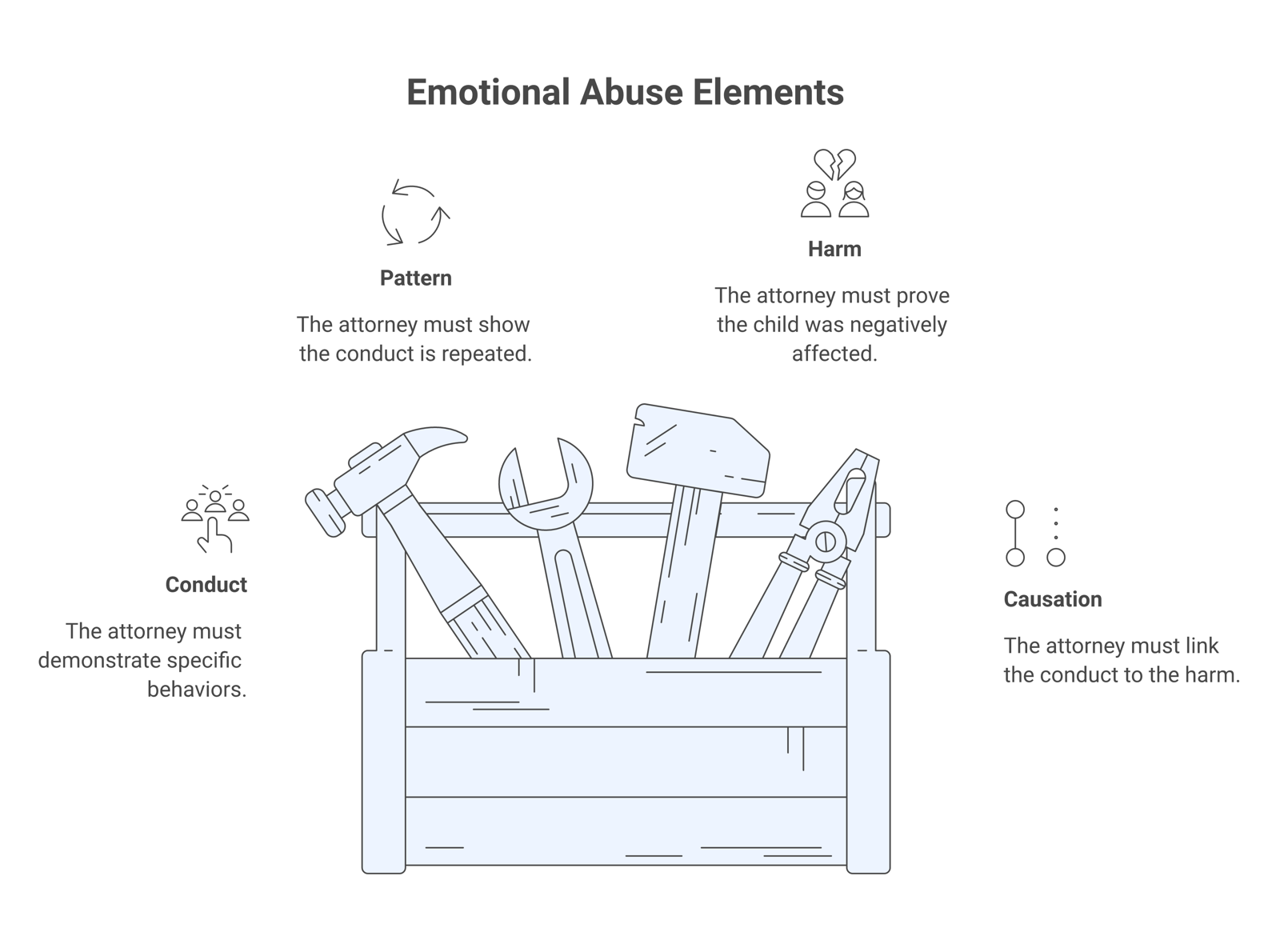
What judges consider emotional abuse in custody cases is, generally, a pattern of non-accidental conduct that harms or is reasonably likely to harm a child’s psychological wellbeing, assessed by behaviors rather than labels within the best-interests analysis. An attorney arguing that alienating conduct meets this standard typically must establish four things: the conduct, a pattern, harm to the child, and causation.
General education, not legal advice. This page is professional education for licensed family-law attorneys and for informed parents working with counsel. It is not legal advice, does not create an attorney-client relationship, and is not a substitute for jurisdiction-specific legal research. Family law and the statutory definition of emotional abuse vary materially by state. Nothing here substitutes for a licensed attorney’s judgment in the relevant jurisdiction.
Emotional-abuse framing runs both ways
The same standard a parent invokes against alienating conduct is engaged when a parent reports the other parent’s abuse of the child. Each claim is assessed on its own proof, case by case. A child’s distancing caused by genuine abuse is justifiable estrangement, not alienation (Coleman), and the emotional-abuse framing must never be used to punish a parent who is protecting a child.
How emotional abuse functions as a custody factor
Emotional or psychological abuse of a child enters a custody case through the best-interests analysis. Every state decides custody by reference to the best interests of the child, and the relevant factors generally include the mental and physical health of the parties and the child’s safety and wellbeing, as the Cornell Legal Information Institute summarizes in its overview of the best interests of the child. Emotional abuse is not usually a freestanding cause of action in a custody matter. It is a factor the court weighs in deciding the parenting arrangement that serves the child.
A theme that runs through current practice is that courts increasingly act on documented behaviors rather than on a diagnostic label. A parent who arrives with conclusions, calling the other parent abusive or a narcissist, but no fact pattern, tends to struggle. A parent who arrives with a documented pattern of conduct, organized and corroborated, gives the court something it can act on. This page treats the emotional-abuse standard and the proof of harm. For procedural handling and the remedy spectrum once a court acts, see the companion page on how courts handle parental alienation, and for the practitioner hub see For Professionals.
This page is the attorney-facing half of a deliberate pair. It covers the standard in counsel’s terms: the four elements an attorney typically establishes (conduct, pattern, harm, and causation), the evidentiary considerations, and the limits on expert testimony. The parent-facing companion, child custody and emotional abuse, explains in plain language how courts weigh emotional abuse within best-interest factors and what tends to carry weight. Parents reading without counsel should start there; the two pages cross-reference rather than repeat each other.
What courts generally treat as emotional or psychological abuse of a child
There is no single national statute defining emotional abuse, and state definitions vary, so this section describes the general standard rather than any one jurisdiction’s text. Across definitions, the common core is a pattern of caregiver conduct that damages, or is reasonably likely to damage, a child’s emotional development or sense of self-worth.
Behaviors, not labels
The clinical standard most often cited tracks the DSM-5 description of child psychological abuse: non-accidental verbal or symbolic acts by a parent or caregiver that result, or have reasonable potential to result, in significant psychological harm to the child. Forensic researcher Shawn Wygant’s work, presented at the Parental Alienation Study Group conference in October 2025 and not yet published in a peer-reviewed journal, draws the practitioner lesson from that standard: courts and evaluators are better served by describing the acts of the parent than by debating a contested syndrome label. The American Academy of Child and Adolescent Psychiatry describes emotional maltreatment in similar behavioral terms, including spurning, terrorizing, isolating, and corrupting a child. The argument is made on conduct the court can see.
Exposure can meet the threshold
A consequence of the behavioral standard is that exposure to harmful conduct can meet it, even before lasting symptoms are visible in the child. The DSM-5 phrasing reaches acts that have reasonable potential to result in harm, not only acts that have already produced a diagnosable injury. Harman, Kruk, and Hines map alienating and related behaviors onto a recognized child-maltreatment typology, including emotional aggression, neglect of the child’s need for both parents, and the misuse of courts or agencies against the other parent. The point for an attorney is that the harm element does not require waiting until a child is visibly damaged, although the strength of the harm showing still matters to the weight a court gives the factor.
The elements an attorney typically establishes
Arguing that conduct rises to emotional abuse as a custody factor generally rests on four elements. They are not a national statutory test, and the labels vary, but together they describe what a court usually needs before it treats the conduct as abuse rather than ordinary parental friction.
Conduct and pattern
The first two elements are the identified conduct and its repetition. A single sharp word in a hard moment is not abuse, so the conduct is shown as specific, documented acts, and the pattern is shown as those acts recurring over time. A pattern is more persuasive than an incident, because it distinguishes a course of conduct from an isolated lapse. Contemporaneous records, third-party observations, and the consistency of the behavior across settings build the pattern.
Harm to the child
The third element is harm, actual or reasonably likely, to the child’s psychological wellbeing. Because exposure can meet the standard, the harm showing ranges from documented symptoms in the child to expert opinion that the conduct is reasonably likely to cause significant psychological harm. The stronger and better corroborated the harm showing, the more weight the factor carries in the best-interests balance.
Causation
The fourth element is the link between the conduct and the harm, and it is the one most often contested. A court has to be satisfied that the parent’s conduct caused or is causing the harm, rather than that the harm arose from some other source. Research on targeted parents warns of a common error in the other direction, the fundamental attribution error, where a professional treats a distressed parent’s reactive behavior as the cause of a rupture rather than a response to it. A disciplined causation analysis, sometimes framed as a but-for inquiry, separates a parent’s reactive frustration from a sustained course of harmful conduct.
Where alienating conduct is argued to meet the standard
Some courts and researchers argue that alienating conduct, a sustained effort by one parent to damage the child’s relationship with the other without legitimate justification, meets the child psychological-abuse standard. Linda Gottlieb frames a court finding of alienation as simultaneously a finding of child psychological abuse, on the reasoning that the manipulation required to override a child’s attachment is itself harmful. A descriptive definition from the Stanbrook line of cases puts it plainly: alienation, where it occurs, “is an abusive practice” that “cripples and stunts children’s development.”
This argument is contested, and an attorney should treat it as such. Law professor Nicholas Bala describes a field split among a clinical camp that presses for recognition, a critical camp that warns the concept is misused, and a middle group that treats alienation as one explanation among several and notes that cases mixing alienation and intimate-partner violence are common rather than exceptional. The honest practitioner position is that alienating conduct may meet the emotional-abuse standard on the right facts, proven case by case, and that the label does no work the proof does not. The conduct, pattern, harm, and causation still have to be established.
Evidentiary considerations and expert testimony
Proof of emotional abuse leans on documentation and corroboration rather than characterization. Contemporaneous messages, records of denied or disrupted contact, third-party witnesses, school and medical records, and the child’s documented functioning over time tend to carry more weight than either parent’s narrative. For the categories of proof in depth, see building a parental alienation case file, and for the special handling of messages and metadata see digital evidence in custody disputes.
Expert testimony on psychological harm has a defined and limited role. An expert can educate the court on what emotional abuse is and whether the documented facts are consistent with it, and a forensic evaluator with access to the whole family can offer a case-specific opinion. The limits matter as much as the uses. An expert who has not examined all relevant parties should be cautious about an explicit diagnosis, and a treating clinician describes what was observed rather than offering a forensic conclusion. One counterintuitive evidentiary point deserves emphasis: research by Baker and Miller on a large sample of maltreated children found that abused children tend to seek closeness to a caregiver rather than reject them, so a child’s strong rejection of a parent is not, by itself, proof that the rejected parent abused the child. That finding cuts in both directions and belongs in any careful analysis of harm.
The both-directions caution
The most important caution on this topic is that the emotional-abuse framing is symmetric, and a practitioner who forgets that does real damage. The same standard one parent invokes against alienating conduct is engaged when the other parent reports abuse of the child. Coercive control is not the property of one gender or one role, and hybrid cases, where both alienation and genuine abuse are present, are common. Each claim is assessed on its own proof.
The data caution against two opposite errors. On one side, proponent researchers describe the belief that alienation is routinely used as an abuser’s tool to strip children from protective parents as an illusory correlation, a vivid narrative built on rare cases rather than the base rate. On the same side, Lorandos’s published review of US case law from 1985 to 2018 (Family Court Review, 2020; about 1,181 conservatively coded decisions) reported that none of the thousands of cases reviewed took a child from a protective mother and placed the child with a physically abusive father. That claim is contested: Joan Meier’s 2020 national study of published custody opinions found that a father’s alienation cross-claim roughly doubled the rate at which mothers alleging abuse lost custody, and the methodological exchange between the two camps remains unresolved. Neither finding licenses complacency. A developmental preference for one parent during a normal stage is affinity, not alienation, and misclassifying it produces false positives. The discipline is the same in every direction: assess the proof, resist the label, and never let an emotional-abuse argument become a way to punish a parent who is protecting a child. For the parent-facing treatment of this topic, see child custody and emotional abuse.
Frequently asked legal questions
What do judges consider emotional abuse in custody cases?
Generally, a pattern of non-accidental conduct by a caregiver that harms, or is reasonably likely to harm, a child’s psychological wellbeing, weighed as a factor in the best-interests analysis rather than as a freestanding claim. Courts increasingly assess the documented behaviors rather than a diagnostic label, and the definition and weight vary by jurisdiction.
Is parental alienation considered emotional abuse?
Sometimes, and it is contested. Some courts and researchers argue that sustained alienating conduct without legitimate justification meets the child psychological-abuse standard, while others treat alienation as one explanation among several. It is established case by case on the conduct, the pattern, the harm, and the causation, not by the label, and outcomes vary by jurisdiction.
How do you prove emotional abuse of a child in custody?
Generally by establishing the conduct, a pattern over time, harm to the child, and causation, supported by documentation, third-party and collateral evidence, the child’s documented functioning, and, in contested cases, expert testimony on psychological harm. Contemporaneous records and corroboration tend to carry more weight than either parent’s characterization.
Can an emotional-abuse claim backfire on a protective parent?
Yes, which is why the framing must be handled carefully. The same standard is engaged when a parent reports the other’s abuse, so each claim is assessed on its own proof. A child’s distancing caused by genuine abuse is justifiable estrangement, not alienation, and the framing must never be used to punish a parent who is protecting a child.
Where to go next
- For the practitioner hub, see the For Professionals pillar.
- For procedural handling and the remedy spectrum, see how courts handle parental alienation.
- For the proof categories, see building a parental alienation case file and digital evidence in custody disputes.
- For the parent-facing companion, see child custody and emotional abuse.
Sources cited
- Cornell Legal Information Institute (Wex). Best interests of the child. law.cornell.edu/wex/best_interests_of_the_child
- American Bar Association, Section of Family Law. americanbar.org/groups/family_law
- American Academy of Child and Adolescent Psychiatry (AACAP). aacap.org
- American Psychological Association. Divorce and child custody. apa.org/topics/divorce-child-custody
- Harman, J. J., Kruk, E., & Hines, D. A. (2018). Parental alienating behaviors: An unacknowledged form of family violence. Psychological Bulletin, 144(12), 1275 to 1299. https://doi.org/10.1037/bul0000175
- Lorandos, D. (2020). Parental alienation in U.S. courts, 1985 to 2018. Family Court Review, 58(2), 322 to 339.
- Meier, J. S., Dickson, S., O’Sullivan, C., Rosen, L., & Hayes, J. (2020). U.S. child custody outcomes in cases involving parental alienation and abuse allegations: What do the data show? Journal of Social Welfare and Family Law, 42(1), 92 to 105.
If you or your child are in crisis
Free and confidential help is available right now.
- 988 Suicide and Crisis Lifeline. Call or text 988. 988lifeline.org
- Childhelp National Child Abuse Hotline. 1-800-422-4453. childhelp.org
- NAMI HelpLine. 1-800-950-6264. nami.org/help
Last reviewed: 2026-06-07. Author: Alex Buckles (PAC Founder).