

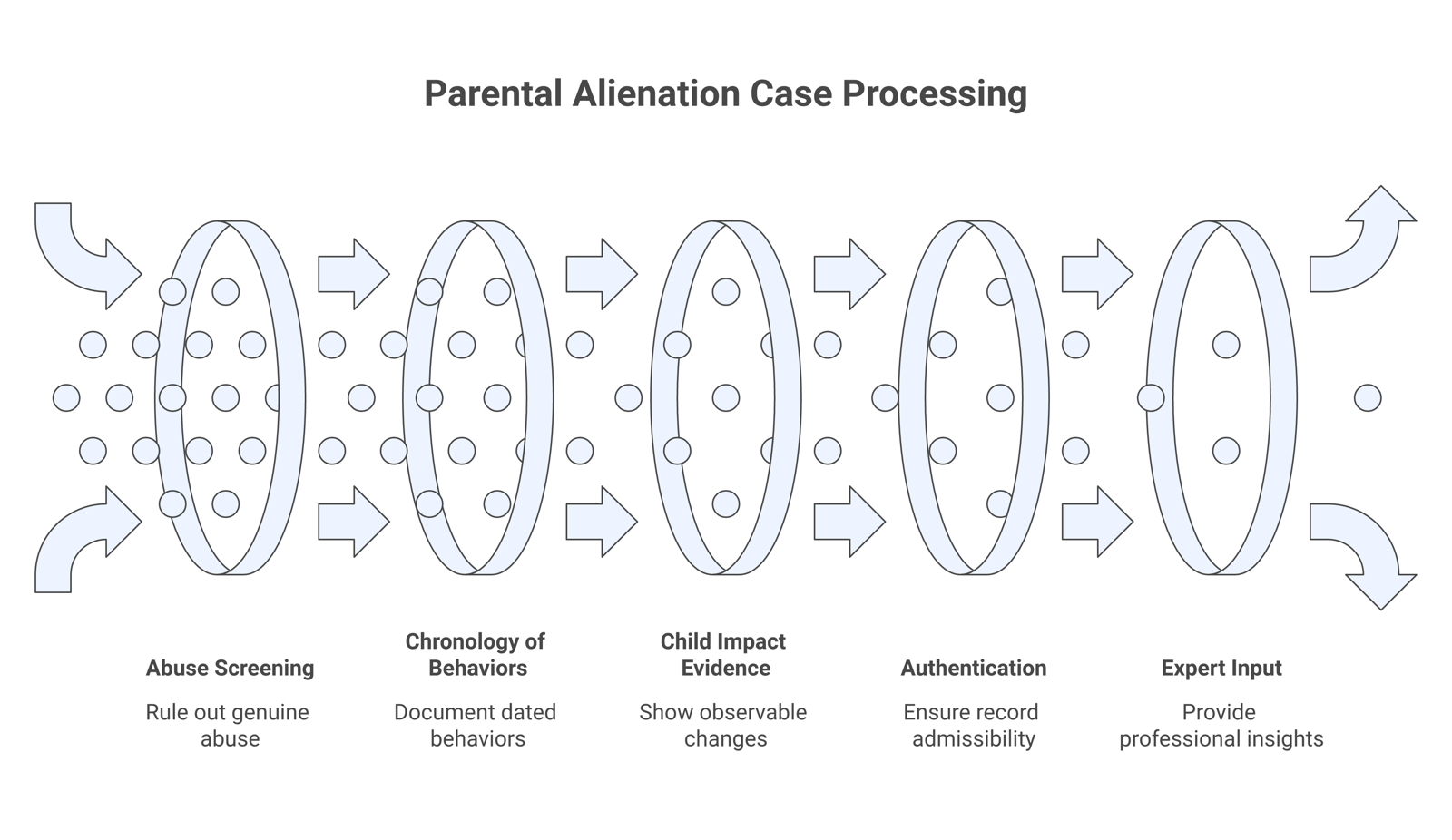
Building a parental alienation case file means organizing the documentary record around documented behaviors and their impact on the child, arranged on a dated chronology, with genuine abuse screened out first. The file reads as a child-welfare account, not a grievance or a weapon. Authentication and expert input slot into that structure.
General professional education, not legal advice. This page is educational information for licensed family-law attorneys and for informed parents working with counsel. It does not create an attorney-client relationship, and it does not address any one state’s law or rules. Procedure varies materially by jurisdiction, so counsel must verify the relevant law before acting.
Screen for abuse first
A child’s rejection of a parent is not always alienation. Where the rejected parent has been abusive, neglectful, or genuinely dangerous, the child’s distancing is justifiable estrangement, not parental alienation, and it is a different legal and safety matter. A case file must never bury a child’s justified rejection or a protective parent’s legitimate concerns. Where bona fide abuse is present, the priority is reporting and child protection.
What a parental alienation case file is
A parental alienation case file is the organized documentary record of a contested-contact case, structured so a court can read it quickly and weigh it fairly. It is the file, not the litigation strategy. The strategy is how the record gets presented in the courtroom, and that work sits on a separate page. This page covers the assembly: how the raw stack of texts, emails, school records, and parenting-app exports becomes a structured account of what happened and what it did to the child.
Parental alienation remains a contested construct. Some scholars and courts treat it as a studied phenomenon; others warn that the label is used to discredit protective parents. A well-built file does not rely on the reader accepting the label. It records behaviors and their effects, then lets the facts carry the weight. As attorney Ashish Joshi and Judge Jon Van Allsburg put it, “labels don’t give us any basis on which to make a ruling. It’s the facts that give us that ability.”
The For Professionals hub at /for-professionals/ collects the related attorney material, and the courtroom-presentation companion to this page sits at litigating parental alienation.
Screen for abuse before you build anything
The first step in building any alienation file is the one most likely to be skipped. Before counsel assembles a single tab, the threshold question is whether the child’s distancing reflects genuine abuse or neglect by the rejected parent. If it does, there is no alienation file to build, because justified rejection is a different matter with a different priority, which is child safety.
This gate is not a formality. It is the central ethical and professional-responsibility caution of the whole exercise. Research by Joan Meier and colleagues, in the National Institute of Justice Family Court Outcomes Study, found that when abuse and alienation were cross-claimed, a parent’s alienation cross-claim was associated with a sharply higher chance that the abuse-alleging parent lost custody. In the study, fathers’ cross-claims of alienation roughly doubled mothers’ risk of losing custody. Critics of the construct read that finding as evidence the label can bury a protective parent’s case, while proponents note the sample skews toward published appellate opinions. Either way, the practical lesson holds: an alienation file assembled on top of an unexamined abuse allegation is a danger, not a strategy.
So the screen comes first. Counsel reviews any abuse disclosures, protective-order history, and child-protection findings on their own terms before deciding whether an alienation theory fits the facts. Where the screen surfaces a credible safety concern, the file is not an alienation file. Where the screen rules out bona fide abuse, the documented behaviors can be organized as below. The boundary stays visible in the file itself, so no later reader can mistake a screened case for an unscreened one.
Organize around behaviors, not the label
Once abuse is screened out, the organizing principle of the file is simple to state and easy to violate: record behaviors, not labels. A file that opens with “the mother is a narcissist” or “this is parental alienation syndrome” asks the court to accept a conclusion. A file that opens with a dated list of denied exchanges, recorded disparagement, and blocked contact gives the court facts it can evaluate.
The Joshi and Van Allsburg “behaviors not labels” standard captures the point. A court can act on a documented pattern of conduct without an expert pinning a syndrome on a parent. “Labels divide, stories unite.” Counsel who arrive with clinical labels and no fact pattern tend to lose ground. Counsel who arrive with a documented behavior pattern, organized and sourced, give the court something to rule on.
This is also where a file protects its own credibility. Each behavior in the file is a discrete, attributable fact: a specific message in the favored parent’s own words, a specific missed handoff, a specific instance of a child being told the other parent does not love them. The file names the behavior and points to the record that documents it. It does not editorialize, and it does not stack adjectives. A behavior-first file is harder to attack precisely because it asks the court to read the conduct rather than trust the author.
Build the chronology of documented behaviors
The spine of the file is a chronology: a dated timeline of documented incidents that a court can follow from start to finish. A chronology turns a scattered record into a sequence, and a sequence is what shows a pattern. One denied exchange is an incident. Forty denied exchanges across eighteen months, each dated and sourced, is a pattern the court can see at a glance.
What each entry records
Each chronology entry is short and disciplined. It records the date and, where it matters, the time. It states what happened in neutral terms. It names any witness. It points to the underlying record that documents it, which might be a parenting-app log, a text thread, an email, a school attendance record, or a calendar export. The entry does not argue. It logs. The argument, if any, belongs to the litigation stage, not to the file.
Contemporaneous entries beat reconstructed ones. A chronology kept as events occur carries more weight than one assembled in the weeks before a hearing, and it reads as more reliable because it is more reliable. Counsel working with a parent should encourage the client to log as they go, in a structured place, which also reduces the impulse to vent in forums that later become cross-examination material.
Categories the chronology tracks
A working chronology usually tracks a handful of recurring behavior categories. Denied or sabotaged exchanges, including late, missed, or obstructed handoffs. Interference with contact, such as blocked calls, ignored messages, or schedule changes made without notice. Disparagement, meaning statements that run down the other parent to or in front of the child. Information withholding, such as a single parent’s name appearing on every school or medical contact form across multiple years. The categories are not a scorecard, and the file does not need every category to be present. It needs the ones that actually occurred, each entry dated and sourced.
The parent-facing companions to this work explain the same discipline for self-represented readers at how to prove parental alienation and how to document parental alienation. The evidence framework section below organizes the evidentiary categories that fill these entries by factor and by evidence strength.
Document the impact on the child
A chronology of behaviors shows what one parent did. A complete file also shows what those behaviors did to the child, because the case is ultimately about the child’s welfare, not the parents’ conflict. Impact evidence is its own layer of the file, distinct from the behavior log.
Impact evidence is concrete and observable, never a diagnosis the file invents. It can include a documented change in the child’s contact pattern over time, school or counseling records noting a shift in the child’s functioning, or third-party observations of the child’s demeanor with each parent. The point is to connect the documented behaviors to a documented change in the child, on the same chronology, so the court can see the relationship rather than be told to assume it. Where the file cannot show impact, it says so plainly. An honest file does not overclaim, and an overclaimed impact section is an easy target on cross-examination.
The three goals as an organizing logic
Joshi’s three-goal courtroom framework offers a useful skeleton for arranging the file, used here as an organizing logic rather than a courtroom script. The framework names three things a contested-contact case eventually has to address: that the phenomenon is real and studied, that specific behaviors occurred in this case, and that the child needs proper and timely intervention. The full courtroom treatment of these goals lives on the litigation page and in the discussion of how courts handle parental alienation; the point here is narrower.
As a file structure, the three goals map onto three bodies of material. The first goal corresponds to the background authorities and any expert input that establish the phenomenon is studied, kept in a foundation section. The second goal corresponds to the chronology and the behavior records, which is the bulk of the file. The third goal corresponds to the impact evidence and any intervention history, oriented to the child’s needs. Arranging the file this way keeps the material in the order a court will reason through it. The American Bar Association’s Section of Family Law publishes general practitioner resources on building and presenting family-law records.
A caution travels with this structure. The framework is a way to organize an honest record, not a template to be filled regardless of the facts. Where the screen surfaced a safety concern, or where the behaviors do not actually appear, the file does not manufacture them to complete the skeleton. An empty section is more honest than a padded one.
The evidence framework: factors, ladder, and binder tabs
The chronology and the impact evidence still need an organizing grammar that an expert, a judge, or a rebuttal reviewer can follow. The working frame in current practice has three layers: an identification model that names what each piece of evidence is for, an evidence-strength ladder that ranks how well each claim is supported, and a binder structure that files everything by the criterion it supports.
The Five-Factor Model as the litigator’s frame
Joshi’s Litigating Parental Alienation: Evaluating and Presenting an Effective Case in Court (American Bar Association, 2021) organizes a working case around the Five-Factor Model. The model itself is Bernet and Greenhill’s formulation (2022, Journal of the American Academy of Child and Adolescent Psychiatry): it is Baker’s four factors with the child’s contact refusal added as factor one, where factor one establishes that there is a problem to explain and the remaining factors distinguish alienation from justified estrangement. Joshi presents it as the litigator’s frame; he did not author it, and critics such as O’Donohue and Milchman regard it as a premature diagnostic framework, so the file uses it as an organizing structure rather than a diagnosis.
- The child is avoiding, resisting, or refusing the relationship. Both quantitative (missed parenting time, refused contact) and qualitative (a child who appears for parenting time but has emotionally shut down, with no warmth and no engagement).
- There was a prior positive relationship. Photographs with timestamps, third-party affidavits, coaching and school records, parent-teacher conference records. This sets the disproportionality baseline that distinguishes alienation from a relationship that was always strained.
- Absence of bona fide abuse or neglect by the targeted parent. Sub-optimal parenting decisions, strict house rules, and ordinary discipline are not abuse. Where allegations have been made and investigated, the unsubstantiated outcomes (CPS, DCF, police reports) are themselves evidence.
- Evidence of alienating behaviors by the favored parent. Emails, voicemails, witness statements, therapy records, CPS reports, police reports. Four to ten of Baker’s 17 strategies is typical; the case does not need all 17.
- Signs of alienation present in the child. The eight behavioral manifestations (campaign of denigration; weak, frivolous, or absurd reasons; lack of ambivalence; independent-thinker phenomenon; borrowed scenarios; absence of guilt; reflexive support for the favored parent; spread of animosity to extended family).
Baker’s levels-of-evidence ladder
Dr. Amy J. L. Baker’s clinical-legal binder structure includes a five-level evidence-strength ladder that organizes every claim in a case from weakest to strongest:
- The parent’s own assertion (“I believe my ex is badmouthing me”).
- The parent’s direct observation (“I heard them say it”).
- A friend or family member willing to testify they heard or saw it.
- A neutral third party (teacher, coach, doctor) willing to testify.
- A recording, contemporaneous written record, or court-admissible documentary evidence.
The working rule: for every claim, push the evidence as high up the ladder as the case allows. Tape outranks affidavit; affidavit outranks self-report. Where a recording exists and is admissible in the jurisdiction, the recording leads. The ladder is a credibility-ranking grammar that protects a record on appeal as much as at trial.
The binder, tab by tab
A working binder organizes the record by Baker’s four-factor structure, which maps cleanly onto the Five-Factor Model courtroom presentation:
- Tab 1, Prior positive relationship (Baker factor 1). Photographs with timestamps. Third-party affidavits. Coaching and school records. Parent-teacher conference records.
- Tab 2, Absence of bona fide abuse (Baker factor 2). CPS, DCF, and police-investigation outcomes documenting unsubstantiated allegations.
- Tab 3, Alienating behaviors by the favored parent (Baker factor 3). One sub-tab per Baker strategy actually present in the case (most cases have four to ten of the 17). The best evidence available per strategy, at the highest ladder level available.
- Tab 4, Behavioral manifestations in the child (Baker factor 4). One sub-tab per manifestation observed. The best evidence per manifestation.
The working rule: every piece of evidence is filed under the framework criterion it supports, at the highest ladder level available. This is the structure an expert witness or rebuttal expert can review and discuss with continuity. The evidence categories that fill the tabs (behavioral documentation, custody-evaluation reports, expert testimony, contemporaneous messages and recordings, third-party records, and social-media evidence) each carry their own collection discipline: the violation-logging method lives at documenting custody violations, and the authentication, recording-law, and preservation rules live at digital evidence in custody disputes.
Cross-jurisdictional cover and its limits
Cross-jurisdictional permissive cover is itself an evidentiary asset. When the local jurisdiction has no precedent for the requested relief, a binder of cases from other jurisdictions that have ordered similar relief in similar fact patterns is not binding but lowers the perceived radicalism of the request. Demosthenes Lorandos’s published survey of US decisions from 1985 through 2018 (Family Court Review, 2020), which conservatively coded 1,181 cases in which alienation was material, is a canonical starting point; note that it is proponent-authored and counts only cases where the concept was found material, and that critics led by Joan Meier dispute how alienation claims function in court, so the cover should be presented as case law, not as settled science.
The credibility discipline that protects the record
The record’s strength can be undone by the client’s conduct outside it. Joshi documents cases in which the targeted parent’s social-media venting damaged credibility enough to lose the appeal despite the alienation evidence. The rules are simple: do not post about the case on social media, do not publicly attack judges, guardians ad litem, evaluators, or therapists, do not share court filings, and route the venting to a therapist or parenting coach instead. The mechanism is cross-examination: a parent confronted on the stand with their own posts loses the credibility the file was built to earn.
Slot authentication into the file
Every record in the file needs a path to admissibility, and authentication is the gate most records stumble on. Authentication asks whether an item is what the offering party claims it is. The widely adopted reference is Federal Rule of Evidence 901, which most states mirror in substance though the numbering and detail vary, and the Cornell Legal Information Institute publishes the text of Rule 901 as a neutral source.
In file terms, the discipline is to note, for each record, how it will be authenticated. A participant can testify to a message they sent or received. Distinctive characteristics can do the work, such as a phone number, an account handle, or content only the author would know. Co-parenting-app exports carry server-side time stamps that simplify the foundation. Native exports with metadata beat screenshots. The file does not need to brief the full evidentiary argument, because that work and the recording-law cautions live in the companion page on digital evidence in custody disputes. The file simply records, beside each item, the authentication route counsel intends to use, so nothing in the chronology is left without a way into evidence.
The role and limits of experts
Expert input has a place in the file, and it has limits that the file should respect. Dr. Alan Blotcky, a forensic psychologist who has testified in these cases across many states, describes four distinct ways an expert can appear. A court-appointed custody evaluator offers the most comprehensive view but usually requires a court order and significant time and cost. A blind consultant educates the court on general principles without being retained by either parent. A behind-the-scenes consultant trains counsel without testifying. A retained expert reviews the case record and testifies to general principles plus a case-specific narrative.
The most important limit attaches to the retained expert. An expert who has reviewed the timeline, the messages, and the records but has not interviewed the other parent and the children should avoid offering an explicit diagnosis, because the clinical picture is incomplete. As Blotcky frames it, a clear diagnosis should be avoided where one parent and the children have not been interviewed. A file that leans on a diagnosis the expert was not positioned to make invites a credibility attack. A file that uses the expert to explain general principles and to interpret the documented behaviors, while staying inside what the expert actually examined, holds up better.
Expert input is also not always required. Under the behaviors-not-labels standard, a court can act on documented behavior without an expert diagnosing a syndrome, which matters because most contested-contact litigants cannot afford a full evaluation. The file should treat an expert as a way to strengthen a contested record within proper limits, not as a substitute for the documented behaviors themselves.
Keep the file honest
A case file is a persuasive document, and persuasive documents tempt their authors to shade the record. The discipline that protects an alienation file is the same discipline that makes it credible: it stays honest about what the evidence shows and about what it does not.
That honesty has a specific edge here, given the construct’s misuse history. The same file structure that organizes a genuine alienation case can be turned against a protective parent if it is built without the abuse screen, or if it buries a child’s justified rejection under a tidy chronology. The Meier study is the standing reminder that this risk is real and that courts have acted on alienation cross-claims in ways that harmed abuse-alleging parents. A file that screens for abuse first, records behaviors rather than labels, shows impact only where it can, and respects the limits of its own experts is a file built for a child’s welfare. A file that skips those steps is built for advantage, and that is the file this page is written to prevent.
Frequently asked questions
What goes in a parental alienation case file?
A behavior-focused record. It contains a dated chronology of documented behaviors, such as denied exchanges, disparagement, and interference with contact, with a source noted for each entry. It contains evidence of the impact on the child, where that impact can be shown. It contains an authentication route for each record and any expert input, within proper limits. It is built only after genuine abuse and a child’s justified rejection have been screened out.
How do you organize evidence for a parental alienation case?
Around documented behaviors and their impact on the child rather than the label, arranged on a dated chronology so a pattern is visible. Each entry records the date, what happened in neutral terms, any witness, and the underlying record. Authentication is noted beside each item, and the whole file is gated by an abuse screen at the front. Contemporaneous logging beats records reconstructed before a hearing.
What evidence is needed to prove parental alienation?
No single piece. Courts that find alienation do so on a record organized around the Five-Factor Model (contact refusal; prior positive relationship; absence of bona fide abuse; alienating behaviors by the favored parent; signs in the child), with each claim supported by the highest-ladder evidence available, from a recording or contemporaneous record down to the parent’s own assertion. The framework is contested, so the record leans on the documented behaviors rather than on the label.
Do you need an expert to build a parental alienation case file?
Not always. Under the behaviors-not-labels standard, a court can act on documented behavior without an expert diagnosing a syndrome, which matters because many litigants cannot afford a full evaluation. Experts strengthen contested files within limits. A retained expert who has not interviewed the other parent and the children should avoid an explicit diagnosis and stay inside what was actually examined.
How do you screen for abuse before building an alienation file?
Counsel reviews any abuse disclosures, protective-order history, and child-protection findings on their own terms before deciding whether an alienation theory fits the facts. Where a credible safety concern surfaces, the matter is not an alienation file, because justified rejection is a different and higher priority. The misuse history documented by Meier and colleagues is the reason this screen comes first and stays visible in the file.
What is the difference between a case file and a litigation strategy?
The file is the organized documentary record: the chronology, the behavior logs, the impact evidence, the authentication notes, and the expert input. The litigation strategy is how that record is presented to the court, including the courtroom goals and the order of proof. This page covers the file. The courtroom presentation sits on the companion litigation page.
What this page does not do
This page is general professional education, not legal advice. It does not name any one state’s rules of evidence or procedure as if they applied nationally, and it does not tell counsel what to file or when. It does not frame the file as a way to gain advantage over the other parent, and it does not present the construct as settled science. The right use of a case file is the careful, abuse-screened, behavior-focused one, oriented to the child’s welfare.
The evidence framework section above organizes the evidentiary categories that fill the file. For violation logging, see documenting custody violations. For authentication and recording-law detail, see digital evidence in custody disputes. For the court’s analytic posture, see how courts handle parental alienation. For the courtroom presentation, see litigating parental alienation. The full For Professionals hub collects the rest.
Sources and further reading
- American Bar Association, Section of Family Law. americanbar.org/groups/family_law
- Cornell Legal Information Institute. Federal Rules of Evidence, Rule 901 (authentication). law.cornell.edu/rules/fre/rule_901
- Meier, J. S., Dickson, S., O’Sullivan, C., Rosen, L., and Hayes, J. (2020). U.S. child custody outcomes in cases involving parental alienation and abuse allegations. National Institute of Justice, Family Court Outcomes Study. nij.ojp.gov
- Joshi, A. S. (2021). Litigating Parental Alienation: Evaluating and Presenting an Effective Case in Court. American Bar Association. americanbar.org
- Bernet, W., and Greenhill, L. L. (2022). The Five-Factor Model for the diagnosis of parental alienation. Journal of the American Academy of Child and Adolescent Psychiatry, 61(5), 591 to 594. doi.org/10.1016/j.jaac.2021.11.026
- Baker, A. J. L. (2020). Reliability and validity of the four-factor model of parental alienation. Journal of Family Therapy, 42(1), 100 to 118. doi.org/10.1111/1467-6427.12253
- Baker, A. J. L., and Darnall, D. (2006). Behaviors and strategies employed in parental alienation: A survey of parental experiences. Journal of Divorce & Remarriage, 45(1-2), 97 to 124.
- Lorandos, D. (2020). Parental alienation in U.S. courts, 1985 to 2018. Family Court Review, 58(2), 322 to 339.
If you or a child are in crisis
Free and confidential help is available right now.
- 988 Suicide and Crisis Lifeline. Call or text 988. 988lifeline.org
- Childhelp National Child Abuse Hotline. 1-800-422-4453. childhelp.org
- NAMI HelpLine. 1-800-950-6264. nami.org/help
Last reviewed: 2026-06-10. Author: Alex Buckles (PAC Founder).