

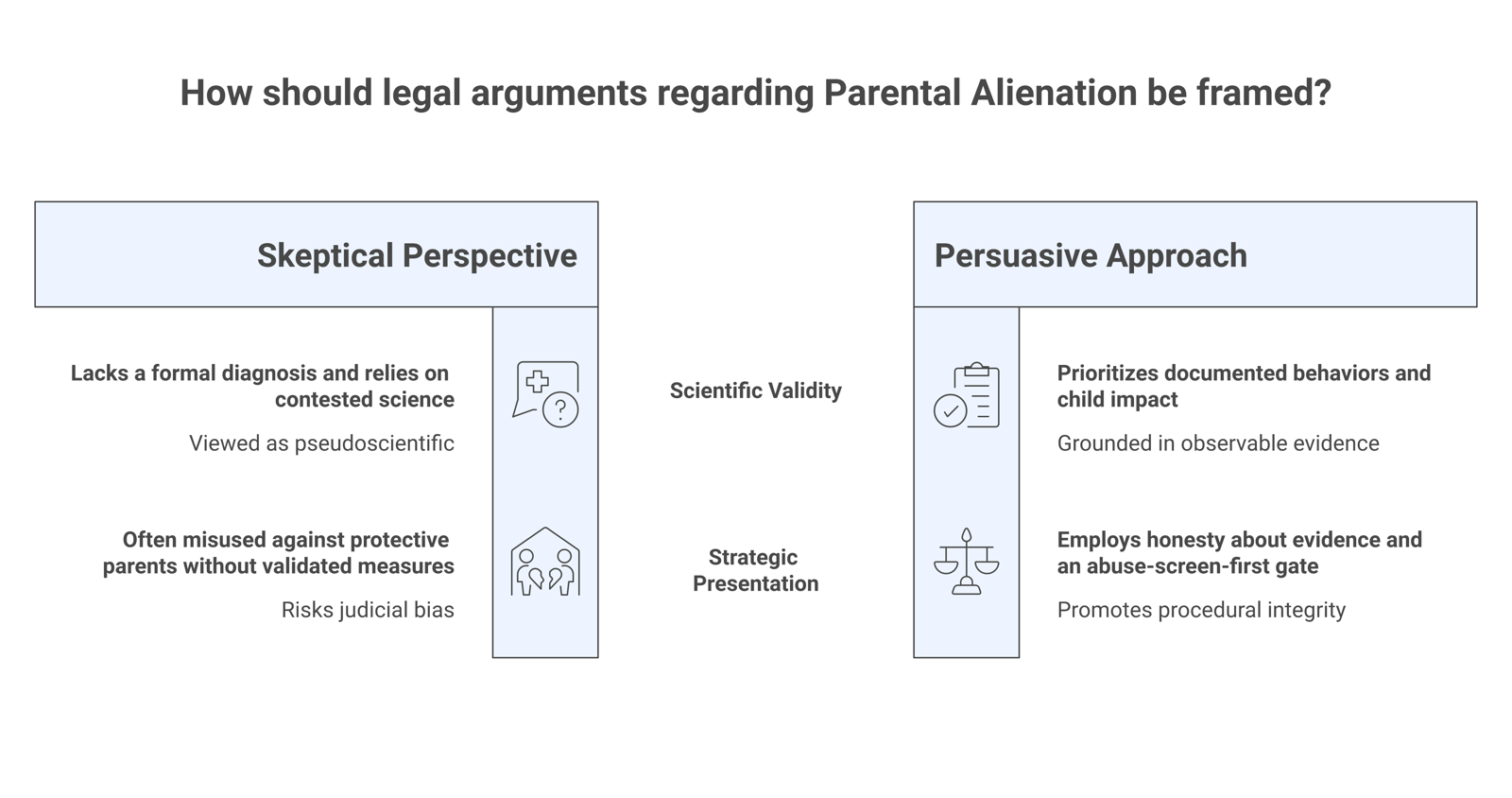
Working with a skeptical court on alienation starts with understanding why the skepticism exists. The construct is contested, has no formal diagnosis, and has sometimes been misused against protective parents. So the effective and ethical approach is not to argue that a contested theory is settled. It is to present documented behaviors and their impact on the child.
A note on safety
A child’s rejection of a parent is not always alienation. If the rejected parent has been abusive, neglectful, or genuinely dangerous, the child’s distancing may be justifiable estrangement, not parental alienation, and it is a different legal and safety matter. Courts are right to screen for abuse first. If a child’s safety is at risk, contact local law enforcement or a domestic-violence resource.
This page is general education, not legal advice. It does not create an attorney-client relationship and does not address any one court’s rules. Anyone in a custody case should work with a licensed family-law attorney in their own area.
The honest answer: drop the label, present the behaviors
A parent who fears the judge or evaluator does not believe in parental alienation often feels the deck is stacked. The instinct is to convince the court that alienation is real and that the other parent is doing it. That instinct usually backfires. The construct is genuinely contested, and a court that hears a parent insist a debated theory is settled tends to trust that parent less, not more.
There is a better path, and it is also the more honest one. Courts act on documented behaviors, not on a label. As one bench-and-bar framework puts it, “labels don’t give us any basis on which to make a ruling. It’s the facts that give us that ability.” The two leading family-court organizations advise that there should be no immediate label for a child’s contact problems, because several factors can explain them. So the move that works with a skeptical court is the same move that is ethically sound: describe the specific conduct you witnessed and its effect on your child, and let the court decide what to call it.
Why skepticism exists, and why some of it is warranted
It helps to treat the skepticism as information, not as an enemy. Courts and clinicians are cautious for reasons that deserve a fair hearing, and a parent who understands those reasons can respond to them honestly rather than fighting them.
There is no formal diagnosis
Parental alienation does not appear as a diagnosis in the standard diagnostic manuals used by clinicians. A large survey of family-court professionals found that practitioners often over-believe how settled the science is. Many wrongly assumed that long-term outcome studies exist, when in fact no validated measure of alienation has been established. A judge who knows this is not being unreasonable by treating the label with caution. The sibling page on how judges view parental alienation covers that judicial posture in more depth.
The misuse against protective parents
There is a serious, well-documented concern that alienation claims have been used to discredit genuine abuse allegations. In a national study of US custody outcomes, researcher Joan Meier and colleagues found that when a father cross-claimed alienation, courts became far less likely to credit a mother’s abuse allegation, and her risk of losing custody roughly doubled. The study has its critics, and its authors agree it cannot prove any single ruling was wrong. Its core finding still matters: the alienation label can be turned against a protective parent. A court that has seen this happen has good reason to be careful. You can read the Meier study at the National Institute of Justice.
The critical scholarship
A body of scholarship is openly critical of parental alienation in custody litigation. Psychologist Jean Mercer, who has reviewed the reunification treatments often paired with alienation findings, argues that those treatments have not been shown to be safe or effective and that the principles should be approached with caution in family courts. A United Nations special rapporteur has gone further, calling parental alienation a “pseudo-concept,” though that report is one appointed expert’s thematic statement rather than a binding position, and it is itself contested. Whether or not a reader agrees with these critics, their existence is part of why a court may be wary. The question of whether the field is sound is taken up in is parental alienation junk science and in is parental alienation admissible in court.
Focus on behaviors and the child’s welfare
Once a parent stops trying to win an argument about a theory, the path forward becomes clearer. Courts respond to facts about conduct and facts about the child. So the work is to document specific behaviors and show their effect.
Specific is the operative word. “On these dates, scheduled calls did not connect.” “These exchanges did not happen, and here is the record.” “My child, who used to love this activity, began refusing it, and said this.” Scholars who study these cases warn against a simple single-factor story in which one parent is blamed for everything, because a child’s resistance can have several causes and a one-sided account risks a false conclusion. Presenting documented behaviors, alongside an honest acknowledgment of other factors, is both more credible and more accurate. The American Bar Association’s Section of Family Law publishes general consumer information on how courts weigh evidence in custody matters, and the documentation work itself is covered in how to prove parental alienation and in the paired page on preparing to testify in a parental alienation case.
Keep the child’s welfare, not the dispute with the other parent, at the center. A skeptical court is far more receptive to a parent who is plainly focused on the child than to one who seems focused on winning.
Be honest about what the evidence does and does not show
Credibility with a cautious court is built by candor, not by overclaiming. If the evidence shows a pattern of blocked contact, say that, and show it. If it does not yet show an effect on the child, do not pretend it does. If another explanation is possible, acknowledge it and explain why the documented behaviors still concern you.
This honesty is not a tactical pose. It reflects the actual state of the field. Even sympathetic researchers concede there are no long-term outcome studies and no validated test for alienation. A parent who treats the construct as proven is overstating what anyone can show, and a knowledgeable court will notice. A parent who sticks to documented facts, and is honest about their limits, gives the court something solid to stand on.
The court may simply weigh the facts differently
It is worth naming a hard possibility. A court can hear the same facts and reach a different conclusion than a parent hoped. That is not always bias, and it is not always skepticism about alienation. Family courts weigh many factors, and reasonable judges can disagree about what a record shows and what serves a child.
Accepting this does two things. It protects a parent from the trap of assuming any unfavorable ruling proves the system is rigged. And it keeps the focus where it belongs, on presenting the clearest, most honest record possible, rather than on reading the judge’s mind. A parent cannot control the outcome. A parent can control whether the court receives an honest, specific, child-centered account.
What not to do
- Do not try to get around the judge or manipulate the process. Courts notice, and it destroys credibility.
- Do not insist that parental alienation is settled science. It is not, and the claim invites pushback.
- Do not lead with the label. Lead with behaviors and child impact.
- Do not dismiss the abuse question. A court that suspects you are using alienation to deflect a safety concern will not trust you.
- Do not treat skepticism as proof of bias. Some caution is warranted, and meeting it with honesty works better than meeting it with grievance.
The through-line is simple. The goal is not to defeat a skeptical court. The goal is to give it honest, documented facts about your child.
Frequently asked questions
Why are some judges skeptical of parental alienation?
Because the construct is contested. It has no diagnosis in the standard manuals, no validated measure, and a documented history of being used to discredit abuse allegations against protective parents. National research and critical scholarship have raised real concerns. A judge who treats the label with caution is often responding to that record, not being unfair.
What do you do if the judge does not believe in parental alienation?
Drop the label and present documented behaviors and their effect on your child. Courts act on facts, not on a contested term. Describe the specific conduct you witnessed, show its impact, keep the child’s welfare at the center, and let the court decide what to call it. Do not try to argue that a debated theory is settled.
Is parental alienation taken seriously in court?
It varies by court and by the facts. Courts generally act on documented behaviors and the child’s welfare, and they screen for abuse first. A well-documented pattern of conduct and its effect on a child can be taken seriously even when the label itself is treated with caution.
Is parental alienation junk science?
It is contested rather than settled. Some scholars and bodies are sharply critical, and there is no formal diagnosis or validated measure. At the same time, most family-court professionals reject the blanket “junk science” framing and agree that alienating behaviors can occur. The honest description is a debated construct, not a proven one and not a fraud.
Can you change a skeptical judge’s mind about parental alienation?
The aim is not to win an argument about a theory. It is to present honest, documented facts the court can act on. A parent influences a court by being credible, specific, and child-focused, not by persuading it that a contested construct is proven or by trying to get around its caution.
What this page does not do
This page is not legal advice, and it does not coach anyone to manipulate or get around a court. It does not treat parental alienation as settled science, and it does not frame a skeptical judge as an enemy. It acknowledges that some skepticism is warranted. The approach it teaches is honest, documented, child-focused presentation, which serves both the child and the integrity of the process.
For the paired guidance on testimony, see preparing to testify in a parental alienation case. For how courts view the construct, see how do judges view parental alienation and is parental alienation admissible in court. For the science debate, see is parental alienation junk science. For documentation, see how to prove parental alienation. The full Court silo covers the rest.
Sources and further reading
- Meier, J. S., Dickson, S., O’Sullivan, C., Rosen, L., & Hayes, J. (2020). U.S. child custody outcomes in cases involving parental alienation and abuse allegations. National Institute of Justice. nij.ojp.gov
- American Bar Association, Section of Family Law. americanbar.org/groups/family_law
- American Psychological Association. Divorce and child custody. apa.org/topics/divorce-child-custody
If you or your child are in crisis
Free and confidential help is available right now.
- 988 Suicide and Crisis Lifeline. Call or text 988. 988lifeline.org
- Childhelp National Child Abuse Hotline. 1-800-422-4453. childhelp.org
- NAMI HelpLine. 1-800-950-6264. nami.org/help
Last reviewed: 2026-06-07. Author: Parental Alienation Center (Organization). Editorial review: held to the PAC Editorial Standards (balance, primary-source citation, reader safety); an independent expert review board will be appointed.