

What judges look for in custody cases is the best interests of the child. Courts weigh recurring factors: stability and continuity, each parent’s caregiving role and capacity, the child’s developmental needs, each parent’s willingness to support the bond with the other parent, any history of family violence, and the child’s age-weighted preference.
A note on safety
A child’s distance from a parent is not always alienation. If a parent has been abusive, neglectful, or genuinely dangerous, a child’s distancing is justifiable estrangement, not parental alienation, and reporting that abuse in good faith is protective, not unfriendly. The willingness-to-co-parent factor must never punish a parent who acts to keep a child safe. If a child’s safety is at risk, contact local law enforcement or a domestic-violence resource first.
This page is general US-national education. It is not legal advice, does not create an attorney-client relationship, and does not address any one state’s law. State best-interests factors vary. Anyone facing a custody decision should consult a licensed family-law attorney in their own jurisdiction.
The short answer: the best interests of the child
The governing standard in US custody decisions is the best interests of the child. The court decides based on the child’s welfare, not on the wishes or the convenience of either parent. The Cornell Legal Information Institute keeps a general reference on the standard and how it is applied.
Each state writes its own list of factors, so the exact wording varies. The themes, though, repeat across the country. A judge is trying to picture which arrangement gives this child the safest, steadiest, most loving path forward. Courts also tend to act on documented behavior rather than on labels, a posture covered in depth on how judges view parental alienation. The sections below walk through the factors that recur most often.
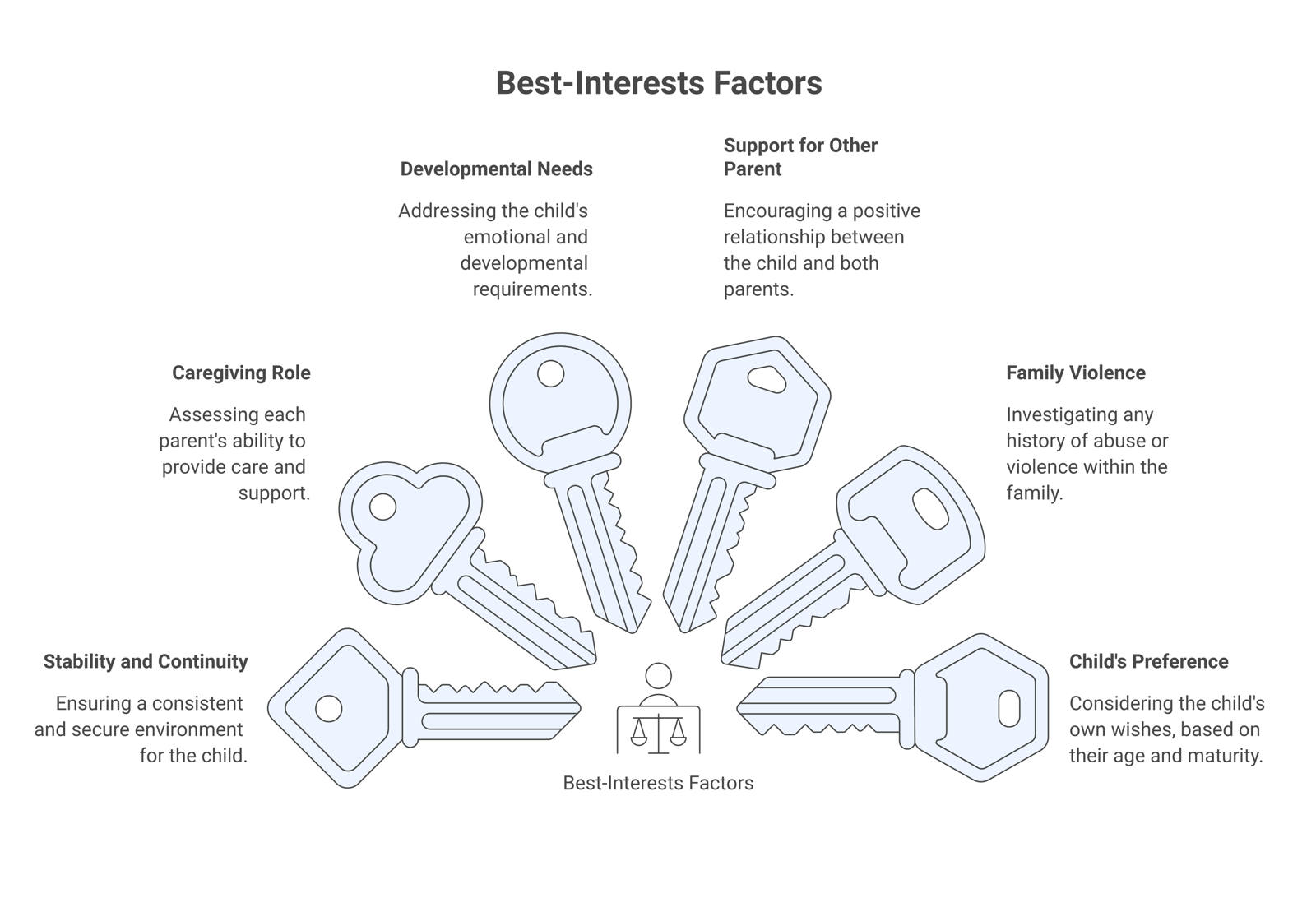
Stability and continuity
Stability is one of the first things a court considers. Children do better with predictable routines, a settled home, a consistent school, and steady relationships with siblings, friends, and extended family. So a judge often asks which arrangement keeps the most of that intact.
This factor is not a reward for the parent with the bigger house. It is about continuity for the child. A parent who has provided a stable base, kept the child in the same school, and protected daily routines is showing the court something the child needs. Sometimes stability points toward keeping things as they are. Other times a current setup is not stable at all, and change is what protects the child. The court looks at the child’s actual experience, not at appearances.
Each parent’s caregiving role and capacity
Courts look closely at who has been doing the caregiving and who can meet the child’s needs going forward. This includes the everyday work: feeding, bedtimes, doctor visits, homework, comfort after a hard day. It also includes capacity, meaning each parent’s ability and willingness to keep doing that work.
Judges are not grading parents against an ideal. They are asking a practical question about who can give this child responsive, reliable care. A parent’s work schedule, health, and support network all factor in, but none of them decides the case alone. A parent who has been the primary caregiver does not automatically keep that role, and a parent who worked long hours is not written off. The court weighs the full picture of caregiving, then looks forward.
The child’s developmental and emotional needs
Every child has needs that shift with age. A toddler needs consistency and secure attachment. A school-age child needs academic support and stable friendships. A teenager needs autonomy balanced with structure. Courts try to match the arrangement to the child in front of them, not to a generic child.
Special needs raise the stakes here. If a child has a medical condition, a learning difference, or a mental-health diagnosis, the court asks which parent understands those needs and can meet them. The American Psychological Association’s guidance on divorce and child custody underscores how much a child’s adjustment depends on the quality of care and the level of conflict around them. Because of that, a parent who can keep conflict low and care high is meeting a real developmental need.
Willingness to support the other relationship (the friendly parent factor)
Many states ask whether each parent supports the child’s relationship with the other parent. This is sometimes called the friendly parent factor, and it is where custody law and parental alienation meet. The logic is simple: a child generally benefits from a healthy bond with both fit parents, so a parent who actively undermines that bond is working against the child’s interests.
Undermining can look like badmouthing the other parent, blocking calls and visits, or pressuring a child to choose sides. Researcher Jennifer Harman and colleagues, writing in the journal Psychological Bulletin, argue that these behaviors map onto recognized patterns of coercive control and amount to a form of family violence. When a court sees a documented pattern of that conduct, it weighs against the parent doing it. Litigators who handle these cases stress that the court acts on the documented behaviors and the child’s response, not on the word “alienation” alone. For how courts treat the alienation question specifically, see how judges view parental alienation, and for the broader custody context, see parental alienation and child custody. The kind of record that supports this factor is covered in how to document parental alienation and in can text messages prove parental alienation.
The crucial balance: protecting a protective parent
The friendly parent factor carries a real risk, and courts know it. The same factor that flags a parent who poisons a child’s bond can be turned, unfairly, against a parent who reports genuine abuse. A protective parent who limits contact to keep a child safe is not being “unfriendly.” That parent is doing exactly what a child needs.
Research on how this plays out in court is contested, and the honest version names both sides. Joan Meier’s 2020 national study of published custody opinions found that a father’s alienation cross-claim roughly doubled the rate at which mothers alleging abuse lost custody, while proponent researchers led by Jennifer Harman and Demosthenes Lorandos dispute her methods and report case datasets in which courts did not take children from protective parents and place them with abusive ones. The methodological exchange between the two camps remains unresolved. Psychologist Joshua Coleman’s taxonomy draws the underlying line: when a parent was actually abusive or neglectful, a child’s distancing is justifiable estrangement, not alienation. Law professor Nicholas Bala, who has trained judges across several countries, notes that most cases are not clean, and that the common judicial response is more time for the rejected parent plus family counseling, not a custody reversal. So the honest reading of this factor is two-sided. Undermining a safe bond cuts against the child. Protecting a child from a dangerous one does not.
Any history of family violence or abuse
Safety comes first. Courts treat any credible history of family violence, child abuse, or neglect as a serious factor, and many states require the judge to weigh it heavily. A substantiated history of abuse can limit or supervise a parent’s time, regardless of other factors.
Allegations are handled with care on both sides. A court tries to sort genuine safety concerns from claims raised for tactical advantage, because both happen. This is one reason documentation and professional evaluation matter so much. A parent who raises a good-faith safety concern is not penalized for it. At the same time, a court does not act on an accusation alone; it looks for evidence. The aim throughout is the child’s protection, not point-scoring between adults.
The child’s own preference
Older children and teenagers often have a say, but it is one factor among many, not the deciding vote. Courts weigh a child’s preference by age and maturity. A thoughtful sixteen-year-old’s reasoned wish carries more weight than a six-year-old’s mood on a given day.
Judges also ask where the preference came from. A genuine, freely formed preference is meaningful. A preference that looks coached, rehearsed, or pressured is treated differently, because the court is protecting the child’s interests, not rubber-stamping an adult’s influence. This is another place where documented behavior matters more than labels. A court is far more persuaded by a clear record of what happened than by either parent’s characterization of the child’s wishes.
How judges weigh it all
No single factor decides a custody case. A judge holds all of them together and asks what arrangement serves this particular child. A strong showing on stability does not cancel a serious safety concern, and one weak area does not sink an otherwise fit parent.
Two themes run through the whole analysis. First, courts act on documented behavior rather than on labels, so a clear record tends to matter more than strong adjectives. Second, these decisions are made case by case on the evidence presented, which is why specialists who work in this field generally argue for trusting judges to weigh real facts rather than applying rigid rules. For readers preparing for the assessment a court may order, see preparing for a custody evaluation, and the full Court silo maps the rest of the legal landscape.
Frequently asked questions
What do judges look for in custody cases?
Judges look for the best interests of the child. In practice that means a recurring set of factors: stability and continuity, each parent’s caregiving role and capacity, the child’s developmental and emotional needs, each parent’s willingness to support the child’s bond with the other parent, any history of family violence or abuse, and the child’s own preference weighed by age and maturity. No single factor controls, and the exact list varies by state.
What is the best interests of the child standard?
It is the governing legal test in US custody decisions. The standard directs the court to decide based on the child’s welfare rather than on the wishes or convenience of either parent. Each state defines its own specific factors, but the themes of safety, stability, caregiving, and the child’s needs repeat across jurisdictions.
Does the friendly parent factor hurt a parent who reports abuse?
It should not. The willingness factor asks whether a parent supports a safe and loving relationship with the other parent. Reporting genuine abuse in good faith is protective, not unfriendly. Whether courts always get this right is contested: critics report that alienation cross-claims raise the odds an abuse-alleging parent loses custody, while proponent researchers dispute those findings, and the exchange is unresolved. A child’s distancing from a truly abusive parent is justifiable estrangement, not alienation.
How much does a child’s preference matter in custody?
A child’s preference is one factor among several, weighed by the child’s age and maturity, and it does not control the outcome. Courts give more weight to an older, more mature child’s reasoned wishes. A judge also asks whether the preference is the child’s own or the product of pressure from a parent.
What makes a parent look unfavorable in a custody case?
Courts act on documented behaviors, not on labels or insults. Patterns that undermine a child’s safety, stability, or relationship with a safe parent weigh against a parent. Good-faith protective action, such as reporting genuine abuse, does not. A clear, factual record matters far more than how either parent describes the other.
What this page does not do
This page is not legal advice, and it does not name any one state’s factors as if they applied nationally. It does not tell readers how to present to a judge or how to “win” anything. Custody decisions belong to a court, working from the real facts, with a licensed attorney’s help. The page also refuses to treat a parent’s good-faith safety concern as a tactical risk. Protecting a child is never the wrong move.
For the alienation-specific question, see how judges view parental alienation. For the custody context, see parental alienation and child custody. For the assessment a court may order, see preparing for a custody evaluation. For building a clear record, see how to document parental alienation and can text messages prove parental alienation. The full Court silo covers the rest.
Sources and further reading
- Cornell Legal Information Institute (Wex). Best interests of the child. law.cornell.edu/wex/best_interests_of_the_child
- American Psychological Association. Divorce and child custody. apa.org/topics/divorce-child-custody
- Association of Family and Conciliation Courts (AFCC). afccnet.org
- Harman, J. J., Kruk, E., & Hines, D. A. (2018). Parental alienating behaviors: An unacknowledged form of family violence. Psychological Bulletin, 144(12), 1275 to 1299. https://doi.org/10.1037/bul0000175
- Meier, J. S., Dickson, S., O’Sullivan, C., Rosen, L., & Hayes, J. (2020). U.S. child custody outcomes in cases involving parental alienation and abuse allegations: What do the data show? Journal of Social Welfare and Family Law, 42(1), 92 to 105.
If you or your child are in crisis
Free and confidential help is available right now.
- 988 Suicide and Crisis Lifeline. Call or text 988. 988lifeline.org
- Childhelp National Child Abuse Hotline. 1-800-422-4453. childhelp.org
- NAMI HelpLine. 1-800-950-6264. nami.org/help
Last reviewed: 2026-06-07. Author: Alex Buckles (PAC Founder).