

A parenting coordinator, or PC, is a professional appointed to help high-conflict parents carry out their parenting plan after a custody order, resolving day-to-day disputes quickly. The role is guided by professional standards such as the AFCC’s 2019 guidelines. A PC can reduce friction and document patterns, but a PC is not a therapist and cannot fix severe alienation alone.
A caveat before anything else
Parenting coordination assumes two parents who can be helped to follow a plan. Where one parent is unsafe, where there is ongoing domestic violence or coercive control, or where a child’s rejection of a parent is a justified response to abuse, a dispute-resolution process is not the answer and can make things worse. Professional guidelines require screening for intimate partner violence before and during parenting coordination for exactly that reason. If you or a child are in danger, contact local law enforcement or a domestic-violence resource first.
This page is general US-national education. It is not legal advice, it does not create an attorney-client relationship, and it does not address any one state’s statutes or court rules on parenting coordination, which vary widely, including whether and what a PC can decide. Anyone considering or living under a PC appointment should consult a licensed family-law attorney in their own state.
The short answer
A parenting coordinator works after the custody order, in the space where most high-conflict damage actually happens: the weekly friction over exchanges, schedules, holidays, communication, and interpretation of an order that was supposed to settle everything. Instead of returning to court for every dispute, the parents bring it to the PC, who tries to resolve it quickly through education and agreement, and, where the law and the appointment allow, decides small issues within defined limits.
In alienation dynamics, that speed matters. Interference patterns thrive on delay: a missed weekend disputed for three months in court is a weekend lost and a precedent set. A PC can address it the same week, and a PC’s records can make a long pattern visible to the court later. But the limits matter just as much, and this page covers both.
What a parenting coordinator is
The Association of Family and Conciliation Courts, the leading interdisciplinary professional body in this space, describes parenting coordination as a child-focused dispute-resolution process for parents with enduring high conflict, combining assessment, education, case management, conflict management, and, where authorized, limited decision-making. The AFCC’s Guidelines for Parenting Coordination, revised by an interdisciplinary task force in 2019, set out recommended qualifications, training, ethical obligations, and practices; the AFCC also publishes a plain-language overview of the parenting coordination process for families. The American Psychological Association has likewise adopted professional-practice guidelines for psychologists who serve in the role.
PCs are typically experienced family-law attorneys or mental-health professionals with additional training in family dynamics, high-conflict personalities, domestic-violence screening, and dispute resolution. Authority varies enormously by jurisdiction: some states have parenting-coordination statutes or court rules defining the role and its decision-making limits; in others the role exists by court order or by the parents’ agreement, with whatever authority that order or agreement grants. Decisions a PC is empowered to make are usually small and implementation-level, often subject to court review, and a PC can never change custody.
PC versus GAL, mediator, and evaluator
Families meet a confusing cast of court-adjacent professionals, and the roles are genuinely different.
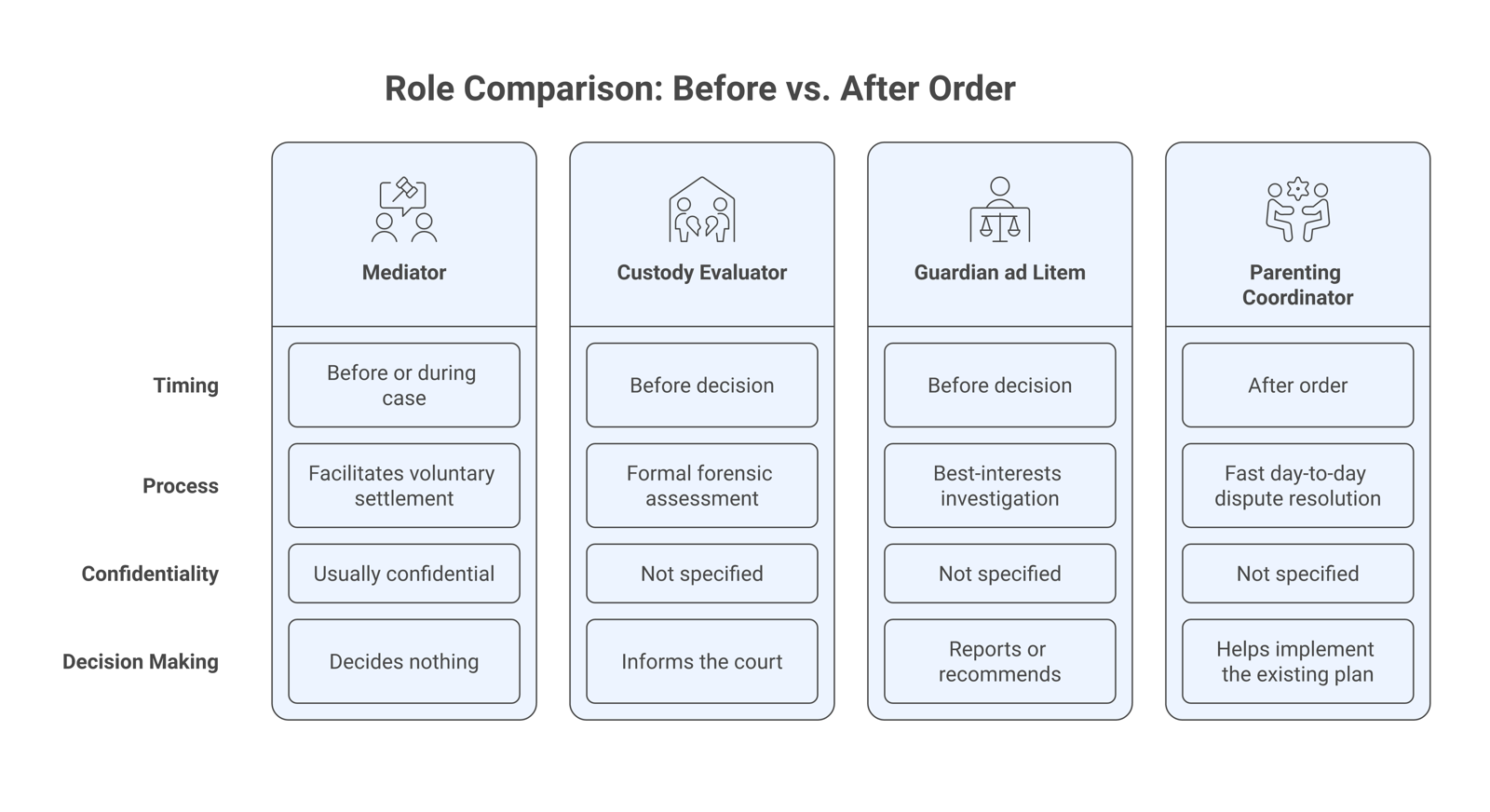
A guardian ad litem investigates a child’s best interests before a decision and reports to the court; the GAL looks backward and inward to inform the ruling. That role is covered in guardian ad litem in parental alienation cases. A custody evaluator performs a formal forensic assessment, also to inform the decision; see preparing for a custody evaluation. A mediator facilitates voluntary settlement between parents, usually before an order, is typically confidential, and decides nothing; the mediation route is covered in how to prepare for child custody mediation and, for professionals, high-conflict mediation.
The parenting coordinator is the after-the-order role. The PC presumes the parenting plan and helps it function. Unlike mediation, parenting coordination is usually not confidential as to the court, and unlike a mediator a PC may have defined authority to break small deadlocks. Unlike a GAL or evaluator, the PC’s job is not to recommend who should have custody but to keep the existing plan working for the child.
How PCs handle high-conflict and alienation dynamics
In the families PCs serve, conflict is not an episode but an operating system, and a subset of those families involve alienating behaviors: chronic schedule interference, last-minute cancellations framed as the child’s choice, information withheld, exchanges turned into loyalty tests. PC practice in these cases tends to combine several moves.
Structure replaces discretion. The PC tightens ambiguous plan language into rules that leave nothing to argue about: exact times, defined exchange locations, written communication through a monitored channel. Vague orders feed conflict; precise ones starve it. The communication disciplines involved overlap with what best way to communicate with a high-conflict co-parent and parallel parenting versus co-parenting describe.
Speed replaces drift. Because disputes reach the PC in days rather than months, a parent who games the schedule loses the long runway that court delay used to provide. Each incident gets addressed while the facts are fresh.
Documentation replaces dueling narratives. A PC who has watched eighteen months of exchanges develops a grounded, contemporaneous record. If the case returns to court, that record can help the judge see a pattern rather than a swearing contest, which is the perennial challenge described in how to prove parental alienation.
Education replaces blame, where it can. PCs teach disengagement skills, child-centered communication, and the cost of loyalty conflicts. With two parents who are reactive but reachable, that often genuinely helps.
The evidence, and the honest limits
Candor requires saying plainly what parenting coordination is not. The AFCC guidelines are aspirational best-practice standards, not a guarantee that the intervention works; they explicitly do not define mandatory practice. The research base on parenting-coordination outcomes is modest. Studies and program reports suggest PCs can reduce the volume of court filings and help parents resolve day-to-day disputes, but rigorous controlled outcome research, especially on child wellbeing, remains thin. That is a reason for measured expectations, not a reason to dismiss the role.
The sharper limit is severe alienation itself. Parenting coordination is a conflict-management intervention. Where one parent is systematically dismantling the child’s relationship with the other, the problem is not poor communication, and a PC has no power to fix it: a PC cannot change custody, cannot compel a parent to support the child’s other relationship, and cannot do therapy. In those cases the PC’s realistic contributions are containment and a record, while the structural questions go back to the court; see the PA case is not a custody case for why that framing matters. There is also a fairness risk worth naming: a determined high-conflict parent can try to use the PC process itself as a new arena, flooding it with complaints against the other parent. Trained PCs watch for that pattern, and parents should not feed it.
Finally, the domestic-violence boundary is structural, not a footnote. The 2019 AFCC revision gave intimate-partner-violence screening a central place precisely because a private, ongoing dispute-resolution forum can become a venue for continued coercive control. Where serious safety issues exist, parenting coordination may be inappropriate altogether, or require substantial safeguards.
When courts appoint a PC, and working with one productively
Courts typically consider parenting coordination for the small share of families who keep returning to court after the order: repeated enforcement motions, chronic plan violations, communication breakdown that harms the child. Depending on the jurisdiction, appointment may require the parents’ consent, especially where the PC will hold decision-making authority, and orders usually define scope, term, fee allocation, and review rights. PC services are typically paid by the parents, which is a real access limitation, and fee allocation is set in the order.
Working productively with a PC mirrors what works with any neutral. Use the process: raise issues promptly and concisely through the designated channel rather than stockpiling grievances. Follow the protocols even when the other parent does not, because the record being built notices who follows rules. Keep communications brief, factual, and child-focused; write as if a judge will read it, because a judge may. Accept small losses without litigation reflexes, and never use the child as a messenger or recruit the child’s voice for PC disputes. A parent who treats the PC as a referee to be won over, rather than a structure to be used honestly, is repeating the pattern that brought the family there.
Frequently asked questions
What does a parenting coordinator actually do?
A PC helps high-conflict parents implement an existing parenting plan: resolving day-to-day disputes about schedules, exchanges, and communication quickly, educating parents on reducing conflict, monitoring compliance, and, where the law and the appointment order allow, making limited implementation-level decisions subject to court review. A PC cannot change custody.
Is a parenting coordinator the same as a guardian ad litem or mediator?
No. A GAL investigates and reports on a child’s best interests before a decision. A mediator facilitates voluntary, usually confidential settlement and decides nothing. A PC works after the order, usually reports to the court rather than confidentially, and may hold narrow decision-making power over small implementation disputes. A custody evaluator is a fourth, separate forensic role.
Can a parenting coordinator help with parental alienation?
Within limits. A PC can act on interference patterns quickly, tighten loopholes that feed conflict, and build a contemporaneous record that helps a court see the pattern later. But a PC cannot change custody, order therapy, or stop a determined alienating parent. Severe alienation is a structural problem for the court, not a communication problem for a coordinator.
Who pays for a parenting coordinator?
Typically the parents, in shares set by the appointment order or agreement. Cost varies with the professional’s rate and the family’s level of conflict, and affordability is a genuine limitation of the model.
Do we have to agree to a parenting coordinator?
It depends on the jurisdiction. Some states authorize appointment by statute or rule, sometimes requiring consent, particularly where the PC will have decision-making authority; elsewhere the role exists by stipulation or court order. The appointment order defines the scope. This is a question for a licensed attorney in your state.
What this page does not do
This page does not recommend parenting coordination for any particular family, and it does not present the PC as a remedy for severe alienation, because it is not one. It does not coach either parent on using the PC process against the other. The right use of this information is to understand the role’s genuine value, its honest limits, and the questions worth bringing to a licensed attorney before agreeing to or contesting an appointment.
For the adjacent roles, see guardian ad litem in parental alienation cases and preparing for a custody evaluation. For the conflict-management skills a PC will expect, see best way to communicate with a high-conflict co-parent. The full Court silo covers the rest.
Sources and further reading
- Association of Family and Conciliation Courts (2019). Guidelines for Parenting Coordination. AFCC Task Force on Parenting Coordination. afccnet.org
- Association of Family and Conciliation Courts. Understanding the parenting coordination process (family resource). afccnet.org
- American Psychological Association. Guidelines for the practice of parenting coordination. apa.org
- Fidler, B. J., and Bala, N. (2010). Children resisting postseparation contact with a parent: Concepts, controversies, and conundrums. Family Court Review, 48(1), 10 to 47.
If you or your child are in crisis
Free and confidential help is available right now.
- 988 Suicide and Crisis Lifeline. Call or text 988. 988lifeline.org
- Childhelp National Child Abuse Hotline. 1-800-422-4453. childhelp.org
- NAMI HelpLine. 1-800-950-6264. nami.org/help
Last reviewed: 2026-06-10. Author: Alex Buckles (PAC Founder).