

How to deal with a narcissistic ex in family court comes down to conduct: stay calm and factual, document everything, and describe behaviors rather than attaching a diagnosis. Courts decide on the child’s interest and on what each parent actually did, so the composed, child-focused parent tends to be heard most clearly.
A note on safety
High-conflict behavior is not the same as abuse, and recognizing a pattern is not a diagnosis. Where there is genuine abuse, threats, or danger, safety comes first. Raise it honestly with counsel and with the court, and follow any protective steps they advise. A child who pulls away from a parent who was frightening or harmful has a real reason. That is justifiable estrangement, not alienation. If anyone is in danger, contact local law enforcement or a domestic-violence hotline first.
This page is general information, not legal advice. It does not create an attorney-client relationship and does not address any one state’s law. State rules and procedures vary widely. Anyone in a custody dispute should consult a licensed family-law attorney in their own jurisdiction.
How to deal with a narcissistic ex in family court: the short answer
How to deal with a narcissistic ex in family court rests on five steady habits, not on a single dramatic moment. Stay calm and factual. Document everything in a clear, dated record. Describe behaviors rather than labels. Expect provocation, and do not take the bait. Work closely with counsel and any evaluator the court appoints.
One point sits underneath all five. A diagnosis is not the parent’s to make, and a courtroom is not where one gets made. Courts rule on conduct and on the child’s best interest, not on a personality label. A parent who keeps the focus on documented behavior, and who carries themselves with composure, gives the court something it can actually act on.
Why courts rule on conduct, not on the label you attach to your ex
Family courts do not diagnose. A judge weighs each parent’s behavior against the child’s best interest, using the factors their jurisdiction sets out. Litigator Ashish Joshi and Judge Jon Van Allsburg, presenting together for the Parental Alienation Study Group, put it plainly: a court can act on behavior alone, without anyone proving a syndrome or a disorder.
Their guidance is direct. “You don’t need to prove the other parent is a narcissist,” Joshi tells parents. “Talk about the behaviors.” Van Allsburg adds the reason from the bench: “Labels don’t give us any basis on which to make a ruling. It’s the facts that give us that ability.” Parents who arrive armed with a diagnosis but no fact pattern tend to lose ground.
There is a household pattern that many parents recognize behind a high-conflict ex, and naming it privately can help a parent make sense of what they are seeing. A court, though, reads that pattern only through conduct: who did what, when, and how it affected the child. The label stays in the background. The behavior is what gets presented. For how judges weigh these cases, see how judges view parental alienation.
Stay calm and factual: the composure that gets heard
Veteran family-law attorney Robert Hoffman describes a pattern he calls the Four A’s and the Four C’s. Targeted parents often present as Angry, Anxious, Agitated, and Afraid. That reaction is understandable after months of conflict, yet it reads poorly in an evaluation room or on a witness stand. A high-conflict parent, by contrast, often presents as Cool, Calm, Charming, and Convincing.
This can feel deeply unfair. The parent causing harm may come across as the more likable one in a short meeting, while the parent under pressure looks unsteady. Hoffman names the dynamic so parents can prepare for it rather than be ambushed by it. Composure is not about hiding the truth. It is about presenting in a way the court can trust.
Hoffman adds a second caution he calls spontaneous trait transference. When a parent spends their testimony bashing the other side, the listener begins to attribute that negativity to the speaker. The counter-discipline is balance: acknowledge what is working, admit one’s own imperfections, and stay measured. Passion for a child is acceptable and even sympathetic. Anger, defensiveness, and contempt are corrosive. The American Bar Association’s Section of Family Law publishes general consumer information on how the family-court process works.
Document everything, the right way
A calm record is one of the most useful things a parent can build. Save written messages. Note each missed exchange, denied call, or blocked event, with the date and a plain description of what happened. Keep it all in one place, sorted by time. A clear record protects the child’s time and gives counsel and the court something solid to work from.
The tone of the record matters as much as its contents. Notes written in anger read as a grievance. Notes written as plain fact read as evidence. A simple test helps before saving anything: would this entry look calm and child-focused if an evaluator or a judge read it? Documentation done this way supports the behaviors-not-labels approach the court responds to. The mechanics of building that record are covered in how to prove parental alienation.
Present behaviors, not labels
The behaviors-not-labels standard is worth treating as a rule, not a suggestion. Instead of testifying that an ex is a narcissist, a parent describes what the ex did. There were three denied phone calls last month. A school event was hidden. A handoff was canceled an hour beforehand. Each of these is a fact a court can examine and act on. A diagnosis is not.
This approach is both ethical and effective. It is ethical because no parent is qualified to diagnose the other from across a courtroom, and pretending otherwise damages credibility. It is effective because, as Joshi and Van Allsburg stress, behavior is the only thing a court can rule on. Specific conduct paired with the child’s response tells the story far better than any label could.
Expect provocation, and do not take the bait
A high-conflict ex may try to provoke a reaction, because a visible reaction can be used. Ryan Thomas, who was an alienated child for many years before reconnecting with his father, describes how natural emotion gets turned against a targeted parent. A guardian ad litem who sees tears, anger, or frustration may read it back as instability, then record that the parent seemed unstable. The emotion was justified. The reading was not.
Planning for provocation is what keeps it from working. Regulate before a hearing or a meeting, not during it. When a message or a comment is built to bait, a flat and factual response gives nothing to attach a narrative to. The day-to-day toolkit for this, including gray-rock replies, brief written messages, and low-contact communication, lives on the companion page, how to deal with a narcissistic co-parent. That page handles the messaging; this one handles the courtroom.
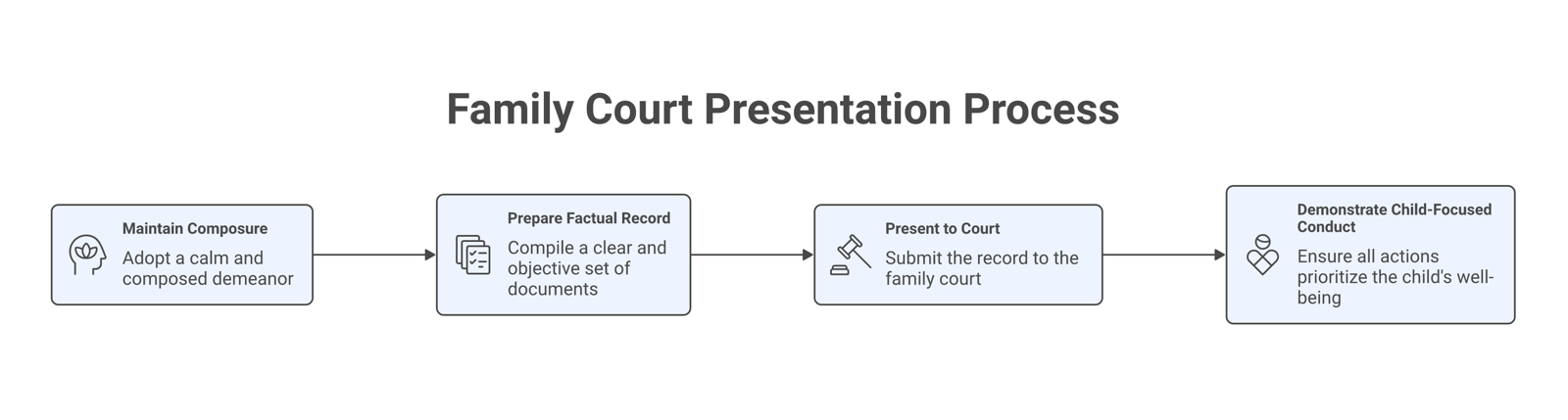
Help the evaluator and guardian ad litem see the facts
Many parents assume that once a guardian ad litem or evaluator interviews everyone, the truth will be obvious. It frequently is not. Ryan Thomas catalogs why a court-appointed professional can miss the pattern: some take a story at face value, some are told the same narrative the child has been told, and some read a parent’s natural emotion as proof of the other side’s account. None of that means the parent is powerless.
What a parent can control is the quality and consistency of what they present. Offer a calm, specific, factual account. Name behaviors rather than diagnoses. Stay regulated in every interaction, so there is nothing for a competing narrative to grab. Preparation matters more than hope, because a parent cannot control a professional’s skill but can control their own clarity. Practical preparation for that process is covered in preparing for a custody evaluation.
How to conduct yourself in family court, step by step
These five steps gather the approach into a sequence a parent can return to before any hearing or meeting.
- Stay calm and factual in every interaction. Treat each exchange, in the building or in writing, as something a judge might later read. Composure is part of the evidence.
- Keep a clear, dated record of behaviors. Log missed exchanges, denied contact, and written messages, in plain language, sorted by date.
- Describe behaviors, not labels. Present specific conduct and the child’s response. Leave any diagnosis out of the courtroom.
- Expect provocation and do not react to it. Regulate before hearings. Answer bait with brief, factual statements that give nothing to use.
- Work closely with counsel and any evaluator. Share the documented facts, follow legal guidance, and let the professionals carry the argument.
When it is abuse, not high conflict
Some conduct goes past high conflict into abuse, threats, or danger. That is no longer a question of presentation. It is a safety matter. Write down the specifics, raise them honestly with counsel and with the court, and follow any protective measures the court can order. Safety for the child and the parent comes before any strategy about composure.
It is also worth naming the other side of this honestly. A child who resists or rejects a parent who was genuinely abusive is protecting themselves, and that is not alienation. Courts and clinicians treat those situations differently, and they should. The American Psychological Association offers general guidance on children, divorce and child custody that underscores keeping a child’s wellbeing at the center.
How this differs from day-to-day coping
This page is about conduct inside the family-court process. Carrying oneself with composure, documenting behavior, and presenting facts are courtroom disciplines. The separate work of surviving daily contact with a high-conflict ex, low-contact communication, business-only messaging, and steady boundaries, is covered on the Help page, how to deal with a narcissistic co-parent. The two fit together. One keeps the peace between hearings; the other keeps a parent credible during them. For the wider set of court topics, see the Court center.
Frequently asked questions
How do you deal with a narcissistic ex in family court?
Focus on conduct. Stay calm and factual, keep a clear and dated record of behaviors, and describe what the other parent did rather than calling them a narcissist. Expect provocation and avoid reacting to it. Work closely with a licensed attorney and any evaluator the court appoints. Courts rule on behavior and the child’s interest, so composed and specific tends to be heard more clearly than emotional and general.
Should you call your ex a narcissist in court?
It usually backfires. A diagnosis is not a parent’s to make, and labels give a court little to act on. As one judge put it, facts give a court the basis for a ruling, not labels. Describe specific behaviors and their effect on the child instead. That approach is both more honest and more persuasive.
How do courts view a narcissistic ex?
Courts do not diagnose. A judge weighs each parent’s documented conduct against the child’s best interest, using the factors set out in their jurisdiction. A pattern of obstructive or harmful behavior can matter a great deal, but it has to be shown through facts, not asserted through a label.
What should you document for family court?
Keep a calm, dated record of behaviors that affect the child: missed or denied parenting time, blocked phone calls, hidden school or medical events, and written messages. Record plain facts rather than opinions, and store everything in one place, sorted by date. A licensed attorney can advise on what is admissible and useful in a specific case.
Will the custody evaluator or guardian ad litem see what the other parent is doing?
Not automatically. A professional may accept a story at face value or read a parent’s natural emotion as instability. A parent improves the odds by presenting a calm, consistent, factual account, naming behaviors rather than diagnoses, and staying regulated in every interaction.
Sources and further reading
- American Bar Association, Section of Family Law. americanbar.org/groups/family_law
- American Psychological Association. Divorce and child custody. apa.org/topics/divorce-child-custody
If you or your child are in crisis
Free and confidential help is available right now.
- 988 Suicide and Crisis Lifeline. Call or text 988. 988lifeline.org
- Childhelp National Child Abuse Hotline. 1-800-422-4453. childhelp.org
- NAMI HelpLine. 1-800-950-6264. nami.org/help
Last reviewed: 2026-06-06. Author: Alex Buckles (PAC Founder).