

Can police enforce parenting time? In most situations, no. Police usually treat a custody or parenting-time order as a civil matter for the family court and will not force a handover. The realistic path is a contempt or enforcement motion. Narrow exceptions exist when a child is in genuine danger or a criminal statute applies.
A note on safety
If a child is in immediate danger, that is not a parenting-time dispute, and safety comes first: call 911. A child’s distancing caused by genuine abuse or neglect is justifiable estrangement, not parental alienation, and it is a different legal and safety matter. This page is about civil enforcement of an existing order, not about a safety emergency.
This page is general US-national education. It is not legal advice, does not create an attorney-client relationship, and does not address any one state’s law. Police practice and custodial-interference statutes vary by jurisdiction. Anyone with a case should consult a licensed family-law attorney in their own state.
The short answer
When a scheduled exchange falls through and one parent will not hand over the child, the first instinct is often to call the police. In most situations, that call will not produce the result the parent hopes for. Officers generally view a custody or parenting-time order as a civil matter, and they usually will not force a transfer of the child based on a family-court order alone.
This is not a loophole or a failure. It reflects how the roles are divided. Family courts write and enforce parenting-time orders. Police respond to crimes and emergencies. A judicial framework from one group of county judges puts the rule plainly: law enforcement has no obligation to enforce civil custody or parenting-time orders, and a parent in that situation should be referred to the family court’s enforcement process rather than to 911.
Why police usually decline to enforce a parenting-time order
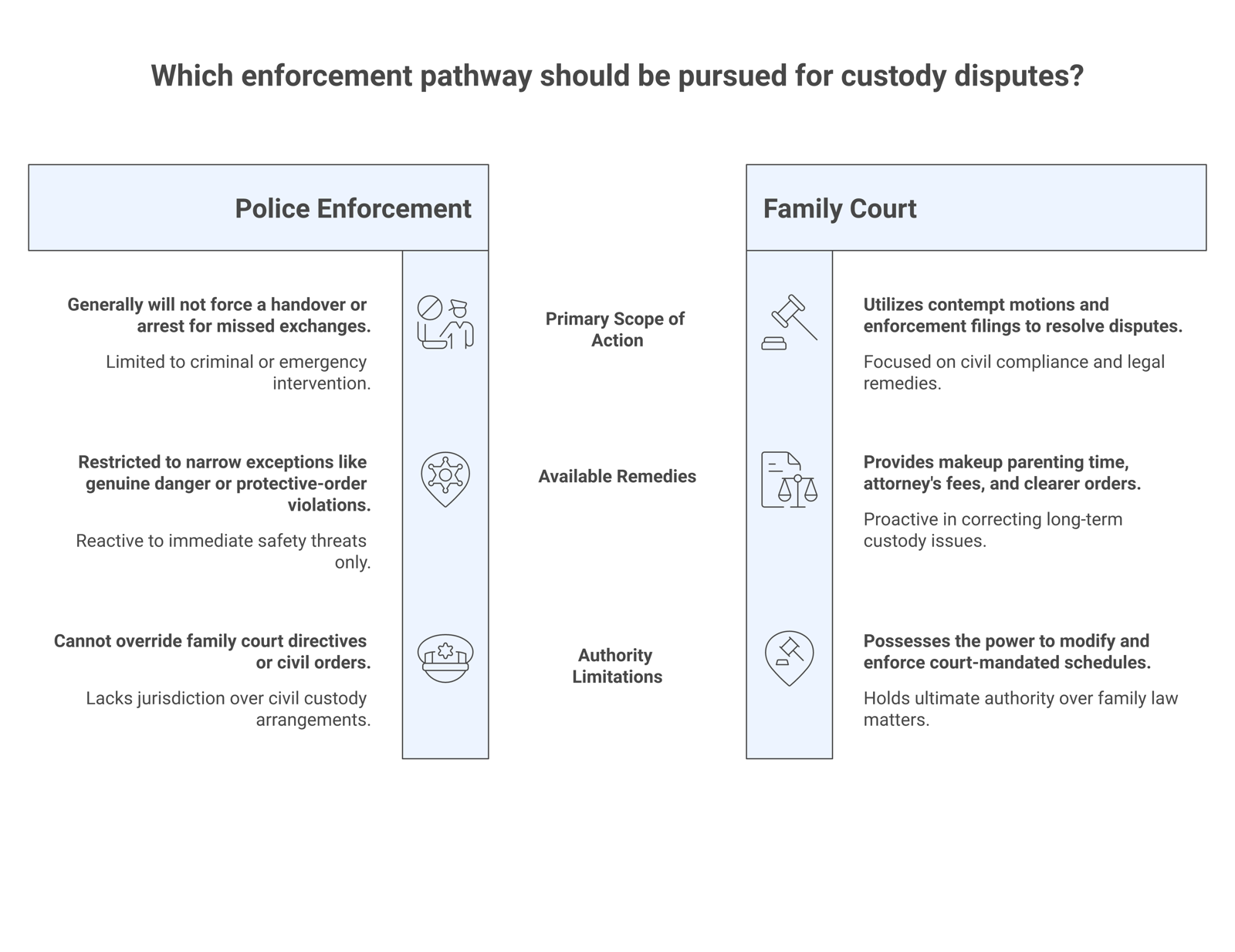
The line that matters here is the line between a civil dispute and a crime. A parenting-time order is a civil order. When one parent keeps the child past their time or refuses an exchange, that is usually a violation of a civil order, not a criminal act. Police are trained to act on crimes, threats, and emergencies, and a disagreement over a custody schedule does not usually fit any of those.
There is also a practical reason. An officer arriving at a failed exchange rarely has the full court file, the current order, or the history. The officer cannot reliably tell, on the spot, who is right about an ambiguous schedule or a recent modification. Forcing a child into a car based on a document an officer cannot fully verify carries real risk. So most departments take a cautious posture: they may take a report, but they treat the underlying dispute as one for the family court to resolve.
Some parents find this frustrating, especially when the order seems clear to them. The honest framing is that police generally will not be the enforcement tool, and planning around that fact leads to better outcomes than repeated calls that go nowhere.
The narrow exceptions
The general rule has real exceptions. They are narrower than many parents hope, and they turn on safety and on the criminal law, not on the parenting schedule itself.
A child in genuine danger
If a child is in immediate danger, the situation is no longer a civil parenting-time dispute. Threats, violence, abuse, or a credible risk of harm are police matters, and a parent who sees genuine danger should call 911. Officers respond to the safety threat, not to the custody order. This is the most important exception, and it is about protecting the child, not about winning an exchange.
A criminal custodial-interference statute in some places
Some jurisdictions have a criminal statute, often called custodial interference or interference with custody, that can apply when a parent wrongfully keeps or takes a child in defined circumstances. Whether such a statute exists, and what it requires, varies widely from place to place. These statutes usually target serious conduct, such as concealing a child or fleeing with one, rather than an ordinary late or missed exchange. Whether a given situation could ever meet that bar is a question for police and prosecutors, guided by the law of that jurisdiction, not something a parent should assume.
A protective-order violation
If there is a protective or restraining order in place and someone violates it, that violation is enforceable by police in a way an ordinary parenting-time order is not. This is a separate track from civil parenting-time enforcement, and it exists to address safety, not scheduling.
What to do instead when an exchange is denied
When police are not the answer, there is still a clear, calm path. These general steps apply in most places, though the specific filings and forms differ by jurisdiction.
- Stay calm and keep the child out of the conflict. A failed exchange is upsetting, but a scene helps no one and frightens the child. Keep your voice steady and do not argue in front of the child.
- Document the denied exchange. Note the date, the time, the place, who was present, and what was said. A short, factual record made the same day is far more useful later than a memory.
- Keep your records together. Save texts, emails, and messages, and keep a simple parenting-time log. The work of documenting parental alienation and interference is the same work that supports an enforcement motion.
- Ask police to make a report only if it helps your record. A parent can sometimes ask responding officers to note that an exchange was denied. Treat that as documentation, not as a way to force a handover.
- File a contempt or enforcement motion, or talk to an attorney. The family court is the venue that can actually enforce its own order. A licensed attorney can explain the local process and the realistic remedies, including makeup parenting time.
These steps are about building a calm, credible record and moving the dispute to the venue that can resolve it. For the conduct behind a denied exchange, see what is visitation interference.
The family-court enforcement path
The realistic enforcement tool is a motion filed in family court. When a court has entered a parenting-time order, refusing to follow it can be contempt of court. The targeted parent documents each specific violation and asks the court to enforce its own order. The Cornell Legal Information Institute keeps a general reference on contempt of court, and the American Bar Association’s Section of Family Law publishes general consumer information on how enforcement works.
A court that finds a willful violation has several options. It can order makeup parenting time. It can require attorney’s fees to be paid. It can tighten the order or add specific exchange terms. In serious or repeat cases, a court has stronger tools still. The key point is what gets enforced and by whom. Nobody is sanctioned for “parental alienation” by name. A parent is held accountable for violating a specific parenting-time order, and that accountability runs through the court, not through a police cruiser. The mechanics of a contempt motion are covered on its own page. Outcomes vary by court and by the strength of the record, so no result is guaranteed.
Protecting the child from a confrontation
The most important reader of this page is not in the room, but the child is in the situation. A denied exchange is one of the moments most likely to turn into a scene, and a scene at the curb, with raised voices or a police car in the driveway, lands hardest on the child.
Repeated police calls over scheduling can frighten a child and can even become part of a pattern that teaches the child to fear an exchange. Specialists in this field treat that kind of repeated drama as harmful to the child, and sometimes as a tactic that makes a hard situation worse. The protective move is the calm one: keep the conflict away from the child, document quietly, and let the family court do the enforcing. The American Psychological Association’s general resources on divorce and child custody reflect the same priority, the child’s wellbeing through the conflict. For situations where the child, rather than the other parent, is refusing contact, see child refusing visitation, and for the broader pattern of a co-parent keeping a child away, see when an ex keeps a child away.
Frequently asked questions
Can police enforce parenting time?
In most situations, no. Police usually treat a custody or parenting-time order as a civil matter for the family court and will not force a handover. The realistic path is a contempt or enforcement motion in family court. Narrow exceptions exist for a child in genuine danger, a protective-order violation, or a criminal custodial-interference statute in some places.
Will police enforce a custody order?
Generally not. Officers responding to a denied exchange will often make a report, but they treat the dispute as civil and leave enforcement to the family court. They step in mainly where there is a crime, a credible safety threat, or a protective-order violation.
Should I call the police if my ex won’t give me the kids?
A parent can ask police to document the denied exchange, but should not expect them to force a transfer. It is usually better to stay calm, keep records, avoid a scene in front of the child, and file for enforcement or makeup time in family court. If a child is in genuine danger, call 911.
What can I do if my ex denies parenting time?
Document each denied exchange calmly, keep your records together, and file a contempt or enforcement motion in family court. Common remedies include makeup parenting time, fees, and stronger orders. A licensed attorney can advise on the process in your jurisdiction.
Is denying parenting time a crime?
Usually it is a civil violation of a court order, not a crime. Some jurisdictions have a criminal custodial-interference statute that can apply in narrow circumstances, such as concealing or fleeing with a child. Whether it applies is for police and prosecutors to assess under local law.
What this page does not do
This page is not legal advice. It does not name any one state’s custodial-interference statute as if it applied nationally. It does not tell readers to call or not call the police in their specific situation. Those judgments depend on the facts and the local law, and they belong to the reader together with a licensed attorney. And the page does not frame enforcement as a way to win against the other parent. The right use of these tools is the calm, documented one, oriented to the child’s wellbeing.
For the conduct behind a denied exchange, see what is visitation interference. For the enforcement mechanism, see contempt for parental alienation. For documentation, see how to prove parental alienation. The full Court silo covers the rest, and a related evidentiary question is covered at is parental alienation admissible in court.
Sources and further reading
- American Bar Association, Section of Family Law. americanbar.org/groups/family_law
- Cornell Legal Information Institute (Wex). Contempt of court. law.cornell.edu/wex/contempt_of_court
- American Psychological Association. Divorce and child custody. apa.org/topics/divorce-child-custody
If you or your child are in crisis
Free and confidential help is available right now.
- 988 Suicide and Crisis Lifeline. Call or text 988. 988lifeline.org
- Childhelp National Child Abuse Hotline. 1-800-422-4453. childhelp.org
- NAMI HelpLine. 1-800-950-6264. nami.org/help
Last reviewed: 2026-06-07. Author: Alex Buckles (PAC Founder).