

This page is general information, not legal or clinical advice. It does not create a professional relationship, and it does not address any one state’s custody law. Anyone making decisions about parenting after separation should consult a licensed family-law attorney or a qualified clinician.
Co-parenting is an arrangement in which two separated parents share responsibility for raising their child. Healthy co-parenting is child-centered and low in conflict, and it takes more than one form. This guide explains what co-parenting means, the main styles, what good looks like, and when it is not safe.
A note on safety
Co-parenting is not appropriate where there is abuse. Where one parent is unsafe, shared decision-making and direct contact can put a child or a parent at risk. In those situations, parallel parenting or another court-structured arrangement may be needed, and safety comes first. If you or your child are in danger, contact local law enforcement or a domestic-violence resource right away.
What is co-parenting?
Co-parenting means two parents who no longer live together still raise their child as a team. They share the daily work, the big decisions, and the time. The marriage or relationship has ended, but the parenting has not. Both parents stay involved in the child’s life.
The arrangement usually rests on a custody order or a parenting plan. That plan sets the schedule and spells out who decides what. The Cornell Legal Information Institute keeps a general reference on child custody and how these arrangements are framed.
What makes co-parenting work is not the legal paperwork alone. It is how the two parents treat each other and the child. Research summarized by the American Psychological Association finds that children adjust best when conflict between parents stays low. The goal is simple to state and hard to live: put the child first.
It also helps to picture co-parenting as a long relationship of its own. The romantic partnership is over, but the working partnership around the child can last for years. Many parents find it easier once they stop treating the other person as an ex and start treating them as a fellow parent. The child does not need the adults to agree on everything. The child needs both adults to stay steady, present, and focused on what is best for them.
What healthy co-parenting looks like
Healthy co-parenting has a few clear markers. None of them require the parents to be friends. They only require both parents to keep the child at the center.
Conflict stays low. The parents disagree at times, but they keep those disagreements away from the child. The child never carries messages, hears one parent run down the other, or feels forced to pick a side.
Rules stay consistent across both homes. Bedtimes, screen limits, and homework expectations line up closely. Guidance from the American Academy of Pediatrics, shared through its HealthyChildren resource, points to consistency and routine as anchors for a child moving between two homes.
Logistics stay reliable. Exchanges happen on time. Schedules are shared in advance. Each parent respects the other’s time with the child.
The child has permission to love both parents. This is the heart of it. A child in a healthy arrangement is free to enjoy time with each parent without guilt. That freedom protects the child’s sense of security, and it is the single feature that separates healthy co-parenting from the alternatives.
The main styles of co-parenting
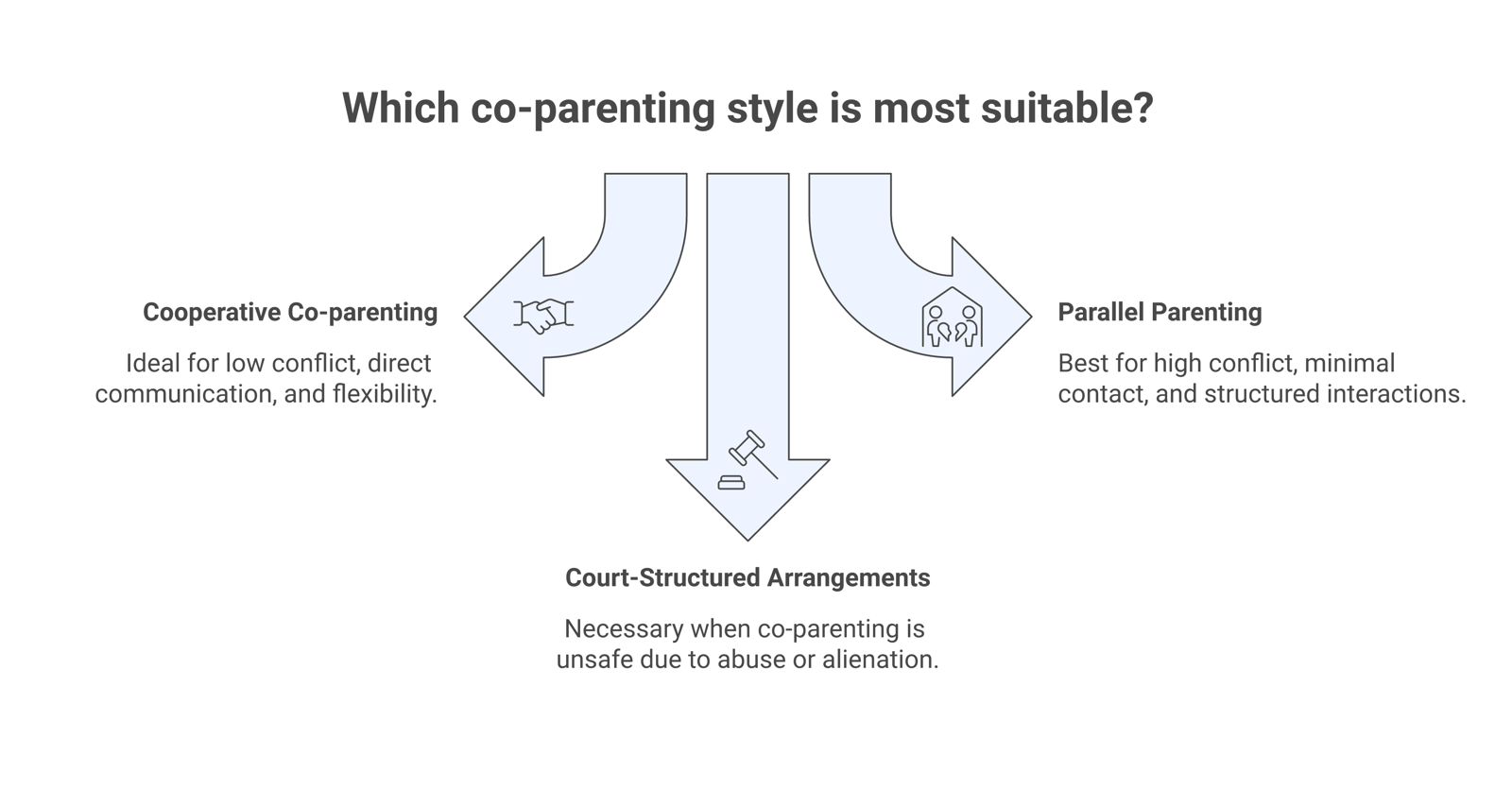
Co-parenting does not look the same in every family. The right style depends on how well the two parents can communicate, which usually tracks the level of conflict between them. The diagram below compares three realities by conflict level.
Cooperative co-parenting
Cooperative co-parenting is the low-conflict version, and it is what most people picture. The parents talk directly, adjust the schedule when life happens, and make decisions together. They might attend a school event in the same room without tension. This style asks for flexibility and goodwill on both sides. It works well when both parents can set their own feelings aside for the child.
Parallel parenting
Parallel parenting is built for high conflict. Here the parents reduce direct contact to the minimum and keep every exchange businesslike. Communication runs through email, a parenting app, or short written notes, not long conversations. Each parent handles their own time independently, within a detailed schedule that leaves little to negotiate. The structure is the point. It lets the child enjoy a strong bond with each parent while staying clear of the conflict between them. For a deeper comparison, see parallel parenting vs co-parenting.
When co-parenting is high-conflict or counter-parenting
Some situations do not fit either healthy model. In high-conflict cases, one parent may undermine the other, break agreements, or use the child as a weapon. Counter-parenting is the term for actively working against the other parent’s role rather than alongside it. Alienating behavior, where one parent tries to damage the child’s relationship with the other, is the opposite of healthy co-parenting. To understand that pattern, see parental alienation after divorce and what is considered harassment by a co-parent. When one parent shows these patterns, see how to deal with a narcissistic co-parent.
Can you co-parent with a high-conflict ex?
Yes, many parents do, though it rarely looks cooperative. The usual path is parallel parenting. By cutting direct contact and leaning on a clear, detailed schedule, a parent can protect the child even when the other parent stays difficult.
The mindset shift helps. The aim is not a warm partnership. The aim is a stable, predictable environment for the child, run with the calm tone of a business arrangement. Brief, factual, written communication lowers the chance of a flare-up. A parenting app or a shared calendar can carry the logistics so the parents barely have to speak.
Professional support can ease the strain. Co-parenting counseling gives both parents a structured place to work through conflict, and the healthy co-parenting strategies page offers practical tools for daily life. One limit holds, though. Where the conflict involves abuse, the answer changes, and the next section explains why.
When co-parenting is not safe or possible
Co-parenting assumes that both parents are safe and able to share the child’s care. When that assumption breaks, the arrangement can do harm.
Abuse is the clearest line. Where there has been domestic violence, child abuse, or coercive control, shared decision-making and direct contact can put a child or a parent in danger. Co-parenting is not appropriate in those situations. A court may order supervised exchanges, supervised visitation, or no contact at all, and the safe parent should follow legal guidance rather than try to cooperate.
Severe, entrenched conflict can also make cooperation unworkable. When every exchange becomes a battle, parallel parenting or another court-structured arrangement often protects the child better than forcing two parents to collaborate.
Severe alienation sits in this category too. When one parent has worked to destroy the child’s bond with the other, ordinary co-parenting tools are not enough, and the situation usually needs court oversight and professional help. A protective parent who limits contact because of genuine abuse is not alienating. That distinction matters, and a qualified clinician or attorney can help sort it out.
Frequently asked questions
What is co-parenting?
Co-parenting is an arrangement in which two separated parents share responsibility for raising their child. They split the time, the daily care, and the major decisions, even though they no longer live together. At its best, co-parenting is child-centered and low in conflict, with both parents staying actively involved in the child’s life.
What does healthy co-parenting look like?
Healthy co-parenting keeps conflict low, rules consistent across both homes, and logistics reliable. The parents do not have to be friends. The child never carries messages or feels pressure to pick a side. The defining marker is that the child is free to love and enjoy both parents without guilt.
What is the difference between co-parenting and parallel parenting?
Cooperative co-parenting uses direct, flexible communication and shared decisions, and it suits low-conflict situations. Parallel parenting is built for high conflict. It keeps contact minimal and businesslike, with a detailed schedule that limits negotiation. Both can serve the child well; parallel parenting simply shields the child from the conflict between the parents.
Can you co-parent with a high-conflict ex?
Often yes, usually through parallel parenting. By reducing direct contact, keeping communication brief and written, and following a detailed schedule, a parent can give the child stability despite the conflict. The exception is abuse. Where a parent is unsafe, co-parenting is not appropriate, and a court-structured arrangement is needed instead.
When is co-parenting not possible?
Co-parenting is not appropriate where there is abuse, including domestic violence, child abuse, or coercive control. It can also break down in cases of severe, entrenched conflict or severe alienation. In those situations, parallel parenting or another court-structured arrangement, often with professional support, protects the child better than forced cooperation.
Where to go next
Co-parenting is a wide topic, and this page is the starting point. For the detailed comparison of the two main models, see parallel parenting vs co-parenting. For practical daily tools, see healthy co-parenting strategies. For structured professional help, see co-parenting counseling. The full Help section covers the rest.
This page does not give legal or clinical advice, and it does not tell anyone what to file or decide. Choices about custody and a parenting plan belong with a licensed attorney or clinician who knows the family. The page also never frames co-parenting as a way to win against the other parent. The right approach is the calm, documented, child-centered one.
Sources and further reading
- American Psychological Association. Divorce and child custody. apa.org/topics/divorce-child-custody
- American Academy of Pediatrics. HealthyChildren. healthychildren.org
- Cornell Legal Information Institute (Wex). Child custody. law.cornell.edu/wex/child_custody
If you or your child are in crisis
Free and confidential help is available right now.
- 988 Suicide and Crisis Lifeline. Call or text 988. 988lifeline.org
- Childhelp National Child Abuse Hotline. 1-800-422-4453. childhelp.org
- NAMI HelpLine. 1-800-950-6264. nami.org/help
Last reviewed: 2026-06-08. Author: Alex Buckles (PAC Founder).