

Covering parental alienation responsibly means treating it as a contested construct, not a settled diagnosis, and carefully distinguishing genuine alienating behaviour from a child’s justified rejection of an abusive parent and from a protective parent’s actions. The England and Wales Family Justice Council 2024 framework gives reporters the clearest neutral vocabulary for doing this well.
A note before you assign or write
A child’s rejection of a parent is not always alienation. If the rejected parent has been abusive, neglectful, or genuinely dangerous, the child’s distancing is a justified response, not parental alienation, and conflating the two can put a protective parent and a child at risk. The alienation label is sometimes invoked in custody disputes to discredit a parent who has reported abuse. Responsible coverage holds that line.
This page is general professional guidance for journalists, editors, and producers. It is educational information, not legal or clinical advice, and it does not direct coverage of any specific case or family.
The short version for editors on deadline
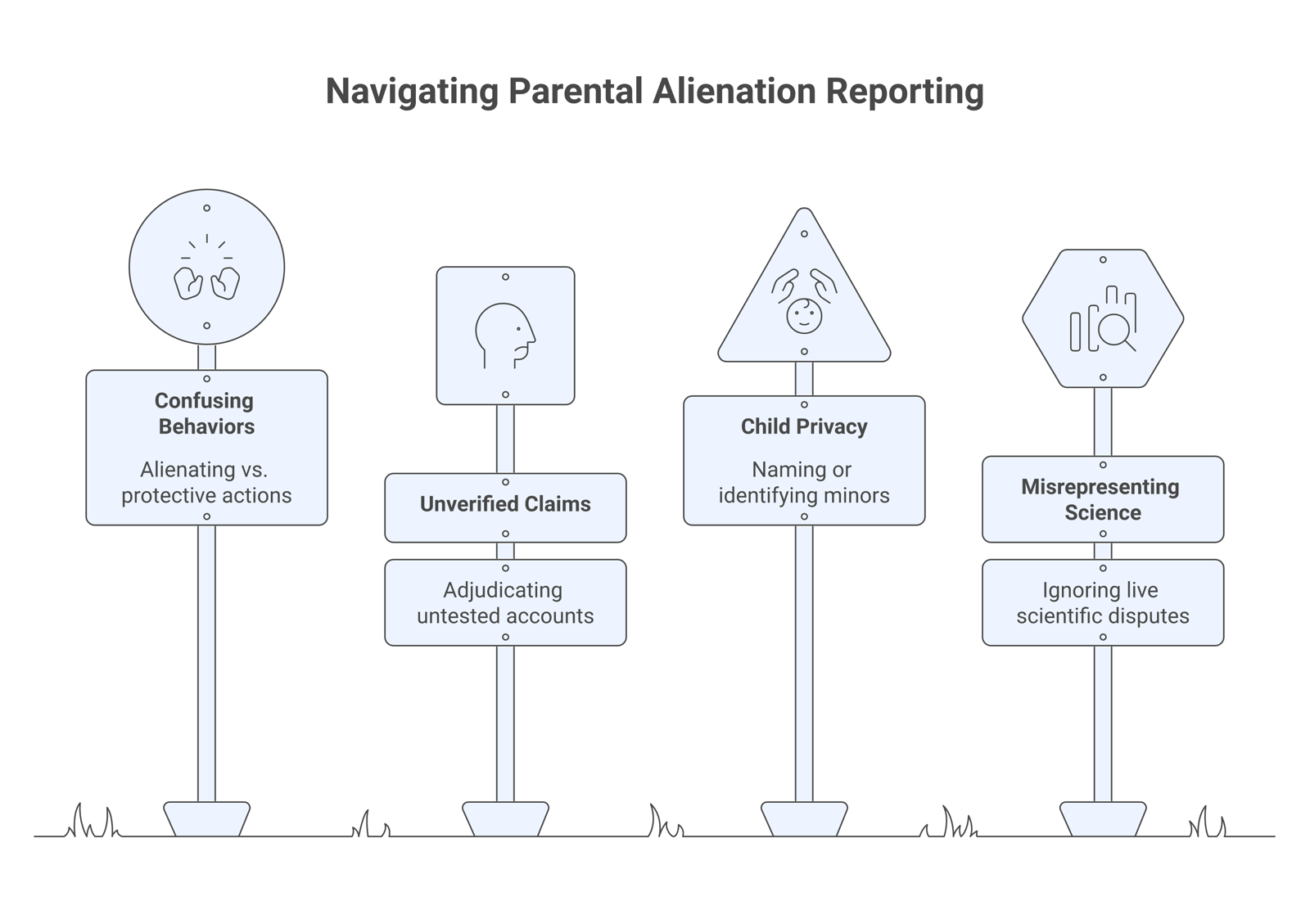
If you have one screen of attention, here it is. Parental alienation is a real and seriously harmful pattern when it occurs, but it is a contested construct in the science and a flashpoint in family-court policy. It is not a diagnosis you can find in the DSM-5-TR or ICD-11. The strongest, fairest coverage does four things at once: it states the science honestly, it uses neutral behaviour-based language instead of disputed syndrome labels, it attributes one parent’s account as a claim rather than a finding, and it protects the children who cannot consent to being in the story.
The single most consequential mistake is conflation. A child who refuses contact may be alienated, may be reacting to genuine abuse, or may be aligned with one parent for ordinary developmental reasons. Good reporting asks which one is operating before adopting any frame.
| Do | Avoid |
|---|---|
| Treat parental alienation as a contested construct | Calling it a settled medical diagnosis or “syndrome” |
| Distinguish alienating behaviour, protective behaviour, and justified rejection | Treating every refused contact as alienation |
| Attribute each parent’s account as a claim | Reporting one untested account as established fact |
| Name the live scientific dispute and both camps | Framing the field as either “junk science” or “proven” |
| Protect children’s privacy and identity | Naming or identifying minors to illustrate the topic |
| Point readers to genuine support resources | Treating the story as entertainment or a custody scoreboard |
Start with the science as it actually stands
Coverage frequently asks whether parental alienation is “real” or “fake.” Both framings flatten a layered answer. The honest version is that researchers describe a genuine pattern, the most-cited of whom classify alienating behaviours as a form of family violence, while the formal diagnostic systems have not adopted a standalone diagnosis by that name.
The DSM-5-TR, published by the American Psychological Association alongside the psychiatric manual, does not list “parental alienation” as a diagnosis. Neither does the ICD-11. Both systems carry relational-problem and child-psychological-abuse codes that clinicians apply when behaviour meets the criteria, but that is not the same as a recognized “parental alienation syndrome.” A reporter who writes “the diagnosis of parental alienation” has already made a factual error. A reporter who writes “a contested construct that some clinicians describe as a pattern of behaviour, not a formal diagnosis” is on solid ground. For the underlying definitions and the diagnostic-status detail, the plain-language explainer for journalists walks the science end to end, and the is parental alienation junk science page treats the validity question directly.
Use neutral vocabulary: the Family Justice Council 2024 framework
The cleanest neutral vocabulary now available comes from the England and Wales Family Justice Council, whose December 2024 guidance followed one of its largest consultations. It deliberately rejects a diagnosable “parental alienation syndrome” and replaces loaded labels with behaviour-based terms a reporter can use without taking a side.
The framework separates three things that loose coverage tends to blur:
- Alienating Behaviours (AB). Conduct by one parent that, directly or indirectly, damages a child’s relationship with the other parent without a justified cause.
- Protective Behaviours (PB). Steps a parent takes to keep a child safe from a parent who has been abusive or unsafe. These are not alienation.
- Appropriate Justified Rejection (AJR). A child’s reluctance, resistance, or refusal that is a reasonable response to the rejected parent’s own conduct. This is not alienation either.
The guidance also sets out a three-prong test a court applies before it may find alienating behaviour: first, the child is reluctant, resisting, or refusing a relationship; second, that reluctance is not an appropriate justified rejection and is not explained by another factor such as affinity or alignment; and third, the other parent engaged in behaviours that directly or indirectly caused it. Reporters do not need to adjudicate these prongs. Naming them shows readers why the question is harder than a headline suggests.
Why the FJC vocabulary travels well for reporters
The terms describe observable behaviour rather than diagnosing a person, so they survive the political fight over what to call the phenomenon. A critic can attack a syndrome label or a courtroom expert, but it is hard to argue with “the court examined whether the child’s refusal was a justified response or the result of one parent’s behaviour.” The vocabulary is also jurisdiction-portable. It originates in England and Wales, yet the underlying distinctions apply to any family-court system, which is why it works as neutral copy for a US or international audience.
Report the dispute as a live dispute
Parental alienation sits inside an active, unresolved argument among serious researchers and advocates, and the fairest coverage shows that argument rather than resolving it for the reader.
On one side, a DV-protective camp warns that alienation claims are used to discredit parents, usually mothers, who report abuse. The empirical anchor here is Joan Meier’s 2020 study for the National Institute of Justice, which found that when mothers alleged abuse, fathers’ cross-claims of alienation roughly doubled the mothers’ risk of losing custody, an effect that did not run the other way. That is a documented, gender-specific pattern of how the label can function in court.
On the other side, an affirming camp argues that alienation is a maturing field and that the label is not widely misused. Jennifer Harman, Demosthenes Lorandos, and colleagues have published appellate-case studies reporting “little misuse” of alienation claims and arguing that the science is a trustworthy knowledge base. Critics counter that volume of publication is not the same as validity and that much of the cited literature is authored by proponents.
Both poles rest on real research, and both have real critics. International bodies add to the spread: a United Nations Special Rapporteur has described parental alienation as a “pseudo-concept,” while several countries treat it as an actionable concern in law. A piece that presents either side as settled is inaccurate. The honest framing names the dispute, cites a source from each camp, and lets the reader see that the experts themselves disagree. The three camps in parental alienation page maps the positions in more detail for background.
Language pitfalls to avoid
The words a story chooses do a lot of quiet work. A few specific habits reliably mislead readers.
Avoid using “parental alienation syndrome” or “PAS” as though it were an accepted clinical entity. The “syndrome” framing was proposed decades ago and has not been adopted into the formal diagnostic manuals, so presenting it as settled medicine overstates the science. Where a source uses the term, attribute it to that source rather than adopting it in the reporter’s own voice.
Avoid the opposite overcorrection too. Calling the entire field “junk science” is as inaccurate as calling it proven. Some of the underlying research is contested, but serious peer-reviewed work documents that alienating behaviours, where they occur, cause measurable harm. The accurate register sits between the two slogans: a real and harmful pattern, a contested construct, an unsettled science, and a genuine policy dispute.
Attribute, do not adjudicate
In a custody story, each parent has an account, and the two accounts usually conflict. A reporter’s job is to attribute those accounts, not to rule on them. “The father says the mother turned the children against him” is reporting. “The mother alienated the children” is a finding a reporter is not positioned to make.
This matters most when only one parent is talking. A targeted parent’s account of being cut off from a child can be sincere and still be untested, and the other parent may have a safety reason the reporter has not heard. Platforming one untested account as established fact is a common failure in this beat. The corrective is ordinary journalistic discipline: seek the other side, label claims as claims, note what has and has not been established by a court, and resist the pull of a clean villain. The same discipline protects against being used as a tactical instrument by either parent.
Protect the children in the story
The people with the most at stake in an alienation story are the children, and they cannot consent to appearing in it. Naming or identifying a minor to illustrate the phenomenon can follow that child for life and can deepen the very conflict the story describes.
Practical safeguards keep the reporting humane. Do not name children, and avoid the combinations of detail that identify them indirectly, such as a parent’s full name plus a school plus a town. Be cautious with images, social-media material, and court documents that a child never chose to make public. Where a family’s identity is genuinely newsworthy and consent is in question, the welfare of the child outweighs the color it adds. Educators adapting this material for teaching should apply the same care to case examples.
Point your audience to real support
Coverage reaches parents and adult children who are living the experience, so a responsible piece offers a door to help rather than leaving readers alone with the distress. A short resource line at the end of a story does real work.
Useful pointers include the crisis lines listed at the foot of this page, neutral educational resources that explain the construct without selling a custody strategy, and the reminder that a child’s wellbeing, not a parent’s victory, is the measure that matters. The For Professionals hub collects role-specific material, and the companion guide will going to court hurt my child gives the parent-facing, non-legal view that many readers of an alienation story will be searching for next.
Frequently asked questions
How should journalists report on parental alienation?
Report it as a contested construct rather than a settled diagnosis, use neutral behaviour-based language such as the Family Justice Council 2024 terms, attribute each parent’s account as a claim instead of a finding, name the live scientific and policy dispute with sources from both camps, and protect the privacy of any children. The most consequential discipline is not conflating genuine alienating behaviour with a child’s justified rejection of an abusive parent.
Is parental alienation a real diagnosis?
No. The DSM-5-TR and the ICD-11 do not include “parental alienation” as a standalone diagnosis. Researchers describe it as a behaviour pattern, and the most-cited classify alienating behaviours as a form of family violence, but the formal diagnostic systems use relational-problem and child-abuse codes rather than a named syndrome. Coverage that calls it a diagnosis is inaccurate.
What is the difference between alienation and a justified rejection?
Alienating behaviour is conduct by one parent that damages a child’s relationship with the other parent without a justified cause. An appropriate justified rejection is a child’s reasonable response to the rejected parent’s own conduct, including abuse or neglect. Protective behaviour is a parent keeping a child safe from an unsafe parent. The Family Justice Council 2024 framework separates these three, and only the first is alienation.
What words should reporters avoid when covering parental alienation?
Avoid presenting “parental alienation syndrome” or “PAS” as an accepted diagnosis, since the formal manuals have not adopted it. Avoid the opposite slogan that the field is “junk science,” which overstates the critique. Avoid stating one parent alienated the children as a finding when it is a contested claim. Attribute disputed terms to the source using them rather than adopting them in the reporter’s own voice.
Why is parental alienation controversial?
Because serious researchers and advocates disagree about it. A protective camp documents that alienation claims can be used to discredit parents who report abuse, anchored in Meier’s 2020 findings. An affirming camp argues the label is not widely misused and that the science is maturing. International bodies range from treating it as actionable to calling it a “pseudo-concept.” The construct is genuinely contested, which is why balanced coverage shows the dispute.
Where to go next
- For the full professional hub, see the For Professionals pillar.
- For the underlying science and named experts to interview, see the plain-language explainer for journalists.
- For the validity debate, see is parental alienation junk science.
- For the map of positions, see three camps in parental alienation.
- For the parent-facing companion, see will going to court hurt my child.
Sources and further reading
- Family Justice Council (December 2024). Guidance on responding to a child’s unexplained reluctance, resistance or refusal to spend time with a parent and allegations of alienating behaviour. judiciary.uk
- Meier, J. S. (2020). U.S. child custody outcomes in cases involving parental alienation and abuse allegations. National Institute of Justice. nij.ojp.gov
- American Psychological Association. Divorce and child custody. apa.org/topics/divorce-child-custody
If you or someone you are reporting on is in crisis
Free and confidential help is available right now.
- 988 Suicide and Crisis Lifeline. Call or text 988. 988lifeline.org
- Childhelp National Child Abuse Hotline. 1-800-422-4453. childhelp.org
- NAMI HelpLine. 1-800-950-6264. nami.org/help
Last reviewed: 2026-06-07. Author: Alex Buckles (PAC Founder).