

This page is general information, not legal or clinical advice. It does not diagnose any person or address any one state’s law. Anyone with concerns about their family should consult a qualified mental-health professional or a licensed attorney in their own jurisdiction.
If you have noticed something off in how your child speaks about their other parent, you are not alone. The 17 signs of parental alienation are the documented strategies one parent can use to weaken a child’s bond with the other. This guide names all 17, grounded in research, and explains what they mean.
A note on safety
A child pulling away from a parent is not always alienation. When a child resists contact because of genuine abuse or neglect, that is a protective response, not alienation, and this list should never be used to discredit a parent keeping a child safe. If a child’s safety is at risk, contact local law enforcement or a child-protection resource first.
What the 17 signs of parental alienation actually are
The 17 signs of parental alienation are not symptoms in the child. They are the strategies the alienating parent uses. This distinction matters. The list describes adult behavior, not a diagnosis a reader can pin on a child.
Researcher Amy J.L. Baker built this list from interviews with forty adults who had lived through alienation as children, published in Adult Children of Parental Alienation Syndrome (2007), with survey grounding in Baker and Darnall (2006). Her research identified 17 primary strategies that alienating parents tend to repeat, and later studies using the Baker Strategy Questionnaire found the same behaviors in other samples, including an Italian adult sample (Verrocchio, Baker & Bernet, 2016). That replication is part of why the list is treated as the standard catalog rather than a single author’s opinion.
One honest note before the list: there is no canonical numbering of the 17 strategies. Baker’s own materials list them without a fixed order, and different books and websites number them differently. The order below follows Baker’s published catalog and matches the numbering used on this site’s parental alienation checklist.
No single sign confirms alienation on its own. Many of these behaviors can appear, in mild form, in ordinary high-conflict separations. What distinguishes alienation is repetition, intensity, and the steady erosion of a child’s bond with a parent who has done nothing to deserve it.
For a broader view of how alienation presents, see parental alienation symptoms. This page stays focused on naming the 17 strategies clearly.
The 17 strategies, one by one
For lived illustrations of each, see examples of parental alienation.
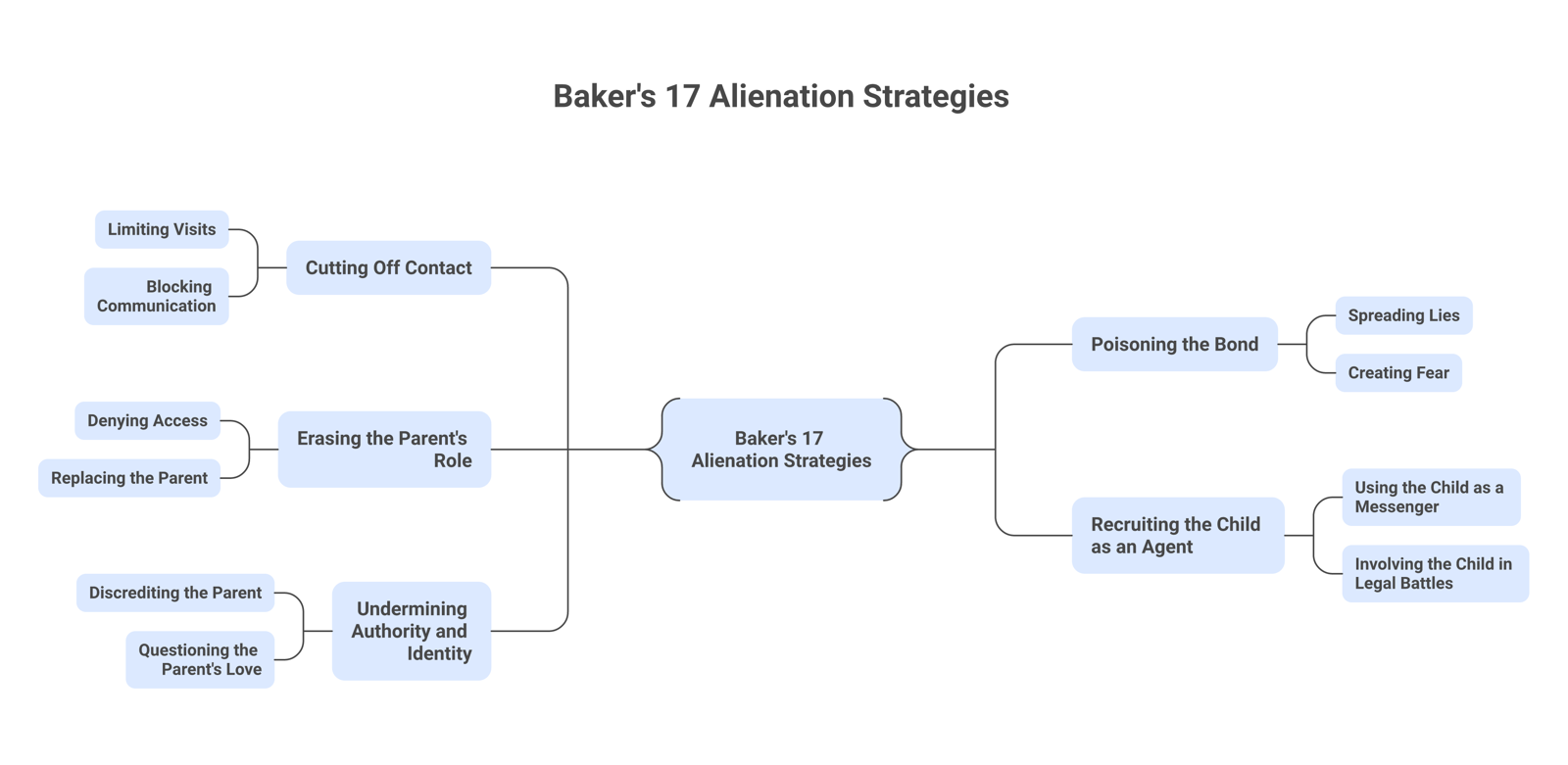
- Badmouthing. The parent speaks of the other parent with contempt, blame, or ridicule, repeatedly and within the child’s hearing.
- Limiting contact. The parent reduces the child’s time with the other parent, canceling visits or filling the schedule so little time remains.
- Interfering with communication. Calls go unanswered, texts are blocked or screened, and the child cannot reach the other parent freely.
- Interfering with symbolic communication. Photos vanish from the wall, gifts go missing, and reminders of the other parent are removed from the child’s daily world.
- Withdrawing love when the child shows positive feeling. Warmth from the alienating parent cools, or turns to anger, the moment the child says anything kind about the other parent.
- Telling the child the targeted parent does not love them. The child hears, directly or by hint, that the other parent does not care about them.
- Forcing the child to choose. The child is pressed to pick a side, often through loaded questions or loyalty tests.
- Creating the impression the targeted parent is dangerous. The parent suggests the other parent is unsafe, frightening, or a threat, when no real danger exists.
- Confiding in the child. The parent shares adult grievances, marital history, and court details, placing the child in the role of a confidant.
- Forcing the child to reject the targeted parent. The parent pushes the child to refuse visits or cut off the relationship outright.
- Asking the child to spy. The child is sent to report back on the other parent’s home, habits, or relationships.
- Asking the child to keep secrets. The child is told to hide things from the other parent, building a private alliance.
- Referring to the targeted parent by first name. The parent stops calling the other parent “Mom” or “Dad” in front of the child, using a first name to shrink the role.
- Referring to a step-parent as mom or dad. A new partner is given the parental title, and the child is encouraged to use it, quietly replacing the targeted parent in the child’s language.
- Withholding medical, academic, and other information. School updates, doctor visits, and events are kept from the other parent, or the parent’s name is kept off records, cutting them out of the child’s life.
- Changing the child’s name. A surname or first name is altered to sever the link to the other parent.
- Cultivating dependency and undermining the targeted parent’s authority. The parent builds the child’s reliance on them alone and overrides the other parent’s rules and decisions, teaching the child that the targeted parent does not count.
A simpler way to hold the pattern
Reading 17 separate items can blur together. Cheryl Mefferd, BSN, RN, a nurse, educator, and advocate who founded the nonprofit Parental Alienation Speaks, groups Baker’s 17 strategies into five plain categories: isolation, fear, erasing, undermining the targeted parent’s authority, and encouraging betrayal. The grouping is her own educational organization of Baker’s catalog, useful for holding the pattern in mind, not a clinical taxonomy.
The 8 behaviors seen in an alienated child
The 17 strategies are causes. The eight behaviors psychiatrist Richard Gardner described in the child, from a campaign of denigration to a spread of animosity toward the targeted parent’s extended family, are the effects, and they are what an evaluator looks for on the child’s side. Several of those behaviors appearing together, alongside the parent-side strategies above, carry more weight than any single sign, and a child may show one or two of them for reasons that have nothing to do with alienation. The full child-side list, with plain definitions and examples of each, lives on 8 behaviors of an alienated child.
Signs are a pattern, not a single moment
One badmouthing comment or one missed call does not prove alienation. The signs matter as a pattern that repeats over time, where several strategies appear together and the child’s bond visibly erodes. A single hard week is not a diagnosis.
The boundary with abuse is the most important caution. A child who resists a parent because that parent is abusive or neglectful is reacting in a healthy, protective way. That is estrangement grounded in real experience, not alienation. The two can look similar from the outside, which is exactly why a careful, professional assessment matters more than a quick label. Using this list to discredit a parent who is protecting a child would cause real harm. The American Psychological Association offers measured guidance on divorce, custody, and children’s wellbeing.
If you are weighing your own situation, the page on signs your ex is alienating your child walks through the pattern with care.
What to do if you notice these signs
Recognizing the signs is a starting point, not an ending. Three steps tend to serve a worried parent best.
First, document calmly. Keep a dated record of missed exchanges, messages, and specific incidents, in plain factual language. The page on how to document parental alienation explains how to build that record well.
Second, stay calm with the child. Reacting with anger or counter-badmouthing tends to deepen the child’s bind. Steady warmth, without pressure, protects the relationship over time.
Third, seek a qualified professional. A licensed therapist who understands family conflict, and where needed a family-law attorney in your own area, can help you weigh real options. A trained clinician can also tell the difference between alienation and a child reacting to something real, which protects everyone, the child most of all. A short self-review can help you organize what you have seen; the parental alienation checklist is built for that. The full Signs section covers the rest.
This page does not promise that naming the signs will repair the bond. Recognition is a first step toward steady, informed action, taken with calm and with help.
Frequently asked questions
What are the 17 signs of parental alienation?
They are the 17 primary strategies an alienating parent uses to damage a child’s bond with the other parent, documented by researcher Amy Baker. They include badmouthing, limiting contact, interfering with communication, telling the child the other parent does not love them, forcing the child to choose, and asking the child to spy, among others.
What are the signs an ex is alienating your child?
The clearest signs are a pattern over time, not one event. Watch for repeated badmouthing, blocked calls and visits, a child suddenly rejecting a parent for trivial reasons, secrets and spying, and a step-parent being cast in the parental role. Several strategies appearing together carry more weight than any single moment.
How do the 17 strategies relate to the 8 behaviors of an alienated child?
The 17 strategies describe what an alienating parent does. The eight behaviors, first described by psychiatrist Richard Gardner, describe what then shows up in the child, such as a campaign of denigration and a loss of mixed feelings about the two parents. One list is the cause side and the other is the effect side; the child-side list is covered in full on 8 behaviors of an alienated child.
Is parental alienation hard to prove?
Often, yes. Alienation shows as a pattern of behavior over time rather than a single clear act, and a child may repeat coached statements convincingly. Calm, dated documentation of specific incidents helps, and a qualified professional can assess whether the pattern fits alienation or another explanation.
What should you do if you notice signs of parental alienation?
Document calmly, stay steady and warm with your child, and seek a qualified professional. A licensed therapist and, where needed, a family-law attorney in your own jurisdiction can help you understand your options. Avoid retaliating or badmouthing the other parent, which tends to make the child’s position harder.
Sources and further reading
- Baker, A. J. L. (2007). Adult Children of Parental Alienation Syndrome: Breaking the Ties That Bind. W. W. Norton. (Source of the 17 primary strategies.)
- Baker, A. J. L., & Darnall, D. (2006). Behaviors and strategies employed in parental alienation: A survey of parental experiences. Journal of Divorce & Remarriage, 45(1-2), 97 to 124.
- Baker, A. J. L., & Fine, P. R. (2008/2014). Beyond the High Road: Responding to 17 Parental Alienation Strategies / Co-parenting with a Toxic Ex. (The popularized treatment of the 17 strategies.)
- Verrocchio, M. C., Baker, A. J. L., & Bernet, W. (2016). [SCL-90-R Italian adult sample.] Journal of Forensic Sciences, 61(3), 692 to 698.
- Gardner, R. A. (1998). The Parental Alienation Syndrome (2nd ed.). Creative Therapeutics. (Source of the eight behavioral manifestations.)
- American Psychological Association. Divorce and child custody. apa.org/topics/divorce-child-custody
If you or your child are in crisis
Free and confidential help is available right now.
- 988 Suicide and Crisis Lifeline. Call or text 988. 988lifeline.org
- Childhelp National Child Abuse Hotline. 1-800-422-4453. childhelp.org
- NAMI HelpLine. 1-800-950-6264. nami.org/help
Last reviewed: 2026-06-08. Author: Alex Buckles (PAC Founder).