

Kayden’s Law is a 2022 federal reform, part of the Violence Against Women Act reauthorization, that offers states extra grant money to make family courts safer for children when abuse is alleged. It does not mention parental alienation, yet it shapes how courts weigh alienation and reunification claims.
A note on the abuse boundary, first
Estrangement caused by genuine abuse is not parental alienation, and the two must never be conflated. Kayden’s Law is built around telling them apart: protecting a child who is pulling away from a parent who harmed them, while still leaving room for courts to address a child who has been turned against a safe parent. If a child may be unsafe, contact local law enforcement or a child-protection agency before anything else.
This page is general education about a federal law. It is not legal advice, it does not create an attorney-client relationship, and it does not tell you how any law applies to a specific case. State adoption and state rules vary. Anyone with a live custody matter should consult an attorney licensed in their own state.
What Kayden’s Law is
Kayden’s Law is the Keeping Children Safe from Family Violence Act, Title XV of the Violence Against Women Act Reauthorization Act of 2022 (Public Law 117-103). Congress passed it with bipartisan support, and it was signed into law on March 9, 2022. You can read the statute text on congress.gov, where it appears as Title XV of the larger reauthorization bill.
The law works through funding, not a mandate. It does not order any state to change its custody laws. Instead, it offers states more federal grant money if they adopt a set of child-safety reforms. This money comes from the Services, Training, Officers, and Prosecutors program, often called STOP grants. The reforms apply in custody and abuse cases. A state that opts in can receive a funding boost; a state that does nothing keeps its existing law. So the federal government sets the standard and pays states to meet it, rather than forcing the change.
That design matters for the debate later on. Kayden’s Law is an incentive, not a command. Its real effect depends on which states choose to opt in, and how they write their own versions.
Why Kayden’s Law exists
The law is named for Kayden Mancuso, a 7-year-old Pennsylvania girl who was killed by her father in 2018. A family court had granted the father unsupervised parenting time despite her mother’s documented concerns about his history of violence. The case became a national example of a common fear. Family courts can give a dangerous parent access to a child, even when a safe parent has raised a clear alarm.
To the advocates who pushed for the law, Kayden’s death was not a one-off. They pointed to a broader pattern in custody fights. One parent reports abuse. The other parent says the first one is turning the child against them, or is just a poor co-parent. Critics worried this move could flip the case. The parent who raised the safety concern becomes the problem.
Research fueled that concern. A 2020 study led by Joan Meier at George Washington University, funded by the National Institute of Justice, examined custody cases and reported that when fathers raised alienation claims, mothers alleging abuse lost custody at a much higher rate. The GWU National Family Violence Law Center houses that work. Affirming-side scholars have contested the study’s sample and conclusions, and it is fair to note that the data is debated rather than settled. Even so, it shaped the case for reform, and Kayden’s Law is the legislative answer that emerged.
What Kayden’s Law does
Kayden’s Law sets out reforms a state must adopt to qualify for the enhanced grant. The provisions are technical, but they group into five plain ideas.
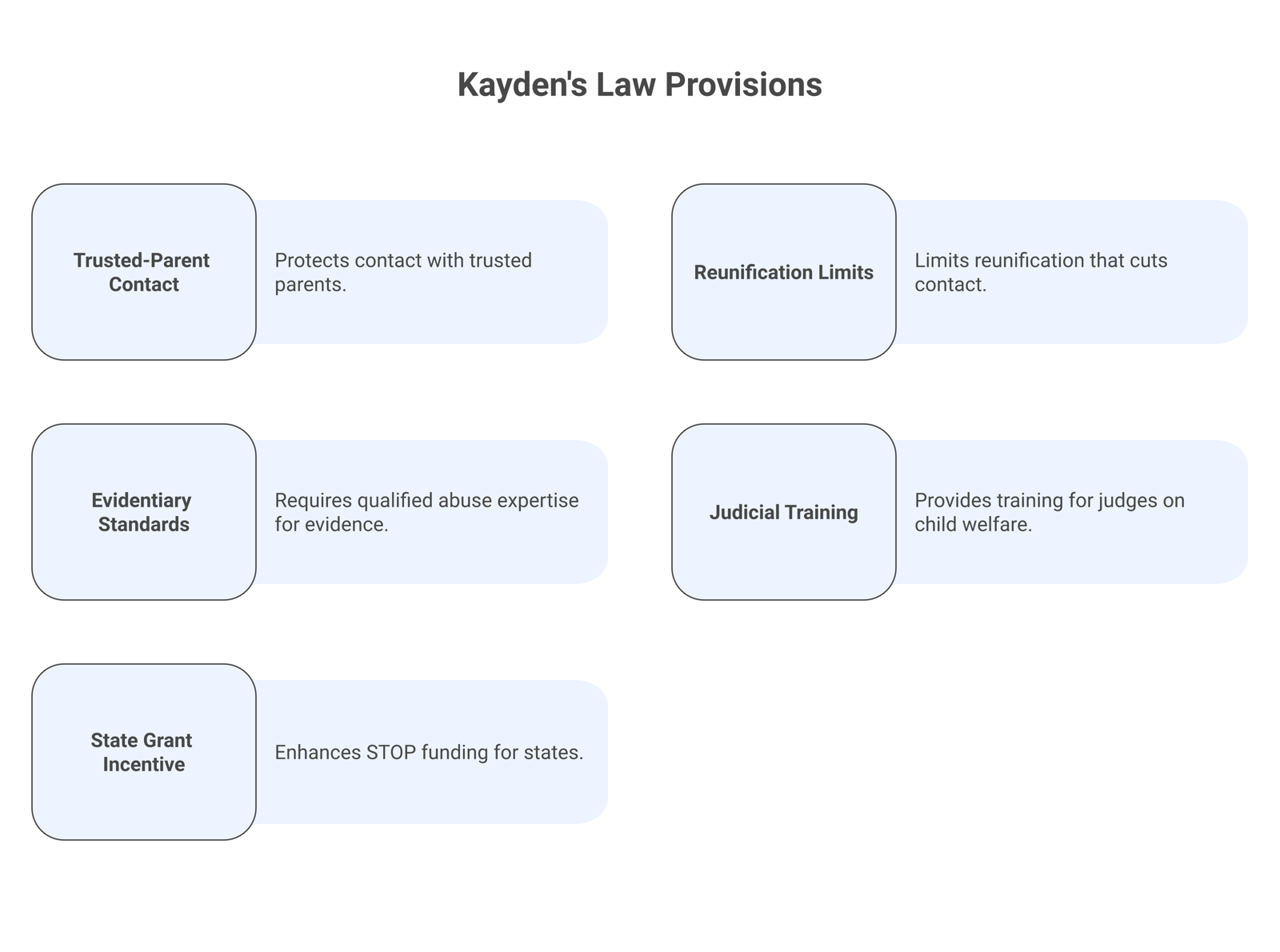
First, the law protects a child’s bond with a trusted parent. It asks states to stop courts from cutting a child’s contact with a safe, bonded parent, when the only goal is to improve the child’s bond with the other parent. A safe parent should not lose a child just to fix a strained relationship elsewhere.
Second, it limits court-ordered reunification treatment that cuts off contact. The law presses states to bar reunification programs that work by separating a child from a bonded parent. It also bars reunification treatment that lacks solid proof that it is safe and works. In the words of the federal text, a court “may not order a reunification treatment, unless there is generally accepted and scientifically valid proof of the safety, effectiveness, and therapeutic value” of that treatment.
Third, it raises the bar on abuse expertise. The law asks states to allow abuse testimony only from people with real, demonstrated training in domestic violence and child abuse, not just forensic credentials. It also asks courts to weigh past abuse, such as protection orders, arrests, and convictions.
Fourth, it requires ongoing judicial training. Judges and court staff would get training on child abuse, coercive control, trauma, and how victims and abusers behave. The training may not include theories the research does not support.
Fifth, it attaches a state grant incentive to all of the above. The Attorney General may increase an eligible state’s STOP grant, which is the carrot that makes the rest of the package attractive to a legislature.
How Kayden’s Law relates to parental alienation
Here is the point that surprises many readers. The federal text of Kayden’s Law never uses the words “parental alienation.” It is written as a domestic-violence and child-safety law, not as a statement about whether parental alienation is real.
The link is indirect but real. Alienation claims often lead to certain remedies. A court may reverse custody to the rejected parent, or order an intensive reunification program. Those are the very remedies Kayden’s Law makes harder to get when abuse is alleged. The law protects a bonded child’s contact with a safe parent. It also raises the proof bar on reunification treatment. So it makes courts more cautious about alienation-based and reunification-based custody changes, in cases where abuse is on the table. A law review analysis in the Minnesota Journal of Law and Inequality goes further, arguing the law could undercut alienation theory in court altogether.
It helps to be precise here, because this is where the page could mislead. Kayden’s Law does not ban courts from considering parental alienation, and it does not declare alienation a fiction. What it does is add safeguards so that an alienation argument cannot, by itself, override a substantiated abuse concern or justify an unproven reunification program. For more on the treatment side of this question, see court-ordered reunification therapy. For the underlying question of whether alienation is a real phenomenon, see is parental alienation real.
Colorado and other conforming states
Because Kayden’s Law works through funding, states adopt it one at a time, on their own terms. Pennsylvania, Kayden’s home state, was among the early movers. Colorado followed with a conforming statute that is often cited as the clearest example.
Colorado’s law is C.R.S. 14-10-127.5, enacted as HB23-1178 in 2023. It limits court-ordered reunification treatment, adds domestic-violence and trauma training requirements, and tightens who can serve as a qualified expert. Like the federal law, it is built to keep a court from cutting a child off from a protective, bonded parent in the name of repairing a different relationship. Colorado is presented here as one example of how a state can conform, not as a rule that applies anywhere else.
Other states have moved in related directions, some by adopting Kayden’s Law style reforms and some through their own bills. The broader legislative picture, including bills that push toward recognizing alienation and bills that push toward protecting against its misuse, is tracked on the Legislation hub. Two contrasting examples sit there: New Hampshire’s HB1323, which would define and require courts to weigh alienation, and Illinois HB5176, which defines alienation only as conduct against a safe parent and writes abuse carve-outs into each definition.
The debate around Kayden’s Law
Kayden’s Law sits at the center of an honest disagreement, and a neutral page has to show both sides.
Domestic-violence-protective advocates support the law strongly. They see it as a long-overdue fix. In their view, the old system too often discounted abuse reports. It also leaned on reunification remedies that lacked scientific support. For them, the Mancuso case and the Meier data describe a real danger, and the law’s safeguards are a reasonable response that keeps children with the parent who protects them.
Some parental-alienation-affirming advocates raise a different worry. They accept that genuine alienation exists and harms children, and they fear that a law tilted toward caution could be used by a genuinely alienating parent to resist a needed remedy. On this view, a parent who is actually turning a child against the other could invoke abuse concerns and shelter behind the law’s protections, leaving a truly alienated child stuck. Centrist scholars, including Michael Saini, Marsha Kline Pruett, and Janet Johnston, have written that the hardest task is neither denying alienation nor denying abuse, but telling engineered alienation apart from a child’s justified estrangement, case by case.
Both camps are pointing at the same underlying problem from opposite ends. The shared difficulty is accuracy: a court has to separate a child who fears a parent for good reason from a child who has been coached to reject a safe parent, and the same words can describe either situation. Kayden’s Law tries to reduce one error, a protective parent losing a child to an alienation label. Critics worry it could raise the opposite error in the rare cases where the alienation is real and the abuse claim is not. For documented cases where courts have failed in both of these directions, see the legal failure stories.
The site does not take a side on that balance. What it reports is what the law says, why it was passed, and where reasonable people disagree.
Frequently asked questions
What is Kayden’s Law?
Kayden’s Law is the Keeping Children Safe from Family Violence Act, Title XV of the 2022 reauthorization of the Violence Against Women Act (Public Law 117-103). It offers states extra federal STOP grant funding if they adopt child-safety reforms in custody and abuse cases, including limits on cutting a child off from a safe parent and limits on unproven reunification treatment.
Who was Kayden Mancuso?
Kayden Mancuso was a 7-year-old Pennsylvania girl murdered by her father in 2018, after a family court granted him unsupervised parenting time despite her mother’s documented concerns about his history of violence. The federal law is named in her memory.
Does Kayden’s Law mention parental alienation?
No. The federal text never uses the phrase “parental alienation.” It is written as a domestic-violence and child-safety law. It affects alienation cases indirectly, by making courts more cautious about alienation-based and reunification-based remedies where abuse is alleged, without banning courts from considering alienation.
Which states have adopted Kayden’s Law?
Adoption is voluntary because the law works through grant funding rather than a mandate. Pennsylvania was an early adopter, and Colorado enacted a conforming statute (HB23-1178) in 2023. Other states have adopted related reforms. A current state-by-state list is best confirmed with an attorney or an official legislative source.
Is Kayden’s Law good or bad for alienated parents?
It depends on the facts of the case. The law protects children and protective parents in abuse cases, which most observers welcome. Some alienation-affirming advocates worry it could let a genuinely alienating parent resist a needed remedy by raising abuse concerns. The law is designed to draw that line, and reasonable people disagree about how well it does.
Sources and further reading
- U.S. Congress. H.R.2471, Title XV, Keeping Children Safe from Family Violence Act (VAWA Reauthorization Act of 2022, Public Law 117-103). congress.gov/bill/117th-congress/house-bill/2471/text
- Minnesota Journal of Law and Inequality (2024). Can Kayden’s Law Erase the Legal Fiction of Parental Alienation? lawandinequality.org
- George Washington University Law School. National Family Violence Law Center. law.gwu.edu/national-family-violence-law-center
- Colorado General Assembly. HB23-1178, codified at C.R.S. 14-10-127.5 (2023).
If you or your child are in crisis
Free and confidential help is available right now.
- 988 Suicide and Crisis Lifeline. Call or text 988. 988lifeline.org
- Childhelp National Child Abuse Hotline. 1-800-422-4453. childhelp.org
- NAMI HelpLine. 1-800-950-6264. nami.org/help
Last reviewed: 2026-06-07. Author: Alex Buckles (PAC Founder). Editorial review: held to the PAC Editorial Standards (balance, primary-source citation, reader safety); an independent expert review board will be appointed.