

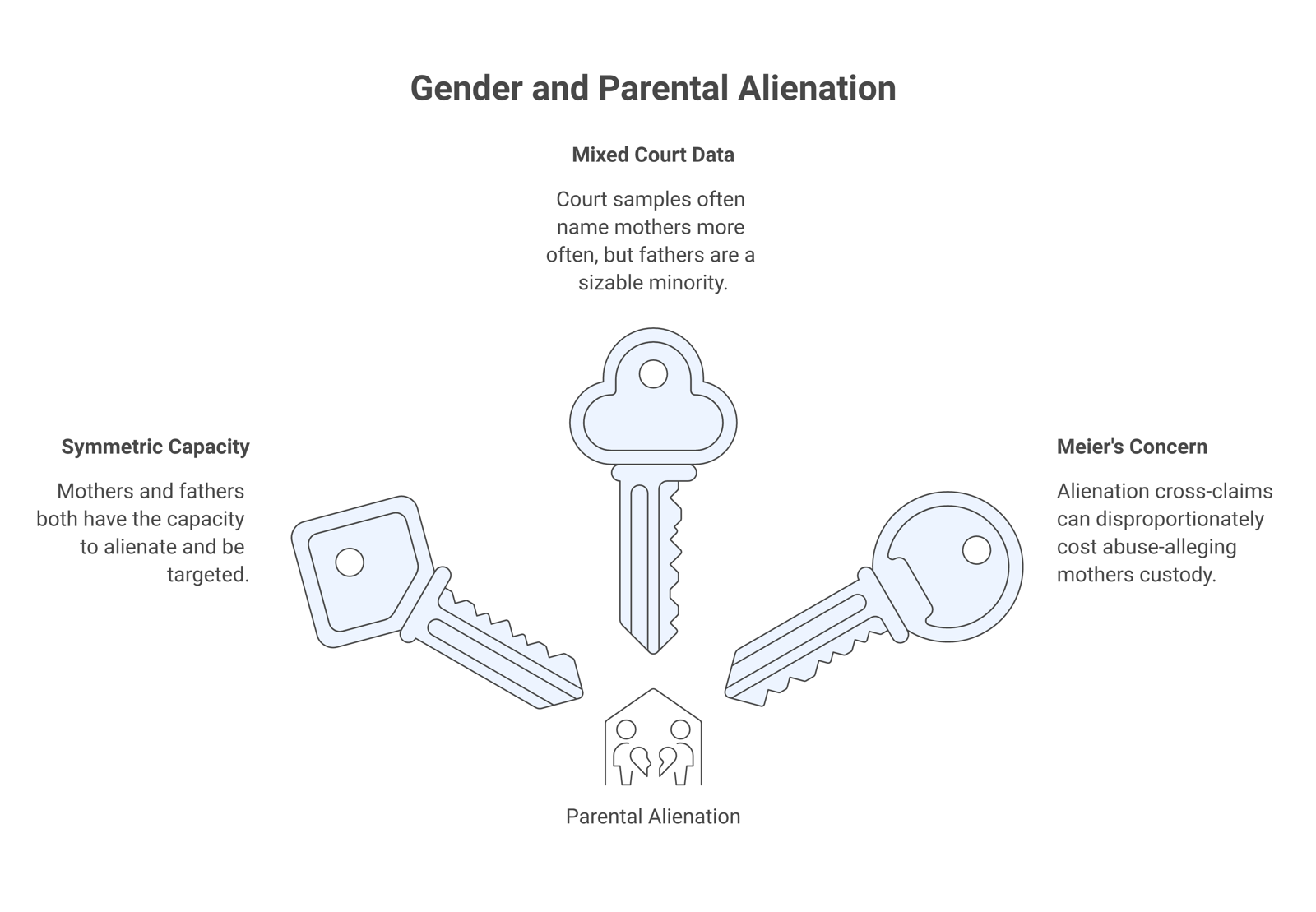
Gender and parental alienation are often linked in heated ways, but the data is more careful. Research indicates mothers and fathers are roughly equally capable of, and vulnerable to, alienating behaviors, with differences mostly in strategy. Prevalence figures are wide estimates. Court samples are mixed. One serious finding is that alienation cross-claims can cost abuse-alleging mothers custody.
A note on safety
A child’s rejection of a parent is not always alienation. When a child distances from a parent because of genuine abuse, neglect, or danger, that is justifiable estrangement, not parental alienation, and the two must never be conflated. Abuse and alienation can also co-occur, which is part of why the gender question is so contested.
This page is general education, not legal or clinical advice. It does not diagnose any family or assess any case. Figures are cited as estimates. Anyone navigating a specific situation should consult a licensed professional.
The short answer
Parental alienation is not inherently a one-gender phenomenon. Research indicates that mothers and fathers are roughly equally capable of alienating behaviors, and roughly equally vulnerable to being the targeted parent. The differences that show up are mostly differences in strategy, not in who does it.
The numbers people quote need care. Prevalence estimates are wide and depend heavily on how a study defines and measures alienating behavior. Court-identified samples often name mothers more often as the alienating parent, with fathers a sizable minority, but a court sample is not a population rate. A separate and serious finding sits alongside all of this: one large US study found that when a parent accused of abuse responds by alleging alienation, that cross-claim disproportionately costs abuse-alleging mothers custody. The honest picture holds these threads together rather than picking a side.
Why people think parental alienation is gendered
Two stories circulate, and they point in opposite directions. One says parental alienation is something fathers do to mothers. The other says parental alienation is a weapon fathers use against mothers in court. Both are oversimplifications, and the evidence supports neither as a general rule.
The first story draws on family-court samples, where the parent identified as alienating is often the mother, because mothers more often hold primary residence after separation. The second story draws on a real concern from the domestic-violence field: that an abuse allegation can be reframed as “alienation” to deflect scrutiny. Each camp has a grain of truth and a large blind spot. Reading the gender question well means seeing where each story comes from without adopting either as the whole truth. The broader question of whether the construct itself is sound is covered on is parental alienation real.
What the research shows about who alienates
When researchers ask who is capable of alienating behavior, the answer is not one gender. It is both.
Capacity and vulnerability look roughly symmetric
Work by Jennifer Harman and colleagues, drawing on representative US survey samples, indicates that mothers and fathers engage in alienating behaviors at broadly similar rates, and that both can be the targeted parent. Their prevalence research, published in the journal Children and Youth Services Review, estimated that a large number of US parents report being the target of such behaviors, with no clean split that makes this a male problem or a female problem. Surveys of frontline practitioners point the same way: clinicians who work these cases report seeing alienating behavior from mothers and from fathers.
This symmetry is a finding about capacity and vulnerability, not a claim that the two genders behave identically in every setting. It is also contested. Some scholars in the domestic-violence field argue that gender-neutral framing can obscure patterns of abuse, and that point deserves to be heard rather than waved away. The careful reading is that capacity runs both ways, while context still matters.
Differences show up mostly in strategy
Where research does find gender differences, they tend to be in how alienating behavior is carried out rather than how often. In the work cited above, mothers more often used indirect strategies, while fathers in the same studies used both indirect and direct strategies. Indirect strategies might include subtle gatekeeping or shaping a child’s perception over time. Direct strategies might include open denigration or interference with contact.
Strategy is not the same as frequency, and it is not the same as harm. A difference in method does not tell you which parent alienates more, and it does not tell you how a given child is affected. Treating a strategy finding as if it settled the “who does this more” question is a common error.
What prevalence numbers do and do not tell us
People reach for a single number, and parental alienation does not offer one cleanly. Estimates of how many parents are affected run into the millions in the United States. One widely cited figure, from Harman, Kruk and Hines in 2018, put the number of US adults who report being targets of alienating behaviors at roughly 22 million. Representative polls from 2016 and 2019 produced figures in the same broad neighborhood.
These are estimates, and they move with the definition. A study that counts any reported interference will produce a larger number than a study that requires a sustained pattern plus a child who has rejected a parent without a justifiable reason. So the honest way to use any prevalence figure is as an order-of-magnitude estimate, not a precise count. For a fuller treatment of the numbers, see parental alienation statistics. The key point for the gender question is that none of the credible prevalence work resolves into “mostly mothers” or “mostly fathers.” It points to a problem that affects parents of both genders.
Why court-identified samples skew
A lot of confusion comes from mixing two different kinds of data. Prevalence research asks a representative slice of the population. Court-identified samples look only at cases that reached a courtroom or a clinical evaluation. Those two lenses produce different pictures, and the courtroom lens is the one that gets quoted most.
In several smaller court-identified and clinical samples, the parent identified as alienating is the mother more often than the father, with fathers a significant minority, on the order of one third in some datasets. One forensic case series, for example, found the alienating parent was the mother in roughly fourteen of sixteen cases. A Nordic validity study found targeted parents were most often fathers, while still concluding that the behavior was “not gender specific.”
Here is the trap. A court sample is shaped by who litigates, who holds primary residence, and which cases judges flag, so it cannot stand in for a population rate. If mothers more often hold primary custody after separation, then mothers will more often be the parent positioned to restrict contact, which inflates their share in court samples without telling you anything about base rates in the general population. Reading a court skew as a prevalence fact is one of the most common mistakes in this whole area.
The Meier finding and the DV-protective concern
There is one gender finding that the page treats with particular seriousness, because it concerns child and parent safety. A 2020 national study led by Joan Meier, conducted for the US National Institute of Justice, examined custody outcomes in cases where abuse and alienation were both raised. It found that when a parent accused of abuse cross-claimed parental alienation, that move was associated with a sharp increase in the abuse-alleging parent losing custody, and the effect fell hardest on mothers. In the study’s own words, “fathers’ cross-claims of alienation virtually double mothers’ risk of losing custody.”
This finding is the strongest reason the gender question cannot be reduced to “both genders alienate, so gender does not matter.” Whatever the base rates of alienating behavior are, the way alienation claims function inside contested custody litigation can disadvantage parents raising genuine abuse concerns. That is a policy concern about how courts handle competing claims, and it is part of why several jurisdictions now insist on screening for abuse before treating a contact problem as alienation. How judges weigh these competing claims is discussed in how judges view parental alienation.
The Meier study has its limits, and naming them is part of treating it fairly. Its sample over-represents published appellate opinions, which can skew toward cases where mothers lost, and the authors are clear that the data cannot show that any individual ruling was wrong. Affirming scholars argue that an appellate-skewed sample cannot establish base rates. Those critiques are real. They do not erase the core concern, which is that abuse allegations and alienation allegations can collide in ways that put protective parents at risk. The research on how abuse and alienation interact is covered in research on parental alienation and abuse.
Two oversimplifications the evidence rejects
Put the pieces together and two popular claims fall apart.
The first claim is that parental alienation is something fathers do to mothers. The capacity research does not support it. Both genders engage in alienating behavior, both can be targeted, and the prevalence estimates do not break down along gender lines. Treating alienation as a male behavior erases the fathers and the mothers who do not fit that script, and it misreads court samples as population facts.
The second claim is that parental alienation is a weapon fathers use against mothers. This one is more careful, because the Meier finding shows that alienation cross-claims really can disadvantage abuse-alleging mothers in court. The mistake is jumping from “alienation claims can be misused against protective mothers” to “alienation is therefore always or only a male weapon.” Genuine alienation happens, it harms children, and it is not confined to one gender of perpetrator or target. The right conclusion is narrower and harder: courts must screen for abuse first, take the Meier concern seriously, and still recognize that real alienation occurs across genders. The neighboring page parental alienation around the world shows how different legal systems are trying to hold exactly this balance.
What this means for reading any gender claim
A few habits help when reading any statement about gender and parental alienation.
Ask whether a figure is a population rate or a court sample, because the two are constantly confused. Ask whether the study screened for abuse, since an unscreened sample can mislabel justified estrangement as alienation. Ask who produced the data and what they advocate, because both the affirming camp and the critical camp publish work shaped by their priors. And hold the abuse-vs-alienation boundary firmly, since the gender question becomes dangerous exactly when a real abuse case gets reframed, or when a real alienation case gets dismissed as mere conflict. None of these habits requires picking a gendered side. They just require reading the evidence for what it is. The full Learn silo covers the rest of the foundations.
Frequently asked questions
Do mothers or fathers commit parental alienation more?
Research indicates that mothers and fathers are roughly equally capable of alienating behaviors, so there is no credible population-level finding that one gender does it more. Court-identified samples often name mothers more often, but that reflects who litigates and who holds primary residence, not a base rate. The differences research does find are mostly in strategy.
Is parental alienation a gendered concept?
It is not inherently a one-gender phenomenon. Both genders can alienate and both can be targeted. The concept does intersect with a real gender concern, since one US study found that alienation cross-claims disproportionately cost abuse-alleging mothers custody, but that is a finding about court dynamics, not about who alienates.
Is parental alienation used against mothers in court?
It can be. A 2020 National Institute of Justice study led by Joan Meier found that when a parent accused of abuse cross-claimed alienation, the abuse-alleging parent, most often the mother, faced a sharply higher risk of losing custody. The study has acknowledged limits, but the concern that alienation claims can disadvantage protective parents is taken seriously across the field.
How common is parental alienation?
Estimates run into the millions of US parents who report being targets of alienating behaviors, with one figure putting it near 22 million. These numbers vary widely by definition and method and should be treated as estimates rather than precise counts. None of the credible prevalence work splits the problem cleanly along gender lines.
Do mothers and fathers use different alienating strategies?
Some research suggests differences in method. In several studies, mothers more often used indirect strategies, while fathers used both indirect and direct strategies. Strategy is not the same as frequency or harm, so a difference in method does not show that one gender alienates more.
Sources and further reading
- Harman, J. J., Leder-Elder, S., & Biringen, Z. (2016). Prevalence of parental alienation drawn from a representative poll. Children and Youth Services Review. sciencedirect.com/science/article/abs/pii/S0190740916301335
- Meier, J. S., et al. (2020). US child custody outcomes in cases involving parental alienation and abuse allegations. National Institute of Justice. nij.ojp.gov
- American Psychological Association. Divorce and child custody. apa.org/topics/divorce-child-custody
If you or your child are in crisis
Free and confidential help is available right now.
- 988 Suicide and Crisis Lifeline. Call or text 988. 988lifeline.org
- Childhelp National Child Abuse Hotline. 1-800-422-4453. childhelp.org
- NAMI HelpLine. 1-800-950-6264. nami.org/help
Last reviewed: 2026-06-07. Author: Parental Alienation Center.