

This page is general information, not legal advice. It does not create an attorney-client relationship, and it does not address any one state’s law. Harassment is defined differently across jurisdictions, so anyone weighing legal action should consult a licensed attorney where they live.
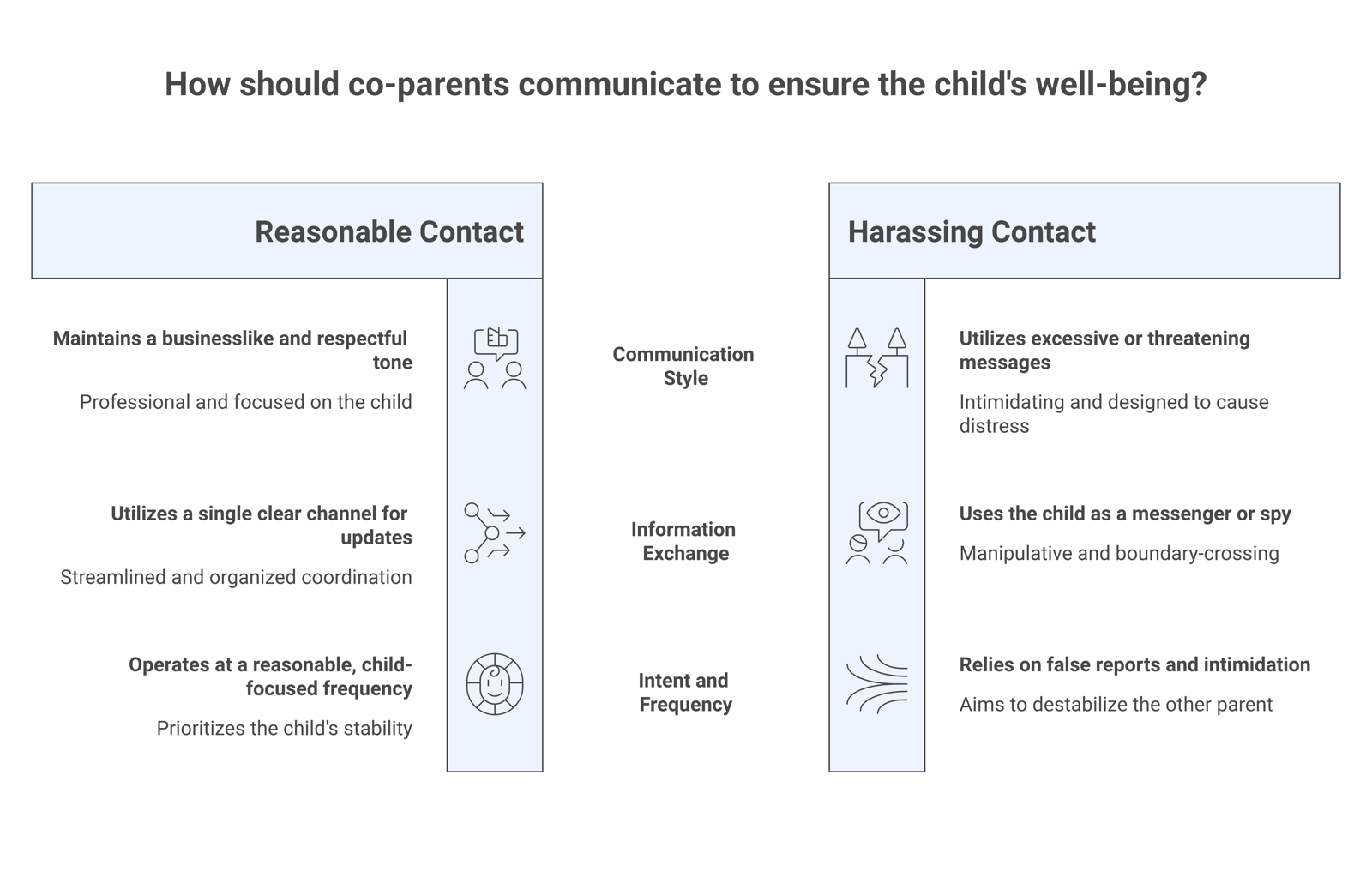
What is considered harassment by a co-parent is a pattern of contact or conduct meant to control, intimidate, or distress the other parent rather than to serve the child. It differs from ordinary co-parenting conflict in its intent, frequency, and effect. Here is how to tell the difference, the common patterns, and what you can do.
A note on safety
Harassment and abuse are not the same thing, and genuine safety concerns are not garden-variety harassment. If a co-parent’s conduct makes you fear for your safety or your child’s safety, treat that as more than harassment and seek help first. Contact local law enforcement or a domestic-violence resource before anything else.
What is considered harassment by a co-parent
Harassment is conduct aimed at a person that serves no legitimate purpose and that a reasonable person would find distressing. Between co-parents, the legitimate purpose is the child. Contact about pickups, school, health, and schedules is normal, even when it is tense. Harassment is the contact that has stopped being about the child and started being about control. The Cornell Legal Information Institute keeps a general reference on harassment, though the exact legal definition varies by state.
A simple three-part test helps. Look at intent, frequency, and effect. Intent asks what the contact is for. Frequency asks whether it is reasonable or relentless. Effect asks what it does to you over time. One sharp message is conflict. A daily stream of messages designed to wear you down is something else.
No single message proves harassment, and no single test settles it. Harassment lives in the pattern. A judge, a therapist, or a mediator looks at the whole record, not one bad day. That is why the rest of this page focuses on patterns rather than isolated moments.
Harassment versus ordinary co-parenting conflict
Conflict and harassment can look similar from the outside, so the line matters. Conflict is disagreement about parenting. Two people who love the same child can argue about bedtime, screen time, or holidays and still be co-parenting in good faith. Disagreement, even loud disagreement, is not harassment.
Harassment is different in kind, not just degree. Its purpose is not to solve a parenting question. Its purpose is to control or distress the other parent. A message that asks “Can we move Friday pickup to 5?” is conflict if you disagree about the time. A message that says “You will never be free of me” is not about pickup at all.
Not every annoying message is harassment. This distinction protects everyone. A co-parent who is curt, slow to reply, or stubborn is difficult, not necessarily harassing. Treating ordinary friction as harassment is unfair to the other parent and weakens your credibility if a real pattern ever needs to be shown. The American Psychological Association notes that high conflict harms children, and its guidance on divorce and child custody frames the goal as reducing that conflict, not winning it.
Common patterns of co-parent harassment
Harassment between co-parents tends to follow recognizable patterns. Naming them helps you see a pattern instead of a string of bad days.
Excessive messaging is the most common. This is not one urgent text. It is a flood of messages, often at all hours, often demanding instant replies, designed to occupy your mind and your time. The volume itself becomes the message.
Threats and intimidation come next. These range from open threats to take the child to subtle warnings about court, money, or reputation. The aim is fear, not resolution.
Using the children is among the most damaging patterns. A harassing co-parent may route messages through the child, quiz the child about your home, or use exchanges and visits to provoke you. Researcher Jennifer Harman places this on the “use of children” part of the power-and-control wheel: relaying messages through a child, using visitation to harass, threatening to take the child, and guilt-tripping the child. This pattern overlaps heavily with co-parent sabotage and with the signs your ex is alienating your child.
False reports are a quieter form. A co-parent may make unfounded complaints to police, schools, or child-protection agencies to harass through institutions. Drawing on appellate and Canadian research, the analyst Sharples describes false-allegation coaching and contact interference as legal-and-administrative aggression, a way to attack through systems rather than directly.
Financial and legal harassment closes the set. Repeated baseless filings, deliberate delay, and using shared costs as leverage turn the legal system itself into a weapon. The point is to drain time, money, and energy, not to resolve anything.
How harassment maps to coercive control
These patterns are not random. Together they form the coercive-control playbook, and seeing them that way changes how you read them. Harman’s work argues that parental alienating behaviors and coercive control are the same phenomenon, plotted on the Duluth power-and-control wheel. Isolation, intimidation, using the children, and economic abuse are spokes on that wheel, and a harassing co-parent often touches several at once.
Coercive control also tends to move in a cycle. The clinician Koppejan describes a five-stage pattern in which control builds, peaks, eases into calm, and then rebuilds. Recognizing the cycle helps you understand why a quiet week does not mean the pattern is over. The calm is often part of the pattern, not the end of it.
One point matters above all here. As Koppejan puts it, coercive control is “a human thing, not a gender thing.” Harassment and coercive control are not the work of one gender against another. Any parent of any gender can use these tactics, and any parent of any gender can be on the receiving end. Reading the pattern accurately matters more than any assumption about who does what.
When it is more than harassment
Some of what this page calls harassment can rise to abuse, and the line is worth taking seriously. Coercive control is recognized as a form of abuse in its own right, not just a collection of unpleasant acts. The National Domestic Violence Hotline maintains resources on coercive control and how it operates inside intimate and family relationships.
The practical signal is fear. Ordinary harassment is exhausting and distressing. Abuse adds fear for your safety or your child’s safety. When threats feel credible, when monitoring feels like stalking, or when you find yourself changing your behavior to stay safe, you are past the territory this page covers. At that point, documentation is still useful, but safety comes first. Reach out to a domestic-violence advocate or local law enforcement, and consider a safety plan with someone trained to help build one.
Constructive responses to a harassing co-parent
There are calm, child-centered responses that protect you without escalating the conflict. None of them is about winning. All of them are about reducing the harm.
Document the pattern. Keep messages, log incidents with dates and times, and save anything that shows the contact is about control rather than the child. A clear record turns a feeling into evidence. The guide on how to document parental alienation walks through building that record carefully.
Move to low-contact tools. A single, written channel, such as a co-parenting app or one monitored email thread, limits the surface area for harassment and creates a record at the same time. The page on how to communicate with a toxic ex covers techniques like brief, businesslike, child-focused replies.
Hold boundaries. You are not required to answer every message instantly or to engage with provocations. Replying only to child-related content, on a set rhythm, starves harassment of the reaction it seeks. For many families, a more separate structure is the answer, which is what parallel parenting is built for.
Seek help when you need it. A family therapist, a parenting coordinator, or a licensed attorney in your area can help you respond well. When a personality disorder seems to be driving the conduct, the page on dealing with a narcissistic co-parent offers further grounding.
Frequently asked questions
What is considered harassment by a co-parent?
Harassment by a co-parent is a pattern of contact or conduct aimed at controlling, intimidating, or distressing the other parent rather than serving the child. It includes excessive messaging, threats, using the children to relay messages or monitor, false reports, and legal or financial pressure. Intent, frequency, and effect distinguish it from ordinary conflict, and definitions vary by jurisdiction.
What is the difference between co-parenting conflict and harassment?
Conflict is disagreement about parenting, even heated disagreement, made in good faith about the child. Harassment is conduct whose aim and effect is control or distress, not resolution. The test is intent, frequency, and effect. A tense message about pickup is conflict; a relentless stream meant to wear you down is harassment.
Is constant texting from a co-parent harassment?
It can be, but frequency alone is not the test. Constant texting about a genuine child emergency is not harassment. Constant texting designed to occupy your time, provoke you, or assert control is. Look at the content and intent alongside the volume. A flood of messages aimed at distress rather than parenting points toward harassment.
What can you do about a harassing co-parent?
Document the pattern with dates, times, and saved messages. Move communication to a single low-contact channel, such as a co-parenting app. Reply only to child-related content, on a steady rhythm, and avoid reacting to provocation. Seek help from a therapist, parenting coordinator, or attorney where you live. If you feel unsafe, contact a domestic-violence resource first.
Is co-parent harassment a form of abuse?
It can be. When harassment forms a sustained pattern of coercive control, isolation, intimidation, and using the children, it is recognized as abuse rather than mere conflict. The clearest signal is fear for your safety or your child’s. If that is present, treat it as abuse, prioritize safety, and reach out to a domestic-violence advocate or local law enforcement.
What this page does not do
This page is not legal advice. It does not name any one state’s harassment statute as if it applied everywhere, and harassment thresholds differ across jurisdictions. Decisions about protective orders or filings belong to a licensed attorney working with the real facts. The page also does not coach using a harassment claim as a tactic to gain an edge in custody. The honest use of this material is to protect a child and a household, not to win a fight.
For the high-conflict personality behind some of this conduct, see dealing with a narcissistic co-parent. For undermining of your parenting, see co-parent sabotage. For a more separate structure, see parallel parenting versus co-parenting. The full Help section covers the rest.
Sources and further reading
- Cornell Legal Information Institute (Wex). Harassment. law.cornell.edu/wex/harassment
- American Psychological Association. Divorce and child custody. apa.org/topics/divorce-child-custody
- The National Domestic Violence Hotline. thehotline.org
If you or your child are in crisis
Free and confidential help is available right now.
- 988 Suicide and Crisis Lifeline. Call or text 988. 988lifeline.org
- Childhelp National Child Abuse Hotline. 1-800-422-4453. childhelp.org
- NAMI HelpLine. 1-800-950-6264. nami.org/help
Last reviewed: 2026-06-08. Author: Alex Buckles (PAC Founder).