

Healthy co-parenting strategies keep a child out of adult conflict, protect the child’s bond with both parents, and rely on calm, business-like communication. These child-centered habits, used consistently across two homes, lower tension and reduce the risk that a child is pulled into taking sides.
A note on safety
Cooperative co-parenting assumes two safe parents. Where there is abuse or coercive control, cooperation is not the goal, safety is, and parallel parenting or supervised arrangements protect the child. A child’s distancing from a parent who has been frightening or harmful is justifiable estrangement, not parental alienation. Anyone facing abuse should seek professional and legal help first.
This page is general information. It is not clinical or legal advice and does not create a professional relationship. Every family is different. A reader facing a specific situation should consult a qualified family therapist or attorney in their own area.
What healthy co-parenting strategies look like
Healthy co-parenting strategies are everyday habits that put the child first and keep two homes working together. They share one simple goal. A child should feel free to love both parents and stay out of grown-up disputes. Research on divorce and child custody from the American Psychological Association finds that children do best when conflict between parents stays low and both parents stay involved. The habits below build toward that outcome.
Five habits form the core. Keep the child out of adult conflict. Support the child’s bond with the other parent. Communicate in a calm, business-like way. Hold routines steady across both homes. Shift to parallel parenting when conflict stays high. Each habit lowers the chance that a child gets drawn into taking sides.
These strategies matter even when a split is friendly. Some parents assume an amicable separation needs no special care. Survivor educator Ryan Thomas describes a quieter pattern he calls stealth alienation, the version most likely to be missed. It shows up in low-conflict splits, where small undercutting comments build a frame over time without any open fight. A parent might sigh that the other parent “has other priorities” or “put us in a bad spot.” None of it sounds angry. The words still cut. A calm surface does not remove the need for child-centered habits. It makes them easy to forget. Readers tracking how these patterns escalate can review the stages of parental alienation.
Keep the child out of adult conflict
The most protective habit is also the hardest. Keep the child out of every adult dispute. Children are not messengers, sounding boards, or judges of who is right. Asking a child to carry a message, report on the other home, or pick a side places a loyalty burden on someone far too young to hold it.
Social scientist Jennifer Harman and colleagues describe how pressure that uses a child against the other parent maps onto patterns of coercive control. Their 2018 review in Psychological Bulletin frames repeated alienating behavior as a form of family violence. That is the line no co-parent should cross. Venting about an ex within earshot, quizzing a child after visits, or hinting that the other parent is unsafe all push a child toward that line.
A few moves help. Save adult topics for adult channels. Keep exchanges brief and neutral at the door. Speak about the other parent with basic respect, even on hard days. When upset feelings rise in front of a child, name the repair afterward. A simple “I support your time with your dad” can soften a sharp moment and protect the child from carrying it.
Support the child’s bond with the other parent
A healthy co-parent guards the child’s relationship with the other home. Clinician Stephanie Sterns describes a love-loyalty paradox. When a child senses that loving one parent risks losing approval from the other, the child gets trapped. Sterns teaches a release the favored parent can say out loud: it is okay to love everybody in the other house.
That permission matters more than it sounds. A child who hears it can relax, and the bind eases. Small signals do the same work. Speak warmly about the other parent’s plans. Keep photos from both homes visible. Encourage calls, and let the child share good news from either side. No child should feel guilty for enjoying time away.
Communicate in a business-like, child-focused way
Talk is where most co-parenting holds or breaks. The goal is plain. Treat the exchange like a working partnership focused on one shared project, the child. Messages stay short, factual, and free of blame. Topics stick to logistics: schedules, school, health, and money for the child.
A written channel helps a great deal. Email or a co-parenting app gives each parent time to think and creates a calm record. Brief, neutral replies lower the temperature on a hard day. One useful pattern keeps each message brief, informative, friendly, and firm. Questions about the other parent’s private life stay off the table. The child’s needs stay on it.
Keep consistent routines across both homes
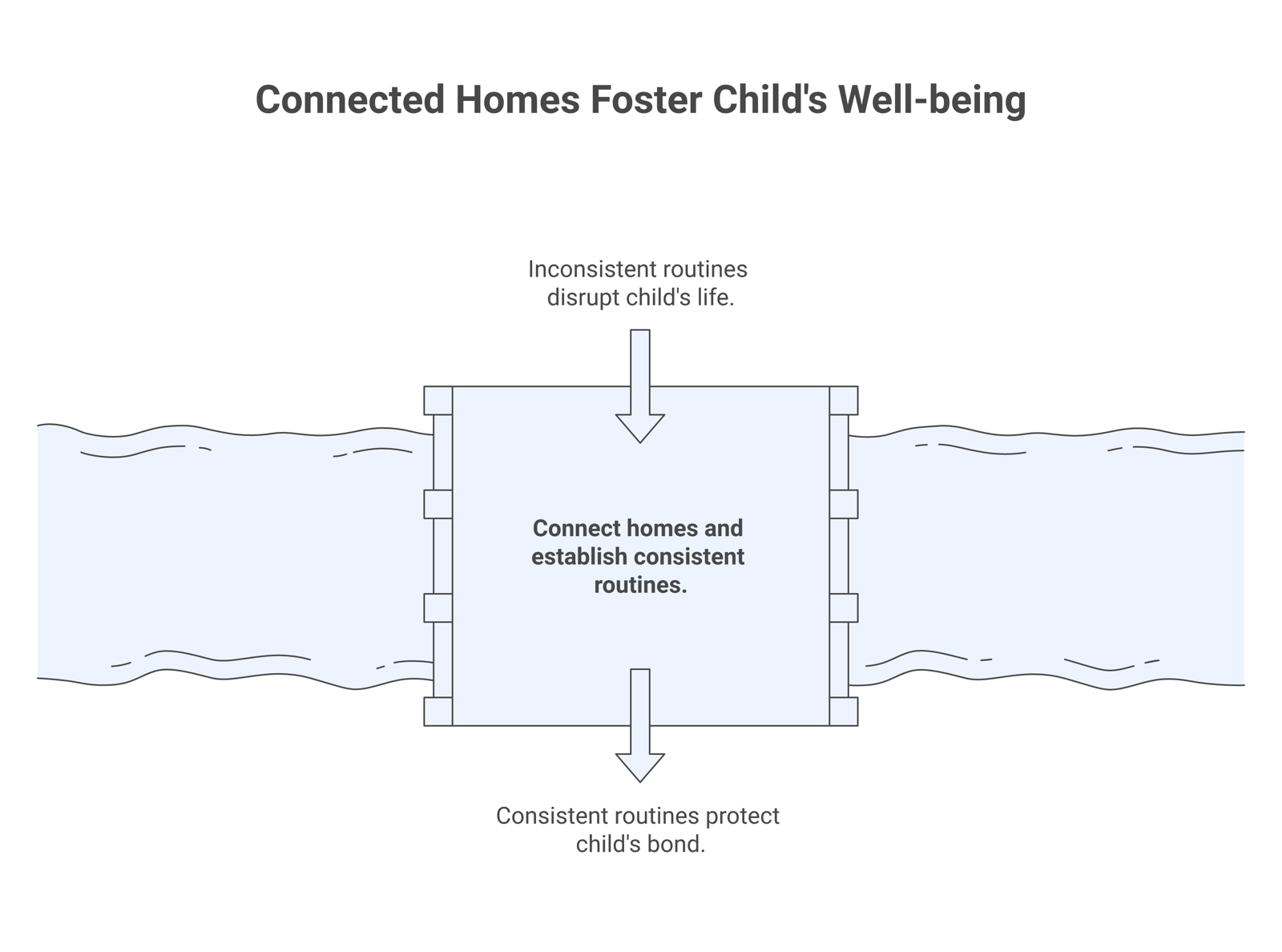
Children move between two home systems, not one. Sterns urges parents and helpers to look at both homes, not only the one in the room. Steady routines across those homes give a child a sense of safety. Bedtimes, homework habits, and screen rules do not need to match perfectly. They should rhyme.
A shared calendar keeps both parents current on practices, appointments, and events. Steady handoffs lower stress at the door. When a child knows what each week holds, the gap between homes feels smaller. Sterns notes that many adults miss how much tension between homes unsettles a child. Steady routines are the quiet fix that lowers that tension.
Know when to shift to parallel parenting
Co-parenting at its best needs two safe, willing parents. Sometimes that is not the case. Sterns places conflict on a spectrum: co-parenting, then parallel parenting, then a higher-tension tier she calls oppositional parenting, then abuse. The right strategy depends on where a family sits on that spectrum.
When conflict stays high, parallel parenting can protect a child better than a forced truce. Each parent runs their own home with minimal direct contact and a strict, business-like channel for logistics only. The child still gets both parents. The adults simply stop colliding. For a fuller comparison, see parallel parenting vs co-parenting. Parents dealing with a controlling ex can also read how to deal with a narcissistic co-parent.
Where there is abuse or coercive control, cooperation is not the goal, safety is. A child’s distancing from a parent who has been frightening or harmful is justifiable estrangement, not alienation, and it calls for protection rather than reunion pressure. Anyone in that situation should seek professional and legal guidance, and the crisis resources at the bottom of this page are available at any hour.
How to build a healthy co-parenting routine
These steps turn the habits above into a simple plan.
- Put the parenting plan in writing. Spell out the schedule, holidays, and decision rules, so there is less to argue about later.
- Choose one communication channel. Agree on email or a co-parenting app, and keep every message short and factual.
- Align core routines. Set compatible bedtimes, homework time, and screen limits across both homes.
- Protect the bond out loud. Tell the child it is okay to love both parents and both homes.
- Review and adjust. Revisit the plan as the child grows, and add a neutral third party if talks stall.
Co-parenting counseling can help two willing parents build these skills. For the earlier prevention steps during a separation, see protecting children during divorce. The full Help section covers related guidance.
Frequently asked questions
What are healthy co-parenting strategies?
Healthy co-parenting strategies are child-centered habits that help two parents raise a child across two homes with less conflict. The core habits keep the child out of adult disputes, protect the child’s bond with both parents, rely on calm and business-like communication, and hold routines steady. Used together, they lower tension and reduce the risk a child is pulled into taking sides.
How can co-parents reduce the risk of parental alienation?
Co-parents lower the risk by keeping children out of adult conflict and supporting the child’s relationship with the other parent. It helps to avoid venting about an ex, quizzing a child after visits, or using a child as a messenger. Researcher Jennifer Harman and colleagues link repeated pressure that turns a child against a parent to coercive control, so steady respect for the other home is the strongest safeguard.
What is the difference between co-parenting and parallel parenting?
Co-parenting means two parents cooperate closely and communicate often. Parallel parenting means each parent runs their own home with little direct contact and a strict channel for logistics only. Parallel parenting suits high-conflict cases, where less contact keeps the child out of the middle.
Can you co-parent with a high-conflict ex?
Working closely is hard with a high-conflict ex and may not be safe. Many families do better with parallel parenting, which limits contact while keeping both parents involved. Where there is abuse or coercive control, supervised or protective arrangements come first, and a professional should guide the plan.
Do amicable co-parents still need these strategies?
Yes. A calm surface does not guarantee a child is protected. Educator Ryan Thomas describes stealth patterns that appear in low-conflict splits, where small undercutting comments build over time. Child-centered habits keep an amicable arrangement genuinely healthy.
What this page does not do
This page does not promise that good habits will fix a determined high-conflict ex or undo alienation that is already underway. It does not frame co-parenting as winning or out-maneuvering the other parent, because that framing harms the child. It does not give clinical or legal advice, and it does not tell anyone in an abusive situation to simply cooperate. The right next step depends on the family, and a qualified therapist or attorney can help with the specifics.
Sources and further reading
- American Psychological Association. Divorce and child custody. apa.org/topics/divorce-child-custody
- Harman, J. J., Kruk, E., & Hines, D. A. (2018). Parental alienating behaviors: An unacknowledged form of family violence. Psychological Bulletin, 144(12), 1275 to 1299. https://doi.org/10.1037/bul0000175
If you or your child are in crisis
Free and confidential help is available right now.
- 988 Suicide and Crisis Lifeline. Call or text 988. 988lifeline.org
- Childhelp National Child Abuse Hotline. 1-800-422-4453. childhelp.org
- NAMI HelpLine. 1-800-950-6264. nami.org/help
Last reviewed: 2026-06-06. Author: Alex Buckles, Founder.