

This page is general information, not legal or clinical advice. It does not create a professional relationship and does not address any one state’s rules.
Co-parenting like a business means running the relationship as a low-emotion working partnership: shared rules, professional communication, and the parenting plan as the contract you fall back on. It is not cold, and it is not about winning. It is a way to protect the child and keep yourself out of conflict you cannot control.
A note on safety
This model assumes two safe people who can do business at arm’s length. Where there is abuse or fear for safety, a business mindset is not a substitute for a safety plan and protective measures. If that is your situation, see the resources at the foot of this page first.
What “co-parenting like a business” means
Co-parenting like a business means relating to your co-parent the way two professionals relate when they have to keep a shared enterprise running, regardless of how they feel about each other. The certified family mediator Matthew Brickman calls the shared enterprise “Kid Inc.” and describes the parents as two CEOs of the same company, bound by the same rules, each accountable for their part.
The point of the model is to take the relationship out of the emotional register, where high-conflict co-parenting always goes badly, and put it into a working one. Two CEOs do not have to like each other. They have to keep the company running. The “company” here is your child’s stable, two-home life, and the job is to run it well even when the personal relationship is over and painful.
This reframe does real work. It gives you a script for hard moments (“what would a professional do here?”) and it lowers the stakes of each interaction. You are not trying to repair a marriage or win an argument. You are keeping Kid Inc. running.
The parenting plan is your contract
In a business, the partners do not renegotiate the whole relationship every time a question comes up. They rely on the documents they already signed. In co-parenting, the parenting plan plays that role. Brickman calls the plan the company’s “corporate docs,” and compares it to the umbrella you keep in the car: most days it stays where it is, and you pull it out only when the weather turns.
Used this way, the plan settles disputes before they spiral. When a disagreement starts, the businesslike move is not to argue about who is right but to check what the plan already says and follow it. That takes the heat out of the exchange and keeps decisions predictable for the child.
Two habits make the contract model work. Keep a calm, factual record of what happens, so the pattern is clear if the plan is ever in question; the page on how to document parental alienation shows how. And remember that what a plan means and how it is enforced are legal questions for an attorney, not something to settle by argument in a text thread. The plan is your default. The lawyer is who tells you what it can do.
The Four Ds: where conflict actually starts
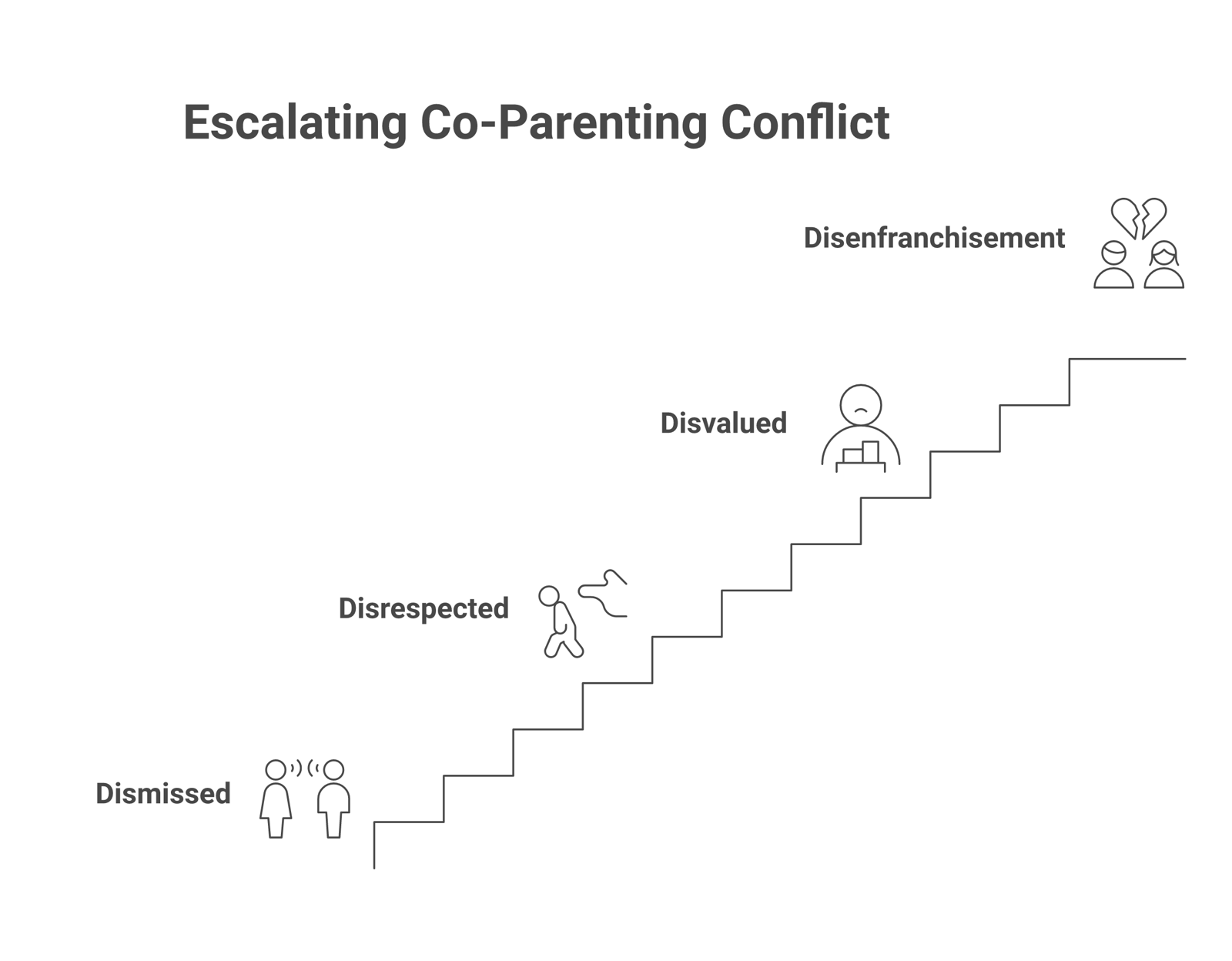
Brickman describes a simple chain that explains why co-parents keep fighting. Conflict tends to begin when a parent feels Dismissed, then Disrespected, then Disvalued. Left there, those feelings lead to Disenfranchisement: the parent checks out, the working relationship breaks down, and conflict fills the space.
Seeing the chain helps in two directions. It helps you notice when your own reactions are coming from feeling dismissed or disrespected, which is the moment to slow down rather than fire back. And it helps you avoid triggering the chain in the other parent, not to manage them, but because a co-parent who feels completely dismissed becomes harder to do business with, and the child pays for the breakdown.
None of this asks you to accept genuine mistreatment. It is a map of how ordinary friction escalates into entrenched conflict, so you can step off the chain earlier.
How to run the relationship like a business
A few practices turn the mindset into daily habit. Keep communication professional and route it through one written channel, the way a company keeps a paper trail; the best way to communicate with a high-conflict co-parent page covers the messaging method in detail. Make decisions based on the plan and the child’s needs rather than on how you feel about the other parent that day.
Hold the same rules for both sides, and expect accountability both ways. A business relationship is not one person managing another; it is two parties held to a shared standard. Keep meetings and messages short and on-agenda. Save the personal history for your therapist or support group, not the co-parenting channel.
The aim of all of it is steadiness. A parent who runs the relationship like a business is harder to provoke, easier for professionals to read as the reasonable one, and far less drained by the daily friction. For the cooperative end of the spectrum, see healthy co-parenting strategies.
What a business mindset protects the child from
The reason to depersonalize is not only your own peace. It is the child. Research on how children absorb their parents’ emotions, summarized in the work of Bill Eddy, shows that children carry the tension between their parents in their own bodies, and that low conflict is one of the strongest protections for a child’s wellbeing. The American Psychological Association makes the same point about children doing best when parental conflict stays low and routines stay steady.
A business relationship is, by design, a low-conflict one. Every argument you decline to have, every decision you make by the plan instead of by the fight, is tension your child does not have to absorb. The model is not cold toward the child at all. It is one of the warmest things you can do for them, because it keeps their two homes calm.
When business-as-usual is not enough
Sometimes even a businesslike parent cannot get cooperation, because the other side will not do business in good faith. When that happens, the answer is often less contact, not more. Parallel parenting versus co-parenting describes a structure that reduces direct interaction while still serving the child, which can be the right move when the partnership keeps failing.
Two other pages help at the edges. If a decision has to be made together and you are heading into mediation, how to prepare for child custody mediation walks through it. And if the contact has turned relentless rather than merely difficult, what is considered harassment by a co-parent helps you tell the difference. The business model is a strong default. It is not the only tool.
Frequently asked questions
What does co-parenting like a business mean?
It means relating to your co-parent the way two professionals run a shared company: low emotion, shared rules, professional communication, and the parenting plan as the contract you follow. The goal is a stable, calm life for the child, not repairing the personal relationship or winning arguments.
How do you co-parent with someone you cannot stand?
You shift from a personal relationship to a working one. Two business partners do not have to like each other to keep a company running. Keep communication short and professional, make decisions by the plan rather than by feeling, and save the personal history for your therapist or support group.
Should the parenting plan be treated like a contract?
In practice, yes, as your default reference. When a dispute starts, check what the plan already says and follow it rather than renegotiating from scratch. What a plan means legally and how it is enforced are questions for an attorney, but using it as your day-to-day contract prevents a lot of conflict.
Why do co-parents keep fighting?
One useful map is the Four Ds: conflict often starts when a parent feels dismissed, then disrespected, then disvalued, and ends in disenfranchisement, where the working relationship collapses. Noticing the chain early, in yourself and the other parent, is how you step off it before it escalates.
Does a business approach work with a high-conflict ex?
It helps, because it removes much of the emotional fuel the conflict runs on, and you control your own half regardless of the other parent. When the other side will not do business in good faith, a lower-contact structure like parallel parenting is often the better fit.
What this page does not do
This page does not coach tactics against the other parent, and it does not promise the other parent will cooperate. It does not give legal advice about your parenting plan, and it does not treat genuine abuse as ordinary high conflict. It is general information, not legal or clinical advice, and it does not address any one state’s rules.
Sources and further reading
- Association of Family and Conciliation Courts. afccnet.org
- American Psychological Association. Divorce and child custody. apa.org/topics/divorce-child-custody
- Cornell Legal Information Institute (Wex). Mediation. law.cornell.edu/wex/mediation
If you or your child are in crisis
Free and confidential help is available right now.
- 988 Suicide and Crisis Lifeline. Call or text 988. 988lifeline.org
- Childhelp National Child Abuse Hotline. 1-800-422-4453. childhelp.org
- NAMI HelpLine. 1-800-950-6264. nami.org/help
Last reviewed: 2026-06-10. Author: Alex Buckles (PAC Founder). Editorial review: held to the PAC Editorial Standards (balance, primary-source citation, reader safety); an independent expert review board will be appointed.