

Co-parenting counseling is a relational therapy that helps two willing parents in a lower-conflict case communicate, plan, and parent together after separation. It is contraindicated in cases of active parental alienation, coercive control, or ongoing abuse, where parallel parenting and structured communication frameworks such as BIFF and EAR are safer. Choose the path that matches your case.
A note before you read
If you are afraid of your co-parent, if your co-parent monitors, controls, or punishes you for ordinary parenting decisions, or if there is a history of physical, sexual, or financial abuse, joint co-parenting counseling is not the right intervention. Joint sessions can give an abusive partner a stage on which to perform reasonableness and a private setting in which to coerce you afterward. A licensed professional with experience in coercive control should help decide what is safe in your specific case.
What co-parenting counseling is
Co-parenting counseling is a short-to-medium-term form of family therapy aimed at the relationship between two separated or divorced parents, not at the marriage and not at any one person’s mental health. The work focuses on practical questions. How will decisions about school, medical care, and activities get made. How will the calendar move. How will the parents speak to each other in front of the child and out of earshot of the child. How will they handle a disagreement when it lands.
A trained co-parenting counselor brings a few common tools. They help the parents agree on a small set of rules of engagement, often in writing. They translate emotionally loaded exchanges into neutral language. They surface the patterns that produce conflict at handoffs, on holidays, and during transitions. The American Psychological Association maintains general guidance on family therapy and on divorce and child custody, which is a reasonable starting point for understanding the modality and its limits.
The work assumes one structural condition. Both parents are willing to be in the room together and willing to be held accountable in front of each other. When that condition holds, the modality has real value. When it does not, the modality cannot do its job.
When co-parenting counseling helps
Co-parenting counseling tends to help when four conditions are present together. The first is that both parents genuinely want a workable arrangement for the child, even if they no longer want each other. The second is that the conflict between them, while uncomfortable, is bounded. Disagreements are about scheduling, money, or parenting styles, not about whether one parent is fundamentally safe or fit. The third is that neither parent uses the child as a messenger or a witness. The fourth is that both parents can sit in the same room without one feeling unsafe or controlled.
When these four conditions are present, the modality reliably improves communication, reduces handoff friction, and lowers the child’s exposure to conflict. It does not require the parents to like each other. It requires them to operate a shared project, which is what raising a child after separation actually is.
A useful diagnostic in the first one or two sessions is whether the work moves forward. In a case the modality fits, the parents leave with a small, specific agreement they did not have when they walked in. In a case the modality does not fit, the same conversations recur, the same flashpoints reappear, and the counselor finds themselves refereeing rather than facilitating. The pattern usually shows up early. A clinician who notices it and names it has done useful work even if the work then stops.
When co-parenting counseling is contraindicated
Three categories of case make co-parenting counseling actively wrong. Each one has its own mechanism for why joint sessions cause harm.
Active parental alienation
A parent who is actively shaping a child against the other parent is not, in clinical terms, a high-conflict co-parent. The behavior pattern fits the picture of coercively controlling abuse. Jennifer Harman and colleagues, writing in Psychological Bulletin, map parental alienating behaviors directly onto coercive control and treat them as a form of family violence. In a case meeting that description, joint counseling gives the alienating parent a controlled setting in which to perform reasonableness for the therapist while the underlying pattern continues at home. Adult survivor and clinician collaborator Maddie, who runs the Anti-Alienation Project, has described years of joint sessions that, in retrospect, deepened the rejection rather than easing it.
The cleaner intervention sequence, named by Linda Gottlieb and Craig Childress, is protection first and reunification second. That sequence cannot happen inside a joint relational session. It requires a different modality. See parental alienation therapy for the modalities that fit this case, child brainwashed against parent for the signs, and how to stop parental alienation for the wider sequence.
Coercive control
Coercive control is a pattern of behavior in which one partner systematically restricts the other’s autonomy, isolates them, monitors their communication, and punishes deviation. Research from Stefan Koppejan and colleagues frames coercive control as gender-symmetric and emphasizes forensic assessment over assumption. In a coercive-control case, joint counseling does not address the dynamic and can supply the controlling partner with new tools, including the therapist’s vocabulary, to use against the targeted partner afterward. The honest move is parallel parenting and structured communication. See section 4.
Ongoing abuse
Active physical, sexual, or severe emotional abuse rules out joint work entirely. The American Psychological Association and most clinical bodies treat any joint relational work between an abuser and a survivor as contraindicated. The right next step is safety planning and, where appropriate, a domestic-violence advocate or attorney with specific training. A child’s parent who is currently being abused cannot do the kind of equal-footing relational work co-parenting counseling requires. Joint sessions misread the imbalance as conflict and ask the survivor to compromise on a problem that is not theirs to solve.
Co-parenting counseling vs parallel parenting
When joint counseling does not fit, parallel parenting often does. The two structures answer different questions.
Co-parenting counseling assumes that the parents will talk to each other directly and frequently, that they will make joint decisions on major issues, and that they will appear together at school events and pediatric appointments. The work makes that talking less painful.
Parallel parenting assumes the opposite. The parents communicate as little as possible, on a defined channel, in writing, and only about logistics. Each parent makes day-to-day decisions in their own household without consulting the other. Major medical and educational decisions follow the court order. Handoffs happen at neutral places or, in stricter versions, through a third party. The point is to reduce contact between adults who cannot productively share contact, which protects the child from being routed through the conflict.
Bill Eddy of the High Conflict Institute developed much of the structure now used in parallel-parenting practice. The Association of Family and Conciliation Courts publishes parenting-coordination guidelines that overlap with parallel parenting at the higher-conflict end of the spectrum. See AFCC for the organizational reference.
The honest choice between the two is rarely a preference. It is a fit question. If both parents can sit in a room together and work, co-parenting counseling is the lower-friction path. If they cannot, parallel parenting reduces friction by reducing contact. Either path can produce a stable arrangement for the child. The wrong path for a given case can produce a worse one than no intervention at all.
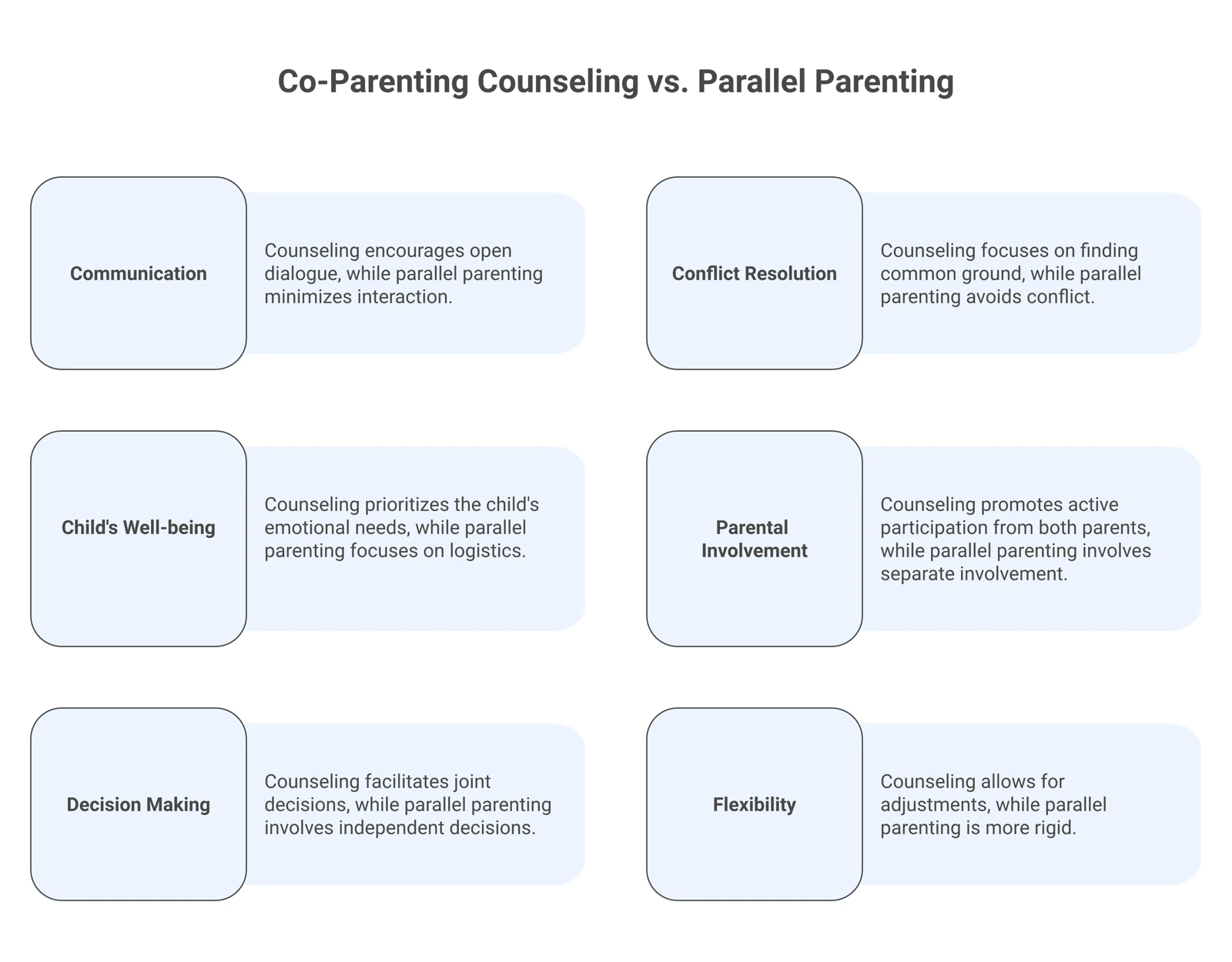
| Dimension | Co-parenting counseling | Parallel parenting |
|---|---|---|
| Communication | Direct, frequent, often verbal | Minimal, written, defined channel |
| Decisions | Joint on major issues | Independent in each household; court order on majors |
| Conflict tolerance required | Bounded, manageable | Low to none required between adults |
| Fits when | Both parents willing and the case is lower-conflict | Conflict is high or one parent feels unsafe |
| Contraindicated when | Active alienation, coercive control, ongoing abuse | Decisions require continuous coordination and both parents are safe |
| Communication frameworks that travel | BIFF, EAR | BIFF, EAR |
What to look for in a co-parenting counselor
The single biggest mistake in this modality is choosing a kind, general family therapist who treats co-parenting work as ordinary couples counseling. A few intake-call questions sort the fit.
Ask whether the clinician has specific training and recent practice in high-conflict separation work, not general couples therapy. Ask whether they have training in screening for coercive control. Ask how they would handle a session in which one parent appeared afraid of the other. Ask whether they will refuse joint work if their screening turns up a coercive-control or active-alienation pattern, rather than continuing because the parents asked for it. A clinician willing to refuse a case for clinical reasons is signalling exactly the discipline the modality requires.
A few red flags belong here. A counselor who promises a workable arrangement after a fixed number of sessions is overselling. A counselor who treats “you both need to communicate better” as the headline finding without screening for power imbalance is missing the most important question in the assessment. A counselor who pressures a reluctant parent to participate because participation looks cooperative is providing cover for whichever parent benefits from joint sessions.
For coping while the case grinds, regardless of which path you choose, see dealing with parental alienation. This page is general information and not clinical or legal advice. The right intervention for a specific family is a decision for licensed professionals who have met that family.
The BIFF and EAR communication frameworks
Bill Eddy developed two communication structures used widely in both co-parenting counseling and parallel parenting. Both travel across paths and both reduce escalation when used consistently. They are not magic. They are habits.
BIFF: Brief, Informative, Friendly, Firm
BIFF governs how to respond to a hostile or provocative message from a high-conflict co-parent. Brief means a few sentences at most, because long replies invite long counter-replies. Informative means facts only, not feelings or interpretations. Friendly means a neutral tone without sarcasm, blame, or threats. Firm means stating the answer clearly so there is no ambiguity to litigate later.
A BIFF response to a long, accusatory email about a missed handoff might read: “Thanks for the note. Pickup tomorrow is at 5 p.m. at your house, per the order. I will text on arrival.” That is brief, informative, friendly, and firm. It is also unsatisfying to write, because it leaves the accusations unanswered. That is the point. Engaging the accusations rewards the pattern that produced them.
EAR: Empathy, Attention, Respect
EAR is the verbal counterpart for the in-person moment when a co-parent is escalating. An EAR statement names the other parent’s feeling, signals that you are listening, and expresses respect without conceding the substance. “I can see you are frustrated about pickup. I want to understand. I respect that you have a different read on it.” The structure is not agreement. It is de-escalation. It buys the conversation thirty seconds in which the other parent’s nervous system can come down enough to talk.
Both BIFF and EAR have a single common rule. They are most useful when the person using them does not need them to work. A parent who deploys BIFF to win the email exchange has missed the point. The technique reduces the temperature of the system over time. The system, in turn, becomes safer for the child.
When the court orders co-parenting counseling
Courts sometimes order co-parenting counseling as part of a custody case. When that happens, the same fit questions still apply. A court order does not change the clinical picture. A case that is structurally inside a coercive-control or active-alienation pattern cannot be safely worked in joint sessions just because a judge directed the parents to try.
A few practical notes belong here. A clinician asked to conduct court-ordered counseling in a case they would otherwise screen out has a professional obligation to flag the contraindication to the court rather than proceed quietly. A targeted parent ordered into joint sessions in an actively alienating case can ask for the court to clarify the scope of the work and to require the counselor to use a coercive-control screening tool at intake. Whether and how any of that can happen is a question of law that varies by jurisdiction. The legal pathways live in the court silo. For the construct itself, see parental alienation syndrome.
Frequently asked questions
What is co-parenting counseling?
Co-parenting counseling is a short-to-medium-term form of family therapy aimed at the relationship between two separated parents. The work focuses on shared decisions, calendaring, communication, and conflict at handoffs. It is not couples therapy and not individual mental-health treatment. The modality assumes that both parents are willing to be in the room together and willing to be held accountable in front of each other.
Does co-parenting counseling work?
It depends on fit. Co-parenting counseling tends to work when both parents want a workable arrangement, conflict is bounded, neither parent uses the child as a messenger, and both parents feel safe in the room. When those four conditions hold, the modality reliably reduces friction. When any of them fails, the modality stalls and can deepen harm.
When is co-parenting counseling not appropriate?
In three categories of case. First, active parental alienation, where one parent is shaping the child against the other and the pattern fits coercively controlling abuse. Second, coercive control, where one partner systematically restricts the other’s autonomy. Third, ongoing physical, sexual, or severe emotional abuse. In all three, joint sessions give the controlling or alienating parent a stage and can supply tools to use afterward. Parallel parenting and structured communication frameworks are the safer fit.
What is the difference between co-parenting counseling and parallel parenting?
Co-parenting counseling assumes the parents will talk directly and make joint decisions on majors. Parallel parenting assumes the opposite. Parallel parenting reduces contact between the adults to a defined written channel, has each parent make day-to-day decisions in their own household, and follows the court order on majors. The choice between them is a fit question, not a preference. Co-parenting counseling fits lower-conflict, two-willing-parents cases. Parallel parenting fits cases where one parent feels unsafe or the conflict is unmanageable.
What is the BIFF method?
BIFF is Bill Eddy’s communication structure for replying to a hostile or provocative message. Brief means a few sentences. Informative means facts only. Friendly means a neutral tone without sarcasm or threats. Firm means stating the answer so clearly there is no ambiguity to litigate later. BIFF works in both co-parenting counseling and parallel parenting and is also useful when neither structure is in place.
Where to go next
- For the broader Help library, start at the Help pillar.
- For the therapy modalities used when alienation is active, see parental alienation therapy.
- For first steps, daily coping, and the full intervention sequence, see how to stop parental alienation.
- For the legal pathways to court-ordered counseling, see the court silo.
Sources and further reading
- Eddy, B. BIFF: Quick Responses to High-Conflict People and Don’t Alienate the Kids. High Conflict Institute Press. BIFF and EAR communication frameworks and high-conflict family practice.
- Harman, J. J., Kruk, E., & Hines, D. A. (2018). Parental alienating behaviors: An unacknowledged form of family violence. Psychological Bulletin, 144(12), 1275 to 1299. https://doi.org/10.1037/bul0000175
- American Psychological Association. (n.d.). Divorce and child custody. apa.org/topics/divorce-child-custody
- Association of Family and Conciliation Courts (AFCC). Parenting coordination and high-conflict practice guidelines. afccnet.org
- Gottlieb, L. Turning Points for Families. Protection-first, reunification-second sequence as applied to court-ordered relational work.
- Childress, C. A. (2015). Foundations: An Attachment-Based Model of Parental Alienation. Oaksong Press. The protection-first doctrine.
- Koppejan, S. Coercive-control-is-gender-symmetric framework and forensic case-investigation discipline.
- Coleman, J. (2021). Rules of Estrangement: Why Adult Children Cut Ties and How to Heal the Conflict. Harmony. Estrangement vs alienation taxonomy.
If you or your child are in crisis
Free and confidential help is available right now.
- 988 Suicide and Crisis Lifeline. Call or text 988. 988lifeline.org
- Childhelp National Child Abuse Hotline. 1-800-422-4453. childhelp.org
- NAMI HelpLine. 1-800-950-6264. nami.org/help
Last reviewed: 2026-06-05. Author: Alex Buckles, Founder.