

This page is general information, not legal or clinical advice. It does not address any one state’s custody law or any one family’s situation. Anyone facing a specific custody, safety, or mental-health concern should consult a licensed professional in their own area.
Co-parenting boundaries are clear, child-centered limits on how two separated parents communicate and coordinate. A boundary is a rule for your own conduct, not a way to control your ex. Good boundaries protect the child from adult conflict and keep you steady. Here is what to set, and how to hold it.
A note on safety
A boundary is not a substitute for safety. Where there is abuse or coercive control, a self-enforced limit is not enough, and a structured or no-contact arrangement, plus professional and legal help, may be needed. If you or your child are in danger, contact local law enforcement or a domestic-violence resource first.
What a co-parenting boundary is (and is not)
A boundary is a limit you set on your own behavior. It is the line you decide to hold, not a command you issue to the other parent. You can decide to answer parenting messages once a day. You cannot decide that your ex will stop sending them. The first is a boundary. The second is a wish.
This distinction sounds small, and it changes everything. A boundary you control is one you can actually keep. A rule aimed at the other adult depends on their cooperation, which is exactly what a difficult co-parent withholds. When you frame the limit around your own response, you stop handing your peace to someone who has not earned it.
Healthy boundaries are also child-centered. The test for any limit is simple. Does this protect the child, or does it serve the adult conflict? A boundary that shields a child from arguments is sound. A boundary used to punish, exclude, or score points is not. The American Academy of Pediatrics offers helpful, child-focused guidance for separated families that keeps the focus where it belongs. To revisit the basics, see what co-parenting is.
The main areas to set boundaries
Boundaries are easier to hold when they are specific. Vague good intentions collapse under pressure. Clear limits in named areas give you something to stand on. Here are the areas that matter most.
Communication channel and frequency. Pick one channel and one rhythm. Many parents use a single co-parenting app or one email thread, checked at set times rather than all day. One channel ends the chaos of texts, calls, and messages arriving everywhere at once.
Money. Keep money in writing and tied to the agreement. Verbal promises and last-minute demands invite conflict. A short written record of who pays what, and when, removes most of the friction.
Scheduling. Exchanges, pickups, and changes belong in one shared calendar, confirmed in writing. Spontaneous changes by phone create misunderstandings that land on the child.
The child as a topic. The child is not a messenger, a spy, or a sounding board for adult grievances. Keeping the child out of adult conflict is the single most protective thing a parent can do. The American Psychological Association notes that ongoing conflict between parents is what harms children most, more than the separation itself.
New partners. Each parent decides how and when to introduce a new partner to the child, on a thoughtful timeline. Neither parent gets a veto over the other’s private life, within the bounds of the child’s safety.
Privacy. Your home, your schedule, your relationships, and your finances are yours. A co-parent is entitled to information that affects the child, not to surveillance of your life.
A usable list of co-parenting boundaries
Parents often want a list they can adapt. Here is a starting set. Treat it as a menu, not a script, and shape it to the child’s age and the family’s situation.
- Use one agreed channel for all parenting communication.
- Respond within a set, reasonable window rather than instantly.
- Keep messages businesslike and focused on the child.
- Confirm all schedule changes in writing.
- Handle money matters in writing and tied to the agreement.
- Do not discuss the other parent with the child or through the child.
- Do not ask the child to carry messages or report on the other home.
- Keep your home, finances, and relationships private.
- Respect each parent’s right to introduce new partners on their own timeline.
- Step back from any exchange that turns hostile, and return to it in writing.
A list works only when you hold it the same way every time. Consistency is what teaches a difficult co-parent where the line actually sits.
How to hold a boundary calmly
Setting a boundary is the easy part. Holding it under pressure is the work. A widely used method for high-conflict communication is BIFF, developed by attorney and conflict specialist Bill Eddy. BIFF stands for Brief, Informative, Friendly, and Firm.
Brief. Short replies give less to react to. A few sentences usually beat a paragraph.
Informative. Stick to facts and logistics. Skip the defense, the history, and the emotion.
Friendly. A neutral, courteous tone lowers the temperature, even when the other message did not.
Firm. Close the loop. State the plan once, then stop. You do not owe a difficult co-parent an argument or a third explanation.
Over-explaining is the most common way parents lose a boundary. Each extra justification reopens the debate. State the limit, hold it, and let silence do the rest. Keep the child off the message thread entirely. For more on wording these messages, see how to communicate with a toxic ex, and for surviving a high-conflict personality, see how to deal with a narcissistic co-parent.
The difference between a boundary and control
This is where many parents get stuck, and where a difficult ex will often accuse you of the very thing you are trying to avoid. The line is clear once you see it.
A boundary limits your own conduct. Control tries to dictate someone else’s. Researcher Jennifer Harman, who studies coercive control in families, draws this line carefully. A firm boundary is consistent, child-centered, and aimed at your own response. Controlling behavior shows up as demands, surveillance, and contact meant to distress rather than to coordinate.
So “I will answer parenting emails once a day” is a boundary. “You may only email me, and you must reply within an hour” is a demand. Checking a co-parenting app at a set time is a boundary. Monitoring the other parent’s social media or showing up uninvited is not. The diagram below lays the two side by side.
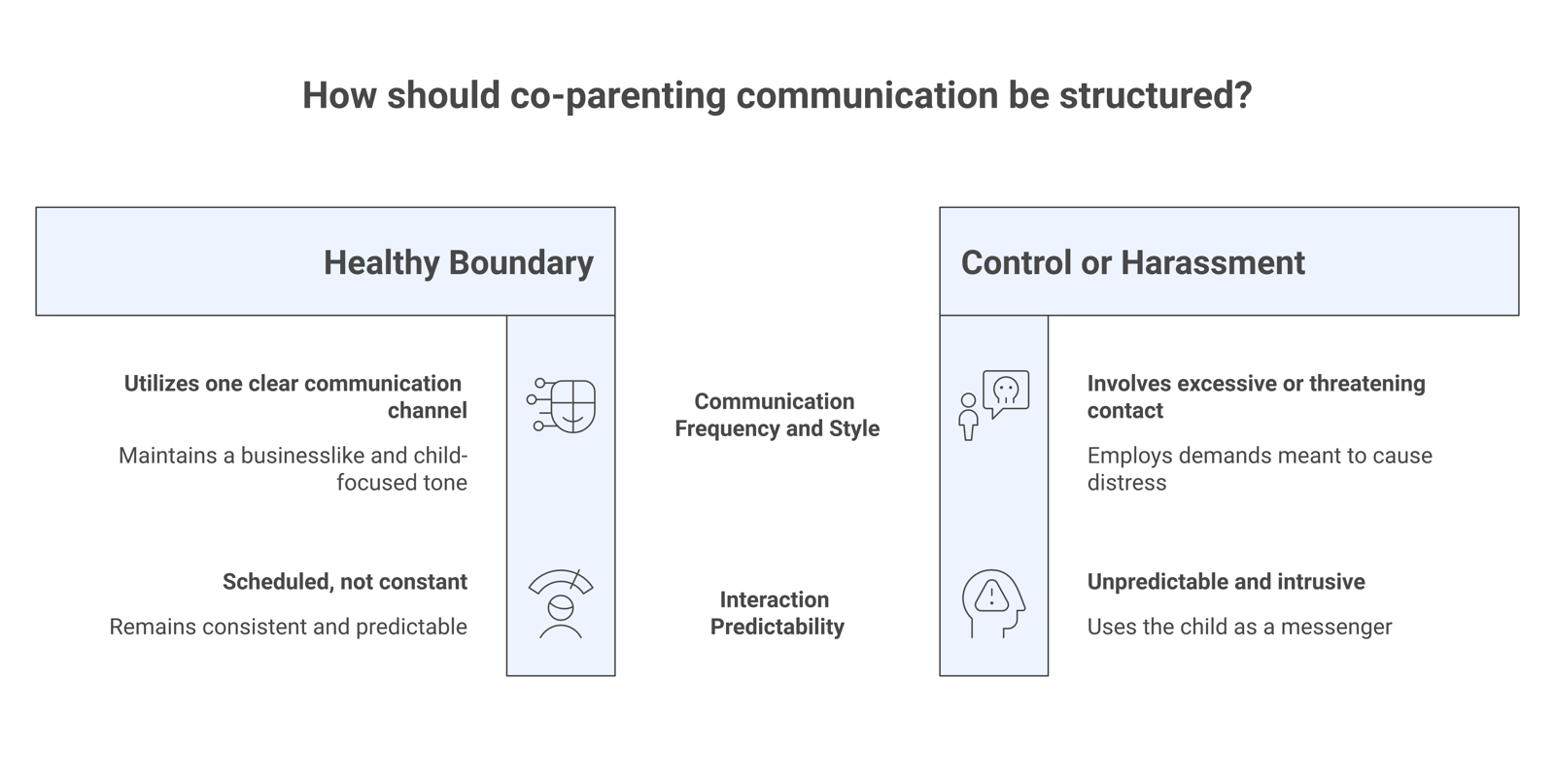
When the other parent’s contact crosses from coordination into a pattern meant to distress, it can become harassment. For that line, see what is considered harassment by a co-parent.
When cooperation is impossible: parallel parenting
Sometimes no boundary is enough to make joint cooperation work, because the other parent will not cooperate at all. That does not mean the situation is hopeless. It means the model needs to change.
Parallel parenting is the answer when cooperation keeps failing. Each parent runs their own household by the order, with contact stripped down to logistics only. There are no joint decisions about daily life, no shared events that turn into standoffs, and minimal direct interaction. The parents disengage from each other and stay engaged with the child. For many high-conflict families, parallel parenting lowers the conflict the child is exposed to. To compare the two models, see parallel parenting versus co-parenting and the broader Help hub.
When boundaries are not enough (abuse)
Boundaries are powerful, and they have a hard limit. They cannot stop abuse. A boundary depends on you holding your own line, and abuse is about another person overriding your lines on purpose.
If a co-parent threatens you, monitors you, isolates you, or uses the children to frighten or control you, that is coercive control, and it calls for more than a self-enforced limit. The National Domestic Violence Hotline explains how coercive control works and what help is available. In these situations, safety comes first. That may mean a structured or no-contact arrangement, a protective order, supervised exchanges, or stepping back from direct communication entirely and working through professionals.
Setting boundaries with an abusive ex can even raise the risk, because it challenges the control they are trying to keep. Anyone in this position deserves real support, not a tidier message thread. If the behavior is escalating, keeping a careful record can help; the page on how to document parental alienation walks through that. Reach out to a domestic-violence advocate or a licensed professional in your area.
Frequently asked questions
What are healthy co-parenting boundaries?
Healthy co-parenting boundaries are clear, child-centered limits on how two separated parents communicate and coordinate. They focus on your own conduct, such as using one channel, answering within a set window, and keeping messages businesslike. The aim is to shield the child from adult conflict, not to control or punish the other parent.
What boundaries should you set with a difficult co-parent?
Start with one communication channel checked at set times, money handled in writing, schedule changes confirmed in writing, and the child kept out of adult conflict entirely. Respect each parent’s privacy and right to introduce new partners. Keep messages brief and businesslike, and step back from any exchange that turns hostile.
How do you enforce co-parenting boundaries?
You hold your own limit calmly and consistently, rather than trying to control the other parent. State the boundary once, keep your replies brief and businesslike, and avoid over-explaining. Consistency is what teaches a difficult co-parent where the line sits. If a boundary is repeatedly crossed, keep a record and seek professional or legal guidance.
What is the difference between a boundary and control?
A boundary limits your own behavior, such as deciding when you respond. Control tries to dictate the other person’s behavior through demands, surveillance, or contact meant to distress. A firm boundary is consistent and child-centered. Controlling behavior serves the adult conflict and, at its extreme, becomes coercive control or harassment.
When do boundaries become not enough?
Boundaries are not enough when there is abuse or coercive control. A self-enforced limit cannot stop someone who overrides your lines on purpose to frighten, isolate, or control you. In those situations safety comes first, which may mean a structured or no-contact arrangement, a protective order, and help from a domestic-violence advocate or licensed professional.
What this page does not do
This page is not legal or clinical advice. It does not address any one state’s custody rules, and it does not tell anyone what to file or how to handle a specific case. Choices about a parenting plan, a protective order, or a child’s care belong to licensed professionals working with the real facts. The page also does not frame boundaries as a way to control, punish, or win against the other parent. The right use of a boundary is the calm, consistent, child-centered one.
For coping with a high-conflict personality, see how to deal with a narcissistic co-parent. For message wording, see how to communicate with a toxic ex. For the structural fallback, see parallel parenting versus co-parenting. The full Help hub covers the rest.
Sources and further reading
- American Psychological Association. Divorce and child custody. apa.org/topics/divorce-child-custody
- American Academy of Pediatrics. HealthyChildren.org. healthychildren.org
- National Domestic Violence Hotline. Coercive control. thehotline.org
If you or your child are in crisis
Free and confidential help is available right now.
- 988 Suicide and Crisis Lifeline. Call or text 988. 988lifeline.org
- Childhelp National Child Abuse Hotline. 1-800-422-4453. childhelp.org
- NAMI HelpLine. 1-800-950-6264. nami.org/help
Last reviewed: 2026-06-08. Author: Alex Buckles (PAC Founder).