

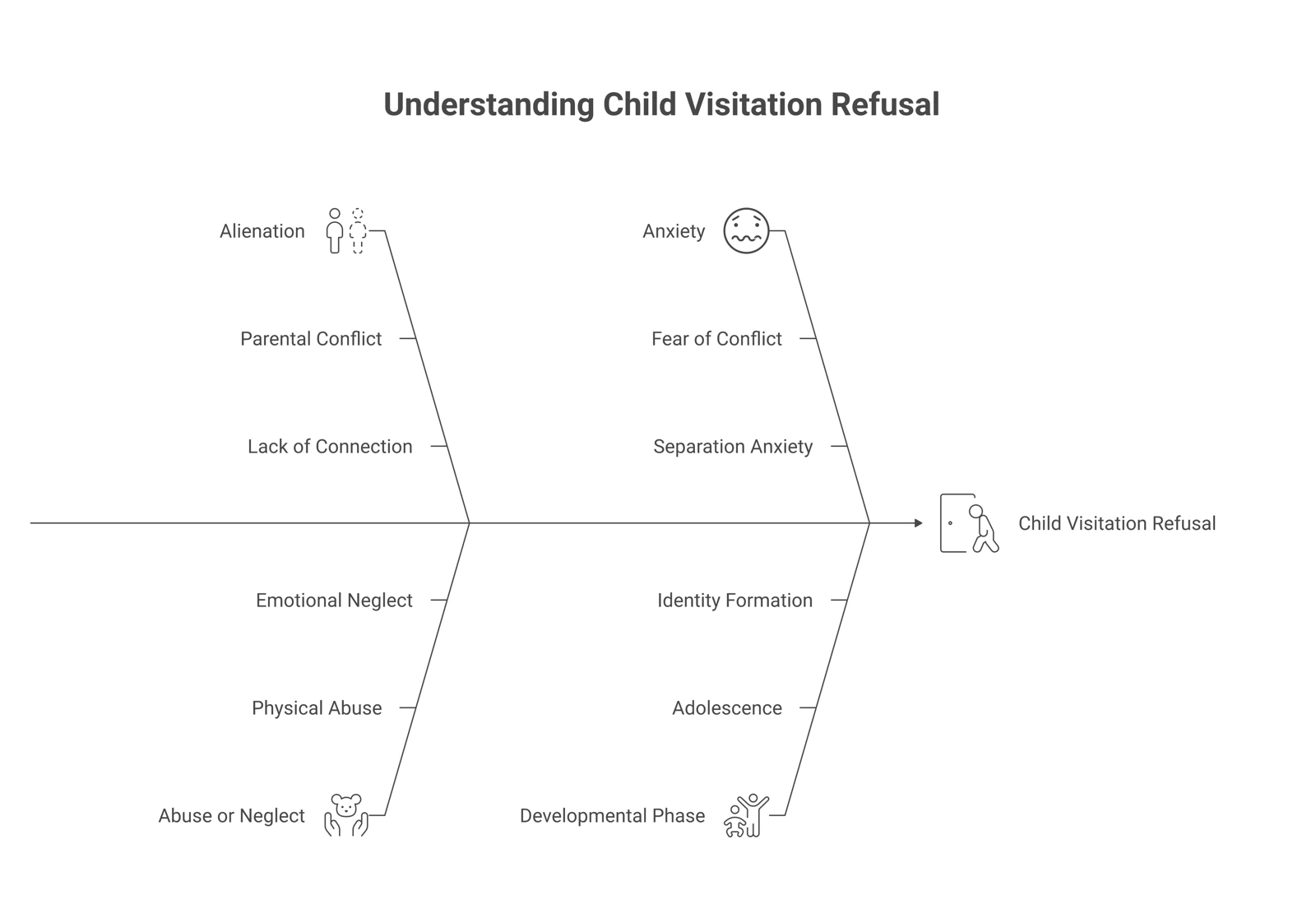
A child refusing visitation may be a sign of parental alienation, or it may be a legitimate response to abuse, anxiety, or a developmental stage. The right first move is not to force the child or accept the refusal at face value. Stay calm, keep offering the time, rule out genuine harm, and document every refusal.
A note before you read
A child’s refusal to see a parent is not always alienation. If the child has been abused, neglected, or frightened by that parent, the refusal can be a protective and legitimate response, called justifiable estrangement. The two are different and must not be conflated. If a child reports harm, take it seriously and contact the proper authorities and a licensed professional.
First, the differential: alienation, abuse, anxiety, or a phase
Before reacting, a parent needs to hold four possible explanations at once. A child can refuse visitation because of parental alienation, because of genuine abuse or neglect, because of anxiety, or because of a normal developmental phase. The right response depends on which one is in play, and sometimes more than one is true.
Psychologist Joshua Coleman, author of Rules of Estrangement, places alienation inside a wider map of why children pull away. His taxonomy lists several distinct pathways. Parental alienation is one. Justifiable estrangement, where a parent was actually abusive or neglectful, is another. Triangulation by a new partner, mental illness, the child’s own need to separate, and even therapist-induced cut-offs round out the list. The pathway determines the fix. That is why guessing is risky.
When refusal may be a legitimate response
If a child can name specific, observable harm and shows fear or sadness rather than cold contempt, the refusal may be a protective response. Anxiety can also drive a refusal that has nothing to do with either parent. A young child may resist a transition because the routine is new, because a pet or a friend is at the other house, or because separations are simply hard at that age. None of these is alienation, and none responds well to pressure. The American Psychological Association notes that children adjust to divorce on different timelines, and distress at exchanges can be part of normal adjustment.
When refusal may be alienation
A different pattern points toward alienation. The child rejects the parent with contempt, denies any good memory, and uses adult vocabulary about the parent’s character. Researcher Richard Warshak and colleagues have studied these resist and refuse dynamics, and the work consistently warns against assuming a single cause. Refusal can also surface in calm, low-conflict separations. Ryan Thomas, a formerly alienated child, describes stealth alienation that grows through small, undercutting comments delivered in a calm or even sad tone. The absence of open conflict is not the absence of alienation. For the recognition layer, see child suddenly hates parent after divorce.
What a parent can and cannot do during a refusal
A parent should not physically force a child into a car. A parenting plan typically obligates a parent to make the child available for the scheduled time and to support that time, not to use physical force against the child. Forcing the issue at the doorway tends to frighten the child and harm the relationship the parent is trying to protect.
A parent can do several things instead. They can stay calm. They can clearly invite the child and keep the door open. They can avoid arguing in front of the child. They can keep showing up for every scheduled exchange so the record reflects that the time was offered. The reframe from Ryan Thomas is useful here. He argues that a targeted parent should not accept a child’s rejection at face value, because the words are often compliance rather than authentic feeling. In his words, “Your children are being compliant. Your children are being obedient. They are saying and doing the things that are necessary in order for them to stay safe.” The internal question becomes what conflict the child is carrying, not whether the child means it.
Protection comes before repair. The protection-first doctrine associated with Dr. Craig Childress holds that a child who is still inside a harmful dynamic cannot be repaired through pressure or through therapy alone. The same logic applies at the doorway. Calm, repeated availability protects the relationship better than a single forced exchange. For the broader sequence, see the Help pillar and the dealing with parental alienation guide.
The five mistakes to avoid
A refusal pulls parents toward predictable, self-defeating moves. Randy Flood, a clinician who has worked in alienation evaluation and reunification since 1992, names five of them, and he is careful to frame them with compassion rather than blame.
- Personalizing the rejection. A parent treats a teenager’s “I hate you” as a verdict on their worth rather than survival behavior under pressure. Personalizing it multiplies the hurt and the anger.
- Escalating discipline. Alienated children can look defiant, so a parent reaches for lectures and consequences. Harsh responses get pulled out of context and used against the parent later.
- Enlisting family and friends to lecture the child. When a parent’s own authority feels discredited, they recruit grandparents or coaches to correct the child. The child experiences this as shaming and pulls further away.
- Retaliating against the other parent. Snarky texts, sarcastic exchange-time comments, and social-media venting feel good and do not help. They get harvested as evidence.
- Presenting to professionals as angry and argumentative. Because resist and refuse cases are counterintuitive, an angry parent can confirm a professional’s bias. Flood’s guidance is to show up “madly in love with their children, not mad.”
How to document denied and refused time
Documentation is a record-keeping habit, not a weapon. The goal is a calm, factual log that a parent keeps for themselves and can share with a professional if needed. The aim is not to build a case to win. It is to keep an accurate account of what happened.
A useful entry records the date, the scheduled time, who was present, what was said and done, and what the parent did to support the time. Neutral language matters. “Arrived at 5:00 for the scheduled exchange. Child stayed inside. I waited fifteen minutes, texted a friendly reminder, and left at 5:20.” That reads as fact. “She poisoned him against me again” reads as conclusion and helps no one. Keep entries contemporaneous, written the same day while memory is fresh. Save texts and emails in their original form rather than paraphrasing them.
The same discipline applies whether the refusal looks like alienation or like something else. A clean, factual record protects the child and the parent in every scenario, and it keeps the parent’s own conduct above reproach, which connects directly to the fifth mistake above.
How to communicate during and after a refusal
Communication after a refusal works best when it is steady and low-key. Sue Cornbluth, a psychologist who works with alienated families, teaches a consistency-over-frequency cadence. Steady, low-frequency, on-message contact reads as authentic presence. Bursts of contact followed by silence read as giving up, and daily contact can read as smothering. For an older child, once a week is often enough. For a younger child, every few days at most.
The content matters as much as the frequency. Cornbluth suggests mixing serious messages, such as a short acknowledgment, with light ones, such as “how was the game.” The tone stays warm and free of pressure or guilt. A parent does not interrogate the child about the other home, and a parent does not ask the child to choose. The message a child needs to receive over months is simple. The parent is still here, still steady, and has not given up.
A parent should also listen for the calm undercutting that can drive a refusal in low-conflict cases. Comments framed as worry or sad resignation can quietly build a story in the child’s mind. Noticing the pattern is not the same as confronting the child about it, which rarely helps. For the upstream behaviors and how to respond to them, see how to stop parental alienation.
The role of the parenting plan
The parenting plan, sometimes called a custody or time-sharing order, is the framework. It sets the schedule and usually describes each parent’s duty to support the child’s relationship with the other parent. It is not a button that forces a child into a car, and it is not a scorecard for winning. It is the agreed structure both parents are expected to follow.
When refusals become a pattern, the parenting plan is also where the issue gets addressed. The Association of Family and Conciliation Courts publishes guidance on resist and refuse dynamics and on parenting coordination, which is one structured way some families work through repeated exchange problems. Because procedures differ by location, this page does not describe specific steps. A licensed attorney in the relevant area can explain what the local framework allows. The broader framing of how parenting plans and enforcement work, without state-specific detail, lives in the court silo.
When a teenager refuses
Older children add a layer of nuance. A teenager’s stated preferences carry more weight as they mature, and many parenting plans and courts give those wishes more attention over time. A parenting plan still applies until it is changed, so a teenager’s refusal does not erase the schedule on its own.
The differential still governs. A teenager pulling away can be doing normal developmental work, can be responding to a real problem, or can be caught in an alienation dynamic. The calm, consistent, pressure-free approach still applies. So does the bright line on abuse. If a teenager reports harm, that report is taken seriously and routed to the proper professionals, not treated as a custody tactic.
Frequently asked questions
Can you force a child to visit the other parent?
A parent should not physically force a child into a car. A parenting plan generally requires a parent to make the child available and to support the scheduled time, not to use physical force. The framework looks at whether each parent supported the relationship, so calm, repeated availability matters more than a single forced exchange.
What should you do when a child refuses visitation?
Stay calm, do not punish the child, and keep offering the scheduled time. Rule out abuse or anxiety first. Document the refusal in neutral, factual terms the same day. Keep communication steady and low-key. Treat the parenting plan as the framework, and ask a licensed attorney about your specific situation.
Is a child refusing visitation parental alienation?
Sometimes, but not always. Refusal can be alienation, or it can be a legitimate response to abuse, anxiety, or a developmental phase. The right response depends on the cause, so the differential comes before any reaction. Assuming alienation in every case is a mistake, and so is dismissing every refusal as the child’s free choice.
How do you document refused visitation?
Record the date, the scheduled time, who was present, what was said and done, and what you did to support the time. Use neutral, factual language and write it the same day. Save texts and emails in their original form. The goal is an accurate record for yourself and any professional you consult, not a case built to win.
Can a teenager refuse to see a parent?
A teenager’s wishes carry more weight as they get older, and many courts give those wishes more attention over time. A parenting plan still applies until it is changed, so the refusal does not cancel the schedule on its own. The same differential and the same calm, consistent approach apply.
Where to go next
- For the calm first-steps sequence and the upstream behaviors that may drive a refusal, see how to stop parental alienation.
- For the recognition layer, see child suddenly hates parent after divorce.
- For how parenting plans and enforcement work in general, see the court silo.
- For the full library, return to the Help pillar.
Citations
- Coleman, J. (2021). Rules of Estrangement: Why Adult Children Cut Ties and How to Heal the Conflict. Harmony.
- American Psychological Association. (n.d.). Divorce and child custody. apa.org/topics/divorce-child-custody
- Warshak, R. A. (2010). Family Bridges: Using insights from social science to reconnect parents and alienated children. Family Court Review, 48(1), 48 to 80. pubmed.ncbi.nlm.nih.gov/24802420
- Association of Family and Conciliation Courts. (n.d.). Resources on resist/refuse dynamics and parenting coordination. afccnet.org
- Thomas, R. (RyanThomasSpeaks). Don’t accept face-value rejection.
- Flood, R. (YouTube practitioner commentary). The top five mistakes rejected and targeted parents make. youtube.com/watch?v=y9bCQcxrjs4
- Cornbluth, S. Consistency-over-frequency reach-out cadence.
If you or your child are in crisis
Free and confidential help is available right now.
- 988 Suicide and Crisis Lifeline. Call or text 988. 988lifeline.org
- Childhelp National Child Abuse Hotline. 1-800-422-4453. childhelp.org
- NAMI HelpLine. 1-800-950-6264. nami.org/help
Last reviewed: 2026-06-05. Author: Alex Buckles, Founder.