

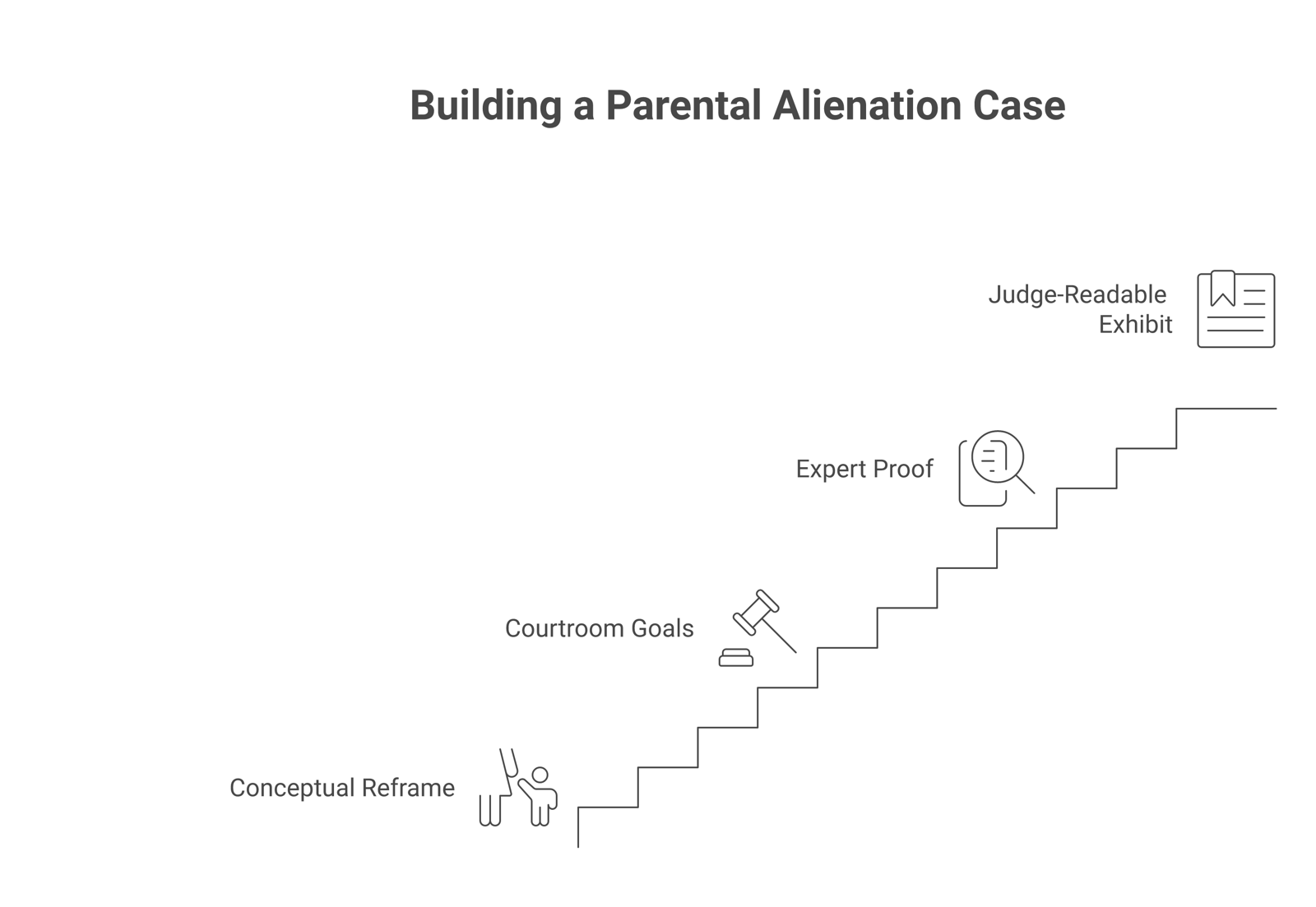
A parental alienation court case is constructed and presented as a clinical, child-welfare matter rather than a he-said, she-said custody fight. Sound counsel pursues three courtroom goals, proves the dynamic through behaviors and qualified experts, and asks the court for timely, child-centered intervention rather than a punitive outcome.
General professional information, not legal advice. This page is educational information for licensed family-law attorneys and for informed parents working with counsel. It does not create an attorney-client relationship, does not address any one state’s law or rules, and counsel must verify the law of the relevant jurisdiction. Family law and procedure vary materially by state.
A note on abuse and estrangement
A child’s rejection of a parent is not always alienation. Where the rejected parent has been abusive, neglectful, or genuinely dangerous, the child’s distancing is justifiable estrangement, not parental alienation. Counsel must distinguish the two at the outset. The frameworks described here must never be used to discredit a protective parent or to cast doubt on a genuine abuse disclosure. Where bona fide abuse is present, the priority is reporting and child protection.
Reframing the parental alienation court case as a child-welfare matter
The first move in any serious parental alienation court case is conceptual, not evidentiary. Attorneys who have tried these matters on an alienation theory argue that the case is a clinical, child-welfare matter, not a high-conflict custody case with the volume turned up. Counsel who treat it as the latter tend to lose the thread.
Why does the framing carry so much weight? In these cases the targeted parent is often in visible crisis while the favored parent presents calmly, so the natural assumption inverts the merits. The skills that win an ordinary custody dispute do not transfer cleanly. Building the case as a child-welfare matter keeps the court focused on the documented pattern and the child’s wellbeing, which is where the analysis belongs.
The three courtroom goals
Attorney Ashish Joshi, author of Litigating Parental Alienation: Evaluating and Presenting an Effective Case in Court (American Bar Association, 2021), frames the courtroom task as three sequential goals. Each goal is a precondition for the next, and his recurring caution is that cases fail when counsel leaps to a remedy before laying the conceptual ground.
Goal one: the phenomenon is real
Goal one asks the trier of fact to accept that parental alienation is a real, studied phenomenon rather than an esoteric theory. Joshi treats this like foundation work: adequate trial time, full voir dire of any expert, and the expert’s credentials established before the substantive opinion. Some judges have never been trained on the subject, so counsel cannot assume the ground is settled. The American Bar Association’s Section of Family Law publishes the volume that lays out this architecture.
Goal two: it is occurring in this case
Goal two applies the field’s leading identification framework, the Five-Factor Model (Bernet and Greenhill, 2022), to the specific facts. The model is Amy Baker’s four factors with the child’s contact refusal added as factor one: counsel shows that the child resists or refuses the relationship, that a prior positive bond existed, that bona fide abuse by the targeted parent is absent, that the favored parent engaged in alienating behaviors, and that signs of the dynamic appear in the child. The proof rests on documents and witnesses, not on a label.
Goal three: the child needs timely intervention
Goal three asks the court to order proper and timely help for the child. Joshi argues that specialized reunification programs are established and outcome-studied rather than radical, and that any court-ordered separation period during such a program is therapeutic in character, not a punishment. Counsel should present that argument with its limits in view: the outcome studies behind the intensive programs are program-affiliated self-report without control groups, and a growing body of legislation now restricts court-ordered reunification treatment. The federal Keeping Children Safe From Family Violence Act, known as Kayden’s Law (Title XV of the Violence Against Women Act Reauthorization of 2022), gives states grant incentives to limit such orders and to tighten expert-qualification standards, and Colorado, California (Piqui’s Law), Pennsylvania, and Utah had adopted conforming laws as of mid-2026. Counsel proposing a remedy must know whether the forum state has adopted these limits; see Kayden’s Law. Time is the constraint that matters, because the window for effective intervention narrows as a child ages.
The scientific case and the two-expert model
Experienced trial counsel describe the litigation as a counterintuitive scientific case rather than a swearing contest. The court has to understand that a child’s rejection can be driven by one parent’s undue influence and can present very differently from a reaction to genuine abuse. That education does not happen by accident.
One structure for delivering it is a two-expert model. A generic educating expert teaches the court what alienation is and how to rule it in or out. A separate case-specific forensic expert reviews the full record and maps the facts to a mild, moderate, or severe determination. Practitioners pair this with comprehensive discovery and a realistic trial length of roughly five to seven days, noting that a compressed one or two-day setting rarely allows a serious case to be tried.
Expert roles carry their own limits. A retained expert who has not interviewed the favored parent and the children should describe general principles and the record rather than offer an explicit diagnosis, because the data for a diagnosis are absent. A treating clinician should report observations and avoid a forensic opinion. The companion page on the evidence courts accept covers how those records and opinions are built into an admissible foundation.
Behaviors, not labels
The presentation discipline that ties the case together is to argue behaviors rather than labels. Joshi and Judge Jon Van Allsburg have articulated, from the bar and the bench, that a court can find alienation and order relief on documented conduct alone, without an expert diagnosing a syndrome.
The working principle is that labels divide while stories unite. As the framework puts it, “labels don’t give us any basis on which to make a ruling. It’s the facts that give us that ability.” Counsel does not need to prove the other parent is a narcissist. Counsel shows interference with parenting time, denigration, and specific alienating strategies, then lets the documented pattern speak. Litigants who arrive with diagnostic shorthand but no fact pattern tend to lose, and litigants who arrive with an organized behavior record tend to fare better. The behaviors-first judicial response is treated in depth on the companion page.
Staging the case responsibly
A parental alienation court case unfolds over time, so counsel benefits from a staged plan rather than a single hearing. Brian Ludmer describes a sequenced roadmap that ties litigation steps to the case timeline. Early structure comes first through a parenting plan or initial order, because delay tends to entrench the dynamic. Narrative-contesting litigation follows, then directive family-systemic therapy with a built-in assessment, then compliance motions, and a trial if the matter does not resolve.
Ludmer frames part of this work as correcting false, exaggerated, or stale narratives in the record while the targeted parent focuses on steady, demonstrable self-improvement. Handled responsibly, that means identifying claims the record does not support and letting the child’s non-reciprocal behavior reveal where the dynamic actually sits. It does not mean manufacturing a case, coaching a parent to perform, or attacking a parent who raises a legitimate protective concern. The staging serves the child’s interest in an accurate finding, which is the only proper aim. Resource limits shape how aggressively any stage can be pursued, so counsel matches the plan to what the client can sustain.
The judge-readable explanatory exhibit
Goal one is easier to meet when the court has something authoritative to read. The Parental Alienation Study Group published an organizational synopsis written by the organization rather than by an individual, designed to be entered as evidence and reviewed by a judge, guardian ad litem, or attorney in a sitting. PASG founder Dr. William Bernet describes it as a consensus document with several hundred references. Counsel using it should remember that PASG is the field’s proponent organization, so the synopsis carries authority as a literature summary, not as a neutral referee.
The synopsis carries a built-in response to the three recurring attacks on the field: that there is no research, that the concept is inappropriate in court, and that no professional body recognizes it. Counsel can use a well-sourced explanatory exhibit to pre-empt a “junk science” challenge before it gains momentum. The exhibit supports the foundation; it does not replace the case-specific proof that Goal two requires. For digital records and their admissibility, see digital evidence in custody disputes.
Presentation and credibility
Counsel cannot ignore how the parties present, because triers of fact are human. Practitioners describe a recurring contrast summarized as the four A’s and the four C’s. The targeted parent often appears angry, anxious, agitated, and afraid, which is an understandable response to prolonged conflict but a corrosive one on the stand. The favored parent often appears cool, calm, charming, and convincing.
This observation is descriptive, and its proper use is ethical. The duty is to help a distressed but truthful parent present with composure, not to coach a false performance. A related caution is that a witness who only attacks the other side ends up wearing the negativity in the listener’s mind, so a balanced, child-focused presentation tends to land better. Passion for the child is appropriate; raw anger is not. None of this changes the underlying obligation of candor, and none of it justifies discrediting a parent whose concern is genuine. For the parent-facing companion on building a record, see how to prove parental alienation.
The framework at a glance
| Stage | Question for the court | Anchor |
|---|---|---|
| Reframe | Is this a child-welfare matter, not a custody quarrel? | Conceptual foundation |
| Goal one | Is alienation a real, studied phenomenon? | Foundation and exhibit |
| Goal two | Is it occurring in this specific case? | Factor model on the facts |
| Goal three | Does the child need timely intervention? | Remedy keyed to severity |
| Proof | Who educates the court and maps the facts? | Two-expert model |
| Presentation | Does the record show behaviors, not labels? | Credibility discipline |
Frequently asked legal questions
How is a parental alienation court case different from a custody dispute?
Experienced counsel build it as a clinical, child-welfare, and child-abuse matter rather than a high-conflict custody case. The focus is a documented behavior pattern and the child’s wellbeing, not blame between adults. The skills that win an ordinary custody case do not transfer cleanly, and outcomes vary materially by jurisdiction.
Do you need an expert witness to prove parental alienation in court?
Not always. Joshi and Judge Van Allsburg note that a court can find alienation on documented behaviors without an expert diagnosing a syndrome. Experts strengthen contested and severe cases, often through a two-expert model that pairs an educating expert with a case-specific forensic expert. Whether to retain one belongs to counsel in the relevant jurisdiction.
What are the three courtroom goals in a parental alienation case?
Joshi frames them in sequence. First, show the court that alienation is a real, studied phenomenon. Second, show that it is occurring in this specific case using documented behaviors and the child’s response. Third, show that the child needs proper and timely intervention. Each goal is a precondition for the next.
Why frame the case around behaviors rather than labels?
Courts rule on facts, not diagnoses. A litigant who proves interference, denigration, and specific alienating strategies gives the court a basis to act, while a litigant who only asserts a label gives the court nothing to rule on. The behaviors approach also lets a parent proceed without an expensive evaluation.
How long does a serious parental alienation case take to try?
Practitioners describe a realistic trial length of roughly five to seven days for a contested case, alongside comprehensive discovery. A compressed one or two-day hearing rarely allows the educating and forensic proof to be presented. Scheduling and procedure differ by court, so counsel should plan against the local docket.
Where to go next
- For the practitioner hub, see the For Professionals pillar.
- For the evidence categories that build the record, see evidence for parental alienation cases.
- For the judicial-response companion, see how courts handle parental alienation.
- For digital records and admissibility, see digital evidence in custody disputes.
- For the parent-facing record-building companion, see how to prove parental alienation.
Sources and further reading
- Joshi, A. S. (2021). Litigating Parental Alienation: Evaluating and Presenting an Effective Case in Court. American Bar Association. americanbar.org
- Harman, J. J., Kruk, E., & Hines, D. A. (2018). Parental alienating behaviors: An unacknowledged form of family violence. Psychological Bulletin, 144(12), 1275 to 1299. https://doi.org/10.1037/bul0000175
- Cornell Legal Information Institute (Wex). Family-law references. law.cornell.edu/wex
- Bernet, W., & Greenhill, L. L. (2022). The Five-Factor Model for the diagnosis of parental alienation. Journal of the American Academy of Child and Adolescent Psychiatry, 61(5), 591 to 594. https://doi.org/10.1016/j.jaac.2021.11.026
- Baker, A. J. L. (2020). Reliability and validity of the four-factor model of parental alienation. Journal of Family Therapy, 42(1), 100 to 118. https://doi.org/10.1111/1467-6427.12253
- Joshi, A. S., and Van Allsburg, J. Proving Alienation Without Experts: Storytelling in the Courtroom. Presentation to the Parental Alienation Study Group conference.
- Ludmer, B. Stage-based case management in alienation litigation. Presentation to the Parental Alienation Study Group conference.
- Parental Alienation Study Group. Organizational synopsis of the parental alienation research literature. pasg.info
- Keeping Children Safe From Family Violence Act (Kayden’s Law), Title XV, Violence Against Women Act Reauthorization Act of 2022, Pub. L. 117-103, codified at 34 U.S.C. 10446(k).
If you or your child are in crisis
Free and confidential help is available right now.
- 988 Suicide and Crisis Lifeline. Call or text 988. 988lifeline.org
- Childhelp National Child Abuse Hotline. 1-800-422-4453. childhelp.org
- NAMI HelpLine. 1-800-950-6264. nami.org/help
Last reviewed: 2026-06-06. Author: Alex Buckles (PAC Founder).