

This page is general information, not legal advice. It does not create an attorney-client relationship, and it does not address any one state’s law. Counsel should apply their own jurisdiction’s rules, including recording-consent rules, and parents should consult a licensed family-law attorney in their own jurisdiction.
Documenting custody violations means building a contemporaneous, organized record of each specific breach of a parenting order, logged by date, type, and supporting evidence. Counsel who direct that work well give a court facts, not labels. This guide walks attorneys through logging violations by type, raising each to its strongest proof, and keeping the record honest.
A note on safety
A parent who withholds a child for genuine safety reasons may have good cause, not a violation. Documentation should capture facts neutrally, and counsel should screen every matter for real abuse or safety risk before treating a refusal as a breach. Recording laws vary by jurisdiction. If a child’s safety is at risk, contact local law enforcement or a domestic-violence resource first.
Why documenting custody violations matters
A client who arrives convinced the other parent is an “alienator” arrives with a conclusion. A court cannot rule on a conclusion. It rules on facts. The whole value of documenting custody violations is that it converts a client’s sense of grievance into a record a judge can act on.
The point is captured in a judicial standard often cited in this field. As one judge put it, “labels don’t give us any basis on which to make a ruling, it’s the facts that give us that ability.” Courts act on documented behaviors, not on diagnostic words. A dated record of ten denied exchanges does work that the word “alienator” never will.
That record serves two distinct downstream uses. It supports an enforcement motion, where the question is whether a specific order was willfully violated. It also supports a modification request, where a pattern of violations can speak to a change in circumstances and to a parent’s willingness to support the child’s relationship with the other parent. The Cornell Legal Information Institute keeps a general reference on contempt and how courts treat the violation of a valid order. For the mechanism the log ultimately feeds, see contempt for parental alienation. For the wider professional shelf, the For Professionals hub collects the related guides.
The discipline described here is narrow on purpose. It is not the full case file, and it is not the courtroom argument. It is the raw material both depend on.
What counts as a custody order violation
A custody order violation is a specific, identifiable breach of a provision in a parenting plan or custody order. The order says one thing; the parent did another. That is the unit of analysis, and counsel should keep the client focused on it.
The behaviors-not-labels principle governs here too. “The other parent is poisoning the children” is a characterization. “On three listed dates the other parent did not produce the children for court-ordered exchanges” is a violation. The first invites argument. The second invites a ruling. Counsel add value by translating the client’s narrative into discrete, provable breaches tied to order language.
Not every refusal is a violation, and this is where careful counsel slow down. A parent who keeps a child home because of a credible, documented safety concern may have good cause rather than a breach. Genuine abuse-driven withholding is not the same thing as obstruction, and a record that ignores that distinction is both inaccurate and dangerous. Counsel should screen every matter for real safety issues before logging a refusal as a violation, and should capture the surrounding facts neutrally so a reviewer can judge them. A clean log does not assume bad faith; it records what happened and lets the facts speak.
The five violation types and what to capture
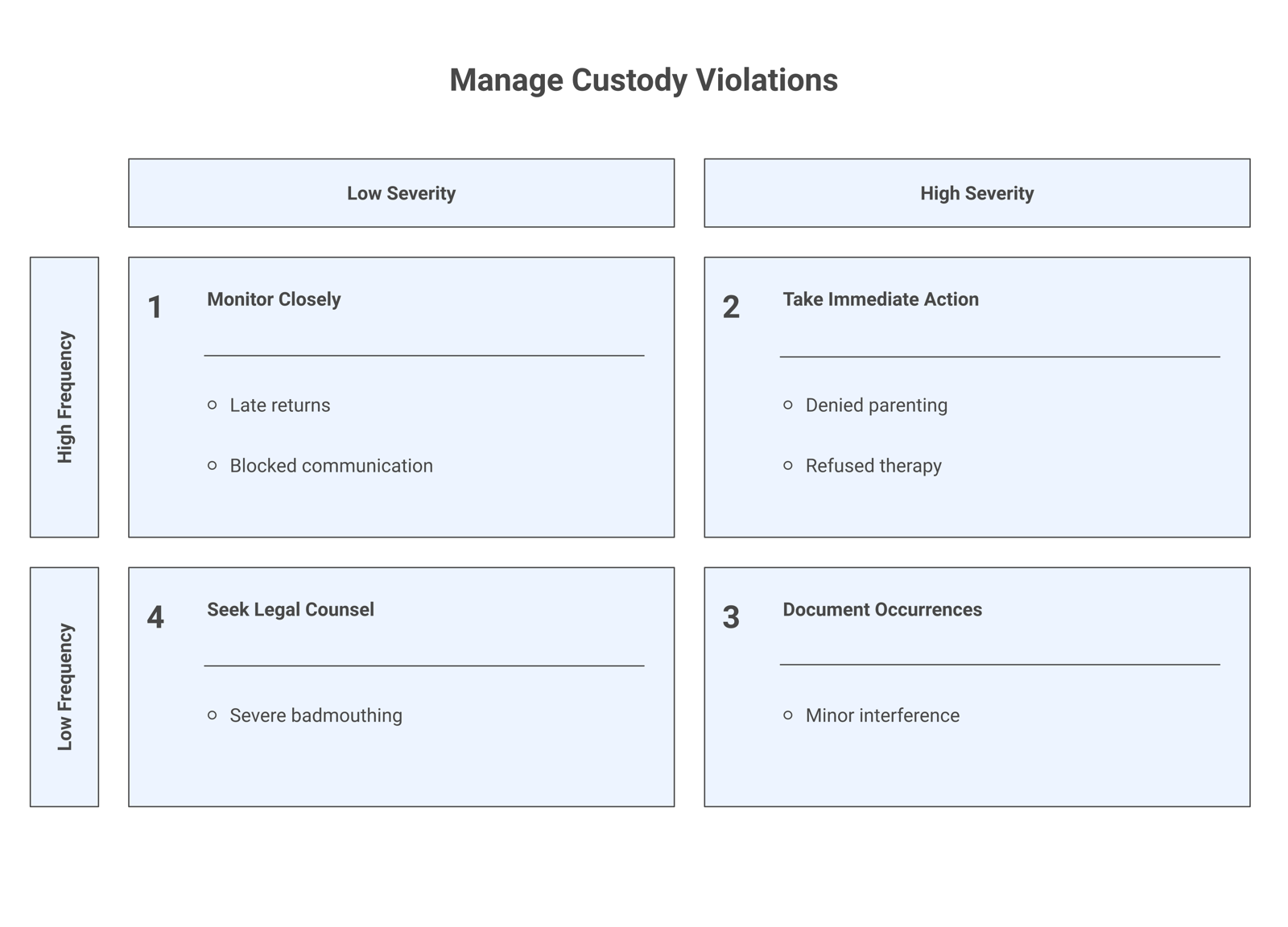
Organizing the log by violation type gives the record structure and tells the client exactly what to capture for each. Five types cover most parenting-order breaches, and each calls for slightly different evidence.
Denied or missed parenting time
This is the most common and often the most consequential violation. For each instance, capture the date and time the exchange was scheduled, the exact order provision that set it, what actually happened, and any messages around it. A screenshot of a text saying “they don’t want to come” sits beside the order clause it breaches. The pairing matters: the order provision plus the dated failure is the violation.
Blocked communication
Court orders often guarantee phone or video contact on a schedule. When that contact is blocked, capture call logs showing attempted and dropped or unanswered calls, screenshots of messages cancelling or refusing calls, and the order provision that established the contact. Patterns matter more than any single missed call, so a running log of attempts is stronger than a memory of “she never lets me call.”
Refused court-ordered therapy
When an order requires reunification therapy or counseling and a parent does not bring the child, capture the appointment records, the provider’s notes or cancellation records where available, and the order provision requiring attendance. A letter or log from the therapist documenting no-shows is among the cleaner pieces of evidence available, because it comes from a neutral third party.
Late returns and exchange problems
Chronic lateness, returns to the wrong location, or exchanges that do not happen as ordered all belong here. Capture timestamps, location data where it exists, and the names of any witnesses present at the exchange point. A single late return is noise. A logged pattern of them is signal.
Badmouthing and interference
This is the hardest type to prove and the easiest to overstate, so the discipline is strict. Capture contemporaneous notes written close in time to the event, the child’s own reported statements recorded factually rather than interpreted, and any third-party accounts from people who witnessed the conduct. Counsel should resist the temptation to log inference as fact. The record notes what was said and who heard it, not what it supposedly proves about motive.
For the digital pieces that recur across these types, messages, call logs, and screenshots, see digital evidence in custody disputes.
Raising each violation up the levels-of-evidence ladder
Not all evidence carries equal weight, and a useful way to think about a log is as a set of entries that can each be pushed up a ladder, from the client’s own belief at the weakest end, through the client’s contemporaneous note, a third-party witness, and a neutral third party, to a record or recording at the strongest. The canonical five-level evidence ladder, and the binder structure it feeds, live on building a parental alienation case file; this page applies the same ranking to the violation log.
The practical instruction to a client is simple. For each violation in the log, ask what would move it one rung higher. A remembered phone refusal becomes stronger as a screenshot. A claimed missed appointment becomes stronger as a provider’s record. A grandparent who saw a refused exchange beats the client’s memory, and a therapist’s no-show log or a school attendance record beats both. Counsel should direct the client toward the highest rung reasonably available for each entry, because the strength of the motion tracks the strength of the underlying evidence.
One caution governs the recorded rung. Audio and video recording is bound by consent rules that vary by jurisdiction, and some recordings that feel obvious to a frustrated parent are unlawful to make. Counsel should advise clients on local recording-consent rules before any recording is attempted, and should never assume a recording is admissible because it is damning. For the recording-law and authentication detail, see digital evidence in custody disputes.
Organizing the log by type and by what it proves
A pile of screenshots is not a record. Organization is what makes the log usable under time pressure, both for the attorney drafting a motion and for the judge reading it.
Two organizing axes work together. The first is by violation type, the five categories above, so every entry has a home and gaps become visible. The second is by what each item proves. An evidence binder built this way pairs each piece with the proposition it supports and the order provision it relates to. A screenshot is not filed as “a text”; it is filed as “evidence that the August 12 exchange was refused, breaching paragraph 7 of the parenting plan.” This evidence-by-factor discipline keeps the record honest, because an item that does not actually prove a discrete violation has nowhere to sit.
A workable log entry carries a small, consistent set of fields: the date and time, the order provision at issue, a factual description of what happened, the violation type, and the evidence attached. Entered contemporaneously and kept in one place, those entries become a chronology a court can follow. The American Bar Association’s Section of Family Law publishes general practitioner and consumer information on family-court records and enforcement.
This violation log is one input to the larger file counsel assembles. The log catalogs discrete breaches; the case file weaves them into a theory. For that next level of assembly, see building a parental alienation case file.
What good documentation looks like in court
The difference a clean record makes is concrete, and one illustration shows it. In Hanson v. Spolnik, the record was carried not by characterization but by evidence a court could examine directly: voicemails and a documented acknowledgment connected to a contempt question. The point for counsel is not the holding of any single case but the lesson it embodies. Specific, authenticated, dated artifacts did the persuading.
That is the standard a violation log should aim for. A judge does not need to be told the other parent is obstructive. A judge needs to see, on a date, against a named order provision, a voicemail or a message or a no-show record that establishes the breach. The work of documenting custody violations is the work of building toward that moment, one well-captured entry at a time.
How that record is received depends on the court and the standard applied. For the way judges weigh this kind of evidence, see how courts handle parental alienation and the enforcement path in contempt for parental alienation.
The limits and the safety screen
A violation log is a tool, and like any tool it can be misused. The honest limits keep its use professional.
Documentation is not surveillance, and it is not a weapon. The purpose of the record is to support enforcement or modification of an order, not to harass, track, or build a hostile dossier on the other parent. Counsel should keep the client’s logging proportionate and order-focused. A record that drifts into monitoring the other parent’s private life loses its evidentiary value and can damage the client’s credibility.
The safety screen runs throughout. Before any refusal is logged as a violation, counsel should consider whether the other parent had good cause, including a genuine concern for the child’s safety. A parent acting to protect a child from real abuse is not committing a violation, and a clinically honest record reflects that possibility rather than erasing it. The American Psychological Association’s resources on divorce and child custody describe how children’s distress and family conflict are assessed, which can inform whether a refusal reflects obstruction or protection.
Documentation also does not decide the case or repair the relationship. It gives counsel material. Choices about what to file, when, and under which provision belong to the attorney working with the real facts and the local rules. The record is the foundation, not the verdict.
Frequently asked questions
How do you document custody violations?
Keep a contemporaneous log of each specific breach of the parenting order. For every instance, record the date and time, the exact order provision at issue, a factual description of what happened, the violation type, and the supporting evidence. Then raise each entry to its strongest available proof, from a memory to a message, a record, or a neutral third-party document.
What counts as a custody order violation?
A custody order violation is a specific breach of a provision in a parenting plan or custody order: a denied or missed parenting-time exchange, blocked court-ordered communication, a refused court-ordered therapy session, a chronic late return, or documented interference. A refusal grounded in a genuine, documented safety concern may be good cause rather than a violation, which is why counsel screen for real safety issues first.
What evidence do you need for a contempt motion?
A contempt motion generally needs the exact text of a clear order provision plus proof that the parent willfully violated it. The strongest support is dated, specific, and drawn from the higher rungs of the evidence ladder: messages, call logs, neutral third-party records, and authenticated recordings where local law permits them. Requirements vary by jurisdiction, so counsel should apply local rules.
How do you keep a custody violation log?
Use one consistent place and a fixed set of fields for every entry: date and time, the order provision at issue, what happened, the violation type, and the evidence attached. Enter each violation contemporaneously, close in time to the event, so the record reads as a reliable chronology rather than a reconstruction. Organize entries by type and by what each item proves.
Can text messages prove a custody violation?
Often, yes. A text message can establish a refused exchange or a cancelled call when it is authentic, complete rather than excerpted out of context, and tied to a specific order provision. Counsel should preserve the full thread and metadata, not isolated screenshots. Rules on authentication and on recording vary by jurisdiction, so local rules govern admissibility.
What this page does not do
This page is not legal advice. It does not name any one state’s statutes or recording rules as if they applied everywhere, and it does not tell counsel what to file or when. Choices about enforcement or modification belong to a licensed attorney working with the real facts and the local rules. The page also does not frame documentation as a weapon or a surveillance tool. The right use of a violation log is the careful, neutral, order-focused one that serves a child’s stability.
For the overall file the log feeds, see building a parental alienation case file. For the digital pieces, see digital evidence in custody disputes. For the parent-facing habit, see how to document parental alienation. The full For Professionals hub covers the rest.
Sources and further reading
- Cornell Legal Information Institute (Wex). Contempt. law.cornell.edu/wex/contempt
- American Bar Association, Section of Family Law. americanbar.org/groups/family_law
- American Psychological Association. Divorce and child custody. apa.org/topics/divorce-child-custody
If you or your child are in crisis
Free and confidential help is available right now.
- 988 Suicide and Crisis Lifeline. Call or text 988. 988lifeline.org
- Childhelp National Child Abuse Hotline. 1-800-422-4453. childhelp.org
- NAMI HelpLine. 1-800-950-6264. nami.org/help
Last reviewed: 2026-06-08. Author: Alex Buckles (PAC Founder). Editorial review: held to the PAC Editorial Standards (balance, primary-source citation, reader safety); an independent expert review board will be appointed.