

This page is general information, not legal advice. It does not create an attorney-client relationship, and it does not address any one state’s law. Anyone considering legal action should consult a licensed family-law attorney in their own jurisdiction.
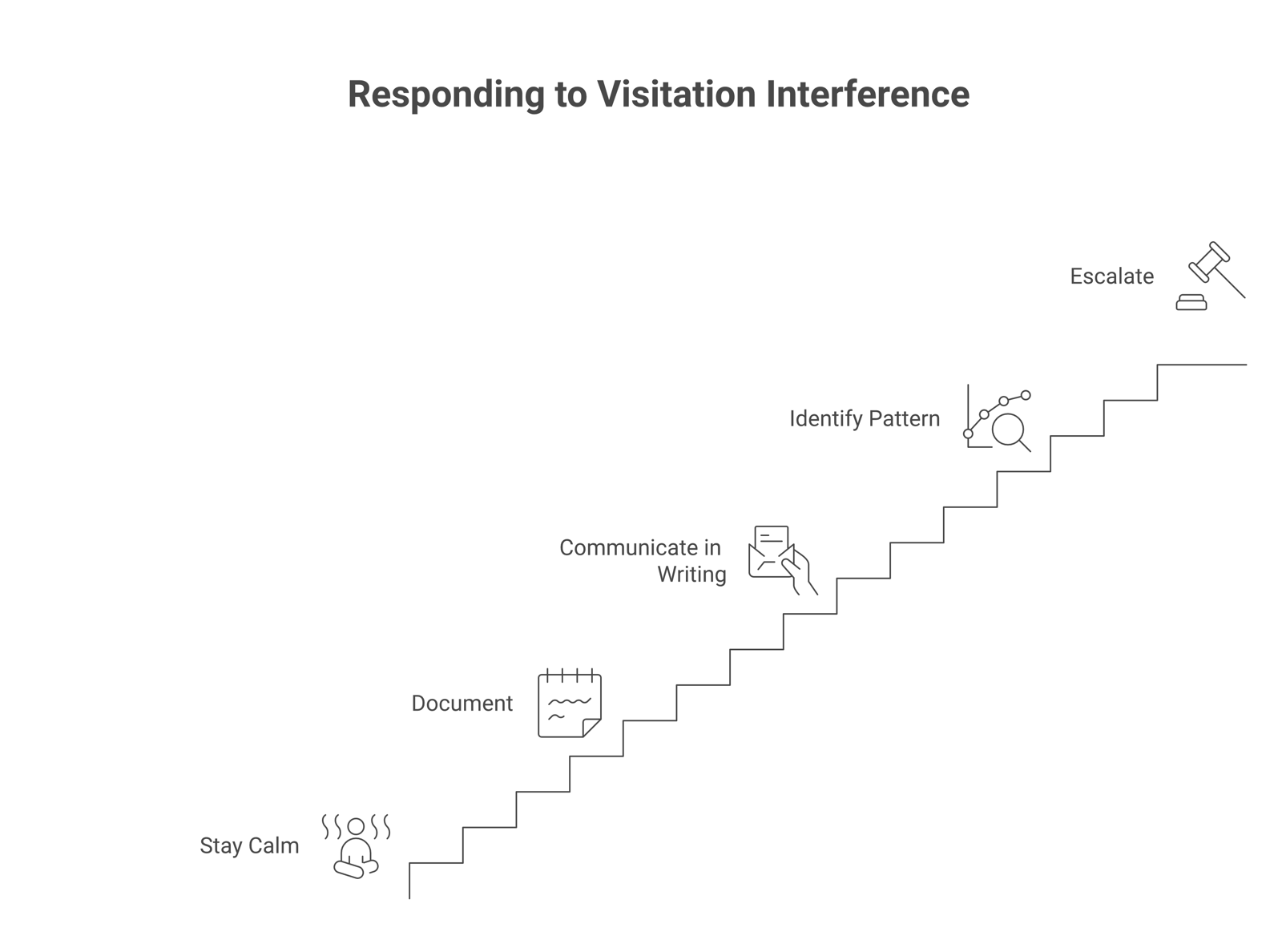
How to respond to visitation interference comes down to a calm, ordered sequence. Stay composed and keep showing up for your time. Document each missed or blocked exchange. Communicate in writing through the right channel. Then escalate through the proper office only after a pattern is on record, rather than retaliating.
A note on safety
Not every blocked exchange is wrongful interference. A parent who withholds a child to protect them from genuine abuse may have a valid defense, and a child’s refusal of a parent is not always interference. If a child is unsafe, safety comes first. Contact local law enforcement or a domestic-violence resource before anything else.
How to respond to visitation interference, in short
Visitation interference happens when a co-parent blocks, shortens, or cancels the parenting time a court order grants. The page on what visitation interference is covers the forms it takes. This page is about the response.
The response is a sequence, not a single reaction. The steps below run in order: stay calm and keep showing up, document each incident, communicate in writing, learn to tell a pattern from a one-off, and escalate through the right channel only when the record supports it. Each step builds the next. Skipping to escalation without a record rarely works, and reacting in anger usually makes things worse for the child. The American Psychological Association’s guidance on divorce and child custody underscores how much steadiness from a parent matters during conflict.
Step 1: Stay calm and keep showing up
The first response is composure. An exchange that falls apart is upsetting, and the impulse to argue at the door or to send an angry message is natural. That impulse rarely helps. It can frighten the child, and it can become evidence against the calmer story a parent is trying to tell.
Keep showing up anyway. Arrive on time for each scheduled exchange, ready to take the child, even when there is reason to expect the other parent will not produce them. Showing up does two things. It signals to the child that the parent keeps coming, and it builds a record that the parent was present and ready while the other parent was not. A parent who stops showing up after a few blocked exchanges hands the other side an argument that the absence was mutual.
Calm is not the same as passive. A parent can be steady and still take every step that follows. The point is to respond from a plan rather than from the heat of the moment.
Step 2: Document each missed or blocked exchange
Documentation is what turns a frustrating pattern into something a court can see. Record each missed or blocked exchange at the time it happens, while the details are fresh.
A useful entry captures four things. The date and time of the scheduled exchange. What the order required. What actually happened, in plain factual language. And anyone who saw it. “October 3, 6:00 p.m. exchange at the agreed location. Child not produced. No advance notice. My sister was with me and saw the other parent’s car was not there” is far stronger than a memory recounted months later.
Strength of evidence runs on a ladder. A parent’s own uncorroborated account sits at the bottom. Dated, contemporaneous notes sit higher. Written messages from the other parent sit higher still, because they are the other side’s own words. Neutral, third-party confirmation, a witness or a timestamped record, sits near the top. The response sequence is built to climb that ladder. Courts act on documented behaviors, not on labels. As one judicial standard puts it, “labels don’t give us any basis on which to make a ruling. It’s the facts that give us that ability.” The page on how to document parental alienation walks through building that record in detail.
Step 3: Communicate in writing through the right channel
Move communication to writing. A co-parenting app or email creates a dated, durable record that a hallway conversation or a phone call does not. When an exchange is missed, a short, factual written message both addresses the problem and documents it.
Keep the tone neutral and the content narrow. “The 6:00 exchange did not happen today. Please confirm the make-up time” is useful. A long message rehearsing every grievance is not, and it can read badly later. The goal is a record that shows one parent acting reasonably and asking, in writing, for the order to be followed.
Writing also slows the conflict down. It removes the live argument and replaces it with a request that can be answered or ignored, either of which becomes part of the record. A parent who keeps the written channel calm and consistent builds the strongest possible version of their own story without saying a word in anger.
Step 4: Tell a pattern from a one-off
Not every missed exchange is wrongful interference. A single canceled visit because of a real emergency, an illness, a car breakdown, a genuine safety concern, is not the same as a repeated, deliberate effort to cut a parent out. Courts know the difference, and so should a responding parent.
This is where good cause and safety matter. A parent who withholds a child once to protect them from genuine danger may have a valid defense, not a violation. Reacting to every isolated hiccup as if it were willful interference burns credibility and energy. The contempt mechanism, covered on the contempt for parental alienation page, turns on a willful violation of a clear order, which means a documented pattern carries far more weight than a single incident.
A pattern looks like repetition. Several blocked exchanges over weeks or months, with no good cause offered, often paired with unanswered messages and last-minute cancellations. The documentation from Step 2 is what reveals the pattern, because a list of dated entries shows a shape that any single bad day does not. The clarity of the underlying order matters too, which is why the types of court orders shape what counts as a violation.
Step 5: Escalate through the proper channels
When a documented pattern exists, escalation runs through the right doors, in order.
The first door is usually a local enforcement office. Many jurisdictions have an office, sometimes called the Friend of the Court or a parenting-time enforcement unit, whose job is to handle exactly these disputes. These offices can often address parenting-time problems faster and at lower cost than a full court motion. Because the structure and name vary widely by location, a parent should ask the court that issued the order, or a local attorney, what exists where they live.
The police are usually not the right door. Officers generally will not enforce a civil custody order at an exchange, because a parenting plan is a civil matter, not a criminal one. The page on whether police can enforce parenting time explains why. Police belong in the picture only when there is a genuine emergency or a crime, not a routine missed exchange.
The next door, when lesser steps fail, is a contempt or enforcement motion through counsel. A motion asks the court to enforce its own order. The American Bar Association’s Section of Family Law publishes general consumer information on enforcement, and the Cornell Legal Information Institute keeps a general reference on contempt. A motion built on a documented pattern, brought by a lawyer who knows the local rules, is the serious end of the sequence, not the first move.
What not to do
Some responses feel satisfying and backfire. A parent should not withhold the child in return when their own time comes, because two violated orders help no one and can land both parents in trouble. A parent should not stop paying support to retaliate, because support and parenting time are separate obligations and withholding one does not excuse the other. A parent should not deny the other parent’s court-ordered time as leverage.
Calling the police for every missed exchange is also a misstep. It rarely produces enforcement of a civil order, and it can read as escalation rather than reasonableness. The measured path, document, write, and escalate through the right office, protects both the child and the parent’s credibility.
Frequently asked questions
How do you respond to visitation interference?
Respond with a calm, ordered sequence. Stay composed and keep showing up for your scheduled time, document each missed or blocked exchange with the date, the time, and what the order required, communicate in writing through the right channel, and escalate through the local enforcement office and then counsel only after a documented pattern exists. Avoid retaliating.
What can you do if your ex denies visitation?
Keep showing up and document the denial at the time, noting the date, the time, what the order required, and any witness. Send a short, factual written message asking that the order be followed and that make-up time be set. If the denials form a pattern, escalate through the local enforcement office or Friend of the Court, and then to a contempt or enforcement motion through a licensed attorney.
Should you call the police for visitation interference?
Usually not. Police generally will not enforce a civil custody order at an exchange, because a parenting plan is a civil matter. Calling them for a routine missed exchange rarely helps and can escalate conflict. Route parenting-time disputes to the local enforcement office or Friend of the Court instead. Call the police only when there is a genuine emergency or a crime in progress.
How do you document denied visitation?
Keep a dated, contemporaneous log. For each missed or blocked exchange, record the date and time, what the order required, what actually happened, and anyone who witnessed it. Save written messages from the other parent, since their own words carry weight, and keep any neutral, third-party confirmation. A list of dated entries is what reveals a pattern a single incident cannot show.
When can you file for contempt over visitation?
A contempt or enforcement motion fits after a clear order is being willfully violated in a documented pattern, and usually after lesser steps, such as written requests and the local enforcement office, have not resolved it. A single missed exchange with good cause is not contempt. A licensed family-law attorney can advise whether the record supports a motion in a particular jurisdiction.
What this page does not do
This page is not legal advice. It does not name any one state’s statutes, offices, or procedures as if they applied everywhere, and it does not tell readers exactly what to file or when. Those choices belong to a licensed attorney working with the real facts and the local rules. The page also does not coach retaliation or promise any outcome. The right response to interference is the calm, documented, child-centered one.
For the definition this page builds on, see what visitation interference is. For the enforcement mechanism at the end of the sequence, see contempt for parental alienation. For the police question, see whether police can enforce parenting time. For support while a co-parent keeps a child away, see when an ex is keeping your child away. The full Court silo covers the rest.
Sources and further reading
- American Psychological Association. Divorce and child custody. apa.org/topics/divorce-child-custody
- American Bar Association, Section of Family Law. americanbar.org/groups/family_law
- Cornell Legal Information Institute (Wex). Contempt. law.cornell.edu/wex/contempt
If you or your child are in crisis
Free and confidential help is available right now.
- 988 Suicide and Crisis Lifeline. Call or text 988. 988lifeline.org
- Childhelp National Child Abuse Hotline. 1-800-422-4453. childhelp.org
- NAMI HelpLine. 1-800-950-6264. nami.org/help
Last reviewed: 2026-06-08. Author: Alex Buckles (PAC Founder). Editorial review: held to the PAC Editorial Standards (balance, primary-source citation, reader safety); an independent expert review board will be appointed.