
This page is general information, not legal advice. It does not create an attorney-client relationship, and it does not address any one state’s law. Anyone considering legal action should consult a licensed family-law attorney in their own jurisdiction.
Contempt for parental alienation is rarely about the word alienation at all. No court holds a parent in contempt for parental alienation by name. A judge holds a parent in contempt for violating a specific court order, a denied visit, a blocked exchange, a refused therapy session. Here is how that mechanism works and where it stops.
A note on safety
A child’s rejection of a parent is not always alienation. A parent who withholds a child to protect them from genuine abuse may have a valid defense to contempt. Contempt is not a tool to force a child into danger, and abuse-driven estrangement is not parental alienation. If a child’s safety is at risk, contact local law enforcement or a domestic-violence resource first.
What contempt for parental alienation really means
Contempt of court is a finding that someone disobeyed a valid court order. In a parental alienation situation, that order is usually a parenting plan or a custody order. Civil contempt is the kind that matters here. Its purpose is to make a person comply, not to punish for its own sake. The Cornell Legal Information Institute keeps a general reference on contempt and how courts use it.
A judge who issues a custody order expects both parents to follow it. When one parent breaks it, the other can ask the court to enforce its own order. That request is a contempt motion, sometimes called a motion for enforcement or a motion for an order to show cause. The court then asks a narrow question. Did this parent disobey a clear order, and did they do it on purpose?
That narrowness matters. A contempt motion is not a referendum on who is the better parent. It is not a trial about the word “alienation.” It is a focused proceeding about one thing, compliance with an order already on the books.
Why nobody is held in contempt “for alienation”
Here is the part that surprises many parents. No judge enters a finding of contempt for parental alienation as such. Courts act on documented behaviors, not on diagnostic labels. A judicial standard described in the field puts it plainly: “labels don’t give us any basis on which to make a ruling. It’s the facts that give us that ability.”
So the contempt finding attaches to a concrete act. A parent denied the other parent court-ordered time. A parent blocked a scheduled exchange. A parent refused to bring the child to court-ordered reunification therapy. Each of those is a violation of a specific order, and each is something a court can see, measure, and sanction. The label “alienation” describes a pattern. The order violation is the thing the court enforces.
This is why experienced litigators steer parents away from arriving in court with labels and toward arriving with a record of behaviors. A parent who says “the other parent is an alienator” gives the judge nothing to rule on. A parent who shows ten missed exchanges, each logged with date and time, gives the judge a basis to act. For more on that shift, see how to prove parental alienation.
What a contempt motion requires
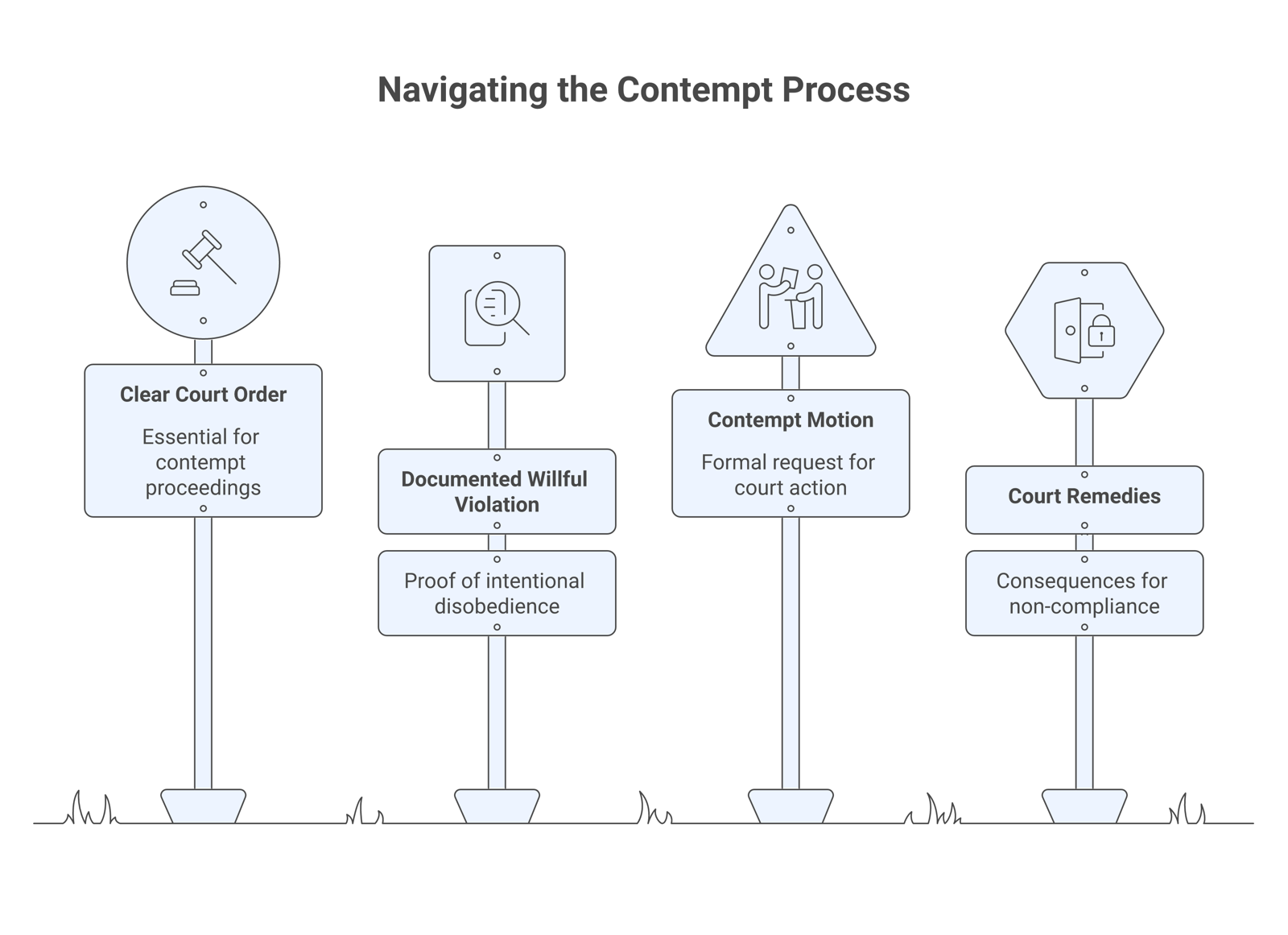
Two things have to be true before a court will find contempt.
First, a clear and specific order. The order has to spell out what each parent must do. “The parents shall cooperate” is vague. “Exchanges occur Friday at 6 p.m. at the agreed location” is specific. A vague order is hard to enforce, because a parent can argue they did not understand it. The wording of the underlying order does a lot of the work, which is why the types of parental alienation court orders matter so much.
Second, a willful violation. The parent must have been able to comply and chosen not to. A parent who missed one exchange because of a genuine emergency has not willfully disobeyed. A parent who simply refused to hand over the child, again and again, with no good cause, has. Courts look for a pattern of choice, not a single accident. A documented safety concern can also supply good cause, which is why genuine abuse is a defense rather than a violation.
Documentation is what turns a complaint into a motion. Dates, times, messages, and the exact text of the order are the raw material a judge needs. The page on how to document parental alienation walks through building that record before a motion is ever filed.
Remedies a court can impose
When a court finds willful contempt, it has a range of remedies. None is automatic, and the court picks what fits the violation.
Makeup parenting time is the most common and most directly corrective remedy. The court orders extra time to replace what the parent lost.
Attorney’s fees and costs can shift to the parent who broke the order, so the other parent is not out of pocket for enforcing a valid order.
Fines and financial sanctions are also available, and courts often escalate them with each repeat violation.
Jail exists as a remedy in serious or repeated cases, and courts use it rarely. A parent is not jailed for parental alienation. A parent is jailed, when it happens at all, for willfully and repeatedly violating a parenting-time order or a therapy order after lesser measures have failed. The American Bar Association’s Section of Family Law publishes general consumer information on how enforcement and contempt work.
The pattern across every one of these remedies is the same point made earlier. The sanction attaches to the order violation, never to the label.
The honest limits of contempt
Contempt is a real tool, but it is a narrow one, and honesty about its limits protects parents from disappointment.
Contempt does not repair the relationship. A fine or a makeup weekend can restore time on paper. It cannot make a child feel safe with a parent again. Specialists who work with severe cases treat the repair of a damaged parent-child bond as a clinical and protective process, closer to child protection than to punishment. One foundational set of principles, drawn from a 1991 court decision and revived by attorney Brian Ludmer, frames severe alienation as a matter of the child’s emotional safety, addressed through structured, directive family therapy rather than through sanctions alone.
Contempt can escalate conflict. A motion is an adversarial act. Filed carelessly or too often, it can deepen the war the child is already trapped inside. Courts notice when enforcement tips into harassment, and a parent who files weak motions can lose credibility at the moment they most need it.
Contempt is slow and uncertain. Hearings take weeks to schedule. Findings depend on the strength of the record and on the judge. No filing produces a fast fix, and no order can command a child to feel differently.
Where contempt fits in a sequence
Litigation strategists describe a parental alienation case as a staged process, not a single hearing. Brian Ludmer’s stage-based model starts with getting a clear order in place, moves to contesting false narratives, adds directive family therapy, and uses compliance motions, including contempt, to enforce each step along the way. Enforcement comes in sequence, after a clear order exists and a violation is documented, not as a first move.
Reading contempt this way keeps expectations realistic. It is one instrument in a longer effort. It is valuable when an order is being broken, and beside the point when the real need is a better order or a therapeutic intervention. For the wider map of options, see whether you can sue for parental alienation, review the order types, and use the Court silo as the hub.
Frequently asked questions
Can you be held in contempt for parental alienation?
Not under that name. There is no contempt finding labeled “parental alienation.” A court holds a parent in contempt for violating a specific order, such as denying court-ordered parenting time or refusing court-ordered therapy. The alienation is the pattern; the order violation is what the court actually enforces.
What happens if a parent violates a custody order?
The other parent can file a contempt motion asking the court to enforce its order. If the court finds the violation was willful, it can order makeup parenting time, shift attorney’s fees, impose fines, and in serious or repeated cases order jail. The remedy is matched to the violation, and lesser measures usually come first.
Does a contempt finding fix parental alienation?
No. Contempt can restore lost time and discourage further violations, but it cannot rebuild a child’s damaged bond with a parent. Specialists treat that repair as a clinical and protective process, often through structured family therapy. Contempt addresses the order violation, not the underlying relationship.
What do you need to prove contempt in a custody case?
Two things. A clear and specific order that told the parent exactly what to do, and a willful violation, meaning the parent could have complied and chose not to without good cause. Documentation carries both, so dates, times, messages, and the exact order text are essential.
Can a parent go to jail for parental alienation?
Jail is rare and is never imposed for parental alienation by name. When a court does order jail, it is for willfully and repeatedly violating a parenting-time or therapy order after fines, fees, and makeup time have failed. A licensed family-law attorney can explain how this works in a particular jurisdiction.
What this page does not do
This page is not legal advice. It does not name any one state’s statutes as if they applied everywhere, and it does not tell readers what to file or when. Choices about a contempt motion belong to a licensed attorney working with the real facts. The page also does not frame enforcement as a weapon or promise any outcome. The right use of contempt is the careful, documented, child-centered one.
For the broader civil picture, see whether you can sue for parental alienation. For the legal-status question, see is parental alienation illegal. For the order types contempt depends on, see parental alienation court orders. The full Court silo covers the rest.
Sources and further reading
- Cornell Legal Information Institute (Wex). Contempt. law.cornell.edu/wex/contempt
- American Bar Association, Section of Family Law. americanbar.org/groups/family_law
- American Psychological Association. Divorce and child custody. apa.org/topics/divorce-child-custody
If you or your child are in crisis
Free and confidential help is available right now.
- 988 Suicide and Crisis Lifeline. Call or text 988. 988lifeline.org
- Childhelp National Child Abuse Hotline. 1-800-422-4453. childhelp.org
- NAMI HelpLine. 1-800-950-6264. nami.org/help
Last reviewed: 2026-06-06. Author: Alex Buckles (PAC Founder).