
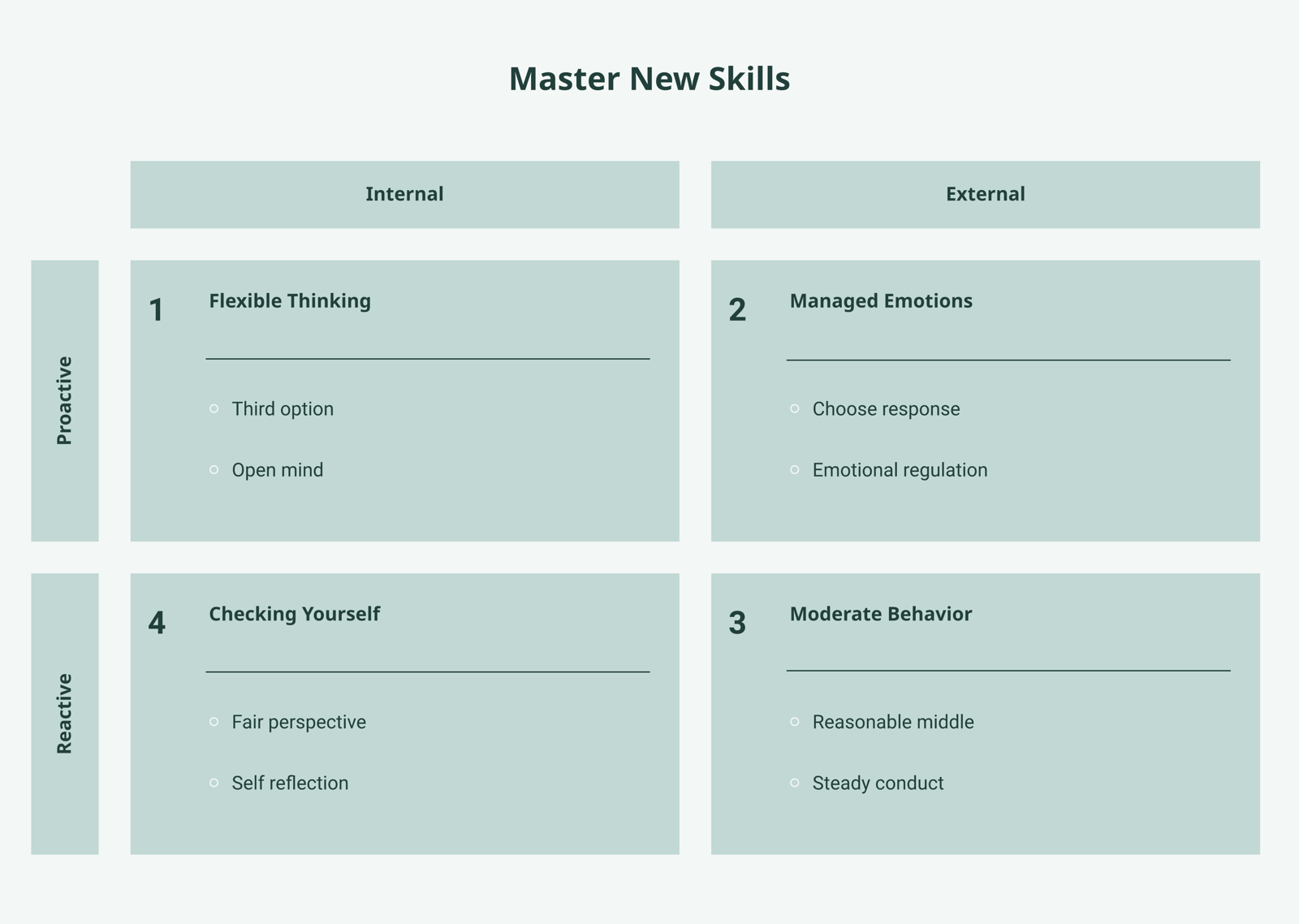
New Ways for Families is a short, structured skills program from Bill Eddy and the High Conflict Institute that a family court can order for both parents at once. It teaches four skills: flexible thinking, managed emotions, moderate behavior, and checking yourself. No parent is labeled the bad one, and the program looks forward rather than relitigating the past.
Before you read on. A skills program is not the right tool where there is active abuse, domestic violence, or a current safety risk to a child or parent. Estrangement caused by genuine abuse is not parental alienation, and the two must never be conflated. Where safety is in question, protection comes first, and the questions are clinical and legal, not skills-based.
General information, not legal or clinical advice. This page explains a method so professionals and parents can understand it. It does not recommend it for any specific case, predict any outcome, or substitute for advice from a licensed attorney or clinician.
What New Ways for Families is
New Ways for Families is a structured, time-limited program built around four skills the program calls the 4 Big Skills. According to the High Conflict Institute, the method is delivered as a hybrid course and is designed for high-conflict or potentially high-conflict separations and co-parenting situations (High Conflict Institute, New Ways Training). But the defining design choice is that it teaches both parents the same skills, so neither is cast as the one to be fixed.
So the four skills are simple to name, but they are hard to practice:
- Flexible thinking. Move past all-or-nothing thinking. Hold two ideas at once, and look for a third option instead of two extremes.
- Managed emotions. Notice the emotional surge before it drives the next move, then choose a response rather than a reaction.
- Moderate behavior. Stay in the reasonable middle, and avoid the extreme moves that escalate a conflict.
- Checking yourself. Pause and ask what a calm, fair person would do, then own your own part instead of assigning blame.
Bill Eddy, a lawyer and clinical social worker who co-founded the High Conflict Institute, frames the underlying problem as an emotional one. In the corpus, Eddy describes alienation as something built “brick by brick” over years, an emotional process in which children absorb chronic anxiety and resolve it by taking a side (F-294). Because the engine is emotional and relational, the program’s logic is that teaching emotional and behavioral skills to both parents addresses the engine more directly than blame does.
How a court can use it
Courts can order New Ways for Families, because it was designed to be court-orderable from the start. In the corpus, Eddy presents it as a method a court can require, delivered as a short online class, that teaches both parents and, in some formats, the children themselves (T-458). The instruction to professionals is blunt: “Don’t argue with or blame the alienator. Set limits and require new behaviors” (T-458).
That design matters for a judge or evaluator for three reasons. First, an order that applies to both parents avoids the appearance of punishing one side, which can lower resistance and reduce grounds for appeal. Second, a skills curriculum gives the court a concrete, time-bound thing to order rather than an open-ended directive. Third, because the program looks forward, it sidesteps the endless backward argument about who did what, which is where high-conflict cases usually stall.
Professionals should still treat New Ways as one option among several, not a default. The right intervention depends on the severity of the case, the safety picture, and what the evidence in front of the court actually shows.
How it differs from adversarial or one-sided interventions
The clearest way to understand New Ways is by contrast. Most court-side interventions in high-conflict cases fall into two camps, and New Ways sits in neither.
| Approach | Who is treated | Posture | What it asks the court to decide |
|---|---|---|---|
| Adversarial litigation | One parent is the target | Backward-looking, blame-based | Who is right |
| One-sided reunification | The child and the rejected parent | Often treats the child as the problem | Whether to compel contact |
| New Ways for Families | Both parents, same skills | Forward-looking, skills-based | Whether to order a structured class |
Adversarial litigation asks the court to decide who is right, which deepens the split that drives alienation in the first place. One-sided reunification, in its weaker forms, can place the burden on the child or the rejected parent while the alienating behavior continues unaddressed. By contrast, New Ways asks both parents to learn the same skills at the same time. So the method tries to change behavior on both sides rather than assign fault to one.
This is not a claim that New Ways replaces reunification work or that reunification is wrong. Severe cases often need more than a skills class, and some need protective and therapeutic steps that a short course cannot provide. New Ways is better understood as an early, lower-intensity structure that can be ordered before a case hardens, or alongside other steps in a staged plan.
An honest look at the evidence
Here the page has to be careful, because the honest answer is uncomfortable. There is no independent, peer-reviewed outcome evaluation of New Ways for Families. The High Conflict Institute reports that the method is “backed by brain science” and draws on more than fifteen years of real-world use (High Conflict Institute, New Ways Training). Yet those are program-reported statements from the organization that created and sells the method. They are not the same as findings from an independent study, and this page does not present them as proof that the program works.
What does the wider peer-reviewed literature say? It does not yet speak to New Ways specifically. It does, however, examine the broader question this method belongs to. O’Hara and colleagues, writing in Family Court Review in 2024, ask whether online parent education can meet the needs of the courts that order it (O’Hara et al., Family Court Review, 2024). That peer-reviewed work sits adjacent to New Ways, not on top of it. It tells a professional that court-ordered online parent education is a studied field with real questions about fit and effectiveness, while leaving the specific question of whether New Ways for Families changes outcomes unanswered by independent research.
So the responsible posture is this. New Ways is a thoughtfully designed, widely used, theory-grounded method whose effectiveness claims are reported by its creators and have not been independently confirmed. A professional can reasonably consider it as a structured, both-parents option. A professional should not present it to a court as a proven cure, because the proof does not yet exist.
What it can and cannot do
New Ways for Families can give a court a concrete, both-parents thing to order. It can also teach a shared vocabulary of skills that both parents and, in some formats, children can use. So it can shift the frame from blame to behavior, which is where Eddy argues the real change happens.
New Ways cannot, on the available evidence, be promised to reverse alienation. It cannot substitute for safety planning where abuse or violence is present. It cannot replace the clinical assessment that severe cases require, and it cannot decide, by itself, what a child needs. Those remain judgments for qualified clinicians, evaluators, and the court.
Frequently asked questions
Is New Ways for Families court-orderable?
Yes. It was designed to be ordered by a family court, and it is delivered as a short, structured class that both parents can be required to complete (T-458; High Conflict Institute).
Who created New Ways for Families?
Bill Eddy, a lawyer and clinical social worker, developed it through the High Conflict Institute, which he co-founded (F-294; High Conflict Institute).
Does New Ways for Families work?
Its effectiveness is program-reported, not independently proven. No peer-reviewed outcome study of New Ways for Families exists as of this review. Treat any effectiveness claim as a statement from its creators, not as established fact.
Is New Ways appropriate where there is abuse?
No. A skills program is not appropriate where there is active abuse, domestic violence, or a safety risk. In those situations the questions are clinical and legal, and protection comes first.
Related reading
- What parental alienation is, in plain terms: Learn.
- How alienation differs from justified estrangement: Signs.
- Reunification therapy and how it compares: Recover.
- Documentation and family court basics: Court.
This page is general educational information. It is not legal or clinical advice, and it does not endorse any specific program for any specific case. New Ways for Families and the 4 Big Skills are programs of the High Conflict Institute. Last reviewed June 17, 2026, by the Parental Alienation Center Editorial Team.