

The PARQ (Parental Acceptance-Rejection Questionnaire) is the one peer-reviewed instrument built to quantify the splitting that marks parental alienation. Its derived measure, the PARQ-Gap, separates alienation-driven rejection from justified estrangement by scoring a child’s lost ambivalence. So it is strong evidence and one input among many, never a standalone verdict on any case.
This page is general information for professionals. It is not clinical or legal advice, and it does not diagnose any individual case.
First, the caveat that belongs before the instrument
Estrangement caused by genuine abuse is not parental alienation. So the two must never be conflated. A child may reject a parent for a real reason, such as abuse, neglect, or abandonment. Then that child is estranged, not alienated. Dr. Amy Baker, a developmental psychologist, draws the line cleanly. Alienation means a child rejects a parent who did not warrant rejection. Estrangement is a reasonable, reality-based response. The PARQ helps tell these apart with data, not guesswork. But no test removes the duty to ask whether the rejected parent actually harmed the child.
Parental alienation is also an influential yet contested construct. Mainstream forensic clinicians treat it as a real relational pattern. Critics argue it is overused in court and is not a formal diagnosis. This page presents both views side by side.
What the PARQ is
The PARQ is a validated, court-tested self-report questionnaire. It measures how a child perceives acceptance or rejection by a parent. It comes from Dr. Ronald Rohner and his Parental Acceptance-Rejection Theory. So its roots sit outside the alienation debate, not inside it. Rohner built it to study warmth and rejection across cultures. Only later did forensic researchers apply it to alienation.
First, the child completes one PARQ for each parent. Each version has 60 items. Then each item is rated on a four-point scale, from almost always true to almost never true. The test is short, about 15 to 20 minutes. It is computer-scored, so the person giving it cannot steer the result. Dr. William Bernet, a child and forensic psychiatrist at Vanderbilt, calls that scoring property a core strength. The tester cannot control the outcome.
A high total, in the range of about 210 to 240, points toward genuine rejection of that parent. But a very low total, around 20 to 80, points instead toward an idealized, enmeshed view. What matters for alienation is not either single score on its own. Instead, it is the relationship between the two scores, which the next sections unpack.
Why lack of ambivalence is the thing being measured
The clinical signal the PARQ targets is splitting, also called lack of ambivalence. Splitting means a child holds one parent as all-good and the other as all-bad. The normal mixed feelings are gone. Richard Gardner listed eight signs of severe alienation. Dr. Bernet has noted that the third sign, lack of ambivalence, is the one that is genuinely measurable.
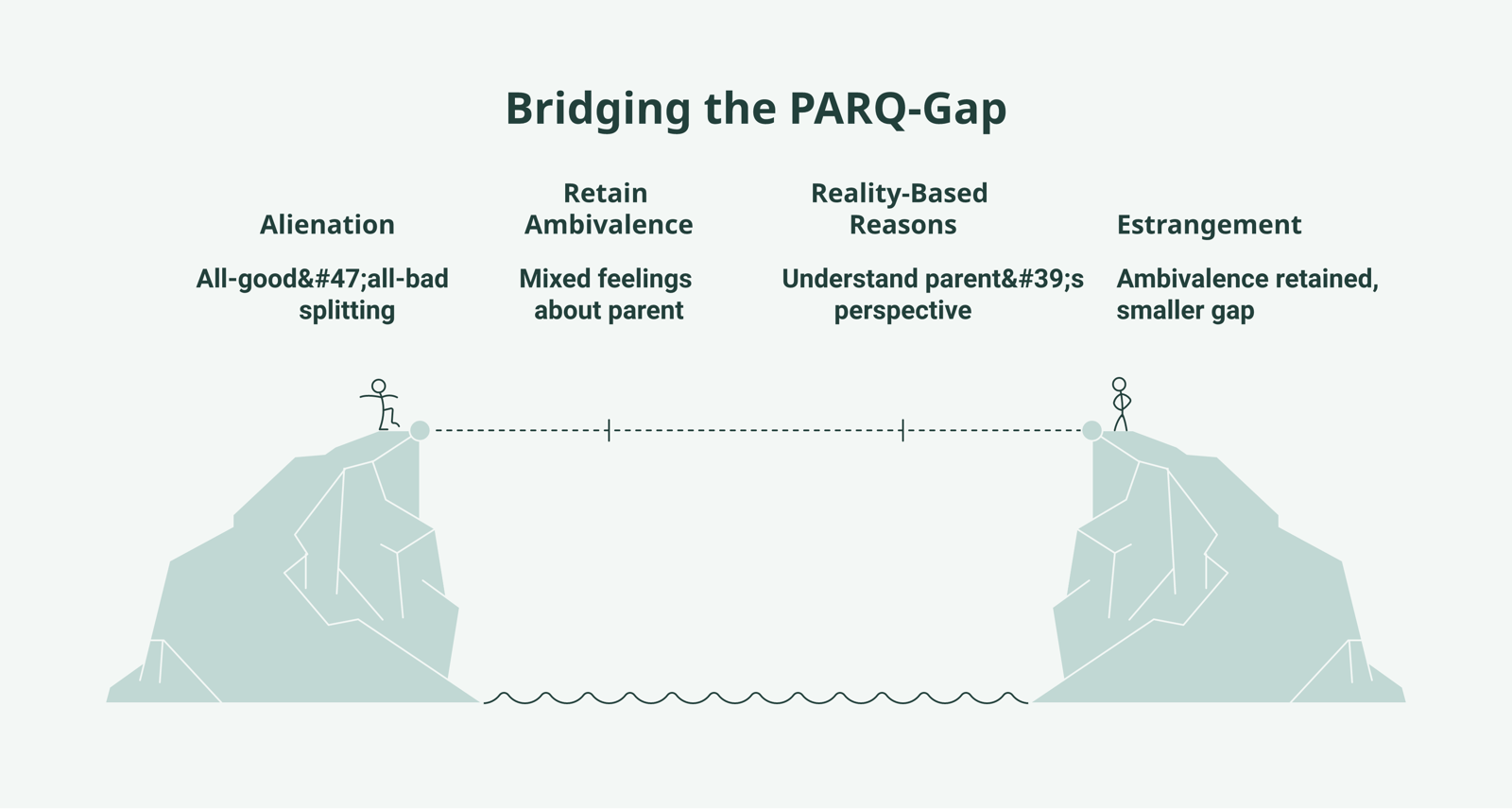
This matters because ambivalence is the tell. As Bernet explains it, an alienated child rates the favored parent as near perfect and the rejected parent as worst possible. Estranged children are different. Even children who were genuinely abused still keep some ambivalence toward the rejected parent. In other words, the abused child usually still holds some good memories and some bad ones. The alienated child often holds none of the gray.
That observation is not unique to one research group. Jaffe, Thakkar, and Piron made the same argument in Cogent Psychology in 2017, treating the denial of ambivalence as a hallmark of parental alienation (Jaffe, Thakkar & Piron, “Denial of ambivalence as a hallmark of parental alienation,” Cogent Psychology 2017). So the measurement idea rests on a recognized clinical observation, then puts a number on it.
The measurement lineage is worth knowing, because evaluators are sometimes asked to defend it. It runs from Bernet’s early likes-and-dislikes lists, through the Bricklin Perceptual Scale, through Baker’s Baker Alienation Questionnaire, and finally to the PARQ.
What the 2018 splitting study found
The first study to test the PARQ as an objective measure of splitting appeared in 2018. Bernet, Gregory, Reay, and Rohner published “An Objective Measure of Splitting in Parental Alienation: The PARQ” in the Journal of Forensic Sciences (Bernet et al., J Forensic Sci 2018;63(3):776-783).
One accuracy note matters for anyone citing this work. The splitting study is in the Journal of Forensic Sciences, not the American Journal of Family Therapy. That second journal is a common miscitation, so professionals should check the source before repeating it in a report or an affidavit.
The study compared severely alienated children against comparison groups. The alienated children produced the extreme split the theory predicts. They idealized one parent and rejected the other, while the comparison children did not. Reviewers called the gap between the groups unusually clean. That strength is also a caution. Results that look almost too good invite scrutiny. So the instrument is meant to be one piece of a larger evaluation.
The PARQ-Gap and the alienation-versus-estrangement distinction
The 2020 follow-up is the study most professionals actually need. Bernet, Gregory, Rohner, and Reay published “Measuring the Difference Between Parental Alienation and Parental Estrangement: The PARQ-Gap” in the Journal of Forensic Sciences (Bernet et al., J Forensic Sci 2020;65(4):1225-1234).
The PARQ-Gap is simple in concept. It is the difference between the child’s score for the favored parent and the score for the rejected parent. So a large gap means the child sees the two parents as opposites, which is the splitting signature. But a smaller gap means the child still holds mixed feelings about the rejected parent, which is more consistent with estrangement than with alienation.
The 2020 study reported that a PARQ-Gap cut-point of 90 separated severely alienated children from non-alienated children with about 99 percent accuracy in that sample. Read that figure carefully. It describes how well one cut-point sorted two research groups under study conditions. It is not a promise that the test will sort any one child correctly in a contested custody file. The authors did not present it as one.
How professionals actually use it
In practice, the PARQ sits inside a battery, not on its own. Evaluators administer it alongside a structured model such as the Five-Factor Model, then read the score against interviews, records, and collateral sources. An extreme score is a trigger for follow-up, not a conclusion. If a child posts a near-zero score for one parent, the evaluator probes why, rather than treating the number as proof of preference.
Two further uses are common. First, the instrument is computer-scored and quick, so clinicians give it before and after an intervention to track change over time. Second, the test cannot be steered by the administrator. So it gives counsel and evaluators a data point that is harder to dismiss as mere opinion. Still, the same source that recommends the PARQ adds a warning. A single low score must never by itself prove a child’s preference.
The limits, and the contested-construct context
The PARQ has real boundaries, and a careful professional names them first. The test measures the child’s perception, not the parent’s conduct. So it cannot tell you whether a rejected parent actually caused the rejection. By itself, it cannot tell alienation from abuse, which is why the abuse caveat at the top of this page is not optional. The result also depends on an honest, capable child. A coached or frightened child may not produce a reliable profile.
The wider context is contested too. Parental alienation as a behavioral construct is more accepted than Parental Alienation Syndrome, the older label that is not in the DSM-5-TR. Critics argue that alienation claims are sometimes raised to deflect from genuine abuse, and that point is well taken. A balanced reading holds both truths at once. The PARQ-Gap is a genuine, peer-reviewed advance in measuring splitting, and it is a tool to inform judgment, never to replace it.
Frequently asked questions
What is the PARQ?
The PARQ is a 60-item self-report questionnaire that measures a child’s perceived acceptance or rejection by a parent. It comes from Dr. Ronald Rohner’s Parental Acceptance-Rejection Theory and is computer-scored in about 15 to 20 minutes.
What is the PARQ-Gap?
The PARQ-Gap is the difference between a child’s score for the favored parent and the score for the rejected parent. A large gap reflects splitting, the all-good and all-bad pattern seen in severe alienation.
How does the PARQ tell alienation from estrangement?
It measures lost ambivalence. Alienated children rate one parent near perfect and the other worst possible, while estranged children, including abused children, keep mixed feelings about the rejected parent.
Is the PARQ accurate enough to decide a case?
No. The 2020 study reported about 99 percent accuracy for one cut-point in a research sample, yet the instrument is meant as one input in a full evaluation, and a single score never proves a child’s preference.
Disclaimer: This page is general information for professionals and is not clinical or legal advice. It does not diagnose any individual case. Estrangement caused by genuine abuse is not parental alienation. Consult a licensed clinician or attorney about a specific situation.
Related reading: See the For Professionals hub, the Signs section, the Court section, and Learn.