

Signs your child is being manipulated by your ex usually show up in how the child now speaks and acts, not in what the ex does in private. When a child relays adult messages, reports back on one home, or carries an adult’s grievances as their own, manipulation may be flowing through them.
Read this first
A child who pulls away from a parent who has been abusive, neglectful, or frightening is not being manipulated. That child is protecting themselves, and the distancing is justified estrangement, not a sign to override. Do not weaponize the signs below against a safe parent. If anyone is in danger, contact 988 or the Childhelp hotline at 1-800-422-4453. Everything that follows assumes the worried parent is safe and broadly normal-range.
General information, not clinical advice. This page cannot diagnose any specific child. A qualified professional who knows your family is the right person to assess what is happening. The behaviors below are signals to discuss with that professional, not proof on their own.
What signs your child is being manipulated by your ex look like
Signs your child is being manipulated by your ex tend to appear in the child’s role, not just the child’s mood. The clearest pattern is triangulation. An adult conflict gets routed through the child, who is handed a job that belongs to grown-ups. The child becomes a channel. Messages, surveillance, secrets, and loyalty tests start to move through a person far too young to carry them.
Family clinicians call this instrumentalizing a child, using the child as a tool inside an adult dispute. This page reads the symptom from the child’s side. It asks one question about each behavior: what is this child being asked to do, and whose job is it really? A parent’s small talk can carry one message by accident. A pattern of the child doing adult work is different, and that pattern is what to watch.
These signals are not a verdict. They point toward a possible cause, and only a trained evaluator can weigh them in context. A companion page catalogs the signs your ex is alienating your child, meaning the adult behaviors. Another covers the fully child brainwashed against parent presentation, which is a later stage. Here the lens stays on the child as a conduit, the in-between phase many parents notice first.
The four conduit roles a manipulated child gets handed
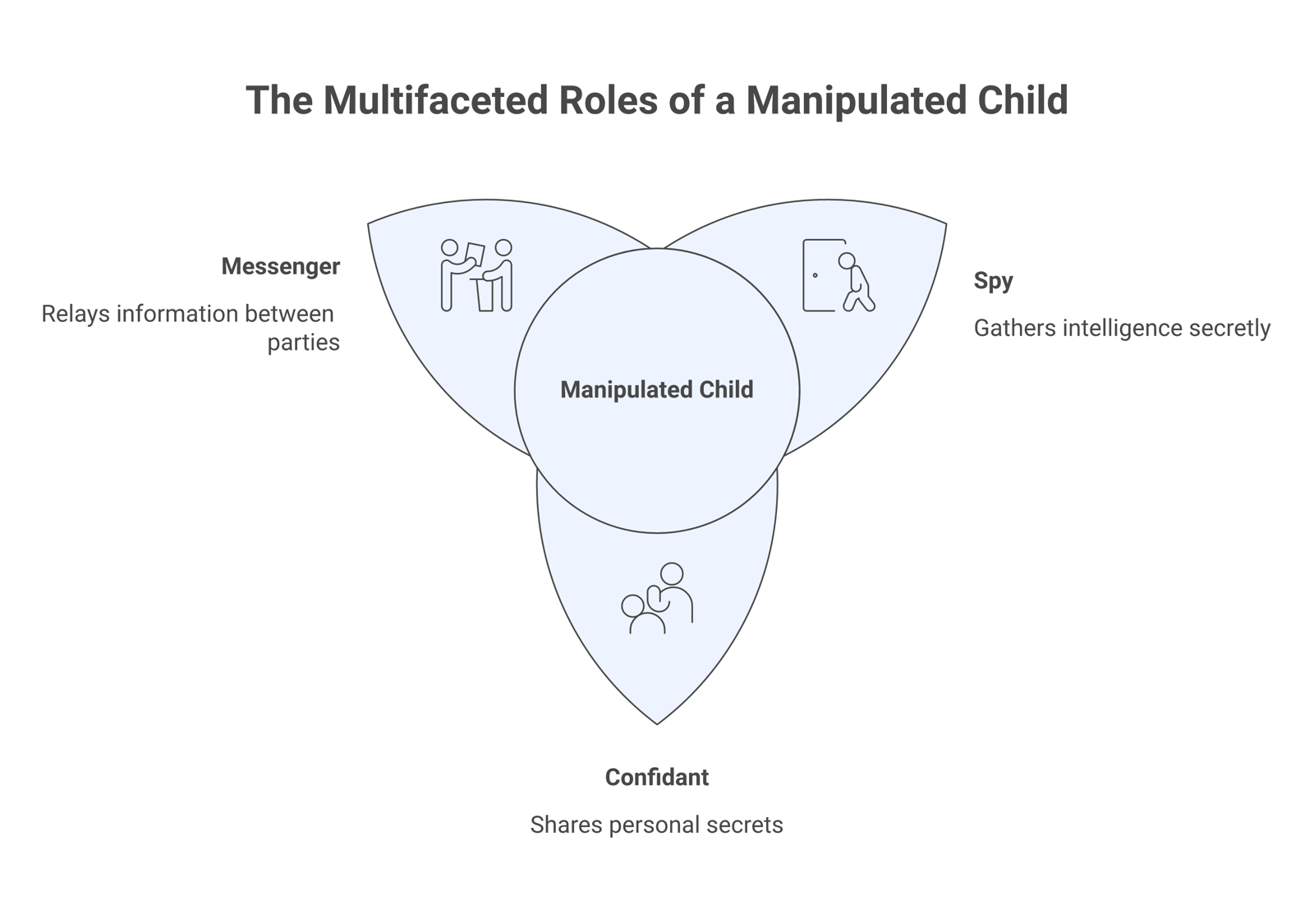
When a parent uses a child as a channel, the child usually gets pushed into one or more of four roles. Reading the role, rather than the single comment, is the most reliable way to tell what is happening.
The messenger
The messenger carries adult content between two homes. “Mom says you still owe money.” “Tell your dad the answer is no.” The child becomes the delivery system for disputes that adults should handle directly. Cheryl Mefferd, organizing Amy Baker’s research on alienating strategies, places this under a cluster she calls encouraging betrayal, where the child is made an information relay and the adults refuse to speak to each other. The cost lands on the child. A messenger gets blamed for the message and absorbs the tension of both sides.
The spy
The spy is sent home with questions, or comes home and is debriefed. A child may ask oddly specific things, who you spend time with, what you bought, whether you have a new partner, and the other parent later seems to know the answers. The child may report back without being asked, because they have learned it earns approval. Mefferd’s taxonomy includes engineered information gathering and “accidentally” shared adult material. The child is not being nosy. The child has been given a surveillance job and rewarded for doing it.
The confidant
The confidant is made into the parent’s emotional caretaker. The roles invert, and the child starts holding adult worries. Psychologist Craig Childress describes this as a role-reversal relationship, where a parent who cannot steady their own feelings uses the child as a regulatory object to stabilize the adult. Baker’s research found the same pattern even in intact homes, where one parent confides in the child about the other parent’s faults and quietly recruits an ally. Signs include a child who knows too much about money, court, or the divorce, and who comforts the parent rather than the other way around.
The loyalty-tester
The loyalty-tester polices their own affection. The child is made to feel that loving the other parent is a betrayal. Former alienated child Ryan Thomas describes a sequence: shrink the child’s world, remove other viewpoints, assert control, then convert that control into guilt. Love for the targeted parent gets reframed as disloyalty, an unspoken “How dare you?” Zach Flood calls the underlying deal a loyalty contract: in exchange for security and approval, the child must adopt one parent’s view and perform it on demand. The child may hide that they enjoyed a visit, or apologize for warmth, as if caring were a wrong.
How a manipulated child starts to talk
Language often shifts before anything else does. A manipulated child begins using words that are too old for them, and grievances that are not their own. A seven-year-old talks about “the settlement” or “what she put me through.” The phrasing sounds borrowed because it is. Under a loyalty contract, the child reproduces an adult narrative sincerely, which is why it does not feel like lying to them.
The sharpest tell is the loss of mixed feelings. Bill Eddy, the lawyer and therapist who co-founded the High Conflict Institute, makes the point from practice: real bonds hold warmth and frustration at the same time. Even a child who was genuinely hurt by a parent usually keeps some good memories. So when a child paints one parent as all good and the other as all bad, with no nuance at all, that flatness is a signal. A child caught in manipulation may deny any happy memory ever existed, and sometimes rejects photos that show one.
Watch, too, for reasons that do not match the feeling. The complaint is thin (“he chews too loud,” “she is boring”), yet the rejection is total. Disproportion between a small stated reason and a large reaction is one of the more telling patterns. For a structured version of these signals to bring to a professional, the parental alienation checklist lays them out in order.
Normal adjustment or manipulation? The difference
This is the part that protects a child and a co-parent from a wrong conclusion. Children change after a separation for many reasons, and most of those reasons are not manipulation. The American Psychological Association notes that children often struggle to adjust to divorce and may direct distress at a parent. Distancing, anger, testing limits, and clinginess are common, ordinary, and temporary. None of that, on its own, means an adult is pulling the strings.
A few markers help tell adjustment apart from manipulation. Ordinary stress keeps ambivalence: the child is angry one day and affectionate the next. Manipulation tends to flatten feelings into a fixed all-good and all-bad split. Ordinary stress produces reasons a child owns and can explain. Manipulation produces borrowed reasons and adult phrasing. A struggling child still acts like a child. A child handed an adult job, carrying messages or secrets or worries, is being burdened in a way that growth and grief do not require.
Two more contrasts matter. A teenager naturally pulls away from both parents as part of growing up, and the timing near a divorce can make ordinary individuation look targeted when it is not. And a child with a real safety reason to avoid a parent is not being manipulated at all, which is why the caveat at the top comes first. The honest position is to hold the possibility of manipulation lightly until a qualified evaluator can weigh it.
Why the manipulation flows through the child
It helps to understand why an adult conflict ends up inside a child. A child depends on a parent for security, and that dependence is the lever. When one parent withdraws warmth whenever the child shows affection for the other, the child learns to perform loyalty to keep the bond safe. Flood’s loyalty contract names this exchange. The child is not weak or dishonest. The child is adapting to pressure in the only way a child can.
The pattern also explains the strange sincerity. A child relaying a false or cruel message often believes it, because the same loyalty pressure that produced the message blocks the child from questioning it. Childress frames the deeper harm as role reversal, where the child’s own development is sacrificed to stabilize a struggling parent. Researchers Jennifer Harman, Edward Kruk, and Denise Hines argue that these alienating behaviors amount to a recognized form of coercive control and family violence. The seriousness of the harm is not in doubt. What the child shows on the surface is the visible edge of that pressure, not a settled choice. For the fuller end-state, see child brainwashed against parent.
What to do if you see these signs
The steps below fit whatever the cause turns out to be, which is why they come before any conclusion.
Stay regulated. A child reads a parent’s nervous system fast, and calm is the one signal that reaches a child under pressure. Keep adult business between adults. Do not send replies back through the child, and do not interrogate the child about the other home, because that turns the child into a counter-spy and doubles the burden. Resist testing the child’s loyalty in return.
Keep the door open without forcing it. Brief, warm, low-pressure contact tells the child you are steady and safe to return to. Document patterns factually, with dates and direct quotes, rather than building a case in your head. Seek a qualified evaluation instead of diagnosing the child yourself, since a clinician trained in family dynamics can weigh the signals properly. Look after your own footing too, because a child cannot be steadied from a collapsed place. For concrete behaviors to compare against, see examples of parental alienation, and for active-situation support, see dealing with parental alienation.
Frequently asked questions
How can you tell if your child is being manipulated by your ex?
Watch the child’s role, not just their mood. Manipulation often shows up when a child is handed an adult job: carrying messages between homes, reporting back on one parent, comforting a parent, or being made to feel guilty for love. Listen for borrowed adult phrases and for a sudden loss of mixed feelings, where one parent is all good and the other all bad. These are signals to bring to a qualified professional, not proof on their own.
What is triangulation in a divorce?
Triangulation is when two adults route their conflict through a third person, usually the child. Instead of speaking to each other, the parents pass messages, surveillance, secrets, and loyalty pressure through the child. The child becomes a channel for a fight that belongs to the grown-ups, which is stressful and confusing for a person too young to hold it.
Is my child being used as a messenger or is this just co-parenting?
Healthy co-parents communicate directly with each other. When a child is repeatedly asked to relay adult content, such as money disputes, scheduling fights, or accusations, the child has been made a messenger. One offhand comment is not a pattern. A steady habit of the child delivering adult business in both directions is a recognized manipulation tactic.
Can normal divorce stress look like manipulation?
Yes, and that is exactly why caution matters. Children commonly distance, get angry, test limits, and regress after a separation, and that is ordinary adjustment, not manipulation. The difference is ambivalence and role. Normal stress keeps mixed feelings and lets the child stay a child. Manipulation flattens feelings into a fixed split and hands the child an adult job.
What should you do if your ex is using your child to spy?
Do not counter-recruit the child or interrogate them about the other home, because that adds to the burden you are worried about. Keep adult information between adults, stay calm, and document the pattern with dates and quotes. Then seek a qualified evaluation rather than trying to diagnose the child yourself. A clinician trained in family dynamics can tell you what the behavior means.
Where to go next
- For the full recognition guide, start at the Signs pillar.
- For the adult behaviors behind these signs, see signs your ex is alienating your child.
- For the later end-state, read child brainwashed against parent.
- For a structured self-check to bring to a professional, use the parental alienation checklist.
- For active-situation support, see dealing with parental alienation.
Sources and further reading
- Harman, J. J., Kruk, E., & Hines, D. A. (2018). Parental alienating behaviors: An unacknowledged form of family violence. Psychological Bulletin, 144(12), 1275 to 1299. https://doi.org/10.1037/bul0000175
- American Psychological Association. Divorce and child custody. apa.org/topics/divorce-child-custody
- Baker, A. J. L. (2007). Adult Children of Parental Alienation Syndrome: Breaking the Ties That Bind. W. W. Norton.
- Childress, C. A. (2015). Foundations: An Attachment-Based Model of Parental Alienation. Oaksong Press.
- Eddy, B. (2010). Don’t Alienate the Kids! Raising Resilient Children While Avoiding High-Conflict Divorce. HCI Press.
If you or your child are in crisis
Free and confidential help is available right now.
- 988 Suicide and Crisis Lifeline. Call or text 988. 988lifeline.org
- Childhelp National Child Abuse Hotline. 1-800-422-4453. childhelp.org
- NAMI HelpLine. 1-800-950-6264. nami.org/help
Last reviewed: 2026-06-06. Author: Alex Buckles (PAC Founder).