

Naming a family rupture honestly is hard. Parental alienation vs estrangement turns on one question: was the rejection earned? Estrangement is a warranted response to real harm. Alienation is a child manipulated into rejecting a safe, loving parent. The two can look identical from outside, yet they move in opposite directions, and only one is justified.
Read this first
A child may pull away because a parent was abusive, neglectful, frightening, or unsafe. That distancing is justifiable estrangement, not alienation, and the child is protecting themselves. This page never pressures anyone to relabel real abuse as alienation. Some rejection is warranted and healthy. If anyone in the family is in danger, contact 988 or the Childhelp hotline at 1-800-422-4453 first.
This page offers general information, not clinical advice. It cannot diagnose any child or family. It is not a substitute for a qualified evaluation. Anyone weighing these questions should seek a clinician trained in family dynamics.
Parental alienation vs estrangement: the core difference
Estrangement is the larger category. The word covers any cut-off, distant, or strained relationship between a parent and a child. Parental alienation is one path into that umbrella, not the whole of it. The distinction has a formal home in the research: Joan Kelly and Janet Johnston’s 2001 reformulation placed alienation and realistic estrangement at different points on a continuum of parent-child stances, and required ruling out justified estrangement before calling any rejection alienation.
The difference that matters is cause. Justified estrangement answers real harm. A parent was abusive, neglectful, or unsafe, and the child stepped away to stay safe. Alienation is the reverse. One parent pressures the child to reject the other parent. That other parent was safe and loving, with no real reason for the break. One rejection is earned. The other is engineered.
This page exists because the two are so easily confused, even by the person living it.
Why the two get confused
A rare voice on this question is Maddie, an adult-child survivor who runs The Anti-Alienation Project. Hers is a lived-experience account, not clinical research, and that is exactly its value here. She was alienated from her father for roughly twenty years, and she is now, by her own account, in a justified estrangement from her mother. She has lived through both. Her observation is unsettling: “When I was going through parental alienation, I thought I was estranged.”
That sentence explains the whole problem. A child shaped by one parent’s control feels the rejection of the other parent as a free choice. It feels like a personal belief. So the child calls it estrangement. The word sounds chosen, while alienation sounds done to them. The label can be wrong from the inside.
Setting makes the confusion worse. Children often struggle to adjust to divorce, the American Psychological Association notes. The same separation that strains a child can also be the moment an alienating parent exploits. Divorce is the leading context for estrangement, and it is also the context where alienation arises. Some share of the adults who describe themselves as estranged, Maddie argues from her own experience, are living alienation under the wrong name. Naming it correctly is not a technicality. It changes what actually helps.
Four questions that tell them apart
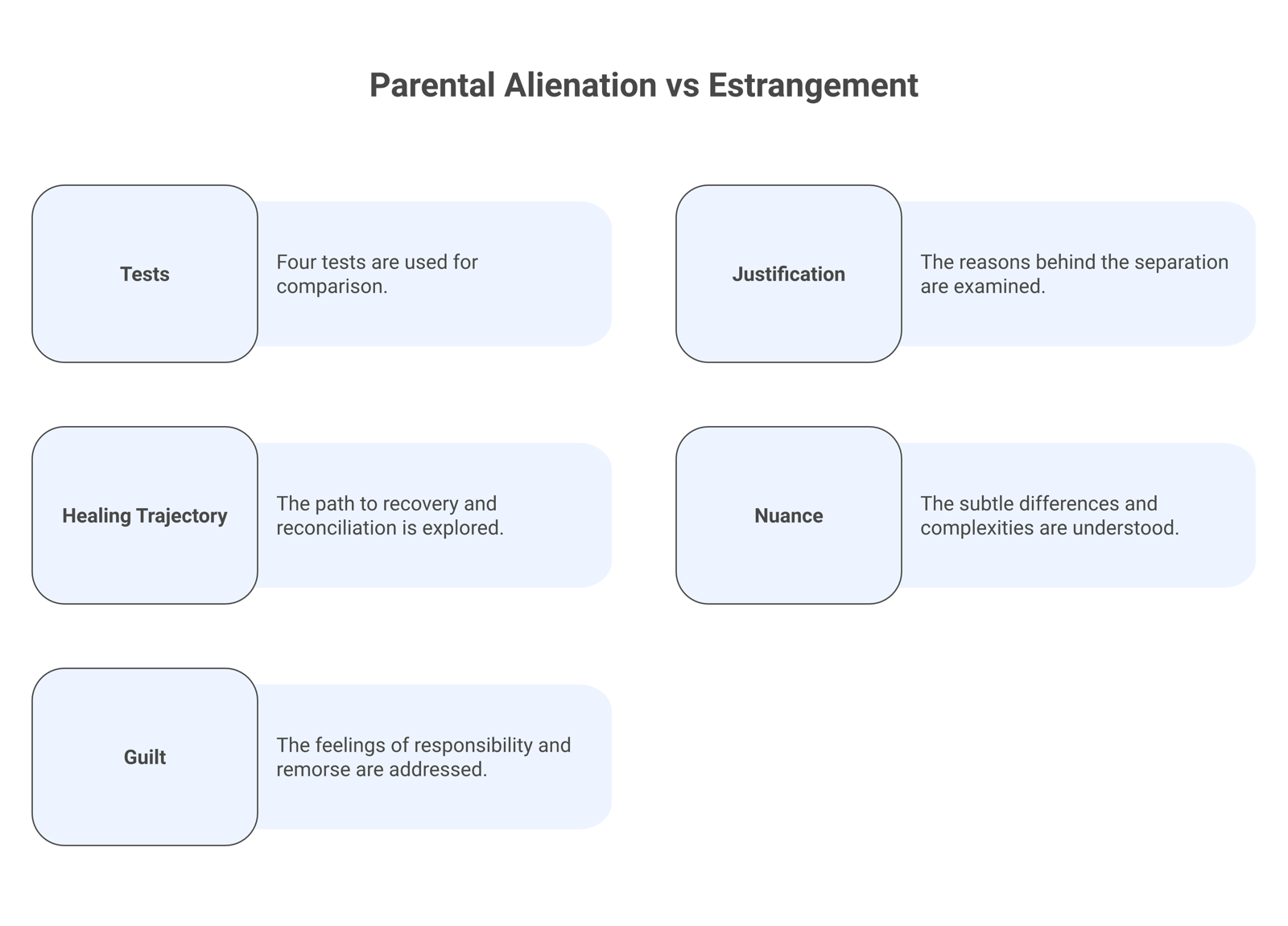
The clinical literature and lived experience converge on four questions. The first comes from the field’s core frameworks: Kelly and Johnston’s rule-out requirement and the Five-Factor Model proposed by William Bernet and Laurence Greenhill (2022), which makes the absence of abuse or neglect an explicit factor. The third and fourth trace to Richard Gardner’s behavioral manifestations, lack of ambivalence and absence of guilt, carried forward in Amy J.L. Baker’s four-factor model. The second, the direction of the pain over time, is a lived-experience observation from survivors such as Maddie of The Anti-Alienation Project. Each question looks at the rejection from a different angle. No single answer is proof. A trained clinician should weigh them together.
| Question to ask | Points to alienation | Points to justified estrangement |
|---|---|---|
| Is the rejection earned? | No real cause; the parent was safe and loving | Yes; real abuse, neglect, or harm occurred |
| Which way is the pain moving? | It persists or grows over the years | It is real but shrinks as health improves |
| Can the child see the parent whole? | All bad, no nuance, no redeeming qualities | Nuanced; holds the good, the bad, and the history |
| How does the child feel about the cutoff? | Little guilt; it feels like righteous justice | Genuine guilt and remorse, even when needed |
The justification test
Ask whether the rejection is warranted. This is the dividing line the field’s frameworks draw formally. Kelly and Johnston’s reformulation requires ruling out realistic estrangement before alienation is even considered, and the Five-Factor Model makes the absence of abuse, neglect, or seriously deficient parenting an explicit factor. Justified estrangement has a real reason behind it: genuine abuse, neglect, or harm the parent has not repaired. Alienation does not. Picture a child who rejects a parent who was loving and safe. If the stated reasons are thin or borrowed, a real reason is missing. That gap is the first clue.
The healing test
Consider which way the pain is moving. This is a lived-experience observation rather than a clinical criterion, and it is one outsiders rarely think to use. Survivors describe justified estrangement as working like a healing process. The pain is real, but it eases over time as the person’s health improves. The distance is protective and self-chosen. Alienation, in these accounts, runs the other way. The wound persists and deepens across the years, because rejecting a once-loved parent never resolves. Maddie’s own words: going through alienation “was not a healing process.” Watch the direction of the pain over time, and bring what you see to a clinician.
The nuance test
Notice whether the child can still see the parent as a whole person. This question comes straight from the research: lack of ambivalence, the all-good and all-bad split, is one of Gardner’s eight behavioral manifestations of alienation, carried forward in Baker’s model. Real bonds hold mixed feelings, a point Bill Eddy, the lawyer and therapist who co-founded the High Conflict Institute, makes in practical terms. Even a child who was truly hurt keeps some warmth alongside the fear. So an estranged adult can usually still name the parent’s good points and their hard past. Alienation flattens that. The targeted parent becomes all bad, with no good trait and no way back. Pure all-good and all-bad, with zero gray, is rarely real. It is more often taught.
The guilt test
Look at how the child feels about the cutoff itself. This question also comes from Gardner’s manifestations: absence of guilt over cruelty toward the rejected parent is a documented marker of alienation. In alienation, the child feels little guilt. The rejection feels righteous, like standing up to injustice against a parent they were taught to fear. In justified estrangement, the person usually carries real guilt and remorse, even while knowing the distance is needed. The pattern runs almost backwards from what people expect. More guilt about a cutoff can point toward earned estrangement. A clean conscience and crusading certainty against a once-loving parent can flag alienation.
A clue clinicians watch: the attachment paradox
One more signal is worth knowing, and it is surprising. Researcher Jennifer Harman and colleagues describe what can be called the attachment paradox. Children who are genuinely abused tend to cling to the abusive parent. They play down the harm, they excuse it, and they often want to go back. This is a well-known attachment response. It is part of why Harman, Kruk, and Hines argue that alienating behaviors constitute a form of family violence. Researchers have also built measurement around the distinction: William Bernet and colleagues’ PARQ-Gap study (2020) measures the difference between parental alienation and parental estrangement by comparing how children rate their acceptance and rejection of each parent.
The lesson is sharp. A strong, steady, and total rejection of a parent the child once loved is not the usual mark of abuse. It looks closer to the mark of influence. A related red flag is instant defense: a child who leaps to shield one parent the moment they sense criticism. Neither sign proves anything alone. Both are reasons for a careful professional to look closer rather than take the rejection at face value.
This paradox must never be used to wave away a child’s real fear. Where abuse is real, the child’s distancing is protective and right. The proper move is to gather evidence and use the right channels, while still telling the child the parent loves them and needs help. The point is narrow. An unexplained, total rejection of a once-loved, safe parent deserves a closer look, not a quick guess that the child must have a hidden reason.
When the rejection is justified estrangement
Some rejection is earned, and saying so is not a loophole. It is the heart of an honest comparison. Kelly and Johnston’s framework names realistic estrangement as its own distinct dynamic: the parent was truly abusive, neglectful, or frightening and has not made amends. A child or adult who steps away from that parent is not alienated. They are protecting themselves, and the repair work belongs to the parent who caused the harm.
This site will never pressure anyone to relabel real abuse as alienation. The four tests above protect that line in both directions. They guard a loving parent against a false story. They also guard a survivor of abuse, so justified distance is never dismissed as someone else’s doing. If the honest answer is estrangement, then the answer is estrangement.
For readers weighing the wider pattern, the parental alienation symptoms guide lays out the behaviors in detail. The child suddenly hates parent after divorce guide covers a fast change right after a separation.
What to do with an honest answer
A label is a starting point, not a verdict. Whichever way the differential points, a few steps hold.
Get a qualified opinion rather than a verdict from the internet. A clinician trained in family dynamics can run these tests properly. They weigh the results against the full history. A self-check, in either direction, is risky.
Keep the focus on the child’s reality, not on winning an argument. The goal is a clear, true picture. The right help depends on which story is real.
Stay steady. The distress of a family rupture is heavy, and a person cannot think clearly about a hard question from a collapsed place.
If the signs point toward alienation, the signs your ex is alienating your child guide and the broader Signs pillar map the next steps. For the contested clinical term itself, read parental alienation syndrome.
Frequently asked questions
Am I being alienated or am I estranged?
The honest test is whether the rejection is earned. Estrangement answers real harm, and the pain tends to ease as health improves. Alienation is the rejection of a safe, loving parent under the other parent’s pressure. There, the pain tends to grow. Nuance and guilt point the same way. Estrangement keeps a balanced view and carries remorse. Alienation brings all-or-nothing thinking and a sense of righteous certainty. A trained clinician should weigh these signs together, not a worried person alone.
What is the difference between parental alienation and estrangement?
Estrangement is the umbrella term for any cut-off or distant parent-child bond. Parental alienation is one cause. One parent turns the child against the other without a real reason. Justified estrangement is a different cause, where the rejected parent did real harm. The dividing line is simple. Estrangement answers something real, while alienation is engineered.
Can estrangement be mistaken for parental alienation?
Yes, and it runs both ways. An adult shaped by one parent’s control can feel an engineered rejection as a free choice and call it estrangement. A parent who caused real harm can wrongly call a child’s justified distance alienation. Because both errors happen, this comparison matters. Naming the experience accurately changes what truly helps.
Is it possible the rejection is justified and not alienation?
Yes. Some rejection is warranted, and this page never treats real abuse as alienation. If a parent was abusive, neglectful, or unsafe, a child’s distancing is justified estrangement, and it is healthy. The four tests are built to protect that line. A survivor’s justified distance is not dismissed as someone else’s manipulation.
How do clinicians tell parental alienation from estrangement?
They look at the whole pattern, not one moment. The frameworks they use, Kelly and Johnston’s reformulation and the Five-Factor Model, require ruling out genuine abuse or neglect first, then weighing the prior relationship, the favored parent’s behaviors, and markers in the child such as lack of ambivalence and absence of guilt. Trained evaluators also note that genuinely abused children tend to cling to a harmful parent. So a total rejection of a once-loved, safe parent is a reason to look closer.
For the clinical differentiator built around the lack-of-ambivalence marker, see estrangement versus parental alienation.
Where to go next
- For the full recognition guide, start at the Signs pillar.
- For the behavior inventory, see parental alienation symptoms.
- For a fast change after separation, see child suddenly hates parent after divorce.
- For the co-parent’s tactics, see signs your ex is alienating your child.
- For the contested term itself, read parental alienation syndrome.
Citations
- Harman, J. J., Kruk, E., & Hines, D. A. (2018). Parental alienating behaviors: An unacknowledged form of family violence. Psychological Bulletin, 144(12), 1275 to 1299. https://doi.org/10.1037/bul0000175
- American Psychological Association. (n.d.). Divorce and child custody. apa.org/topics/divorce-child-custody
- Kelly, J. B., & Johnston, J. R. (2001). The alienated child: A reformulation of parental alienation syndrome. Family Court Review, 39(3), 249 to 266.
- Bernet, W., & Greenhill, L. L. (2022). The Five-Factor Model for the diagnosis of parental alienation. Journal of the American Academy of Child & Adolescent Psychiatry, 61(5), 591 to 594. https://doi.org/10.1016/j.jaac.2021.11.026
- Bernet, W., Gregory, N., Rohner, R. P., & Reay, K. M. (2020). Measuring the difference between parental alienation and parental estrangement: The PARQ-Gap. Journal of Forensic Sciences, 65(4), 1225 to 1234.
- Gardner, R. A. (1998). The Parental Alienation Syndrome (2nd ed.). Creative Therapeutics. (Source of the lack-of-ambivalence and absence-of-guilt manifestations.)
- Baker, A. J. L. (2020). Reliability and validity of the four-factor model of parental alienation. Journal of Family Therapy, 42(1), 100 to 118. https://doi.org/10.1111/1467-6427.12253
- Eddy, B. (2010). Don’t Alienate the Kids! (Practitioner guidance, not peer-reviewed outcome research.)
- Maddie, The Anti-Alienation Project. (2026). A Secret About the “Estrangement Epidemic.” youtube.com/watch?v=DxwiLxp4UkQ (Lived-experience account from a named survivor, not a measured study.)
If you or your child are in crisis
Free and confidential help is available right now.
- 988 Suicide and Crisis Lifeline. Call or text 988. 988lifeline.org
- Childhelp National Child Abuse Hotline. 1-800-422-4453. childhelp.org
- NAMI HelpLine. 1-800-950-6264. nami.org/help
Last reviewed: 2026-06-06. Author: Alex Buckles (PAC Founder).