

Parental alienation symptoms appear in the child, not on paper. The clearest sign is a sudden, all-or-nothing rejection of a once-loved parent: no mixed feelings, no guilt, and reasons that sound borrowed. These patterns help separate true alienation from normal divorce adjustment, and from a child’s justified fear of a genuinely harmful parent.
A note on safety
A child who pulls away from a parent who has been abusive, neglectful, or genuinely frightening is showing justified estrangement, not alienation. That is a protective response, and it is healthy. The symptoms on this page should never be used to dismiss or override a child’s real fear. If a child’s safety is at risk, contact local law enforcement or a domestic-violence resource first.
This page is general education. It is not clinical advice, does not diagnose any child, does not replace an assessment by a qualified clinician, and does not create a treatment relationship. Anyone worried about a specific child should consult a licensed mental-health professional.
What parental alienation symptoms look like in a child
Parental alienation symptoms are behaviors a child shows toward one parent after the other parent’s influence has taken hold. They are not a formal diagnosis. They are observable patterns that clinicians and researchers have described for decades. The single most useful one is the loss of ambivalence.
Bill Eddy, the lawyer and therapist who co-founded the High Conflict Institute, makes the practical point that real human relationships are ambivalent: they carry mixed feelings. A child who casts one parent as all good and the other as all evil, with no nuance at all, is showing something that authentic experience rarely produces. That black-and-white split is the spine of the recognition picture, and it is one of the eight behavioral manifestations Richard Gardner first described.
Why does this matter so much? Because the same surface behavior, a child pulling away from a parent, can have very different causes. Some are healthy. Others reflect real danger. The symptoms below help tell those causes apart, though no single sign settles the question on its own.
The classic symptoms of parental alienation
Clinicians and researchers, building on the work of Amy Baker and Richard Gardner, describe a recognizable cluster of behaviors in alienated children. Four of them stand out for everyday recognition.
Loss of ambivalence (the all-good, all-evil split)
This is the loss-of-ambivalence marker. The favored parent is flawless. The rejected parent is wholly bad, and the child can name no redeeming quality at all. Clinicians describe children who draw one parent as a devil and the other as an angel. Even children who were genuinely mistreated tend to keep some mixed feelings about the parent who hurt them. Pure, polished hatred with no gray is the part that does not fit ordinary experience.
Absence of guilt
Alienated children often treat a once-loved parent with striking coldness and feel no remorse about it. They can be cruel or dismissive and show no discomfort afterward. This contrasts sharply with children who have actually been abused, who tend to manage the abuser’s feelings carefully and tread lightly. The missing guilt is a recognition marker, not a flaw in the child’s character.
Borrowed-scenario, scripted language
Listen closely to the reasons a child gives. In alienation, the words often sound rehearsed, adult, or oddly specific for the child’s age. A child may repeat phrases or accusations they cannot actually explain or define. Baker calls these borrowed scenarios: ideas and vocabulary that came from the favored parent’s mouth, not from the child’s own memory. Reasons that are weak, trivial, or scripted, such as “his car smells like coffee,” point the same way. The pattern is covered in more detail under signs your ex is alienating your child.
Reflexive, automatic support of one parent
Watch what happens at the first hint of conflict between the parents. An alienated child tends to side with the favored parent instantly and automatically, even when that position is illogical or works against the child’s own interest. Reflexive support is another of Gardner’s documented manifestations. A child who leaps to defend one parent the moment they sense any criticism can reveal who holds the controlling role.
The hardest symptom to read: when rejection itself is the red flag
One research finding surprises almost everyone. Researchers including Dr. Jennifer Harman point to an attachment paradox. Severely abused children usually minimize the abuse, make excuses for the abuser, and want to go back. Genuine maltreatment rarely produces clean, total, comfortable rejection.
So a strong, consistent, guilt-free rejection of a parent the child once loved is itself a red flag of influence, not proof that the rejected parent did something wrong. That sounds backward, and it is exactly why these cases get misread so often. Harman frames alienating behavior as a form of child maltreatment in its own right: emotional aggression, neglect of the child’s need for both parents, and the weaponizing of courts or agencies. Her peer-reviewed argument appears in the journal Psychological Bulletin.
None of this means every rejection is alienation. It means the shape of the rejection matters. Abuse-driven distancing and influence-driven rejection tend to look different, and that difference is readable. A child who is being pressured to reject a safe parent is explored further in child brainwashed against a parent.
Telling symptoms apart from normal post-divorce adjustment
Divorce is hard on children, and some distance is normal. A child may be angry, sad, withdrawn, or briefly cooler toward one parent while the family reorganizes. That is adjustment, not alienation, and it usually softens with time and steady contact.
Normal adjustment keeps its gray. The child still remembers good times, still shows mixed feelings, still feels some guilt about being unkind. The reasons make sense for the child’s age and the situation. Alienation symptoms run the other way: the ambivalence disappears, the reasons sound borrowed, and the rejection hardens rather than eases.
The American Psychological Association’s overview of divorce and child custody describes the ordinary range of children’s reactions. Reading that range first helps a worried parent avoid pathologizing a child who is simply grieving a change in the family.
Telling symptoms apart from justified estrangement
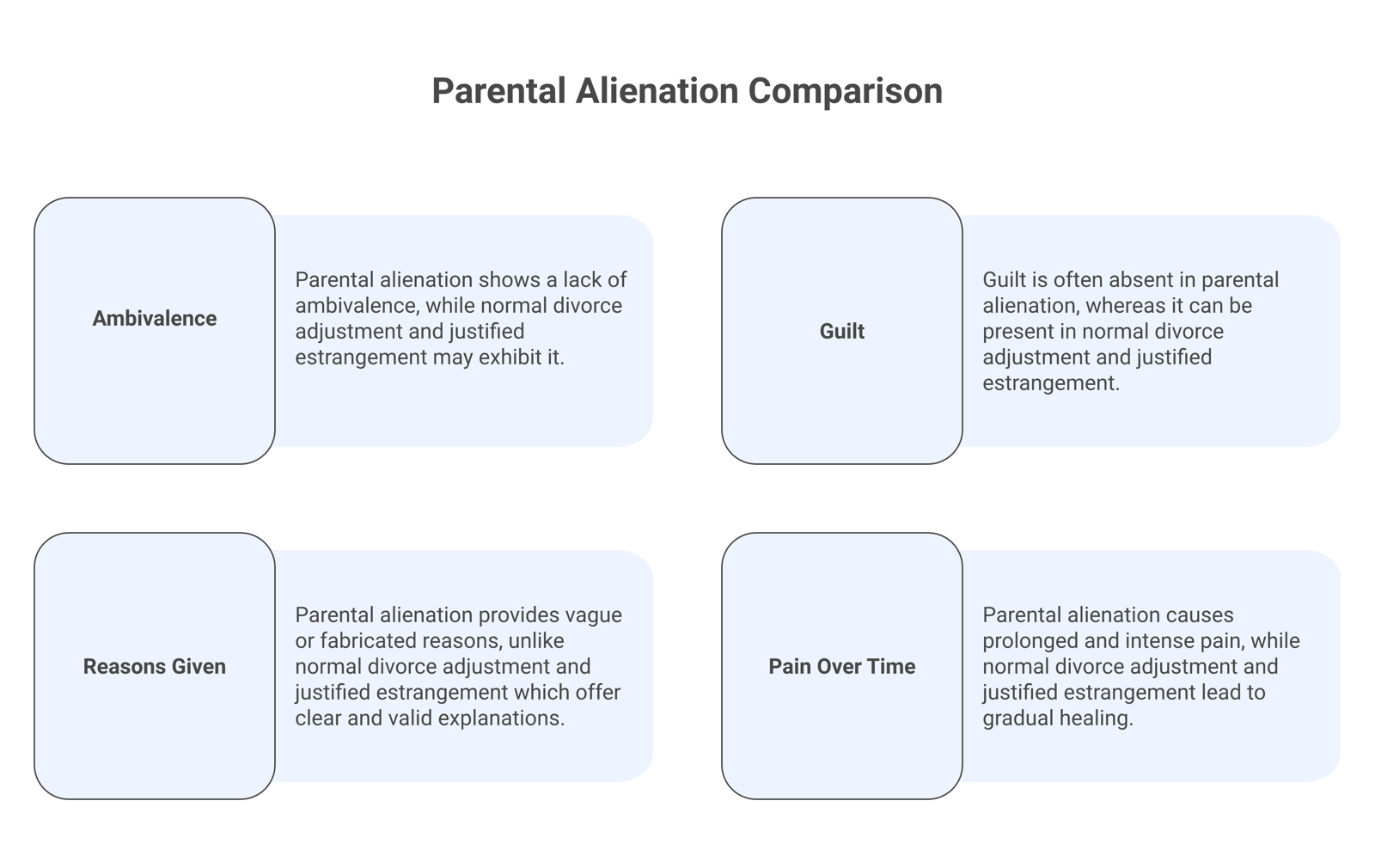
The other line to draw is between alienation and justified estrangement, where a child pulls away from a parent who was truly harmful. The field’s frameworks draw this line formally: Joan Kelly and Janet Johnston’s 2001 reformulation requires ruling out justified estrangement before calling any rejection alienation, and the Five-Factor Model (Bernet & Greenhill, 2022) makes the absence of abuse or neglect an explicit factor. Maddie, an adult survivor who lived through both experiences and now runs The Anti-Alienation Project, distills the same line into four practical tests. Hers is a lived-experience voice, not a clinical authority, and the tests below should be read that way.
- Justification. Estrangement has real cause behind it. Alienation is the rejection of a loving parent without genuine justification.
- Direction of the pain. Justified estrangement tends to heal, and the pain shrinks over time. Alienation pain persists and often worsens, because the rejection is not authentic.
- Nuance. An estranged person can still see the other parent as a whole, flawed human being. Alienation erases the gray entirely.
- Guilt. A person in justified estrangement usually feels guilt about the distance. During alienation the child feels none, because the rejection feels like standing up to injustice.
Two of these tests, the missing nuance and the missing guilt, echo the clinical symptoms above. Lived experience and clinical observation point to the same markers, which is part of why they are worth trusting.
A parent’s self-audit before concluding alienation
Before deciding that a child’s behavior is alienation, it helps to look honestly at every other explanation. A useful self-audit for a parent facing a child who says “I hate you” asks five questions.
- Is the other parent engaging in alienating behaviors, such as bad-mouthing or blocking contact?
- What is your own parenting style, and could part of it add to the strain?
- Have new relationships or stepparents recently changed the home?
- Do you live close enough to share everyday life with the child?
- Do you show up for the child’s activities and routines?
None of these questions blames the targeted parent for alienation. They keep the focus where it belongs: on the child, and on an honest reading of the whole picture before reaching for a label. Children also reject parents for reasons that have nothing to do with either parent’s conduct, including a felt rupture in attachment, so the cause is rarely as simple as it first looks.
A final note on language. Parental alienation syndrome remains a contested construct, and courts treat the diagnostic label with caution. The observable behaviors, not the diagnosis, are what a parent can actually notice and document. For the history and the debate behind the term, see parental alienation syndrome. For a broader view of the warning signs, see the Signs overview and the parental alienation checklist.
Frequently asked questions
What are the main symptoms of parental alienation in a child?
The main symptoms appear in the child’s behavior toward one parent. They include a loss of ambivalence (one parent is all good, the other all evil), an absence of guilt about treating a once-loved parent cruelly, borrowed or scripted reasons the child cannot fully explain, and reflexive, automatic support for the favored parent. No single sign is conclusive, so the pattern matters more than any one behavior.
How is parental alienation different from a child just adjusting to divorce?
Normal post-divorce adjustment keeps its gray. The child still recalls good times, still has mixed feelings, and usually softens with time and steady contact. Alienation symptoms are different: the ambivalence vanishes, the reasons sound rehearsed, and the rejection hardens rather than easing. Time and contact tend to heal adjustment but deepen alienation.
Can a child’s rejection of a parent ever be healthy?
Yes. When a parent has been abusive, neglectful, or frightening, a child’s distancing is justified estrangement, and it is a protective, healthy response. The difference is the cause and the shape of the rejection. Genuine fear of a harmful parent should never be reframed as alienation, and a child’s real safety always comes first.
Why is a child’s strong rejection of a parent treated as a red flag?
Research on abused children shows an attachment paradox: severely mistreated children usually cling to the abuser and make excuses for them, rather than rejecting them cleanly. So a consistent, guilt-free rejection of a parent the child once loved can signal outside influence rather than wrongdoing by the rejected parent. The pattern is counterintuitive, which is why it is so often misread.
Are parental alienation symptoms the same as parental alienation syndrome?
Not quite. The symptoms are observable behaviors in the child. Parental alienation syndrome is a proposed diagnostic label that remains scientifically and legally contested. A parent can recognize and document behaviors without relying on the disputed diagnosis. See parental alienation syndrome for the construct and the controversy.
Sources and further reading
- Harman, J. J., Kruk, E., & Hines, D. A. (2018). Parental alienating behaviors: An unacknowledged form of family violence. Psychological Bulletin, 144(12), 1275 to 1299. https://doi.org/10.1037/bul0000175
- Gardner, R. A. (1998). The Parental Alienation Syndrome (2nd ed.). Creative Therapeutics. (Source of the eight behavioral manifestations, including lack of ambivalence and absence of guilt.)
- Kelly, J. B., & Johnston, J. R. (2001). The alienated child: A reformulation of parental alienation syndrome. Family Court Review, 39(3), 249 to 266.
- Bernet, W., & Greenhill, L. L. (2022). The Five-Factor Model for the diagnosis of parental alienation. Journal of the American Academy of Child & Adolescent Psychiatry, 61(5), 591 to 594. https://doi.org/10.1016/j.jaac.2021.11.026
- American Psychological Association. Divorce and child custody. apa.org/topics/divorce-child-custody
If you or your child are in crisis
Free and confidential help is available right now.
- 988 Suicide and Crisis Lifeline. Call or text 988. 988lifeline.org
- Childhelp National Child Abuse Hotline. 1-800-422-4453. childhelp.org
- NAMI HelpLine. 1-800-950-6264. nami.org/help
Last reviewed: 2026-06-06. Author: Alex Buckles (PAC Founder).