

This page provides general educational information, not clinical or legal advice.
A child brainwashed against a parent shows reflexive, all-or-nothing rejection built on borrowed adult words and grievances that do not fit the child’s own memory. If you are watching this unfold, the pattern is recognizable. It is not a verdict. The same surface signs can appear in justified estrangement, so careful observation comes before any conclusion.
A note before you read
A child’s rejection of a parent is not always coaching. If the rejected parent has been abusive, neglectful, or genuinely frightening, the child’s distancing is justifiable estrangement, not brainwashing. The same surface signs can appear in both. The distinction is clinical work, and this page never asks a reader to settle it alone.
What “brainwashed” really means here
“Brainwashed” is the word many parents reach for, not a clinical diagnosis. It captures a real and documented process. Clinical psychologist Dr. Richard Warshak, author of Divorce Poison, calls it rewriting reality. He compares it to state propaganda. To turn a population against a once-respected figure, Warshak notes, propagandists do more than plant new beliefs. Their “corruption of reality had to reach back in time.” A parent doing this to a child rewrites shared history so the other parent appears to have always been absent, dangerous, or unloving.
So “brainwashing” here is shorthand for a set of mechanisms that researchers have described in detail. Bill Eddy of the High Conflict Institute lays out how those mechanisms work on a child’s developing brain. The point of this page is recognition, not labeling. Seeing the signs is the start of a careful conversation with a clinician, not the end of one.
The signs a child is brainwashed against a parent
The signs below describe a pattern over time, not a single bad day. One item alone proves nothing. A worried parent should look for several of these together, sustained across weeks, and disproportionate to anything that has actually happened in the relationship.
Reflexive, ambivalence-free rejection
The clearest single sign is rejection with no mixed feelings. Eddy puts it plainly: “All human relationships are ambivalent and ambiguous.” Real relationships carry mixed feelings. Even a child who has been genuinely hurt by a parent usually keeps some warmth alongside the fear. When a child casts one parent as all good and the other as all bad, with no nuance at all, that pure-negative pattern is the loss-of-ambivalence diagnostic. It points toward a taught response rather than a felt one.
Borrowed words and grievances that do not fit
A second sign is language that does not belong to the child. The child repeats adult phrasing they cannot define, recites legal or financial complaints far above their years, or describes events with a conviction that outruns their actual memory. Researchers call these borrowed scenarios. The grievance often does not match the child’s own history. A child may condemn a parent for “abandoning” them when that parent was present every day, because the story, not the experience, is doing the talking.
Sincere belief in things that did not happen
A third sign is the hardest to watch. The child sincerely believes things that did not happen. Clinician Zach Flood describes this through the loyalty contract and the encapsulated delusional system. Inside that system the child is not lying. The child confabulates, filling memory gaps to fit a repeated narrative, and then believes the result. This is why arguing the facts rarely lands. It also explains why a child can look fine at school and with friends while rejecting one parent at home. The dysfunction is encapsulated to a single relationship. For concrete illustrations, see examples of parental alienation, and for a structured observation tool, the parental alienation checklist. The wider behavioral inventory lives on the signs pillar.
Why coached rejection feels real to the child
Understanding the mechanism helps a parent stop blaming the child. Eddy’s brain model explains why coached rejection feels authentic from the inside. Repeated experience wires the brain: the more often a child hears “it is all your fault” while feeling sad, the stronger the link between sadness and blame becomes. Unused positive memories of the rejected parent fade through ordinary pruning, especially when contact is cut. Intense emotion shifts the child into right-brain, all-or-nothing processing, and the logical left brain then invents reasons after the fact. That is why alienated children give such thin reasons for rejection, like a parent’s hair or driving.
Eddy describes seven mechanisms of emotional absorption that carry the adult’s feelings into the child. Two matter most for recognition. The illusion-of-truth effect means a claim repeated often enough starts to feel true even when it is implausible. The negative-stereotype effect was shown in the Sam Stone study, where preschoolers primed with a negative story about a visitor later “remembered” him doing damaging things he never did. A child does not need to be lied to outright. Repetition and priming do the work. Warshak’s research on the misinformation effect describes the same arc: an event, false information inserted afterward, then reinforcement until the distortion holds. None of this requires the child to be weak or dishonest. It is how memory and attachment work under pressure.
Brainwashing or justified estrangement?
Not every child who pulls away has been coached. Psychologist Joshua Coleman places coached rejection inside a wider estrangement map that also includes justifiable estrangement, where the rejected parent was actually abusive or neglectful. The same surface behaviors can appear in both, which is exactly why the signs are a prompt to observe, never a verdict to act on.
The cleanest distinguishing question returns to ambivalence. A child responding to real harm tends to keep mixed feelings: they may want distance and still want the relationship to be different. Coached rejection tends to be absolute. Even so, a single test never settles a case. Severity, the child’s age, the history, and any safety concerns all matter, and a clinician trained in these dynamics is the right person to weigh them.
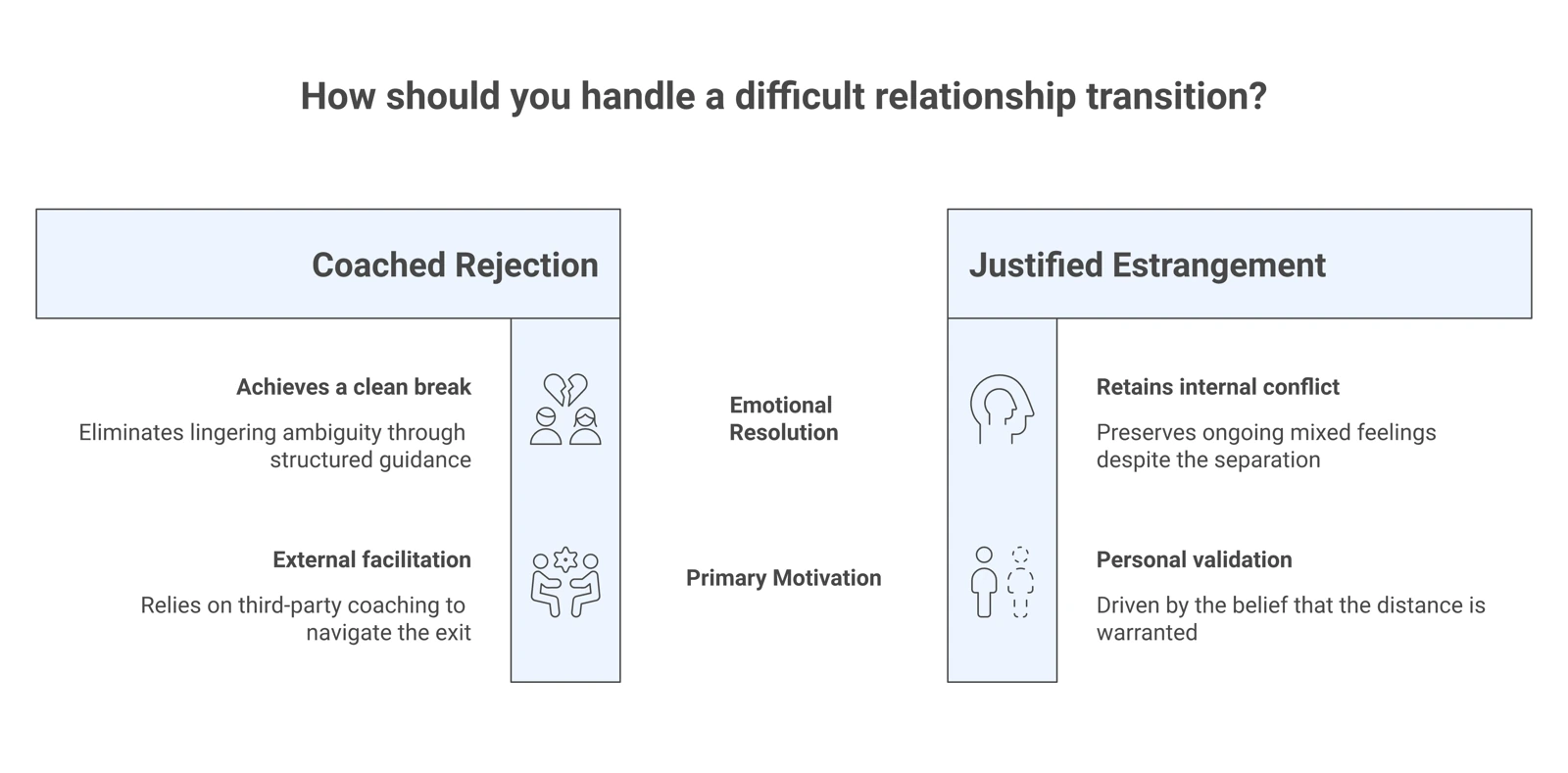
| Coached rejection (brainwashing) | Justified estrangement | |
|---|---|---|
| Feelings about the parent | Pure negative, no mixed feelings | Mixed; distance plus residual warmth |
| Reasons given | Borrowed, thin, adult phrasing | Specific, tied to real events |
| Match to the child’s own history | Often does not fit | Fits what actually happened |
| What the signs mean | Prompt to observe and consult | Prompt to ensure the child is safe |
What to do if your child seems brainwashed
If the signs match what a parent is seeing, the first moves are quiet ones. The instinct to correct the child, prove the truth, or argue the facts usually backfires. Inside the loyalty contract, pushing back puts the child in a worse bind and hardens the rejection.
A gentler response is source-questioning. When a child repeats a negative claim, a parent does not deny it or argue. Eddy suggests asking, “Where did you hear that? How often has that been said?” The aim is to invite the child’s own healthy skepticism, not to win a debate. Warshak’s defense for targeted parents runs the same direction: exercise self-restraint, do not give the campaign new material, and resist arguing a false memory in the heat of the moment. He also advises letting a trusted third party, such as a clinician, do any correcting, because the rejected parent is often heard as defensive.
Beyond that, two steps carry the most weight. Document the pattern over time, with dates, direct quotes, and witnesses where possible, because months of records mean more than one hard week. Consult a licensed clinician experienced in alienation dynamics before deciding anything. For a fuller treatment of next steps, see dealing with parental alienation. For the term itself and its contested history, see parental alienation syndrome.
Frequently asked questions
How do I know if my child is brainwashed against me?
Look for a pattern over time: reflexive, all-or-nothing rejection with no mixed feelings, borrowed adult phrasing, and grievances that do not match the child’s own history. One incident proves nothing. The combination, sustained for weeks and out of proportion to anything that actually happened, is the signal. A clinician trained in alienation dynamics interprets what the pattern means.
Why does my child sincerely believe things that never happened?
Because of confabulation inside a loyalty contract, plus the illusion-of-truth effect. A repeated claim starts to feel true, and the child fills memory gaps to fit the story. The child is not lying. The child believes it. This is why arguing the facts rarely works and why a clinician is better placed to help the child question the narrative.
What is the difference between brainwashing and a child who is just angry or estranged?
A child responding to real harm usually keeps mixed feelings, wanting distance and still wanting the relationship to change. Coached rejection tends to be absolute, with no warmth and thin reasons. The loss of ambivalence is the cleaner signal, but the same surface signs appear in both cases, so only a clinician can interpret them.
What should I do if I think my child is brainwashed against me?
Stay calm and do not interrogate or correct the child. Use gentle source-questioning instead, such as asking where they heard a claim. Document the pattern over time, and consult a clinician trained in alienation dynamics. Arguing the facts or proving the other parent wrong usually hardens the rejection.
Can a parent brainwash a child without meaning to?
Yes. Many of these mechanisms run below conscious intent, through emotional contagion, repeated negative framing, and a child’s automatic absorption of a parent’s fear and anger. The impact on the child does not depend on whether the other parent meant to cause it.
Where to go next
- For the full behavioral inventory, read the signs pillar.
- For concrete illustrations, see examples of parental alienation.
- For a structured observation tool, use the parental alienation checklist.
- For practical next steps, see dealing with parental alienation.
Sources and primary references
- Eddy, B. High Conflict Institute writing on parental alienation and the child’s brain. highconflictinstitute.com
- Warshak, R. A. Divorce Poison: How to Protect Your Family from Bad-mouthing and Brainwashing. Harper. Peer-reviewed work indexed via PubMed.
- Harman, J. J., Kruk, E., & Hines, D. A. (2018). Parental alienating behaviors: An unacknowledged form of family violence. Psychological Bulletin, 144(12), 1275 to 1299. https://doi.org/10.1037/bul0000175
- American Psychological Association. (n.d.). Divorce and child custody. apa.org/topics/divorce-child-custody
- Coleman, J. (2021). Rules of Estrangement: Why Adult Children Cut Ties and How to Heal the Conflict. Harmony.
If you or your child are in crisis
Free and confidential help is available right now.
- 988 Suicide and Crisis Lifeline. Call or text 988. 988lifeline.org
- Childhelp National Child Abuse Hotline. 1-800-422-4453. childhelp.org
- NAMI HelpLine. 1-800-950-6264. nami.org/help
Last reviewed: 2026-06-05. Author: Alex Buckles (PAC Founder).