

How to communicate with a toxic ex starts with one shift: treat every message as business, not personal. Keep it brief, factual, and in writing. Use the BIFF and EAR methods, lean on a co-parenting app, respond flatly to bait, and never route messages through the child.
A note on safety
A high-conflict ex is not the same as an abusive one. Where there is abuse, threats, or coercive control, safety comes first, and app-only or supervised contact may be the right call. A child who pulls away from a parent who was frightening or harmful has a real reason. That is estrangement, not alienation. If anyone is in danger, contact local law enforcement or a domestic-violence hotline first.
This page is general information, not clinical or legal advice. It does not diagnose any person and does not create a professional relationship. Anyone in a high-conflict custody situation should consult a licensed family-law attorney and a qualified mental-health professional in their own area.
How to communicate with a toxic ex: build a system, not a comeback
How to communicate with a toxic ex is a question about systems, not clever replies. The goal is never to win an argument. It is to move information, protect the child, and leave a clean record. A repeatable system does all three. A sharp comeback does the opposite, because it hands a high-conflict ex the very reaction they were fishing for.
“Toxic ex” here is plain shorthand, not a diagnosis. The phrase describes a pattern: messages that provoke, shift blame, or stall instead of solving a problem. Methods on this page respond to that pattern. They work whether or not the other parent carries any clinical label. For broader coping strategies beyond messaging, see how to deal with a narcissistic co-parent.
Move every exchange to writing
The first move is the simplest one. Shift contact off the phone and into writing. Written channels give a parent time to think before answering. They also build a record that a counselor, mediator, or court can read later.
Verbal handoffs are where many flare-ups begin. Keep those moments short and about logistics only. Save everything else for a written message, where tone is far easier to control. A calm paper trail protects the child’s time and keeps the focus on facts rather than memory.
Write BIFF messages: brief, informative, friendly, firm
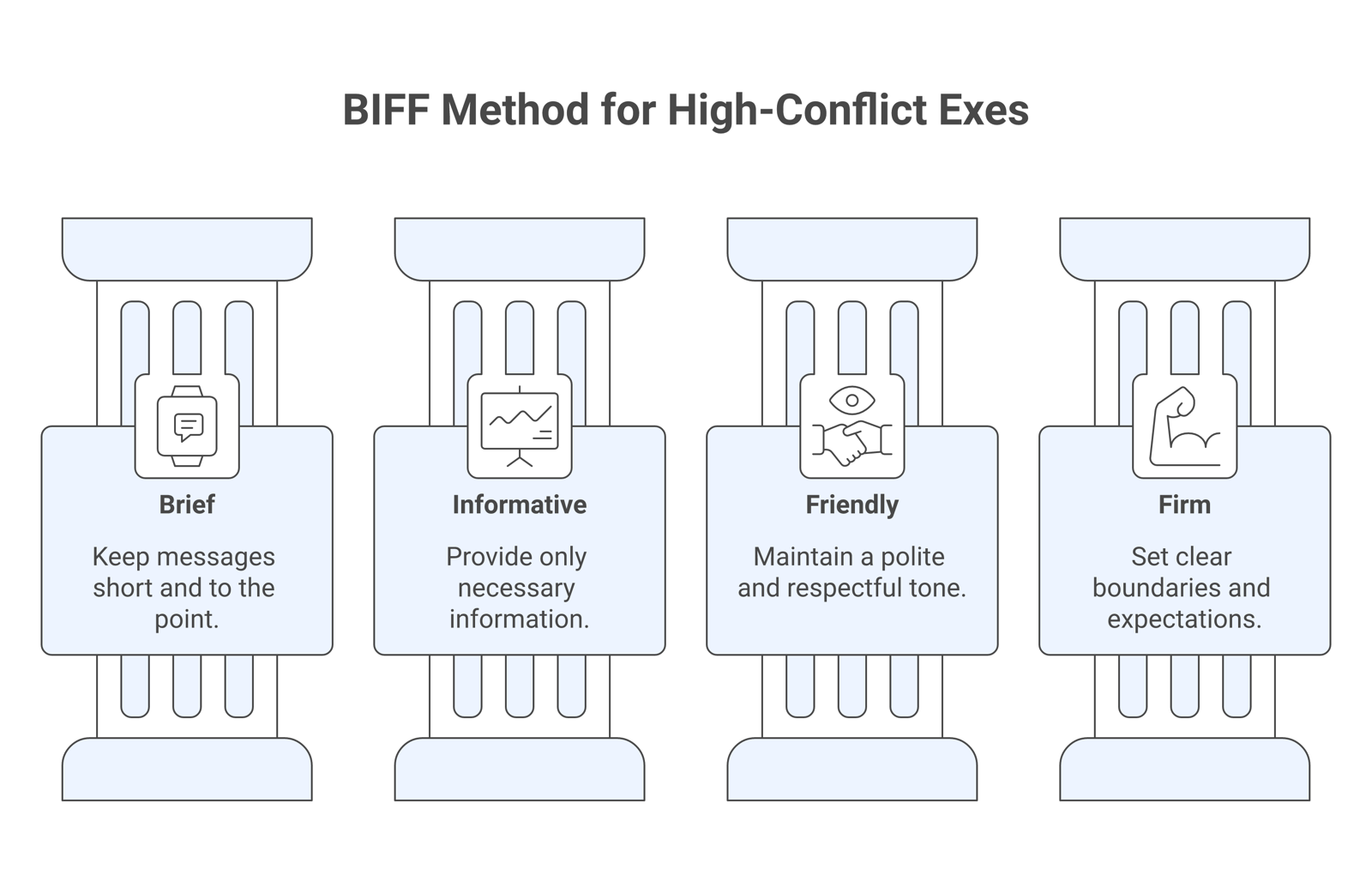
Bill Eddy, a lawyer and therapist who works with high-conflict families, teaches a writing method called BIFF. The four letters stand for brief, informative, friendly, and firm. Each message does those four jobs and nothing more.
- Brief. A few sentences, never paragraphs. Length invites argument.
- Informative. Plain facts about the schedule or the child, with no opinion attached.
- Friendly. A neutral, civil tone, even when the incoming message was not.
- Firm. A clear answer that closes the loop, so there is nothing to reopen.
Picture a hostile message about a pickup time. A BIFF reply might read: “Thanks for the note. Pickup stays at 6 p.m. Friday, as the schedule shows. See you then.” That answer handles the logistics and ignores the bait. It would also read as calm and child-focused if a counselor or judge ever saw it.
Use EAR statements when emotions spike
Some messages run too hot for a flat reply. Eddy offers a second tool for those moments, called EAR: empathy, attention, and respect. An EAR statement lowers the temperature before any logistics get discussed.
The structure stays short. Acknowledge the feeling, show that the message was heard, and signal respect. A line such as “It sounds like the schedule change was frustrating, and the kids matter to both of us” does that work. It concedes no point at all. It simply removes the heat so a real conversation can happen.
EAR and BIFF fit together well. An EAR opener can defuse a tense thread, and a BIFF answer can then settle the logistics. Both keep the parent steady, and both keep the child out of the adult tension.
Use a co-parenting app
A dedicated co-parenting app gives the written system a home. Messages, schedules, and expense logs all sit in one place, time-stamped and hard to alter. Many of these apps were built with family courts in mind, so the record they produce is court-friendly by design.
An app also adds a useful buffer. Some include a tone-check feature that flags hostile wording before a message sends. Knowing that every word is logged tends to cool both parents down. The app becomes the single channel, which means fewer surprise texts and fewer openings for conflict.
Gray-rock the provocations
Not every message deserves a full reply. When one is built to provoke, the steadiest answer gives almost nothing back. This is the gray-rock approach: stay as flat and dull as a plain gray rock, so there is nothing to grab.
Short, neutral replies work best here. “Noted.” “I will confirm by Thursday.” “That works.” None of these offers a feeling to feed on. Ryan Thomas, a formerly alienated child who now coaches targeted parents, describes how a provocation often aims to capture an emotional reaction and use it later. A gray-rock reply denies that footage.
Gray-rock is only for bait, not for genuine questions about the child’s care. A real question about a doctor visit or a school form still deserves a clear, BIFF-style answer. Sorting the two takes practice, and the test is simple: is this message solving something, or fishing for something?
Never use the child as a messenger
One rule sits above all the methods. The child is never the channel. Passing messages through a child, or quizzing them about the other home, pulls them straight into the middle of the adult conflict.
Cheryl Mefferd, who sorts alienating tactics into functional categories, names one category encouraging betrayal. It includes using children as an information relay and refusing direct adult communication. Routing messages through a child feeds that exact pattern, even when a parent means no harm by it.
Randi Fine, who studies how controlling parents organize a family, describes a tactic she calls triangulation: the controlling parent insists that nothing pass between two people without going through them. A direct, written, adult-to-adult channel breaks that hold. It keeps the child a child, not a courier.
Why the communication discipline matters
The discipline can feel cold at first. It is protective, not cold. Fine’s operating model shows how a high-conflict parent can turn ordinary contact into a tool for control. A predictable, businesslike channel quietly removes most of those openings.
The stakes here are real. Researchers Jennifer Harman, Edward Kruk, and Deborah Hines describe parental alienating behaviors as a form of coercive control that can harm children. Steady, documented, child-focused communication is one practical way to limit that harm. The record it builds can also matter later, if the case reaches a counselor or court. When the patterns start to look like alienation, see signs your ex is alienating your child.
When the system is not enough
Sometimes low-contact messaging is not the right fit. Where direct contact keeps fueling conflict, a parallel-parenting setup may serve the child better. Each parent runs their own home with little direct contact, which removes many openings for friction. The differences are explained in parallel parenting vs co-parenting.
When a co-parent actively undermines the schedule or the child’s bond, the problem has moved past messaging. That pattern is covered in co-parent sabotage. For families ready to build steadier habits over time, healthy co-parenting strategies gathers the longer-term groundwork. The broader Help center collects guidance for parents in this situation right now.
If a co-parent’s behavior crosses into abuse, threats, or coercive control, this is no longer a messaging problem. It is a safety problem. Write down the specifics, tell a lawyer or an advocate, and use the crisis resources below. Courts can order app-only contact, supervised exchanges, or other protections when safety is at stake.
Frequently asked questions
How do you communicate with a toxic ex?
Treat each message as business, not a personal exchange. Keep it brief, factual, and in writing, ideally through a co-parenting app. Use the BIFF method, which means brief, informative, friendly, and firm. Answer real questions clearly, give flat replies to bait, and never pass messages through the child.
What is the BIFF method?
BIFF is a writing method from Bill Eddy for high-conflict messages. The letters stand for brief, informative, friendly, and firm. A BIFF reply keeps to a few factual sentences, holds a civil tone, and gives a clear answer. It handles the logistics and ignores any bait in the other message.
What is the gray-rock method?
Gray-rock means answering a provoking message in a flat, brief, dull way, like a plain gray rock. Short replies such as “Noted” give a high-conflict ex nothing to react to. It is used only for bait, not for genuine questions about the child’s care, which still deserve a clear answer.
Should you stop talking to a toxic ex completely?
Usually not, when children are involved. The goal is low, structured contact rather than no contact at all. A written channel and a co-parenting app keep the necessary information flowing while cutting the friction. Full no-contact may fit only where there is abuse, and a lawyer or advocate can help weigh that.
Why should you keep co-parenting messages in writing?
Writing gives a parent time to think before replying, which keeps messages calm. It also builds a clear, time-stamped record of what was actually said. That record protects the child’s schedule and gives a counselor or court something solid to review later if the conflict escalates.
Sources and further reading
- American Psychological Association. Divorce and child custody. apa.org/topics/divorce-child-custody
- Harman, J. J., Kruk, E., & Hines, D. A. (2018). Parental alienating behaviors: An unacknowledged form of family violence. Psychological Bulletin, 144(12), 1275 to 1299. https://doi.org/10.1037/bul0000175
If you or your child are in crisis
Free and confidential help is available right now.
- 988 Suicide and Crisis Lifeline. Call or text 988. 988lifeline.org
- Childhelp National Child Abuse Hotline. 1-800-422-4453. childhelp.org
- NAMI HelpLine. 1-800-950-6264. nami.org/help
Last reviewed: 2026-06-06. Author: Alex Buckles, Founder.