

How long does reunification therapy take? For most families, the realistic range is months to years of weekly or near-weekly work, not days. Claims that four-day intensive programs resolve severe cases come from the programs’ own developers, and several states now restrict those programs. Severity, safety screening, the child’s readiness, and court involvement set the pace.
A note on safety
Where a child is protecting themselves from genuine abuse, forced reunification is not appropriate. Abuse-driven estrangement is not parental alienation, and it is a different clinical and safety matter. When a child has been harmed, that child’s distance can be healthy and protective. A qualified evaluator should sort genuine estrangement from alienation before any reunification work begins. That screening is not a delay in the timeline. It is the first step of the timeline.
This page is general information, not clinical advice. It does not diagnose any child, endorse any single program, or replace an assessment by a licensed clinician. Reunification work should be guided by a qualified professional who knows the family. Timelines on this page are ranges drawn from published practice, not promises about any one case.
How long does reunification therapy take? The honest range
How long does reunification therapy take? Honestly, longer than most parents hope and longer than some programs advertise. The standard format is weekly or twice-monthly sessions with a family therapist, and in published best-practice guidance that work addresses the whole family system, not just the child and the rejected parent (Templer, Matthewson, Haines and Cox, 2017). Mild cases can settle in a few months. Moderate and severe cases commonly run a year or more, and some families work in cycles over several years with pauses and restarts.
The length is not random. It tracks a few clear factors: how severe the rejection is, whether abuse and neglect have been screened out first, the child’s age and readiness, and how the court is involved. Each factor can stretch or shorten the work. None of them can be rushed without cost.
A short note on language helps here. Reunification therapy is the clinical work of rebuilding a damaged parent-child relationship. It is not a single method. Programs differ in intensity, length, and design, and the field has not agreed on one model, so any honest timeline has to describe a range rather than a single number.
What drives the length of reunification therapy
Several factors set the pace. Understanding them helps families plan, and it protects them from false promises.
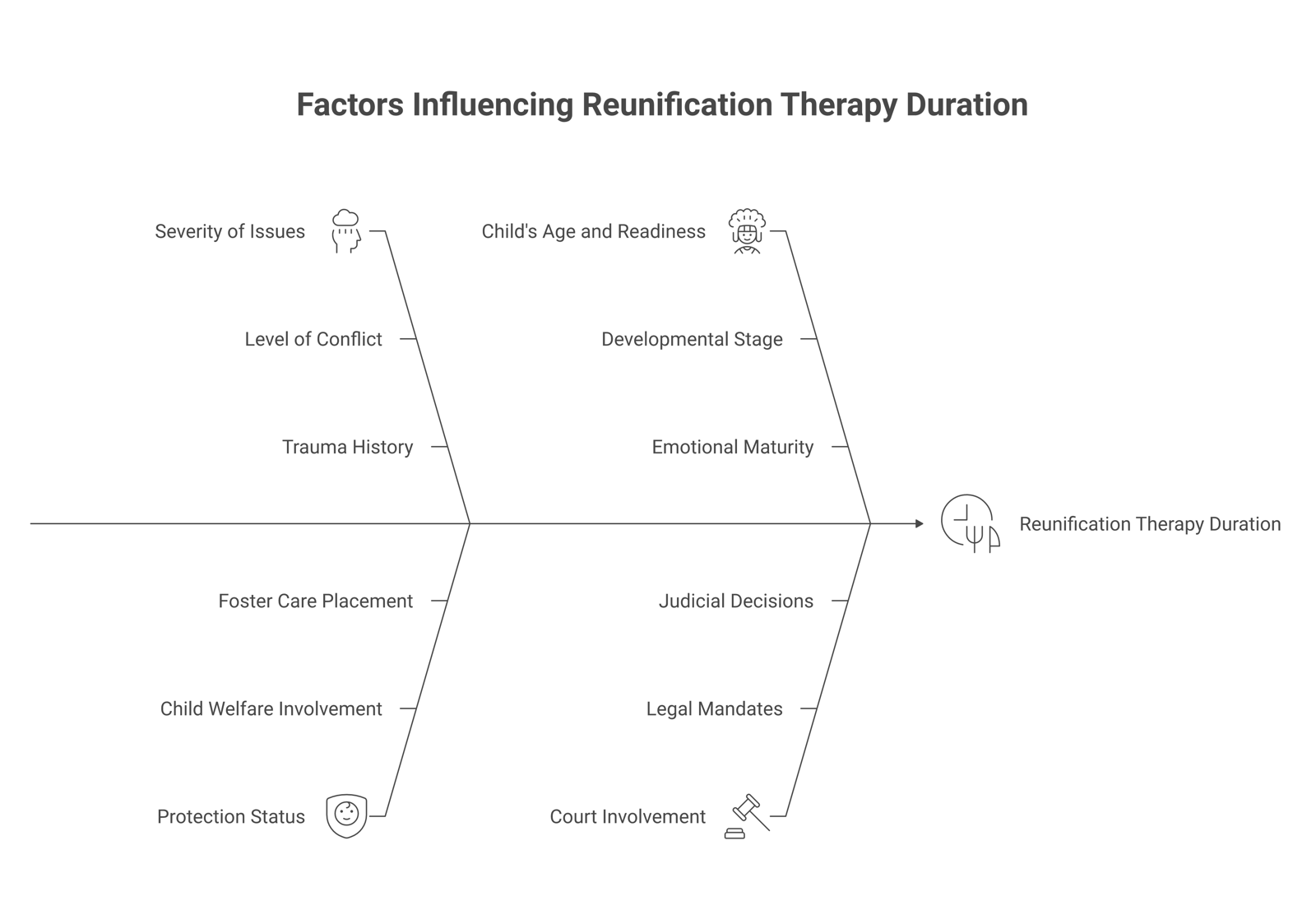
Severity of the rejection
Mild cases move faster than severe ones. When a child still shares warm moments with the rejected parent, the work can be lighter and shorter. When a child has fully adopted a fixed, false belief that the parent is dangerous or unloving, the work runs longer. Severe, entrenched cases call for more structure, more sessions, and months of follow-up, not a few standard appointments.
Whether safety has been screened first
The first phase of any honest timeline is assessment. Rejection driven by genuine abuse or neglect is estrangement, not alienation, and reunification therapy is the wrong tool for it. The joint statement of the Association of Family and Conciliation Courts and the National Council of Juvenile and Family Court Judges (2022) takes a screen-first position: examine all potential causes of a child’s resistance, including family violence, before selecting an intervention. Skipping that step does not shorten the timeline. It risks ordering a child into therapy with a parent who hurt them, and it predicts failed or harmful treatment.
The child’s age and readiness
Age shapes the pace. Younger children sometimes respond quickly once they feel safe. Teenagers, who guard their independence, may need more time and a gentler approach. Readiness matters as much as age. A child who feels cornered will resist, and resistance slows everything down.
Court involvement
Court timing affects the clock too. A clear order, a firm structure, and prompt scheduling can move a case forward, while long delays between hearings can let rejection harden. Harman, Kruk, and Hines (2018) argue that parental alienating behaviors function as a form of family violence and coercive control, which is part of why timely, structured intervention matters where alienation is genuinely the driver. The wider toll of divorce and high conflict on children is documented by the American Psychological Association.
Why the work usually starts with weekly, family-systems therapy
Most contact-refusal cases are not pure alienation. Kelly and Johnston’s reformulation describes a continuum from normal affinity through alignment to alienation and realistic estrangement, and many cases are hybrids with contributions from both households. For those families, clinicians describe multi-modal family interventions that work with the child, both parents, and the wider system at a weekly or near-weekly rhythm (Friedlander and Walters, 2010).
This is the realistic baseline for a timeline. Weekly family-systems work typically needs months to show durable change, because trust rebuilds through repeated, low-pressure contact rather than confrontation. Progress is rarely linear. A good run of sessions can be followed by a setback after a hard transition or a court date, and the therapist’s job includes planning for those dips rather than treating them as failure.
Families should expect the therapist to set goals in phases: safety and engagement first, then graduated contact, then repair of the specific beliefs and memories driving the rejection. Each phase has its own pace, and the phases often overlap. For the methods themselves, see parental alienation therapy, which covers the types and what the evidence says.
What about four-day intensive programs?
Families researching timelines will quickly meet a different claim: that a four-day intensive program can resolve even severe alienation. Family Bridges is the most studied example, and the published numbers deserve careful reading. The foundational paper is by Richard Warshak (2010), who is affiliated with the program. It describes the model and reports an initial 23-child case series in which 22 of 23 children restored a relationship with the rejected parent, per the author’s own report. A later paper (Warshak, 2019) reported on 83 severely alienated children and described contact refusal falling from 85 percent to 6 percent, with 75 to 96 percent improvement by various measures, as reported by participating parents and workshop leaders.
Those figures are program-affiliated self-report without a control group. No independent evaluation of Family Bridges or its sister programs exists. That does not prove the programs fail. It means the often-quoted success rates are the program developers grading their own work, and honest timeline planning cannot treat them as established outcomes.
The same programs also face documented safety critiques. Mercer (2019) examined the principles and practices of parental alienation treatments and raised concerns about coercion and the absence of safety monitoring, and her 2022 comparative review extended that analysis across six intensive programs. Dallam and Silberg (2016) argued that the recommended treatments can cause children foreseeable and lasting psychological harm, particularly where courts compel participation under threat of custody change. Families weighing an intensive should read both sides before treating four days as a shortcut.
The no-contact period: the most contested element
Intensive programs are often paired with a court-ordered period, commonly around 90 days, in which the child has no contact with the favored parent. Proponents argue the pause interrupts ongoing pressure so new experiences with the rejected parent can take hold, and that without it the child relearns the rejection between sessions.
The counterargument is serious and child-centered. A no-contact order cuts a child off from the parent they currently experience as their primary source of safety, which is itself a major intervention in attachment. And if the court got the underlying question wrong, if the child’s resistance was actually driven by abuse that was pleaded but not credited, the order delivers a child to the parent they fear and silences the protective one. Children subjected to such orders have described them as traumatic, and their testimony helped drive the reform statutes described below.
This is why no-contact provisions are the most contested element of reunification practice. A family facing one should expect the court to have made specific findings, should ask how the child’s safety and mental health will be monitored during the period, and should understand that the field has not settled whether and when this tool helps.
What the law now says: Kayden’s Law and Piqui’s Law
Legislatures have begun regulating reunification treatment directly. At the federal level, the Keeping Children Safe From Family Violence Act, known as Kayden’s Law and enacted as part of the Violence Against Women Act Reauthorization of 2022, offers states grant incentives to adopt training standards for courts, limits on reunification treatment, and stricter expert qualifications. It does not change state custody law by itself, but it set a template.
California adopted that template as Piqui’s Law (SB 331, 2023, effective January 1, 2024), which requires judicial training and bans court orders sending children to coercive reunification camps that rely on transport against the child’s will or cutoff from a parent. Colorado, Pennsylvania, and Utah have enacted their own versions as of mid-2026. For a family asking how long reunification therapy takes, the practical point is that the four-day intensive model is now restricted or barred in several states, and the realistic planning baseline is conventional, stepwise therapy.
Why fast-fix claims are a red flag
Any program that guarantees a quick, permanent cure deserves caution. The honest practitioners in this field describe ranges, not promises. They explain that severe cases take structure and time, that screening for abuse comes before any reunification plan, and that follow-up matters for months after the formal work.
A few warning signs stand out. Be wary of a fixed price tied to a fixed outcome. Be wary of a promise that a child will feel a certain way by a certain date. Be wary of success rates quoted without a source, since the published intensive-program figures are developer self-report. And be cautious when a provider skips assessment and rushes to force contact, especially where genuine abuse might be present.
Good reunification work shares a different posture. It assesses first, screens for safety, sets realistic expectations, and treats reunification as a clinical process rather than a punishment or a courtroom win. Slow, steady, well-monitored work is not a lesser option. In most cases it is the evidence-aligned one.
Frequently asked questions
How long does reunification therapy take on average?
There is no reliable average, because cases differ so widely. Most families should plan for months of weekly or twice-monthly sessions, and moderate to severe cases commonly run a year or more, sometimes with cycles of progress and pause over several years. The timeline depends on severity, safety screening, the child’s readiness, and court involvement, so a range is more truthful than a single number.
Can reunification therapy really work in just four days?
Four-day intensive programs report high success rates, but those figures come from the programs’ own developers and affiliates, without control groups or independent evaluation. The same programs face published safety critiques, and several states now restrict coercive intensive formats. A four-day workshop may be part of some court-ordered plans, but no family should treat four days as the realistic timeline for rebuilding a relationship.
Why is reunification therapy taking so long in our case?
Several factors can stretch the timeline. Severe, entrenched rejection takes longer than a mild case. A timeline also stretches when the child returns to ongoing pressure between sessions, when court delays let rejection harden, or when a teenager needs a slower, gentler approach. Slow progress is common, and it does not by itself mean the work is failing.
Is a guaranteed timeline a good sign?
No. A guaranteed date, or a promised feeling by a certain time, is a red flag. Reputable clinicians describe ranges and focus on process, safety, and the child’s wellbeing. Be especially cautious where a provider skips assessment, quotes success rates without sourcing them, rushes to force contact, or ignores the possibility of genuine abuse.
What is the 90-day no-contact period, and is it required?
Some intensive programs pair their workshop with a court-ordered period, often about 90 days, of no contact between the child and the favored parent. It is not a standard requirement of reunification therapy, and it is the most contested element in the field. Proponents say it interrupts ongoing pressure; critics answer that it severs a child’s primary attachment and is dangerous if the court misjudged an abuse allegation. Laws such as California’s Piqui’s Law now restrict coercive versions of this practice. For related steps, see how to reverse parental alienation and how to reconnect with an alienated child.
What this page does not do
This page does not diagnose any child or promise any outcome. It does not endorse one program over another, and it does not treat any program’s self-reported success rate as an established fact. It does not tell any family how long their own case will take, because no honest source can. Decisions about reunification belong to the family and a qualified clinician who knows the situation. For the court structure that often frames this work, see parental alienation court order. For the wider set of active-situation guides, see the Help silo.
Sources and further reading
- American Psychological Association. Divorce and child custody. apa.org/topics/divorce-child-custody
- Harman, J. J., Kruk, E., & Hines, D. A. (2018). Parental alienating behaviors: An unacknowledged form of family violence. Psychological Bulletin, 144(12), 1275 to 1299. https://doi.org/10.1037/bul0000175
- Templer, K., Matthewson, M., Haines, J., & Cox, G. (2017). Recommendations for best practice in response to parental alienation. Journal of Family Therapy, 39(1), 103 to 122.
- Friedlander, S., & Walters, M. G. (2010). When a child rejects a parent: Tailoring the intervention to fit the problem. Family Court Review, 48(1), 98 to 111.
- Kelly, J. B., & Johnston, J. R. (2001). The alienated child: A reformulation of parental alienation syndrome. Family Court Review, 39(3), 249 to 266.
- Warshak, R. A. (2010). Family Bridges: Using insights from social science to reconnect parents and alienated children. Family Court Review, 48(1), 48 to 80. https://doi.org/10.1111/j.1744-1617.2009.01288.x
- Warshak, R. A. (2019). Reclaiming parent-child relationships: Outcomes of Family Bridges with alienated children. Journal of Divorce & Remarriage, 60(8), 645 to 667.
- Mercer, J. (2019). Examining parental alienation treatments: Problems of principles and practices. Child and Adolescent Social Work Journal, 36(4), 351 to 363.
- Dallam, S., & Silberg, J. L. (2016). Recommended treatments for “parental alienation syndrome” (PAS) may cause children foreseeable and lasting psychological harm. Journal of Child Custody, 13(2-3), 134 to 143.
- Association of Family and Conciliation Courts & National Council of Juvenile and Family Court Judges (2022). Joint Statement on Parent-Child Contact Problems.
- Keeping Children Safe From Family Violence Act (Kayden’s Law), Title XV, Violence Against Women Act Reauthorization Act of 2022, Pub. L. 117-103, codified at 34 U.S.C. 10446(k).
- California SB 331, Piqui’s Law: Keeping Children Safe from Family Violence Act (2023, effective January 1, 2024).
If you or your child are in crisis
Free and confidential help is available right now.
- 988 Suicide and Crisis Lifeline. Call or text 988.
- Childhelp National Child Abuse Hotline. 1-800-422-4453.
- NAMI HelpLine. 1-800-950-6264.
Last reviewed: 2026-06-10. Author: Alex Buckles, Founder.