

Searching ex turning child against me usually means a parent is frightened and wants steps, not theory. The first task is to confirm what is happening, separating alienation from normal adjustment and from justified estrangement. The next task is to respond calmly, stay available, and avoid the moves that quietly backfire.
A note on safety
A child pulling away is not always alienation. If a child is distancing because a parent harmed them, frightened them, or neglected them, that is justified estrangement, not an ex turning the child against that parent. Reflect honestly. If a child’s safety is at risk, contact local law enforcement or a domestic violence resource first.
This page offers general information, not clinical or legal advice. It does not create a therapist or attorney relationship. Anyone facing a custody or safety decision should consult a licensed professional in their own area.
When an ex is turning a child against a parent, confirm first
Fear makes a poor guide. Before acting, a parent needs to know which of three things is in play. The change could be normal divorce stress. It could be a fair reaction to real harm. The pattern could also be alienation, where one parent steadily turns a child against the other. Each needs a different response, so confirm first.
Rule out normal post-divorce adjustment
Divorce unsettles children. Many kids become moody, clingy, angry, or withdrawn for months. They may test limits or pick sides for a while. The American Psychological Association notes that children often struggle around a separation and then adjust over time. Normal upset tends to soften. A child who is simply adjusting still shows warmth, still has good moments, and still recovers. Alienation tends to harden instead.
Rule out justified estrangement
Some children pull away for good reason. When a parent has been abusive, frightening, or neglectful, a child’s distance is protective and deserves respect. That is justified estrangement, and it is not the same as an ex turning a child against a parent. Honest reflection matters here. A parent can ask trusted, neutral people for candid feedback. If a child’s fear traces back to real harm, the work is repair and accountability, not a custody fight.
What alienation looks like
Alienation has its own signature. The child’s account often sounds rehearsed, uses grown-up phrases, and lacks real memories. Affection can flip to contempt with no real event behind it. Sometimes the child rejects warm grandparents and cousins on the same side and feels no guilt about the cruelty. One pattern is easy to miss. Ryan Thomas, a formerly alienated child who now coaches targeted parents, describes “stealth alienation” in calm, low conflict splits, where small remarks build a frame without any open fight. The absence of shouting is not the absence of alienation. For a full checklist, see signs your ex is alienating your child.
Why it often intensifies after the divorce
Many parents expect the pressure to ease once the court rules. It frequently does the opposite. Ryan Thomas describes two post-decree triggers. When the alienating parent wins what they wanted, the behavior feels rewarded, so it continues. When that parent loses, they may double down to prove the child is suffering under the order. The child becomes the evidence in both directions. Knowing this pattern helps a parent prepare rather than panic.
Respond without making it worse
The instinct to fight back is human. It is also the trap. Randy Flood, a therapist who works with rejected parents, names five common moves that feel right and make things worse. Steering around them is the heart of a good response.
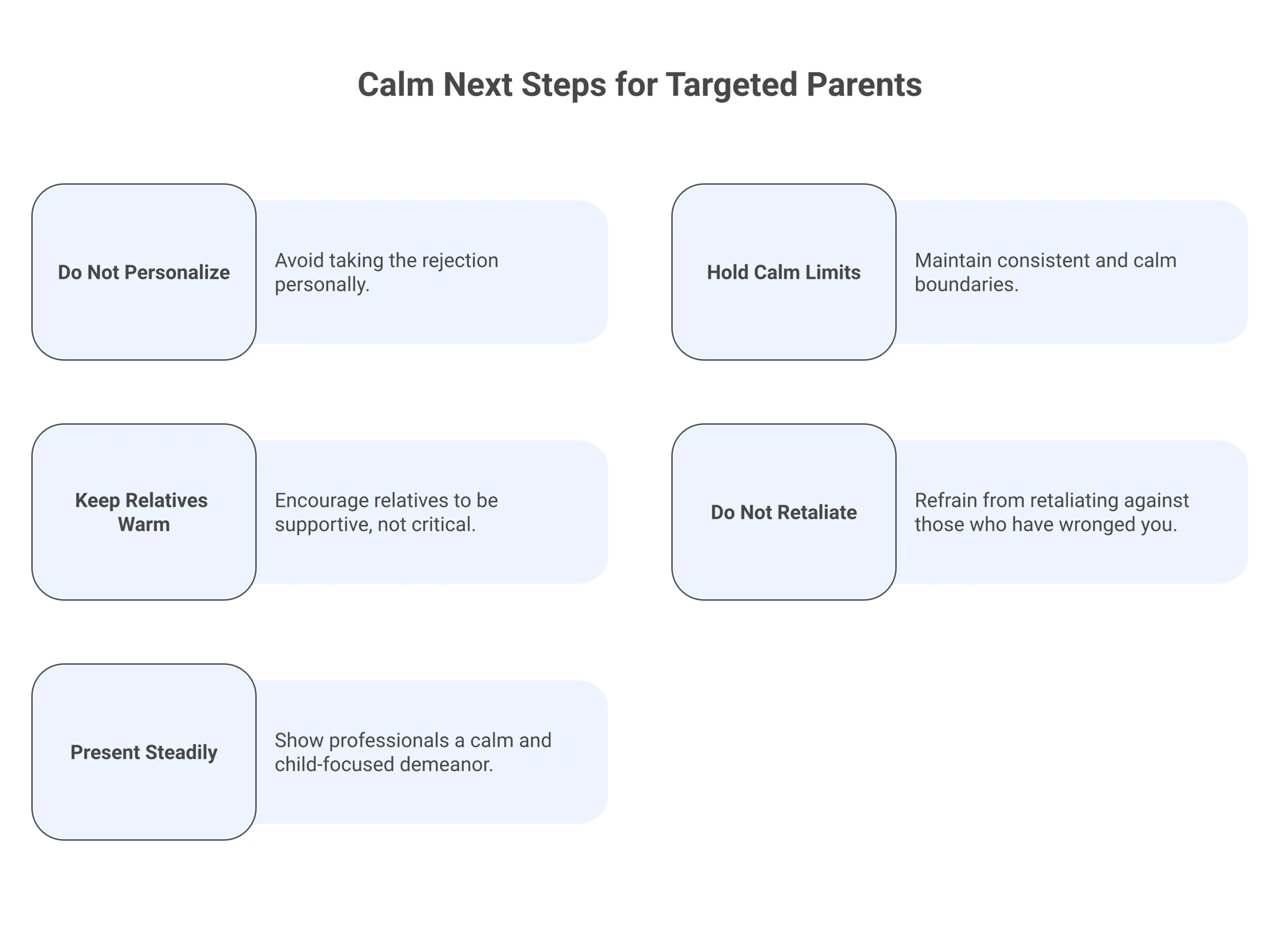
Do not personalize the rejection
A child’s hatred is hard to hear. Flood frames it as survival behavior under a loyalty bind, not a verdict on the parent’s worth. The child is caught, not free. Reading the rejection as the child’s true self multiplies the parent’s pain and often the anger that follows.
Do not escalate discipline
Alienated children can look defiant. Punishing harder rarely helps and often backfires. The other parent can repackage strict discipline as proof the targeted parent is harsh. Calm limits matter, while lectures and heavy consequences tend to push a child further away.
Do not recruit family to lecture the child
When a parent’s authority feels discredited, the urge is to send in grandparents, aunts, or coaches to set the child straight. Flood warns that this spreads the conflict and leaves the child feeling ambushed. Relatives can stay warm and present without correcting the child.
Do not retaliate against the ex
Snarky texts, sarcastic handoffs, and social media venting may feel good. They do not do good. Such moments get saved and shown to courts and counselors as proof the targeted parent is the real problem. Skipping retaliation is part of the plan, not a sign of weakness.
Show up as your best self with professionals
Alienation runs counter to what many professionals expect. A parent who shows up angry and combative can confirm the wrong idea. Flood’s guidance is to appear madly in love with the child, not mad. A calm, factual, child-focused manner carries more weight than outrage. That same steadiness helps when dealing with a narcissistic co-parent.
Document what is happening
Memory fades and strong emotion distorts. A simple, factual record protects the truth. A parent can note dates, missed calls, blocked visits, and the exact words a child repeats. Screenshots, a calendar, and a plain log are enough. The tone should stay neutral, never a diary of rage. Researchers Harman, Kruk, and Hines describe alienating behaviors as a recognized pattern of family violence and coercive control. A clear record helps a clinician or court see that pattern. A good record supports a future case without becoming a daily obsession.
Keep contact warm and low-pressure
The relationship is the goal, so contact has to feel safe rather than heavy. Clinical psychologist Sue Cornbluth teaches a validation-first approach built on listening, acknowledging, validating, and compassion. A parent leads with the child’s feelings, not with “I love you and I miss you,” which the child already knows. Outreach stays steady but light. Cornbluth suggests consistency over frequency, perhaps a short, kind message each week rather than daily contact that can smother. In one case she describes, a mother sent a warm Friday text for two and a half years before her son finally replied. Pressure pushes, while patience invites. The bond often returns on the child’s clock, not the parent’s.
Get support for yourself
This is one of the most stressful experiences a parent can face. Steady support is not a luxury. A supported parent stays more regulated, and a regulated parent is easier for a child to return to. Therapy, a support group, trusted friends, and basic self-care all help. Healthy coping means sleep, movement, and people, not isolation, alcohol, or all-night worry. Caring for the parent is part of caring for the child.
When to involve professionals or the court
Some situations need more than patience. A parent should seek professional help when the pattern hardens, when court orders are ignored, or when a child’s wellbeing is clearly slipping. Therapists who understand alienation can guide the repair. A family-law attorney can explain how to enforce or change an order. Documentation makes both conversations sharper. The aim is the child’s wellbeing and a repaired relationship, not winning or punishment. For a broader plan, see dealing with parental alienation and how to reverse parental alienation, along with the main Help guide.
Frequently asked questions
How do I know if my ex is turning my child against me, or if it is normal adjustment?
Normal adjustment softens over time and still includes warmth and good moments. Alienation tends to harden, the child’s account sounds rehearsed, affection flips to contempt without a real event, and guilt disappears. A child pulling away after real harm is a third, separate situation that calls for honest reflection and repair.
What should I do first if my ex is turning my child against me?
Confirm what is happening, then stay calm and available. Avoid retaliating, over-punishing, or recruiting relatives to lecture the child. Keep contact warm and low-pressure, document the pattern in a neutral log, and line up support for yourself. Seek professional help if the pattern hardens or court orders are ignored.
Will my child come back?
Many children do, though no timeline is guaranteed. Consistency tends to matter more than intensity. A steady, warm, low-pressure presence gives the child a safe path back when they are ready. It usually runs on the child’s clock, and patience tends to beat pressure.
Should I correct the lies my child has been told?
Arguing the facts usually backfires. It can confirm the other parent’s framing and ask the child to give up a story they have lived inside for a long time. A better path is to acknowledge the child’s feelings, stay warm, and let trust rebuild slowly, while keeping a factual record for any professional or court setting.
Is it ever not alienation?
Yes. A child who distances because a parent harmed, frightened, or neglected them is showing justified estrangement, not the result of an ex turning them against that parent. Honest reflection and, when needed, accountability and repair are the right response there, not a custody battle.
Sources and further reading
- American Psychological Association. Divorce and child custody. apa.org/topics/divorce-child-custody
- Harman, J. J., Kruk, E., & Hines, D. A. (2018). Parental alienating behaviors: An unacknowledged form of family violence. Psychological Bulletin, 144(12), 1275 to 1299. https://doi.org/10.1037/bul0000175
If you or your child are in crisis
Free and confidential help is available right now.
- 988 Suicide and Crisis Lifeline. Call or text 988.
- Childhelp National Child Abuse Hotline. 1-800-422-4453.
- NAMI HelpLine. 1-800-950-6264.
Last reviewed: 2026-06-06. Author: Alex Buckles, Founder.