

Co-parent sabotage describes a pattern where one parent undermines the other’s time, communication, or bond with the child. Common forms include blocking phone calls, scheduling over the other parent’s days, gatekeeping information, and badmouthing. A parent who notices it can respond by documenting calmly, staying child-focused, and using the parenting plan.
A note on safety
Where a child or parent faces abuse, the right response is protection, not co-parenting tactics. A child pulling away from a parent who has been abusive, neglectful, or genuinely dangerous is showing justifiable estrangement, not alienation, and that is a different legal and safety matter. If anyone’s safety is at risk, contact local law enforcement or a domestic-violence resource first.
This page is general information, not clinical or legal advice. It does not create a clinical or legal relationship and does not address any one person’s situation. Laws and circumstances vary. Anyone facing a serious co-parenting or custody problem should consult a licensed family-law attorney or a qualified mental-health professional.
What co-parent sabotage looks like
Co-parent sabotage is a pattern where one parent quietly or openly works against the child’s relationship with the other parent. It shows up in small acts that repeat over time. Cheryl Mefferd, who created the Parental Alienation Speaks project, sorts these behaviors into five functional groups, building on Amy Baker’s earlier research. Each group describes what the sabotaging parent is trying to accomplish.
- Isolation. Limiting contact between the child and the other parent. This can mean ignoring scheduled phone calls, withholding the child’s mail, or steering the child toward only one parent’s circle of friends and relatives.
- Fear. Framing the other parent as unsafe or unreliable. A child who feels worried is easier to keep close, so the sabotaging parent may exaggerate small risks or hint that the other home is not safe.
- Erasing. Downplaying the other parent’s place in the child’s history. Photos disappear, shared memories get rewritten, and the child slowly hears a version of the past with one parent edited out.
- Undermining authority. Mocking the other parent’s rules, food, or home. When a child is taught to disrespect a parent, rebuilding that respect is slow work.
- Encouraging betrayal. Using the child as a messenger, asking the child to keep secrets, or rewarding the child for taking sides.
In everyday life these categories look familiar. One parent books a birthday party during the other parent’s weekend. Text messages go unanswered, then exchanges run late. The child arrives repeating adult complaints about money or the divorce. A parent withholds the school calendar or a doctor’s note, a habit often called gatekeeping. None of these acts is dramatic on its own. The harm comes from the repetition.
When scheduling friction is ordinary and not sabotage
Not every problem is sabotage. Two households running one child’s life is genuinely hard. Exchanges run late because traffic is bad. A parent forgets to forward one email. A school event lands on the wrong weekend, and nobody planned it that way. Things like these happen in healthy co-parenting too.
The honest test is pattern and intent. A single missed call is a mistake. A standing habit of forgetting every Tuesday call is a pattern. Ordinary friction tends to run both ways and gets resolved when someone raises it. Sabotage tends to flow one direction and continues after the other parent asks for it to stop. Treating normal friction as sabotage can raise the conflict and pull the child further into the middle, so watching for the pattern matters before drawing conclusions.
Sabotage is not always alienation
Co-parent sabotage and parental alienation overlap, but they are not the same thing. Sabotage describes the behaviors. Alienation describes a deeper outcome, where a child rejects a once-loved parent largely because of those behaviors. Many parents face sabotage that never reaches that point. A measured guide to the wider problem sits in dealing with parental alienation.
Sabotage is not always loud, either. Ryan Thomas, who teaches recovery from alienation, describes a stealth pattern that shows up in calm, low-conflict separations. The undercutting arrives in a soft or even sad tone. The child hears that the other parent is “just really busy,” or that “it is up to you who you spend time with.” Because there is no obvious anger, the targeted parent’s guard stays down, and the slow framing is easy to miss. Parents in friendly splits sometimes assume sabotage cannot reach them. The quieter version can be harder to spot precisely because it does not look like a fight. For where these behaviors cross into full alienation, see signs your ex is alienating your child.
How to respond to co-parent sabotage
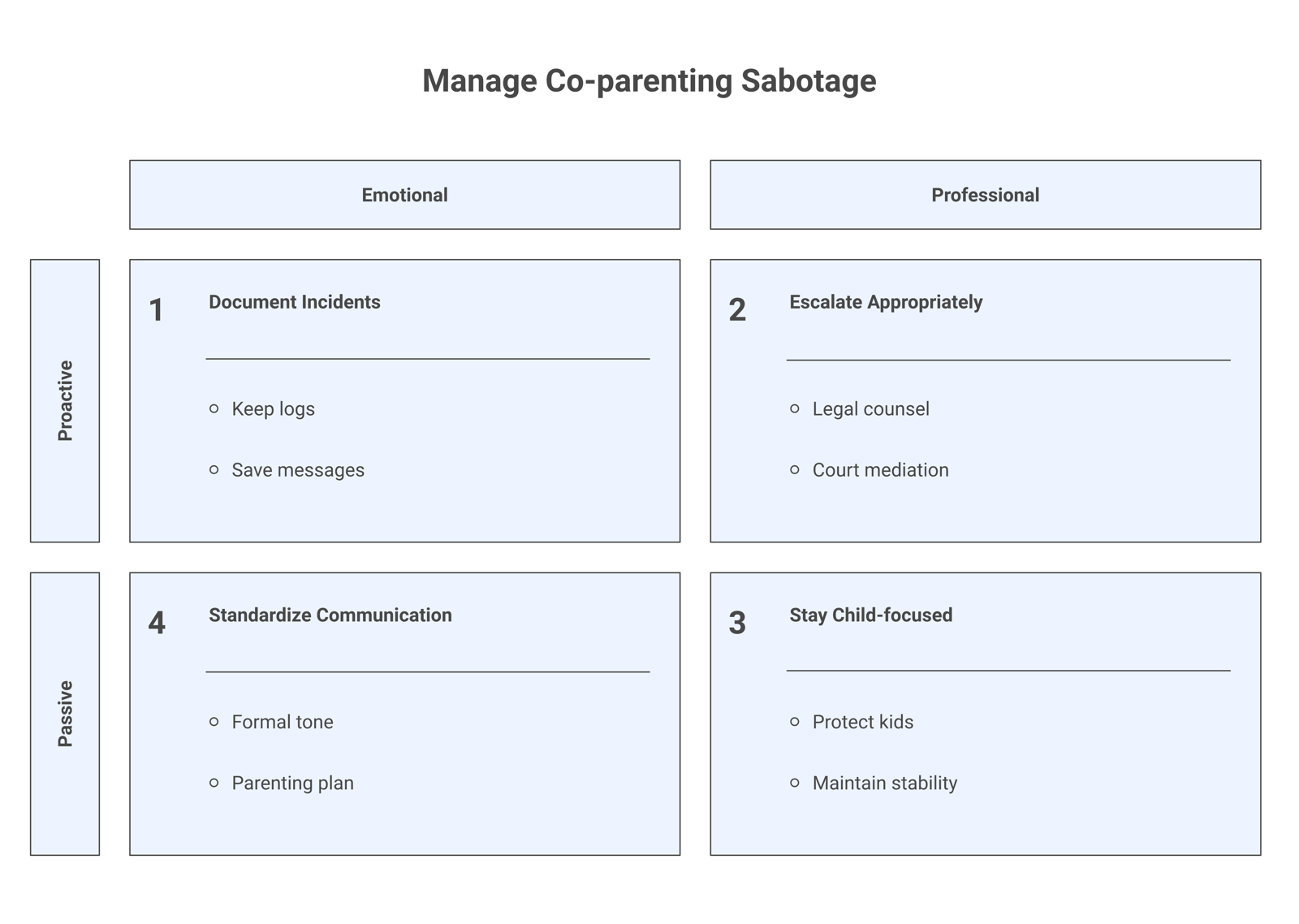
A constructive response keeps the focus on the child and on the written agreement, not on the other parent’s character. The aim is a calm, documented record and a steady home for the child, not a win. The broader Help section collects related guidance for parents in active situations.
Document calmly and consistently
Keep a simple, factual log. Record the date, what was scheduled, what happened, and any message that supports it. Save texts, emails, and the parenting-app history. Stick to facts and skip the commentary. A log that reads like an even record carries far more weight later than one full of anger.
Stay child-focused
Children do best when adults keep them out of grown-up disputes. A parent cannot control the other home, but can control their own. Staying child-focused means not asking the child to carry messages, not questioning the child about the other parent, and not answering badmouthing with badmouthing. Steady, warm parenting on one side gives the child a safe place to land.
Keep communication business-like
Short, polite, practical messages work best. Many parents use a business-letter tone: clear requests, no insults, no long emotional replies. Neutral messages are easier to share with a mediator or a court, and they give the other parent less to react to. Keeping contact limited to scheduling and the child’s needs also lowers the temperature.
Use the parenting plan
The parenting plan or custody order is the anchor. When a dispute comes up, the calm move is to point back to what the plan actually says rather than argue about fairness. If the plan is vague about holidays, exchanges, or communication, that gap is worth fixing through the proper channel. A clear plan removes much of the room sabotage needs to operate.
Escalate appropriately
When documented sabotage continues, structured steps exist. Many families begin with co-parenting counseling or mediation. Some shift toward parallel parenting rather than co-parenting, which reduces direct contact between high-conflict parents while protecting the child’s time with each. When a court order is being broken, a parent can raise it with a family-law professional. Escalation should match the pattern, not the frustration of a single bad week.
Why retaliation tends to backfire
Hitting back feels fair, and it usually costs the child. Blocking the other parent’s calls in return, badmouthing to even the score, or withholding the child to make a point all pull the child deeper into the conflict. Courts and counselors tend to notice when both homes fight through the child. A parent who stays measured, documents, and keeps the child out of it protects both the child and their own standing. Restraint is not weakness here. It is the more effective path.
When sabotage becomes coercive control
Some sabotage sits at a far more serious end. Psychologist Jennifer Harman and colleagues, writing in the journal Psychological Bulletin, argue that severe parental alienating behaviors map onto the recognized patterns of coercive control and amount to a form of family violence. At that level the conduct is no longer ordinary co-parenting friction. It is a controlling pattern aimed at the child and the other parent. When the sabotaging parent shows traits like grandiosity or a need to dominate, the resources on dealing with a narcissistic co-parent may help. A parent who sees this degree of behavior, especially alongside threats or intimidation, should seek professional support and may need legal guidance.
Frequently asked questions
What is co-parent sabotage?
Co-parent sabotage is a pattern where one parent undermines the child’s relationship with the other parent. It includes blocking communication, scheduling over the other parent’s time, gatekeeping information, and badmouthing. A single missed handoff is not sabotage. The defining feature is a repeated, one-directional pattern that continues after the other parent asks for it to stop.
Is co-parent sabotage the same as parental alienation?
No. Sabotage describes the behaviors, while alienation describes a deeper outcome where a child rejects a once-loved parent. Sabotage can exist without ever reaching full alienation, and much of it does not. Recognizing the behaviors early gives a parent the best chance to respond before the pattern hardens.
How do you prove co-parent sabotage?
Documentation is the practical answer. A factual log of dates, missed exchanges, and unanswered messages, plus saved texts and parenting-app records, builds a clear picture over time. Calm, neutral records carry more weight than emotional accounts. A family-law professional can explain what evidence matters in a given case.
Should a parent respond to sabotage by doing the same thing back?
No. Retaliation pulls the child further into the conflict and can damage a parent’s own standing with courts and counselors. The steadier path is to document, keep communication business-like, stay child-focused, and use the parenting plan. Escalation, when needed, should run through mediation or a legal channel, never through the child.
Sources and further reading
- American Psychological Association. Divorce and child custody. apa.org/topics/divorce-child-custody
- Harman, J. J., Kruk, E., & Hines, D. A. (2018). Parental alienating behaviors: An unacknowledged form of family violence. Psychological Bulletin, 144(12), 1275 to 1299. https://doi.org/10.1037/bul0000175
If you or your child are in crisis
Free and confidential help is available right now.
- 988 Suicide and Crisis Lifeline. Call or text 988. 988lifeline.org
- Childhelp National Child Abuse Hotline. 1-800-422-4453. childhelp.org
- NAMI HelpLine. 1-800-950-6264. nami.org/help
Last reviewed: 2026-06-06. Author: Alex Buckles, Founder.