

Parental alienation mediation is family mediation applied to cases where one parent is accused of turning a child against the other. The mediator’s first job is screening, not settlement. Standard interest-based mediation assumes the two parents hold roughly equal power. Where coercive control or alienating behaviors are present, that assumption fails, and mediation is often contraindicated.
A note before you read
A child’s rejection of a parent is not always alienation. If the rejected parent has been abusive, neglectful, or genuinely dangerous, the child’s distancing is justifiable estrangement, not parental alienation. Screening must keep that line bright. A protective parent must never be mislabeled an alienator, and an abuse-driven cut-off must never be mediated as if it were a loyalty conflict. This page is general educational information for professionals. It is not legal or clinical advice for any specific case.
What parental alienation mediation is
Parental alienation mediation is not a special process with its own rules. It is ordinary family mediation that happens to involve a parental alienation allegation. One parent says the other is undermining the child’s relationship with them. That allegation changes what the mediator must do before, during, and sometimes instead of mediating.
Mediation is a voluntary, facilitated negotiation. The mediator is neutral. The mediator does not decide the outcome, does not diagnose either parent, and does not rule on whether alienation is occurring. The parents reach their own agreement, and the mediator helps them get there.
That model works well for many separating families. It works because most separating parents, even angry ones, can advocate for themselves at the table. The trouble starts when one parent cannot. Where one parent has been controlling the other through fear, isolation, or relentless undermining, the table is not level. Research treats parental alienating behaviors as one expression of that control. For the clinical assessment side of identification, see the companion page on identifying parental alienation.
Why mediation assumes a balance of power
Interest-based mediation rests on a quiet assumption: that both parties can speak freely, hold their ground, and walk away from a bad deal. The process is built to surface interests and trade across them. That only produces a fair agreement when neither party can dominate the other.
The family-mediation field has long recognized this. The Association of Family and Conciliation Courts (AFCC) Model Standards of Practice direct mediators to screen for domestic violence and power imbalance, and to suspend or decline mediation when a party cannot participate safely or effectively. Power imbalance is not a side issue in family mediation. It is the issue the standards were written to manage.
Parental alienation cases sit squarely in that zone. Researcher Dr. Jennifer Harman studied the power dynamics between alienating and targeted parents. Her finding is stark. In her 2024 interview data, more than 66 percent of targeted parents reported having little to no power, while the alienating parent held nearly all of it. The allegiance of the children, the undermined authority of the targeted parent, and the social isolation of the targeted parent all concentrate power on one side.
A mediator who treats that case as a balanced negotiation will produce a lopsided agreement. The weaker party concedes because they are worn down, not because the trade serves the child. That is the structural reason screening comes first.
Parental alienating behaviors are a form of coercive control
The strongest research basis for screening comes from Dr. Jennifer Harman and colleagues. Their 2018 review in the journal Psychological Bulletin makes the case that parental alienating behaviors and coercively controlling abuse are not analogies. They are the same phenomenon under two labels.
Harman maps alienating behaviors onto the Duluth power-and-control wheel. The “use of children” spoke covers most of them: using the child to relay messages, using contact to harass the other parent, threatening to take the child away, and making the other parent feel guilty through the child. The review positions parental alienating behaviors as an unacknowledged form of family violence. The targeted parent shows the same trauma, anxiety, depression, and elevated suicidality that intimate-partner-violence victims show.
This framing matters for one practical reason. Family mediators already treat coercive control as a contraindication. If alienating behaviors are coercive control, then a case driven by alienating behaviors is a case the existing standards already tell mediators to screen out or modify.
The frame is gender-neutral by design. Stan Korosi, chair of the Australian organization Parents Beyond Breakup, describes parental alienation as gender-agnostic relational power abuse rather than gendered violence. His term for alienation delivered through narrative is “discursive relational violence.” The control runs through words, allegiance, and storyline rather than through physical force. That is exactly the kind of control a settlement table cannot offset on its own.
Screening for coercive control before mediating
Screening is the mediator’s core competence in these cases. It is not a formality at intake. It is an ongoing posture.
Screen separately, screen for behaviors not labels
Screen each parent separately, never jointly. A party controlled by the other will not disclose in the room with them. Ask about decision-making, money, isolation, and fear, not about the legal label.
The most useful evidentiary discipline comes from litigator Ashish Joshi and Judge Jon Van Allsburg, who teach that courts and professionals should evaluate behaviors, not diagnostic labels. Their rule applies cleanly to mediation. “Labels don’t give us any basis on which to make a ruling. It’s the facts that give us that ability.” A parent who arrives saying “she is a narcissist” or “he is an alienator” has given the mediator nothing to screen. A parent who describes specific conduct over time has given the mediator data.
So the screening questions stay concrete. Who makes the decisions. What happens when you disagree. Has contact with the child been used against you. Has the other parent controlled money, transportation, or your ability to see friends and family. Patterns answer the question. Labels do not.
Keep the screen gender-neutral
Coercive control is not one gender’s behavior. Researcher Heleen Koppejan studied perpetrators and found a slight female-victim majority that was not statistically significant. Her one-line anchor is direct: “It’s a human thing. It’s not a gender thing.” Both parents can perpetrate, and both can be victimized.
The patterns differ even when the prevalence does not. Koppejan found controlling women lean toward dominance and public humiliation, while controlling men lean toward isolation, such as preventing a partner from working or seeing friends. She also names a five-stage cycle: love bombing, pedestal placement, guilt-tripping, insult and quarrel, then a tearful apology that resets the loop.
Koppejan’s investigation discipline transfers to the screening room. Check the contemporaneous record, such as the email trail between the parties, because the pattern and tone reveal who was doing what. Cross-check accounts where possible. Be alert to a party who tries to dominate professionals in a meeting, since that behavior is itself data. Above all, override the “small, pretty, highly educated” bias, because a sympathetic presentation is not evidence of innocence.
Watch for stealth alienation in low-conflict cases
The case mediators most often miss is the quiet one. Ryan Thomas calls it stealth alienation: the pattern that appears in amicable, low-conflict separations where there is no overt fight to alert anyone. The more amicable the surface, the more the targeted parent’s guard is down.
The undercutting is delivered in a calm or even sad tone. One example Thomas names is telling: a parent says “we’re going to mediation, hopefully it goes okay” in front of the child, framing the targeted parent as the source of instability while sounding cooperative. A mediator can be drawn into endorsing a process that one parent is already using as a stage. The signal is not anger. The signal is a child suddenly questioning stability, internalizing that the other parent does not care, or forming a good-parent and bad-parent narrative without any visible conflict to explain it.
When mediation is and is not appropriate
Screening produces a decision, and the decision is rarely all-or-nothing. Three outcomes are common.
Mediation may be appropriate when screening shows a rough balance of power, no safety concern, and a conflict that looks like a genuine disagreement rather than one party’s control over the other. Two parents who both love the child and disagree about a schedule are good candidates. The process is built for them.
Mediation is often contraindicated when screening reveals coercive control, a safety risk, or a power imbalance the process cannot offset. Where one parent holds nearly all the power, as Harman’s data describes, a facilitated negotiation tends to launder that imbalance into a signed agreement. The bright line from Dr. Joshua Coleman’s taxonomy also applies here: if the child’s rejection is driven by genuine abuse, the case is justifiable estrangement, not alienation, and it belongs with child-protection and the court, not a mediation table.
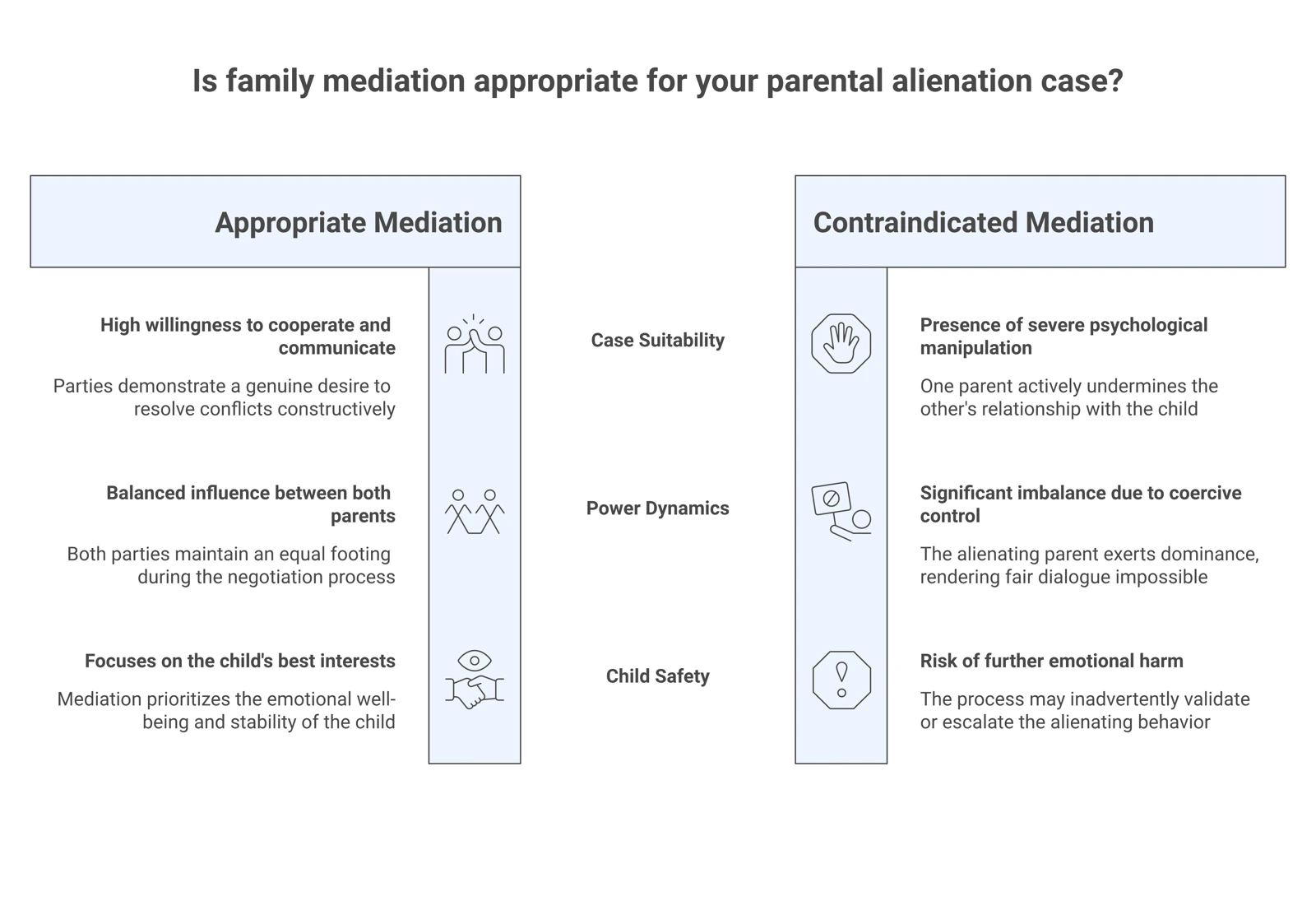
| Mediation may be appropriate | Mediation is often contraindicated | |
|---|---|---|
| Power balance | Roughly equal; both can advocate | One parent holds nearly all the power |
| Safety | No safety concern surfaced | Safety risk or coercive control present |
| Behavior pattern | Genuine disagreement | Pattern of control or alienating behavior |
| Process goal | A workable parenting agreement | Screening, protection, and referral |
The in-between case is the hardest. Some imbalance can be managed with structure: shuttle mediation where the parties never share a room, support persons, longer timelines, or co-mediation. Where structure can restore enough balance for both parents to advocate safely, modified mediation may proceed. Where it cannot, the honest answer is to decline and refer. Declining is not a failure of the process. It is the process working as designed. For the court pathway in cases mediation cannot hold, see the court resources.
The mediator’s role and its limits
The mediator’s role in a parental alienation case is narrow and important. The mediator screens, manages power and safety in the room, decides whether the process can proceed, and refers when it cannot. That is the whole job.
Several things sit outside it. The mediator does not diagnose parental alienation. Diagnosis is clinical and forensic work, and even there it requires multi-session assessment, not a single meeting. The mediator does not decide custody or rule on the allegation. The mediator does not treat the family or attempt to reverse alienation, because mediation is not therapy and cannot interrupt an entrenched dynamic.
Naming those limits protects everyone. A mediator who stays in role keeps the process credible and keeps the children’s interests central. A mediator who drifts into diagnosis or advocacy loses neutrality and can be discredited later. The discipline of behaviors-not-labels protects the mediator here too. Document what was observed and reported. Do not assert conclusions the role cannot support.
Referral pathways
When mediation is not appropriate, referral is the constructive next step. The case does not stop. It moves to a process built to handle it.
Three pathways recur. A forensic custody evaluation is the right referral when the case needs a finding on the allegation, because an evaluator conducts structured interviews, reviews documentary evidence, and reports to the court. Clinical assessment and any indicated treatment belong with a qualified clinician; the companion page on identifying parental alienation describes that work. The court itself is the right referral where safety or power problems require enforceable orders rather than a voluntary agreement.
Attorneys preparing these cases need documented behavioral evidence rather than labels. The sibling page on evidence for parental alienation cases covers what that evidence looks like. For parents who are struggling or in distress while the case moves through these channels, point them to the help resources and to the crisis lines listed at the foot of this page. General guidance on professional resources is available from the American Psychological Association.
Frequently asked questions
Is mediation appropriate for parental alienation?
Sometimes, and only after screening. Where screening shows a rough balance of power and no safety concern, mediation can help two parents resolve a genuine disagreement. Where it reveals coercive control or a power imbalance the process cannot offset, mediation is often contraindicated, because interest-based mediation assumes a balance of power that those cases do not have.
What is the mediator’s role in parental alienation cases?
The mediator screens first, manages power and safety in the room, decides whether the process can proceed, and refers when it cannot. The mediator does not diagnose alienation, does not decide custody, and does not treat the family or try to reverse the dynamic.
How do mediators screen for coercive control?
By screening each parent separately, asking about concrete behaviors rather than labels, and looking for patterns of control over decisions, money, isolation, and contact with the child. The screen stays gender-neutral, because coercive control is not specific to one gender. Checking the contemporaneous record and cross-checking accounts strengthens the screen.
When should a mediator decline to mediate?
When screening reveals coercive control, a safety risk, or a power imbalance that structure cannot offset, and when a child’s rejection appears driven by genuine abuse rather than alienating behavior. Declining and referring is the appropriate professional response, not a failure of the process.
Can mediation fix parental alienation?
No. Mediation is a facilitated negotiation, not a treatment. It cannot interrupt an entrenched alienation dynamic. Where alienating behaviors are present, the mediator’s contribution is accurate screening and a sound referral, not a cure.
Where to go next
- For the full professional hub, see the For Professionals pillar.
- For the clinical assessment side, see identifying parental alienation.
- For the evidence and litigation side, see evidence for parental alienation cases.
- For parents who need support resources, see help.
Citations
- Harman, J. J., Kruk, E., & Hines, D. A. (2018). Parental alienating behaviors: An unacknowledged form of family violence. Psychological Bulletin, 144(12), 1275 to 1299. https://doi.org/10.1037/bul0000175
- Association of Family and Conciliation Courts. Model Standards of Practice for Family and Divorce Mediation. afccnet.org/Resource-Center
- American Psychological Association. (n.d.). Divorce and child custody. apa.org/topics/divorce-child-custody
- Harman, J. J. (2024). Power and dependence in alienated parent-child relationships. Personal Relationships (interview data on asymmetric dependence).
- Coleman, J. (2021). Rules of Estrangement: Why Adult Children Cut Ties and How to Heal the Conflict. Harmony.
If you or your child are in crisis
Free and confidential help is available right now.
- 988 Suicide and Crisis Lifeline. Call or text 988. 988lifeline.org
- Childhelp National Child Abuse Hotline. 1-800-422-4453. childhelp.org
- NAMI HelpLine. 1-800-950-6264. nami.org/help
Last reviewed: 2026-06-05. Author: Alex Buckles (PAC Founder).