

Digital evidence in custody disputes includes text messages, co-parenting-app logs, emails, social-media posts, voicemails, and recordings. To be admitted, each item needs authentication and foundation, a relevance theory, and an answer to any hearsay objection. Counsel should also confirm lawful collection, since recording laws and privacy rules vary by jurisdiction.
A note on safety and surveillance
Digital evidence can document a pattern of alienating behavior, but the same tools can be misused to surveil or harass a co-parent or to manufacture a case. A child’s distancing caused by genuine abuse is estrangement, not alienation, and it is a different legal and safety matter. Lawful collection matters, and recording laws vary by state.
This page is general professional information, not legal advice. It does not address any one state’s rules of evidence or recording statutes, and it does not create an attorney-client relationship. Counsel must verify the law of the relevant jurisdiction before acting.
Digital evidence in custody disputes: the threshold questions
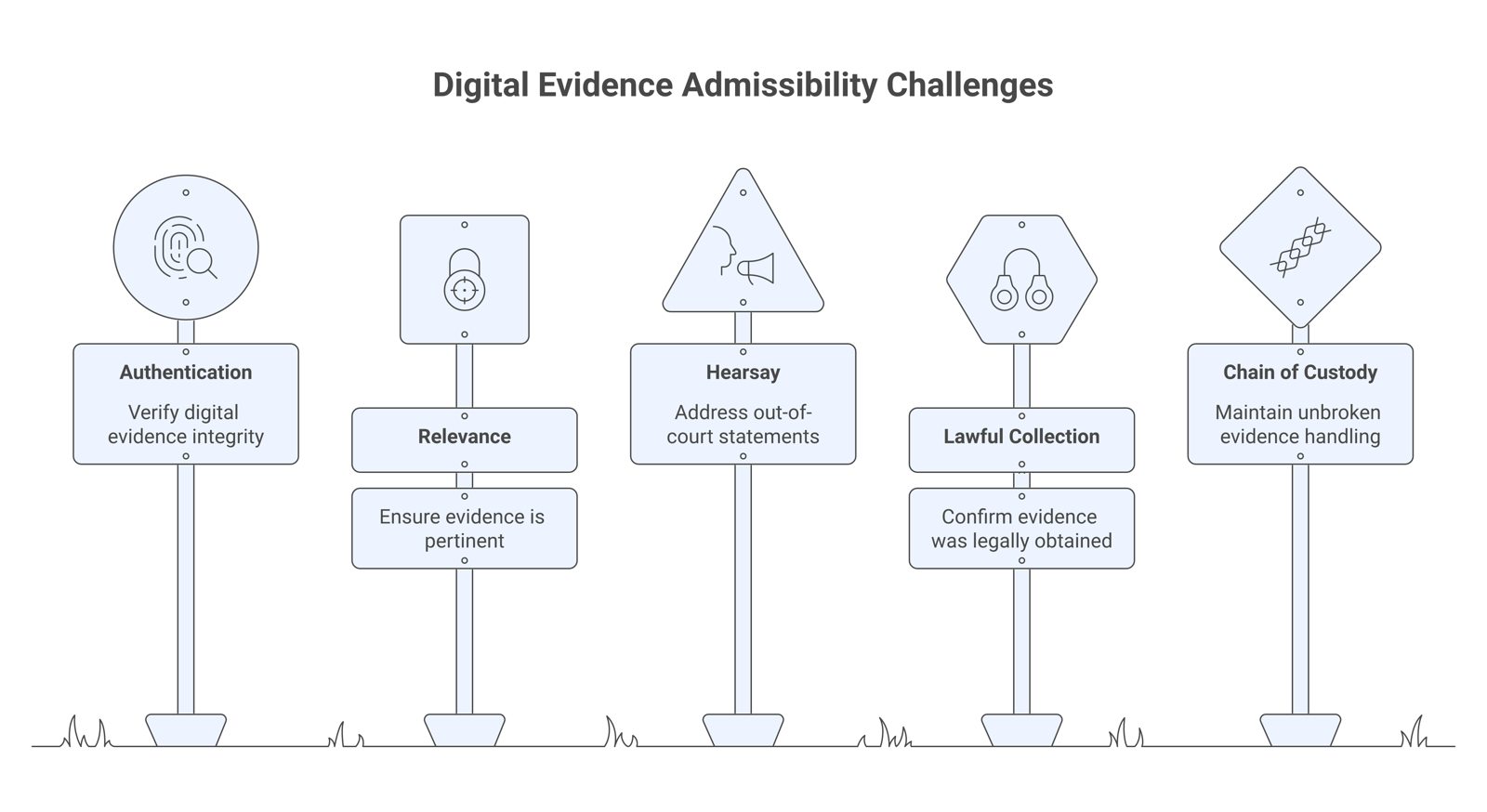
Digital evidence in custody disputes rarely fails because it is weak on the merits. It fails because counsel skipped a threshold question. Every digital exhibit, from a single screenshot to a full app export, has to clear the same five gates before a court will weigh it.
The five gates are authentication and foundation, relevance, hearsay, lawful collection, and chain of custody. Authentication asks whether the item is what the offering party claims. Relevance asks whether it makes a fact of consequence more or less probable. Hearsay asks whether an out-of-court statement is being offered for its truth, and if so, under what route it comes in. Lawful collection asks whether the material was obtained without violating a recording or privacy statute. Chain of custody asks whether the item has been preserved without alteration.
Parental alienation is a frequent use case, because alienating conduct now lives in the digital record. The disciplined record beats the voluminous one. A practitioner who organizes ten clean exhibits around documented behaviors will usually do better than one who dumps a thousand unsorted pages. The broader hub for this material sits at the For Professionals section, and the evidence framework that organizes the broader record is covered in building a parental alienation case file.
Authentication and foundation under Rule 901
Authentication is the first gate and the one most digital exhibits stumble on. The widely adopted model is Federal Rule of Evidence 901, which most states mirror in substance, though the numbering and detail vary. Rule 901 requires the proponent to produce evidence sufficient to support a finding that the item is what the proponent claims it is. The Cornell Legal Information Institute publishes the text of Rule 901 as a neutral reference.
The bar is a foundational one, not a guarantee of weight. A judge decides whether a reasonable juror could find the item authentic, and the opposing party remains free to argue that the item is incomplete or fabricated. That argument goes to weight, not admissibility, once the threshold is met.
Routes for texts, app logs, and emails
Several routes establish that a message is what counsel says it is. A participant in the exchange can testify that they sent or received it. Distinctive characteristics can do the work: a phone number, an account handle, a signature block, reply context, or content only the purported author would know. Co-parenting-app logs from platforms such as Our Family Wizard, TalkingParents, and AppClose carry server-side time stamps and tamper-evident records that simplify authentication. A records custodian or a provider certification can authenticate account data directly.
Screenshots versus native exports
Screenshots are common and weak. A screenshot crops context, strips metadata, and can be edited before it is captured. A native export preserves the full thread, the time stamps, and the underlying data fields. Where a thread matters, counsel should seek the native export and treat the screenshot as a starting point, not the exhibit. Courts admit screenshots routinely, but a native export survives a fabrication challenge far better.
Self-authentication and certified records under Rule 902
Some digital records authenticate themselves. Federal Rule of Evidence 902 lists categories of self-authenticating evidence that need no live sponsoring witness, and the Cornell Legal Information Institute publishes the text of Rule 902. The 2017 additions, subsections (13) and (14), cover certified records generated by an electronic process and certified data copied from an electronic device, storage medium, or file.
These provisions let a qualified person certify, in a written declaration, that an export is a true and accurate copy with intact metadata. A certification can remove the cost and friction of a custodian appearing in person. The provisions are widely but not universally adopted at the state level, so counsel should confirm whether the relevant jurisdiction has a parallel rule before relying on a certification rather than a witness.
Relevance and admissibility: behaviors, not labels
Relevance is where digital evidence in custody disputes earns its keep or wastes the court’s time. The discipline that wins is what attorney Ashish Joshi and Judge Jon Van Allsburg call the behaviors-not-labels standard. A court acts on a documented pattern of conduct, not on a clinical label pinned to a parent. As the framework puts it, “labels don’t give us any basis on which to make a ruling. It’s the facts that give us that ability.”
Each exhibit should map to a specific behavior and a fact of consequence. Joshi’s courtroom framework, set out in his American Bar Association book on litigating these cases, treats the second goal of any presentation as proving that the conduct is occurring here, using documented behaviors and the child’s response. Digital evidence is the raw material for that goal. A blocked exchange, a denied call, a denigrating message, a coached secret: each is a fact, not a diagnosis.
The behavior patterns are well mapped. Cheryl Mefferd’s functional taxonomy groups alienating conduct into five clusters: isolation, fear, erasing and false-memory work, undermining authority, and encouraging betrayal. A digital record captures these in concrete form. Isolation shows up as blocked contact and ignored messages. Fear shows up as performative pre-exchange messages and threats framed for an audience. Undermining and betrayal show up in the words themselves, time-stamped and attributable. Counsel offers the message for the behavior it documents, never for a label it supposedly proves. For the court’s analytic posture, see how courts handle parental alienation, and for the evaluator’s parallel lens, see the custody evaluation.
Hearsay considerations
Many digital exhibits contain statements, and a statement offered for its truth raises a hearsay objection. The analysis tracks the widely adopted federal model, though every jurisdiction has its own wording and its own list of exceptions, so the routes below are a frame, not a ruling.
Several routes carry digital statements past the hearsay bar. A statement by the opposing party, offered against that party, is treated as non-hearsay or as an exclusion from the rule in most systems. That route covers a great deal of co-parent messaging, since the favored parent’s own texts and posts are party statements. A statement offered not for its truth but for a non-hearsay purpose also comes in: to show notice, state of mind, the effect on the listener, or simply that the words were said.
Recognized exceptions can reach the rest. A present-sense impression or an excited utterance may cover a contemporaneous message. A then-existing mental or emotional condition may cover a statement of intent or feeling. Business-records and public-records routes may cover app logs or institutional data. A child’s statement in a message raises its own questions, since the child is usually not a party, and counsel should plan the hearsay route for any such statement before offering it. The disciplined practice is to label the offered purpose for every statement and to brief the route in advance.
Evidentiary weight and the reliability of a child’s statements
A text message or a recording captures the words a child used. It does not establish that the words are reliable. Authentication proves the item is genuine, but the reliability of the statement inside it is a separate, contestable question. Applied memory research is where that question gets argued, and it deserves attention whenever a child’s quoted or recorded statement is doing real work in a case.
Memory researchers sort the influences on a statement into two groups. Estimator variables lie beyond anyone’s control: the child’s age, the stress of the moment, the time that has passed. System variables are controllable: the method of questioning and the feedback the child received. Gary Wells drew this distinction, and it matters because the elicitation method can manufacture a statement or protect it.
Two protocols define careful practice. The cognitive interview, developed by Ronald Fisher and Edward Geiselman, uses rapport, uninterrupted free recall, and an emphasis on accuracy, and it yields more correct detail without a loss of accuracy. The NICHD investigative interview protocol for children, associated with Michael Lamb, opens with rapport, invites fully open-ended recall, suggests nothing, and gives the child permission to say “I don’t know.” A statement gathered this way carries more weight than one drawn out by leading questions.
Contamination is easy to introduce and hard to undo. Research found that changing a single verb in a question shifted what people later reported. Confirming feedback after the fact, a phrase as small as “that is the person,” inflated witnesses’ confidence in a memory that had not improved. Children are especially suggestible and inclined to please an adult. Counsel examining a child’s recorded or quoted statement should ask how it was elicited, by whom, and with what prompting, because a coached or suggestively drawn statement can be authentic as a recording and still unreliable as proof.
Preservation and spoliation
A duty to preserve relevant evidence can arise before a case is filed, once litigation is reasonably anticipated. Counsel should issue a litigation hold to the client and confirm that messages, app data, photos, and account content are retained in native form. The American Bar Association’s Section of Family Law publishes general practitioner material on managing these obligations.
Destruction of relevant material after the duty attaches can support a spoliation finding. Available consequences vary by jurisdiction and can include an adverse-inference instruction, evidentiary preclusion, fee shifting, or other sanctions. The risk runs in both directions. A client who deletes a thread, wipes a phone, or scrubs a profile can convert a manageable case into a sanctions problem. Counsel should also avoid advising any collection method that itself breaks a statute, since that path trades one problem for a worse one. The companion proof discussion for self-represented parents is covered in how to prove parental alienation.
Lawful versus unlawful recording
Recordings are powerful and legally dangerous. Audio recording of a conversation is governed by consent statutes that vary by state. Some states follow a one-party-consent rule, where a participant may record without telling the others. Other states follow an all-party-consent rule, where every participant must agree. A recording made in violation of the applicable statute can expose the recording party to criminal liability and can be excluded from evidence in a single stroke.
The vicarious-consent doctrine, under which a parent purports to consent on behalf of a minor child, is unsettled. It is recognized in some jurisdictions and rejected or untested in others, and it is not a safe assumption. Some courts have excluded covert recordings on discretionary grounds even where the recording itself was not criminal. The surveillance caveat from the top of this page applies with full force here. Recording a co-parent or a child to build a case can shade into harassment or unlawful interception, and a tool meant to document abuse can become the abuse. No recording decision should be made without counsel in the relevant jurisdiction, because the question is not only whether a recording helps but whether making it was lawful.
Chain of custody and metadata discipline
Chain of custody is the discipline that protects a digital exhibit from collection through trial. The goal is a record showing who collected the item, when, from what device or account, and that it has not been altered since. Native exports with intact metadata anchor that record. Metadata, the time stamps, sender and recipient fields, and device or account identifiers, is often what separates a credible exhibit from a contested one.
This discipline matters most against a polished opponent. Attorney Robert Hoffman describes the presentation gap that often decides these cases: the favored parent frequently appears cool, calm, charming, and convincing, while the targeted parent appears angry, anxious, agitated, and afraid. A calm live presentation is hard to rebut with another live presentation. A time-stamped message in the favored parent’s own words, properly authenticated and preserved, is harder to charm away. The contemporaneous record is the counterweight to the courtroom performance, which is why the metadata and the chain that protect it are worth the effort.
A digital record also lands better when it arrives with context a judge can read quickly. A court reviewing a stack of exhibits has limited time, and a short, neutral explanatory document can frame what the messages show without overstating it. As one model, the Parental Alienation Study Group has published an official synopsis of the field, a consensus document written to be read by a judge or evaluator in roughly two hours and offered as a court exhibit. The narrower point holds regardless of any single source: digital evidence is more persuasive when paired with a court-readable explanation of the behavior it documents than when left to speak for itself.
Frequently asked questions
How are text messages authenticated as evidence in a custody case?
Authentication follows the Rule 901 model that most states mirror. A participant can testify that they sent or received the message. Distinctive characteristics can authenticate it: the phone number, the account, reply context, a signature, or content only the author would know. A native export with metadata is stronger than a screenshot, and co-parenting-app logs carry server-side time stamps that simplify the foundation. A provider certification can also authenticate account data under a Rule 902 parallel where the jurisdiction has adopted one.
Are screenshots admissible in family court?
Often yes, subject to authentication, relevance, and any hearsay objection. A screenshot is weaker than a native export, because it crops context and strips metadata and can be edited before capture. Courts admit screenshots routinely, but the opposing party can challenge them as incomplete or altered, which goes to weight. Where a thread matters, the native export should be the exhibit and the screenshot a starting point.
Can social-media posts be used as evidence in custody court?
Generally yes for a party’s own posts, subject to authentication and the same relevance and hearsay analysis. A favored parent’s own public post is typically a party statement, which eases the hearsay route. Authentication still requires linking the account and the post to the author. Preservation discipline and lawful access both matter, and material obtained by unlawful means may be excluded.
What happens if a parent deletes digital evidence?
Destruction of relevant material after a duty to preserve has arisen can support a spoliation finding. Consequences vary by jurisdiction and can include an adverse-inference instruction, evidence preclusion, fee shifting, or other sanctions. The safer course is a litigation hold and native preservation as soon as litigation is reasonably anticipated. Counsel should confirm that nothing relevant is being altered or deleted on either side.
Is it legal to record a co-parent or child to prove alienation?
It depends on the jurisdiction. Recording-consent law varies, with one-party-consent states and all-party-consent states reaching different answers. The vicarious-consent doctrine for a minor child is unsettled and is not a safe assumption. An unlawful recording can be both a crime and inadmissible, and covert recording can shade into harassment. No recording should be made without consulting counsel in the relevant jurisdiction first.
Can a recorded statement from a child be challenged as unreliable?
Yes. Authentication and reliability are separate questions. A genuine recording can still capture a statement that was suggestively or coachingly elicited. Applied memory research separates factors beyond control, such as the child’s age and stress, from controllable ones, such as the interview method and the feedback the child received. A statement drawn out by leading questions or shaped by confirming feedback carries less weight than one gathered through open-ended, non-suggestive questioning along the lines of the NICHD protocol. Counsel can probe how, by whom, and with what prompting a child’s statement was obtained.
Sources and further reading
- Cornell Legal Information Institute. Federal Rules of Evidence, Rule 901 (Authenticating or Identifying Evidence). law.cornell.edu/rules/fre/rule_901
- Cornell Legal Information Institute. Federal Rules of Evidence, Rule 902 (Evidence That Is Self-Authenticating). law.cornell.edu/rules/fre/rule_902
- American Bar Association, Section of Family Law. americanbar.org/groups/family_law
If you or your child are in crisis
Free and confidential help is available right now.
- 988 Suicide and Crisis Lifeline. Call or text 988. 988lifeline.org
- Childhelp National Child Abuse Hotline. 1-800-422-4453. childhelp.org
- NAMI HelpLine. 1-800-950-6264. nami.org/help
Last reviewed: 2026-06-06 (updated). Author: Alex Buckles (PAC Founder).