

This page is general information, not legal advice. It does not create an attorney-client relationship, and it does not address any one state’s law. Custody and parenting-time statutes vary widely. Anyone facing a parenting-time problem should consult a licensed family-law attorney in their own jurisdiction.
Visitation interference is when one parent blocks, withholds, or disrupts the court-ordered parenting time a child is supposed to share with the other parent. Also called parenting-time interference or custodial interference, it ranges from occasional scheduling friction to a deliberate pattern that violates a custody order and can draw court enforcement.
A note on safety
Not all denial of contact is wrongful interference. A parent who withholds a child to protect that child from genuine danger may have a lawful basis for doing so. Abuse-driven estrangement, where a child pulls away from a parent who has been harmful, is a different matter from alienation and is not the subject of this page. If a child’s safety is at risk, contact local law enforcement or a domestic-violence resource first.
What is visitation interference?
Visitation interference is conduct by one parent that wrongfully prevents the other parent from exercising the parenting time a court order grants. The order is the anchor. Once a court enters a parenting plan or custody order, both parents are bound by its schedule. When one parent acts to defeat that schedule, the law tends to treat the conduct as interference rather than as a private disagreement.
The term travels under several names. Courts and statutes may call it parenting-time interference, custodial interference, visitation interference, or denial of parenting time. The labels differ by jurisdiction, yet the core idea is consistent. One parent holds a court-recognized right to time with the child, and the other parent obstructs it.
The Cornell Legal Information Institute maintains a general legal reference on family-law concepts for readers who want plain-language background on how these terms are used. The phrase describes a behavior, not a diagnosis. That distinction matters, because courts respond to documented behavior far more readily than to labels.
Everyday friction is not the same as a pattern of interference
Co-parenting after separation produces friction. A parent runs twenty minutes late because of traffic. A child gets sick and an exchange is rescheduled. A work trip forces a one-time swap. These events are the ordinary texture of shared parenting, and most parenting plans expect them. Isolated, good-faith hiccups rarely amount to wrongful interference.
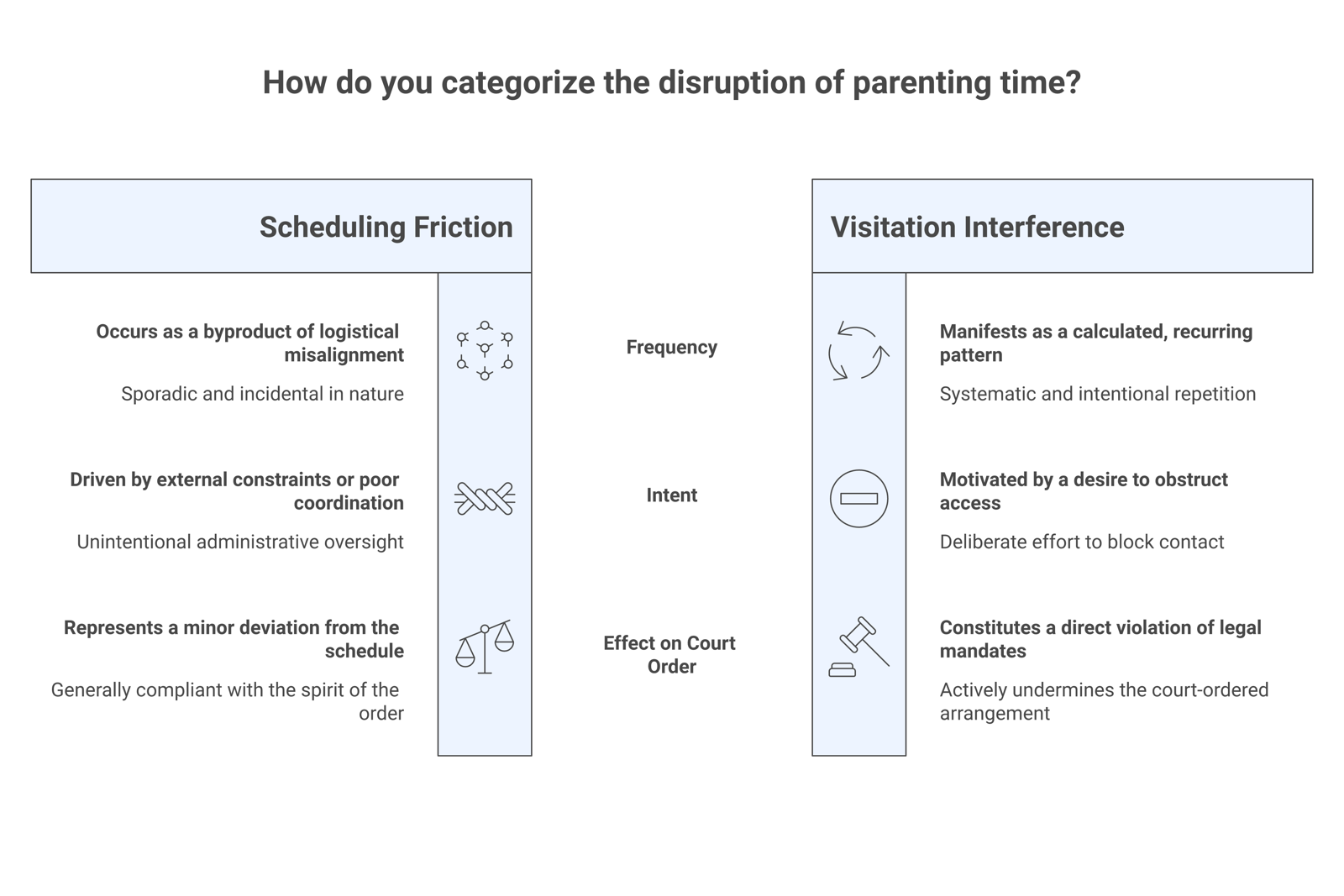
A pattern is different. Interference becomes a legal concern when the conduct is repeated, deliberate, and aimed at defeating the order rather than accommodating real life. The question a court tends to ask is whether the parent is bending to circumstances or working to erase the other parent’s time.
- Frequency. A single missed exchange differs from a standing habit of denied or shortened visits.
- Intent. Good-faith scheduling conflicts differ from conduct designed to block contact.
- Documentation. A pattern shows up in a record of dates, times, and specific denials.
- Effect on the order. Friction works around the schedule; interference works against it.
No bright line settles every case. A court reviews the full record and the surrounding facts. The practical takeaway is that occasional friction is normal, while a documented, repeating pattern of obstruction is the conduct that draws enforcement.
Common examples of visitation interference
Interference takes many forms, and not every form looks dramatic. Some examples are direct refusals. Others are quieter tactics that erode contact over time. Common examples include the following:
- Refusing to produce the child for a scheduled exchange.
- Repeatedly returning the child late or picking the child up early to shorten the other parent’s time.
- Blocking or screening phone calls, video calls, and messages between the child and the other parent.
- Scheduling the child’s activities so they routinely collide with the other parent’s parenting time.
- Moving without notice in a way that frustrates the schedule.
- Telling the child that visits are optional, leaving a young child to decide whether the order is followed.
- Withholding the child over a vague claim of illness that is never documented.
Researchers who study parental alienating behaviors describe contact interference as one recognizable category within a larger set of tactics. The presence of one incident does not establish a pattern. A series of incidents, recorded carefully, often does.
How visitation interference relates to parental alienation
Visitation interference and parental alienation overlap, yet they are not the same thing. Interference is a legal description of conduct that violates a parenting-time order. Parental alienation is a broader psychological pattern in which a child is influenced to reject a parent without legitimate cause. Interference can be one visible behavior inside an alienation dynamic, and it can also occur entirely on its own.
Interference as a behavior within a tactics framework
Cheryl Mefferd, who produces content under Parental Alienation Speaks, organizes alienating conduct into functional categories. One of those categories is isolation, which she describes as the physical and informational separation of the child from the targeted parent. That includes limiting contact, interfering with communication, and interfering with symbolic contact such as cards and gifts. In this framing, visitation interference is the legal label for behaviors that a clinician would file under isolation. The behavior and the legal concept describe the same observable conduct from two angles.
Why courts treat repeated interference as a control tactic
Dr. Jennifer Harman, a social psychologist at Colorado State University, and her colleagues have argued in peer-reviewed work that parental alienating behaviors map onto recognized patterns of coercive control. Within that mapping, using visitation to harass the other parent and threatening to take the child away sit on the established power-and-control framework. Harman’s point is not that every late exchange is abuse. It is that a sustained campaign to control contact can function as a form of coercive control rather than ordinary conflict. The seriousness of the harm is what moves the conduct from friction toward a matter courts take seriously.
Behaviors, not labels, are what courts act on
A practical reason to understand interference as conduct is that courts act on conduct. Litigator Ashish Joshi and Judge Jon Van Allsburg have described a judicial standard often summarized as behaviors, not labels. As Joshi frames it, a parent does not need to prove the other parent is a narcissist. If there is evidence of a parent interfering with parenting time, the case is built on the documented strategies themselves. In Van Allsburg’s words, labels do not give a court a basis on which to rule, while facts do. For a parent worried about contact, the lesson is that a clear record of specific interference is more useful than a clinical-sounding accusation.
Parental alienation is the larger story. Visitation interference is one chapter a court can read directly from the record. Readers comparing the two ideas may also find the distinction between conduct and diagnosis covered in related material on whether the broader conduct is treated as unlawful.
When withholding contact may be lawful
The safety caveat at the top of this page is not a formality. Family law does not require a parent to deliver a child into genuine danger to satisfy a schedule. A parent who reasonably withholds contact to protect a child from abuse, neglect, or a credible threat may have a lawful basis for that decision, and many jurisdictions provide emergency procedures for exactly that situation.
The line is fact-specific and belongs to a court, not to either parent acting alone. A parent who believes a child is at risk generally should seek prompt legal guidance and use the court’s emergency processes rather than quietly defeating the order. Self-help withholding, even when motivated by real fear, can expose a well-meaning parent to an interference finding if the court later disagrees about the danger. The safe path runs through counsel and the court, not around them.
This is also why abuse-driven estrangement does not belong in the alienation category. When a child distances from a parent who has been harmful, the child’s reaction has a legitimate cause. Naming that situation as interference or alienation misreads it. Sorting genuine protection from wrongful obstruction is the work courts are designed to do.
General remedies for visitation interference
When a court finds that a parent has wrongfully interfered with parenting time, several general remedies are available. The specific tools, names, and thresholds vary by jurisdiction, so the descriptions below are general rather than a statement of any one state’s law.
Enforcement of the existing order
The first step is usually enforcement. A parent asks the court to enforce the order it already entered. The request rests on a record of specific violations, each with a date, a time, and a description of what was denied. The court is being asked to make its own order effective, not to create a new right.
Contempt of court
When interference is willful, a court may treat it as contempt of court. Contempt is the mechanism that gives a parenting-time order teeth. A court that finds willful contempt can impose a range of consequences depending on local law, which may include fines, an award of attorney’s fees, or, in serious or repeat cases, more severe sanctions. A central point from court practitioners is what gets sanctioned. A parent is not sanctioned for parental alienation by name. The parent is sanctioned for violating a parenting-time order. The enforcement question is covered in more depth in the discussion of contempt for parental alienation.
Makeup parenting time
Courts frequently order makeup parenting time to restore what interference took away. If a parent was denied a weekend, the court may award an equivalent block of time later. Makeup time aims to make the targeted parent whole on the schedule rather than to punish, and many jurisdictions treat it as a routine first response to proven interference.
Modification of the order
A persistent pattern of interference can support a request to modify the custody or parenting-time order. Many custody frameworks allow a change when there has been a substantial and material change in circumstances, and many best-interest tests weigh each parent’s willingness to support the child’s relationship with the other parent. Modification is evidence-heavy and never automatic. The type of order at issue, and how orders are structured, is covered in related material on parental alienation court orders, and the documentation that supports any of these requests is covered in material on how to prove parental alienation.
A note on tone runs through all of these remedies. The goal of enforcement is to protect a child’s relationship with both parents and to make a court order work as written. It is not to win a contest or to punish for its own sake. Courts respond best to a calm, specific, well-documented record.
What to do if a parenting-time order is being ignored
A parent who believes interference is happening can take a few measured steps. Keeping a factual log of each denied or disrupted exchange, with dates and times, builds the record a court relies on. Communicating in writing creates a paper trail. Seeking legal advice early helps a parent use the right process rather than a self-help shortcut that backfires. For the child-facing side of the problem, where a child resists or refuses time, separate guidance addresses a child refusing visitation, since the causes and responses differ from adult-driven obstruction.
The broader map of legal options, venues, and order types lives in the Court silo, which connects enforcement, modification, and proof into a single picture.
Frequently asked questions
What is visitation interference in simple terms?
Visitation interference is when one parent wrongfully prevents the other parent from having the court-ordered time with their child. It can be a direct refusal to hand the child over, or quieter conduct like blocking calls or routinely shortening visits. A single good-faith scheduling problem is usually not interference. A deliberate, repeated pattern that defeats the order often is.
Is visitation interference the same as parental alienation?
No. Visitation interference is a legal description of conduct that violates a parenting-time order. Parental alienation is a broader psychological pattern in which a child is turned against a parent without legitimate cause. Interference can be one behavior within an alienation dynamic, and it can also happen on its own. Courts tend to act on the documented conduct rather than on the label.
Can a parent ever legally withhold visitation?
Sometimes. A parent who reasonably withholds contact to protect a child from genuine danger, such as abuse or a credible threat, may have a lawful basis, and most jurisdictions provide emergency court procedures for that situation. The safer route is to seek legal guidance and use the court’s emergency process rather than quietly defeating the order, because a court decides whether the withholding was justified.
What are the remedies for visitation interference?
General remedies include enforcement of the existing order, a contempt finding when the interference is willful, makeup parenting time to restore lost contact, and, for a persistent pattern, modification of the custody or parenting-time order. The exact tools and thresholds vary by jurisdiction, so a licensed family-law attorney in the relevant state is the right source for what applies to a specific case.
How does a court tell friction apart from interference?
A court looks at the full record. Frequency, intent, documentation, and the effect on the order all matter. An isolated, good-faith problem, like a single late exchange, reads differently from a standing habit of denied visits. A careful log of specific dates and denials is what helps a court see a pattern rather than a one-time event.
Sources and further reading
- Cornell Legal Information Institute (Wex). Legal reference on family-law concepts. law.cornell.edu/wex
- American Bar Association, Section of Family Law. americanbar.org/groups/family_law
- American Psychological Association. Divorce and child custody. apa.org/topics/divorce-child-custody
If you or your child are in crisis
Free and confidential help is available right now.
- 988 Suicide and Crisis Lifeline. Call or text 988.
- Childhelp National Child Abuse Hotline. 1-800-422-4453.
- NAMI HelpLine. 1-800-950-6264.
Last reviewed: 2026-06-06. Author: Alex Buckles (PAC Founder).