

Can you sue for parental alienation? In most US states, not as a standalone civil lawsuit. The old tort of alienation of affection has been abolished almost everywhere and never covered parent-child cases. A few states allow narrow related claims, but they rarely succeed. For nearly everyone, real relief comes through family court, not a separate suit.
A note on safety
A child’s rejection of a parent is not always alienation. If the rejected parent has been abusive, neglectful, or genuinely dangerous, the child’s distancing is justifiable estrangement, not parental alienation, and it is a different legal and safety matter. If a child’s safety is at risk, contact local law enforcement or a domestic-violence resource first.
This page is general US-national education. It is not legal advice, does not create an attorney-client relationship, and does not address any one state’s law. State laws vary widely. Anyone considering legal action should consult a licensed family-law attorney in their own jurisdiction.
The short answer
Most parents who ask “can I sue for parental alienation” are picturing a civil lawsuit that ends with the alienating parent paying money damages. In most states, that lawsuit does not exist. There is no standalone civil cause of action named “parental alienation.” The historical tort that sounds closest, alienation of affection, has been abolished in the large majority of states and applied to spouses, not to the bond between a parent and a child.
That does not mean a targeted parent has no options. It means the realistic options sit in family court, not in a separate damages suit. Family courts act on documented behaviors, not on the label. As one judicial framework puts it, “labels don’t give us any basis on which to make a ruling. It’s the facts that give us that ability.” The two workhorse tools are a contempt motion for violating a court order and a motion to modify custody.
The old tort of alienation of affection
Alienation of affection is a civil claim with a long history in American law. It once let a married person sue a third party, often a paramour or an interfering in-law, for conduct that damaged the marriage. The claim was about the marital relationship. Damages were meant to compensate the wronged spouse for the loss of the other spouse’s affection, companionship, and support.
The tort has fallen out of favor. The large majority of US states have abolished it by statute or by court decision. Critics argued it treated a spouse as property, invited blackmail, and produced lawsuits that did more harm than good. Only a small number of states still recognize any version of it. The Cornell Legal Information Institute keeps a general reference on the claim and its decline.
Why it does not cover parent-child cases
Even in the few states where alienation of affection survives, it is the wrong tool for a parental alienation problem. The tort protects the marital relationship between two adults. It does not protect the relationship between a parent and a child. A targeted parent who finds the words “alienation of affection” online and assumes they can sue their ex over the children has matched two terms that sound alike but do different legal work.
Where any version still exists
In the handful of states that retain the tort, it remains controversial and is rarely filed. Its survival is also fragile, since legislatures and courts have continued to narrow or repeal it over time. None of this changes the parent-child point. Whether a state has kept the tort or abolished it, alienation of affection is not a vehicle for a parental alienation claim. A licensed attorney in the relevant state can confirm the current status there.
Can you sue your ex with a different civil claim?
Some parents ask whether a different civil theory might reach the alienating conduct. Two come up most often. Both are theoretically possible in some places and both are hard to win. The harm itself is real. Researcher Jennifer Harman and colleagues, writing in the journal Psychological Bulletin, make the case that parental alienating behaviors map onto the recognized patterns of coercive control and amount to a form of family violence. The seriousness of the harm is not in doubt. The question is whether a civil damages suit is an available or sensible way to address it, and usually it is not.
Intentional interference with the parent-child relationship
A small number of US states recognize a tort sometimes called intentional interference with the parent-child relationship, or interference with custody. Where it exists, it can let one parent sue the other parent, or a third party, for damages caused by conduct that wrongfully cuts the child off from the targeted parent.
Most states have not adopted this tort. Where it does exist, it is controversial and rarely litigated, and successful judgments are unusual. Courts worry that money-damages suits between parents pour fuel on a conflict the child is already trapped inside. A targeted parent should not assume the tort is available without checking with counsel in the specific state.
Intentional infliction of emotional distress
Intentional infliction of emotional distress, often shortened to IIED, is a general tort recognized in many states. It lets a person sue for severe emotional harm caused by conduct that is extreme and outrageous. In principle, a targeted parent might try to fit alienating conduct into this frame.
In practice, the bar is very high. Courts require conduct that is truly extreme and outrageous, not merely hurtful, and proof of severe emotional distress. Ordinary family conflict, even painful conflict, usually does not clear it. The Cornell Legal Information Institute keeps a general reference on the elements of IIED. As with the interference tort, a targeted parent should treat IIED as a long shot, not a plan, and ask a licensed attorney whether the facts could ever support it.
Why most relief comes through family court
The reason civil suits are a dead end for most parents is not that the law fails to take parental alienation seriously. It is that the right venue is family court, and the right model is not a grudge suit.
Veteran litigators describe a parental alienation case as a clinical, medical, and child-abuse case, not a high-conflict custody case with the volume turned up. Robert Hoffman, a board-certified Texas family-law attorney who served as lead counsel in a 2016 custody trial tried on a parental alienation theory, argues that the case must be built and tried like a medical-malpractice case. The focus is the child’s welfare and the documented pattern of behavior, not a payout.
Attorney Ashish Joshi, author of an American Bar Association book on litigating these cases, lays out a three-goal courtroom framework. First, show the court that parental alienation is a real, studied phenomenon. Second, show that it is occurring in this specific case, using documented behaviors and the child’s response. Third, show that the child needs proper and timely intervention. Each goal builds on the last. None of the three is served by a separate money-damages lawsuit. For help vetting an attorney who works this way, see how to choose a parental alienation lawyer, and for the broader venue map, see the Court silo.
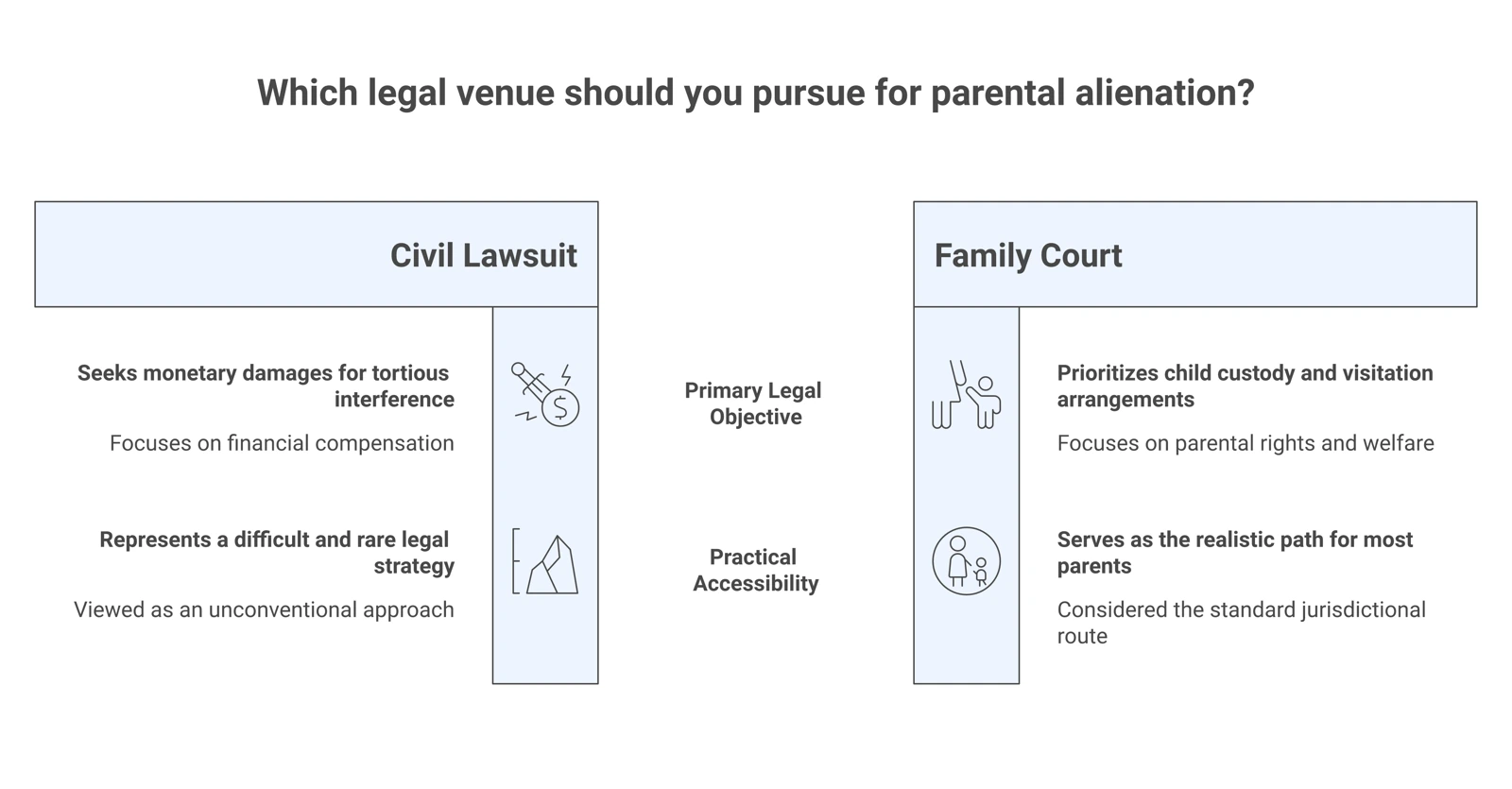
| Civil lawsuit | Family court | |
|---|---|---|
| What you ask for | Money damages | Enforcement, makeup time, custody change |
| How often it works | Rare; tort abolished or unavailable in most states | The standard path for these cases |
| What it can deliver | Damages in a few states, if at all | Contempt sanctions, fees, modified custody, intervention |
| Realistic for most parents | No | Yes |
Contempt of court for violating an order
The most common family-court tool is a contempt motion. When a court has entered a parenting plan or custody order, breaking that order is contempt of court. The targeted parent documents each specific violation, a denied exchange, a refused phone call, a blocked event, and asks the court to enforce its own order. The American Bar Association’s Section of Family Law publishes general consumer information on how these motions work.
A court that finds willful contempt has several options. It can fine the parent who broke the order. It can order makeup parenting time. It can require attorney’s fees to be paid. In serious or repeat cases, it can order jail time. The key point, and a point the corpus litigation frameworks stress, is what gets sanctioned. Nobody is sanctioned for “parental alienation” by name. The parent is sanctioned for violating a parenting-time order or a reunification-therapy order. The contempt mechanism is the actionable enforcement tool, and it runs inside the family court, not in a separate civil suit. For how criminal status and contempt interact, see is parental alienation illegal.
Modifying custody
The other main family-court path is a motion to modify the custody order. Most state custody laws let a parent seek a change when there has been a substantial and material change in circumstances. A documented pattern of alienating behavior can support that showing. Many state best-interest tests also weigh each parent’s willingness to support the child’s bond with the other parent.
A motion to modify is evidence-heavy. It usually needs proof of the alienating conduct, proof of the effect on the child, and a proposed new plan that better serves the child. Joshi’s framework warns lawyers not to retreat to a “hybrid” framing that treats a targeted parent’s frustration as equal to the alienating conduct, since reaction is not the same as causation. Outcomes still vary by court and by the strength of the record, so a modification is never guaranteed. The documentation work this path requires is covered in how to prove parental alienation.
What suing can and cannot accomplish
It helps to be honest about the ledger. A family-court case can deliver enforcement of an existing order, makeup parenting time, attorney’s fees in some cases, a change of custody when the record supports it, and court-ordered intervention for the child. A rare civil tort suit, where it exists, can in theory deliver money damages, though successful awards are unusual.
No legal path can do certain things. No court can order a child to feel differently about a parent. No filing produces a fast fix, since these cases take time and careful proof. And the goal that matters, repairing the child’s relationship with the targeted parent, is treated by specialists as a clinical and protective process, not a punitive one. The harm is serious, as the parental alienation syndrome discussion explains, but seriousness does not convert a money-damages suit into the right remedy. For readers earlier in the process, the Help silo covers active-situation guidance.
Frequently asked questions
Can you sue for parental alienation?
In most US states you cannot bring a successful standalone civil suit “for parental alienation.” There is no civil cause of action by that name. The old tort of alienation of affection has been abolished in most states and covered spouses, not parent-child cases. A few states recognize a narrow tort of intentional interference with the parent-child relationship, but it is rare and rarely successful. For nearly everyone, relief comes through family court.
What is the tort of alienation of affection?
It is a historical civil claim that let a married person sue a third party for conduct that damaged the marriage. It protected the relationship between two spouses, not the relationship between a parent and a child. Most US states have abolished it, and even where it survives it does not reach parental alienation claims.
Can I sue my ex for parental alienation?
Usually not as a separate money-damages lawsuit. The realistic path is family court: a contempt motion for violating a parenting-plan order, or a motion to modify custody. A small number of states allow a related tort suit, but it is uncommon and hard to win. A licensed attorney in your state can tell you whether any civil claim could apply to your facts.
Can you get money for parental alienation?
Money-damages awards are rare. Family courts more often shift attorney’s fees, order makeup parenting time, and modify custody. A handful of states allow tort suits that can seek damages, but successful awards are unusual. The money question should be discussed with an attorney who knows the law in your state.
Is suing for parental alienation worth it?
For most people the realistic and evidence-supported path is family court, not a civil damages suit. Whether any path is worth pursuing depends on cost, the strength of the evidence, and the child’s wellbeing. That decision belongs to the reader together with a licensed attorney, working from the actual facts.
What this page does not do
This page is not legal advice. It does not name any one state’s statutes as if they applied nationally. It does not tell readers what to file or when to file it. Choices about a contempt motion, a custody-modification motion, or any civil suit belong to a licensed attorney working with the real facts. And the page does not frame litigation as a weapon. The right uses of these tools are the careful, evidence-based ones, oriented to the child’s wellbeing.
For the criminal-status question, see is parental alienation illegal. For vetting counsel, see how to choose a parental alienation lawyer. For documentation, see how to prove parental alienation. The full Court silo covers the rest, and the Help silo covers active-situation guidance.
Sources and further reading
- Cornell Legal Information Institute (Wex). Alienation of affections. law.cornell.edu/wex/alienation_of_affections
- Cornell Legal Information Institute (Wex). Intentional infliction of emotional distress. law.cornell.edu/wex/intentional_infliction_of_emotional_distress
- Harman, J. J., Kruk, E., & Hines, D. A. (2018). Parental alienating behaviors: An unacknowledged form of family violence. Psychological Bulletin, 144(12), 1275 to 1299. https://doi.org/10.1037/bul0000175
- American Bar Association, Section of Family Law. americanbar.org/groups/family_law
- American Psychological Association. Divorce and child custody. apa.org/topics/divorce-child-custody
If you or your child are in crisis
Free and confidential help is available right now.
- 988 Suicide and Crisis Lifeline. Call or text 988. 988lifeline.org
- Childhelp National Child Abuse Hotline. 1-800-422-4453. childhelp.org
- NAMI HelpLine. 1-800-950-6264. nami.org/help
Last reviewed: 2026-06-05. Author: Alex Buckles (PAC Founder).